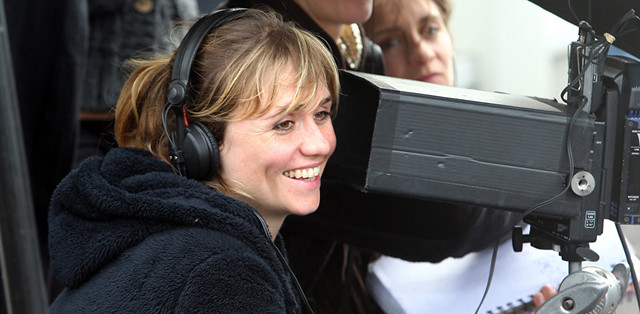
Katell Quillévéré is a rising star writer/director in French cinema. With only three feature films under her belt, she's gaining quite a bit of critical acclaim ever since her coming-of-age debut film Love Like Poison in 2010. Her second film Suzanne, a true masterpiece, starring two of the biggest names in French cinema now -- Sarah Forestier and Adele Haenel -- put her in the league of other great contemporary women directors such as Mia Hansen-Løve, Céline Sciamma and Alice Rohwacher.
Quillévéré's strength is in her ability to make all of her characters shine. Her new film Heal the Living (original title: Réparer les vivants) is a big leap in terms of cinematic filmmaking and the most mature one to date. I got a chance to talk with her during the Rendez-vous with French Cinema series here in New York. In person, she is so lovely and charming.
Heal the Living opens in New York on April 14 at the Quad Cinema.
I’ve seen all your films. So I know a little about the preference of your subjects. I am more curious about your background. You were born in Ivory Coast. Did that influence you in any way as a filmmaker?
Katell Quillévéré: Well, I don’t know. (Laughs.) I have memories but, they are from early childhood… so it’s not really possible for me to make that link with anything. But I remember watching cartoons there. They were American cartoons. I was really fond of the Tom Sawyer and Huckleberry Finn cartoons. It was my first time seeing images and fell in love with those two boys and their insolence…
I don’t think I was really programmed to be working in movies, because there were no artists in my family. Both of my parents are scientists. So my way to avoid school in a way, playing hooky, was cinema. Sorry, that’s not a specific African memory. (Laughs.)
That’s fine. Your previous two films are co-written by Mariette Désert. But HEAL THE LIVING is quite different. It’s an adaptation of a pretty well known, popular book. How did it come about that you decided to do an adaptation?
I started writing a new original script. So I was not looking for an adaptation for a movie project. It came almost by accident, to me. Its meaning was so strong for me in an emotional way. So I decided to put aside the script I was writing and meet the author, Maylis de Kerangal. So I just followed my instincts, actually.
After that, during the process of writing, I discovered that this movie would be as personal as my previous ones. For me it’s a continuation; the story of Heal the Living is the story I’m always telling, the story of the way you survive losing someone, by separation or death. The loss of someone you love and life goes on. It’s always about love, you know. Even though that person is no longer with us, the link between them are still alive. So for me I tell the same story but in a different way. It’s also a way to renew myself in a new environment, in a new narrative way also.
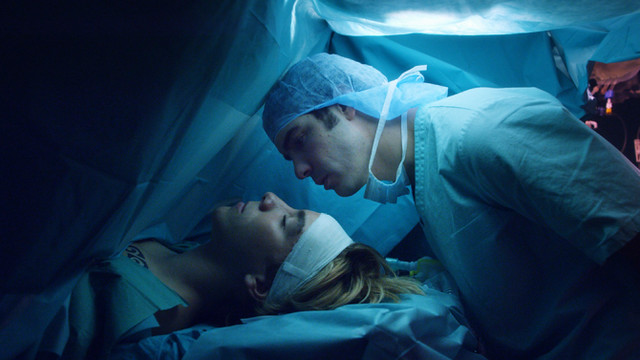
It was really interesting when I was making Suzanne, I had to compress someone’s 25 years of life into a two-hour film. Heal the Living takes place in the timespan of 19-24 hours. So it was an opposite challenge. I also had to deal with it emotionally in the opposite way, because with Suzanne, the main events in her life happens outside the screen -- the loss of her mother, the loss of her child, the day she runs away with this guy -- and here in Heal the Living, everything pretty much happens almost in real time in front of the camera: you have the death of the child, you have to say yes or no for organ donation, you have to accept the transplant, all that. So, that was really interesting for me to confront myself to a new way of dealing with emotions.
For me it did seem like a departure, even though you said the same theme courses through all your films. Cinematically speaking, I think it’s a lot more sophisticated, if you don’t mind me saying so. Even though SUZANNE had very distinctive storytelling style, it didn’t seem to me as cinematic as HEAL THE LIVING. It starts with the boy waking up and going to the beach on his bike. And it’s so gorgeously done. It reminded me of Gus Van Sant's films.
I love Gus Van Sant.
And the surfing scenes with waves. Really beautiful stuff. You used the same cinematographer, Tom Harari, as you did on your previous films. Did you talk about the look of the film with him extensively for this film?
Yeah, but we did it for every movie we made. We’ve known each other since we were at university when we were 20, he shot all my movies, even shorts. Before shooting we kind of make a book with every shot of the movie mapped out and described, even if we change things on location, you know. We prepare a lot because it takes a lot of money to make movies. Time is money. So if you are well prepared, you can save time, therefore save money.
As you say, it’s more sophisticated but we progressed together; he’s better and I am better than before too. We learn our jobs. Every movie we tried to do it better and challenge us. We did have more money for this. We could do more travels, camera movements. We could afford…
Steadicam?
Yes, cranes and steadicam which I couldn’t afford it with Suzanne. The sophistication of mise-en-scene really depends on the money you have.
Right.
But if you want me to tell you about the image more?
Yes, of course.
We were really thinking about constructing the figure of a circle. Like a movement of the waves. Death is not the end. It is part of the living. So we built a movie with the heart in the center and it echoes throughout. The image of the waves is also important in de Kerangal’s book.
So if you pay attention, you can see the construction of those images. I played with symetricity too; in the beginning, those two young guys in the car, the two heads sleeping -- one leaning against the other before the accident, -- there were two young guys sleeping in the waiting room at the end of the movie waiting for their mother to come out of the surgery.
Ah, that’s right.
Two teenagers on the bed in the beginning and the two women in bed later, those are the ways to create the links between characters to create that organic feeling in the movie and to create these waves. Waves are also like the rhythm of the heart.
Moving and traveling were also like DNA of the movie or like the blood circulating inside the body. Them traveling the inside of the body of the movie. When movement stops, it’s always about death. The accident, diagnosis at the doctor's office, confrontation with the question of death, all have stillness. Everything stops. And then when the questions are resolved, the life goes on again. It’s a pretty simple idea but I thought it would go well with the theme of the movie.
Very interesting cast. I know you’ve worked with some of the top actresses in France before. Now you have Tahar Rahim, Emmanuelle Seigner, Kool Shen…
You know Kool Shen?
I know his music a little bit. And I’ve seen him in ABUSE OF WEAKNESS. You also have Anne Dorval, the French Canadian actress… You have all these different actors. How was it dealing with all these different actors?
Okay. First, I wanted to have strong personalities in my movie because it deals with a tough, strong subject. I really wanted to bring this movie to the audience. I wanted people to see it. But I knew the subject is kind of hard. It’s not typical to go see a movie about death and the death of a child.
Right.
So I need them [the actors] to help me to bring the movie to the audience. But I also wanted them to be really different from each other, kind of representing diversity of the society. People from different kind of movies, different countries, different everything. And some are really famous, some are not famous at all. Young actors: some are not professional; for Simon (Gavin Verdet), it’s his first movie, you know.
So that’s what was interesting to me, to choose these people and also, every actor I chose, they have never done the kind of role they play in this movie before. I always pay attention when proposing a role to an actor as kind of a challenge.
But they really look great together. Kool Shen and Emmanuelle. I never dreamed of them being a couple in anything but they are really great together!
Yeah. When I proposed it, “Kool Shen’s going to be the husband of Emmanuelle Seigner.” Everyone was like, "Are you sure?" (Laughs.) No one really believed it.
It really works!
I do like surprises. It’s one of my missions to have surprises like that. Bringing actors to another universe that they are not familiar with is also cool thing to do. And they both are singers.
That is true.
Maybe they will work on an album together. (Laughs.)
What I find interesting is that it has heart and brain connection. Obviously those two things makes us human. Which one, for you, makes us human? Heart or brains?
One can always replace the other. The science decided that the death occurs not when heart stops beating but the death of the brain. That’s what’s changed the definition of death. What the movie is saying is that death of the heart will have a symbolic importance for a human being, for the people left behind.
So that’s why the ritual seems so important, like when Thomas puts the headphones on the boy. Because technically the boy is dead, but in a spiritual way and for his parents who can’t say good bye, the ritual aspects of death will always have an importance, in spite of the question.
So you have to take care of the heart, that’s what I’m trying to say.
Great music always in your films.
Oh thank you. I love music. It’s really important for me.
Yeah so there was a Radiohead song in the end of LOVE LIKE POISON…
Yeah. It’s so cool to meet someone who’s seen all three of my movies.
Yes, of course! (We all laugh.)
But you didn’t think that Heal the Living is not really different than the previous ones.
I didn’t. But I was thinking about it when I was watching it.
Because for me, I really planned it carefully that there is a continuation.
I felt that you have something for each character to explore. That you care about each one of your characters. But I didn’t necessarily think that there were connections between the first two and the third one.
The thematic similiarities I talked about?
Yep. I get it.
You get it now?
Yes. After talking to you, yes definitely.
(She laughs.)
So Suzanne is the Leonard Cohen song, sung by…
Nina Simone.
Yes, the great Nina Simone. And this you have Alexandre Desplat. A beautiful score. Can you tell me a bit about your collaboration with him?
I don’t know if many directors do it this way. Not sure about how they do it in the States. But I have a music consultant who is a friend of mine, and he makes a compilation. So I listen to it before the shooting, during the writing and everything, and we discuss together, then I choose all the music for the movie -- the ones which are going to stay, and also the ones that will be replaced with the new musical composition. I play music on set, too. It can affect the camera movement and emotions of actors and many other things.
Then I work with it in editing. Sometimes it stays on its right place, sometimes it moves when it doesn’t need music or need more and everything. Then I do final edit. Then I give the film to a composer.
A composer knows exactly where the music is needed, from that frame to that frame. He is free to listen to what I used and decide if it works or not. He can do whatever he wants to do and we stop. That’s what Alexandre did. He wanted to listen to what influenced me. But then he forgot it and put it in the garbage and used his own music. And this is really important time for me because I discover that composer is like the first viewer of my movie really.
True.
Because he sees it and he digests it. And he gives it back to me with normal music. And it’s really scary because you know the importance of the music in a movie. It’s also very exciting. We went back and forth a little to find some right melodies but Alexandre is very quick. I don’t know, I think it was two or three weeks. He works so fast. He’s so good at finding the right melody. I can’t really explain how he does it.
What impressed me was that he worked with so many incredible directors, but he is always completely dedicated to a director he is working with, even if the director's young and not famous like me. ‘What is important for me is the movie and intention of its director,’ not his own music. And I think that’s why he is so good. He is really in love with cinema and incredibly generous.
Dustin Chang is a freelance writer. His musings and opinions on everything cinema and beyond can be found at www.dustinchang.com