Showing posts with label Lisandro Alonso. Show all posts

Monday, October 5, 2026

Double Take

Double Freedom/La Libertad Doble (2026) - Alonso Double Freedom To understand Double Freedom, a little bit of context is necessary: it was 25 years ago that Argentinian filmmaker, Lisandro Alonso, made his debut film, La Libertad/Freedom, at age 26. Since then, Argentina saw the resurgence of the national cinema, termed Nuevo Cine Argentino, along with the revitalizations of other Latin American countries' cinema, producing some of the most exciting, innovative films.

Along with Lucrecia Martel, Mariano Llinás, Matías Piñeiro and others, Alonso put Argentinian cinema on the global cinema map again, garnering much deserved attention and accolades. His reputation as a daring arthouse filmmaker, known for his boundary pushing, minimalistic, observational films, attracted foreign co-productions and yielded in collaboration with Hollywood actor Viggo Mortensen in Jauja in 2015, a Quixotic tale of lost daughter in the Argentine outback, where Mortensen takes on the role of Danish John Wayne in The Searchers. The ambitious triptych Eureka, came 8 years later, about the flight of the indigenous people in both South and North American continents across colonial and current timespan followed.

With his new film, Double Freedom/La Libertad Doble, Alonso is going back to his groundbreaking debut film where it all started, and picks up where he left off. In La Libertad, we meet a young lumberjack Misael (non-actor Misael Saavedra), chopping woods for local ranchers in the Pampas. Taking cues from the observational documentary tradition, the film showed Misael's daily routine, as he cooks, washes, defecates and chops woods, minimally interacting with others (who are also playing themselves). The lumberjack's daily routine and his solitary living made the audience question the nature of labor in the 21st century. Alonso's minimalism here was in itself radical. He wasn't representing the working men as the dignified beasts in the capitalist system. As Misael kills and greedily eats armadillo at the end of the film, we knew Alonso was a different filmmaker, trying to get at something bigger and deeper than just representing 'workers' or 'exploitation' and such.

So 25 years have passed. Misael, now 25 years older, is not a young man anymore. But he leads the same life in the Pampas, chopping woods and sellingl them locally. The process is swift and almost mechanical and our lumberjack takes no time in felling trees and stripping them and delivering them to the local ranchers, who use them as poles for their fences. You see the hard life and life experiences in his face and his actions. Yet, there is a continuity - his blue Mets baseball cap is the same, so is the big pitbull mix he keeps by his side - I have no idea if it's the same dog 25 years later or not.

One of his clients tells him that the local mental asylum is closing down due to lack of funding, that his sister Catalina (Catalina Saavedra) will be released. It's surprising news for Misael, who has been living a solitary life for decades now, in his ramshackle shack in the Pampas, now has a burden of taking care of his invalid sister. Catalina on the other hand, institutionalized for a long time, will taste her freedom in the outside world.

So Double Freedom has several meanings in Alonso's unusual sequel to his debut - the freedom afforded by living in the margins and in nature for Misael. Freedom from institutional confinement for Catalina. It also speaks of Alonso's filmmaking methods- not bound by traditional filmmaking, the film time-jumps, fastforwardings quarter a century, leaving the audience outside of time-space continuum, disoriented and confused - very much like David Lynch's Twin Peaks, the Return.

Using non-actors without much dialogue, Alonso's approach is that of Robert Bresson in the purist sense, stripping down all the artifacts and artificiality of filmmaking. Double Freedom questions what we regard as authentic representation of life and how the concept of freedom is ironically confined to the socio-political and individualized world view, with the true freedom always lies out of reach from us.

Thursday, October 12, 2023

Native Americans Take Flight

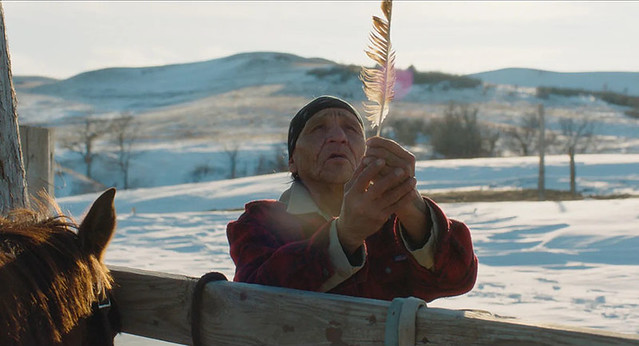
Eureka (2023) - Alonso Eureka Argentine filmmaker, Lisandro Alonso, breaks 9-year silence with Eureka, after Viggo Mortensen starring meta-western Jauja. In an episodic structure, the film freely contemplates the state of indigenous people of the vast American continents, the past and present, as well as their uneasy relationship with cinema. It's perhaps his most expansive and ambitious film to date. He digs deep into the distorted representation and history, the effect of colonialism and the influence of Western culture that displaces the natives who are left out of place and out of time. Using his minimalist, elemental way of filmmaking, combined with Deleuzean look at time-image non-linear approach and Native American spirituality, Eureka is a deeply contemplative, perplexing film.

The first segment is a black and white western in full frame, starring Viggo Mortensen and Chiara Mastroianni. With coverages, combining wide and close-up shots, this is very much like a conventional filmmaking, not like Alonso's other works that utilize uninterrupted long takes and wide shots. Also, it's a rehash of Jauja's themes - looking for a daughter kidnapped by natives in the wild west, which the director intentionally appropriated from John Ford Western, The Searchers. The gunslinger named Murphy (Mortensen), tracks down where his daughter's kept in a small-town sheriff’s office. With the help of El Coronel (Mastroianni), he makes his way in with his vengeful guns blazing, to confront the captor of his daughter. But it is the daughter, the same daughter from Jauja (Dutch actress Wilber Malling Agger reviving her role), now all grown up, who turns a gun on him.

It turns out, the first part is movie within a movie, playing out on TV in a household in the Sioux reservation in South Dakota. More of a background noise for a Native American cop Alaina (Alaina Clifford) and her young basketball coach niece Sadie (Sadie Lapointe) as they get ready for their work. Alaina is taking her night shifts patrolling the neighborhood. Snowstorm is about to hit the area and she has to stop in, as her dispatcher send her to the origins of one distress call after another.

In a documentary style, we see the devastation of the Native American population living in the reservation - poverty, violence, incarceration and alcohol and drug use are everyday occurrence and Alaina being a good cop, she attends her job dutifully. Shot in a documentary style, the prolonged segment is as real as it gets. While white folks are playing out The Searchers fantasy for a century, the Natives are struggling with the bleak reality they inherited.

Mastroianni makes another appearance as a French actress researching the reservation life for a film who got stranded in a storm. She is our interlocutor, El Coronel, an unwitting bridge to the natives from as far back as Cortez days. Sadie visits her young cousin in jail, then goes to her grandfather's trailer. Grandfather tells her, "Time does not exist. It's a human invention." She says she is ready to go away. Her grandfather gives her an herbal tea which will make her sleep and wake up in another life. Say bye to everyone you know. He says. Lapointe, just like many of Alonso's non-actors, shines, as a young woman, who wholly embodies the terrible fate befallen to Native Americans in the 21st century.

Uncharacteristically for Alonso, we are presented with beautiful transition dissolves into the next segment, which takes place in Brazilian Amazon jungle, where a small tribe of peaceful natives who sit around and talk about their dreams. Their clothes and an old-style soda can tell us that this takes place in the past, during the Amazon's gold-rush days of the 1970s. A fight breaks out of their tranquil existence as jealousy between two men over a woman which results in stabbing and the stabber fleeing the village. The man then joins the gold-rush prospecting party nearby. El Coronel makes a third appearance, this time as a white man in charge of the prospecting operation. He is a typical middleman who would do anything for money. El Coronel tells the man that he doesn't belong there and would help him to get out of there.

With such a strong and engaging middle part with Alaina and Sadie, the third part of the film doesn't quite gel with the rest of the film. But overall, Eureka is always a fascinating watch with full of ideas swimming around your head long after you leave the theater.

Thursday, March 19, 2015

Cinema of Searching: Lisandro Alonso Interview

 photo f9176bce-7b23-4c3e-8815-bf61cf285abc_zpsdlhcs0sx.jpg
Known for his use of non-actors, loose narrative and minimal dialog, Lisandro Alonso's films are at once real and otherworldly. His cinematic explorations are often mysterious and open-ended. He is definitely not into making crowd pleasing blockbusters with big name actors for sure.

Then comes, Jauja, his hallucinatory new film which is garnering a lot of buzz, ever since it won the FIPRESCI prize at Cannes and made splashes at TIFF and NYFF last year, stars Viggo Mortensen (who also serves as a producer and provides music) and is a period piece. And for the first time, his characters speak in full sentences. Does this mean Alonso is going mainstream? Or is this just another branch of his explorations in cinematic realm to convey what's unattainable? You will find answers to these questions in this interview below, or maybe not.

Unlike his enigmatic films, Alonso in person (via skype) is very open and engaging, his answers direct yet elusive. 

Jauja opens in New York on 3/20. National roll out will follow. Please visit Cinema Guild website for more info.

JAUJA is a big departure at least in scope from the other 4 features you've made. You have a big Hollywood actor Viggo Mortensen and you also have a co-writer on this for the first time, Argentinian poet Fabian Casas. Then you have Timo Salminen, Aki Kaurismaki's cinematographer as your DP. How did all these come about?

I've been making films since 2001. Every 2-3 years I've made a film. After I made Liverpool in 2008, I wasn't sure I wanted to make films anymore. I went back to my family's farm, I got married and I had a child. 

But I was thinking about doing another film. And I didn't want to repeat what I've done film after film, without any professional actors. There were people I always wanted to work with, like Viggo and Timo. Then I became friends with Fabian Casas. After two or three years, he and I came up with a treatment for Jauja. Since I don't write conventional scripts, I had about 20 pages of this thing that we sent to Viggo. He liked the idea and it took off from there. He produced it and did a music for it too. Now he is promoting the film at festivals all over the world.

Did he know your work before?

I think he'd seen and liked Los Muertos. He told me that he saw something honest in that film. I think he might have seen my other films later on. But that's the film he mentioned. All I can say is that he is a brave man to take on something like this.

Thematically, JAUJA is similar to your second film, LOS MUERTOS. Since you've done 5 films now, do you see the same theme repeating in your body of work?

Yes. But it's just a part of the film. It's a simple premise of father or brother looking for a daughter, son, sister or mother... It's an excuse for me to expand on that thin premise to build up something in that environment. It's like that with all my films.

Going back to the searching for the lost daughter theme, you famously asked "Who's John Ford?" when someone mentioned  his name when comparing a similar shot in one of your films. I think it was from LIVERPOOL. And here we are again with JAUJA.

You know, for the record that I was joking when I asked 'who is John Ford'.

I know I know. But I can't honestly think of any reference when considering your films. They are very unique and original. That said, do you have any filmmakers who influenced you?

Oh yeah, many. I don't know about John Ford, but I watched a lot of Italian neo-realists films when I was in school, you know? I love Tsai Ming-liang, Werner Herzog, Jim Jarmusch, lately I am very fond of Aki Kaurismaki's films.

Do you still go to cinemas and watch a lot of films?

Not as much. But I am very interested in what directors like Apichatpong Weerasethakul is up to or what Paul Thomas Anderson is up to.

In your films, there are contrasts between nature, the simple way of life and civilization, realistic depiction of everyday life and fantasy, past and the present in cinematic terms. Is the idea of phantom/illusion something you are interested in exploring with the cinematic medium?

That's a very good question. But as opposed to...?

Like painting, photography, music, literature....

Yes. I wasn't really good at those. I tried to be a musician when I was 20, but I wasn't really good at it. I tried acting but I couldn't really act. Not good in front of camera. I think I feel more comfortable behind the camera, hiding.

The thing is that there are so many things that I don't really know. That is the part of reason why I make films. I don't have a clear idea of what I'm searching for.

JAUJA also explores colonialism in Argentina's history with Dinesen, a Danish engineer serving a Argentine Army to clear the road for settlers. Is it any way based on Argentina's history?

I've read some books. Fabian read many books on history obviously. It happened here like it happened anywhere. But I didn't want to pinpoint exactly what time period Jauja is set. I know those moments in history happened in more or less the same way that happens in the film. I mean, like organizing the city just outside the green area just to exterminate Indians as they construct those big holes that you see in the film.

But other than that, we are trying to put all these little facts in the film in favor of making the film bigger, and grow it out some other directions. We did that so we could get at the main theme: how one survives when someone that you really love is gone. How to keep going with your life and everything around you when that happens.

How was shooting in Patagonian desert? What were some of the challenges you've had?

Well it was not easy. I mean we were living in some tents and had to house camera gears and microphones and things like that. But we were strong group of people. There were about 25-30 of us. They were like a family to me. Many of them I've been working with for the last 10-15 years.

Then there were some new guys like Viggo and Timo and a young Danish actress (Villbjørg Marling Agger) with her parents. They were all around talking Danish, English and Spanish drinking some bottles of wine at night and working hard again the next day. There were no roads there so we all just walked to the next locations for, I don't know, half an hour or so.

If you are in that kind of shooting environment, you need people and they need your energy to keep going. We managed very well I think. It wasn't that long of a shoot, about 4 weeks or something like that.

But It can be strange for some. I was not afraid for Viggo, because I knew him a little. He is a tough guy. But for Villbjørk, who played Ingeborg, I didn't know if she would be comfortable. She came from Denmark and she hadn't acted in her life. It was her first film role. She must've thought, 'What the hell am I doing here?' It's a desert and there isn't even a bathroom you know? But she did very well and we had a good, supportive group.

Now you've done relatively a big movie and expanded your cinematic horizon, whatever that means...
(we laugh)
but it seems that for you the possibilities of what you are searching for in cinema is opened up a little more, I am wondering what you will do next?

That's a good question. I think about that every day. But to be honest with you, I'm not in a hurry. I just feel that I had a good experience making this film, meeting all those great people and traveling a little bit, presenting the film.

I have some ideas. And I would like to work with the same people again, in terms of Viggo and Timo plus all the crew members I've been working with and Fabian. But I'd like to go farther and go to another country. I'd love to shoot in the Amazons in Brazil. I have some ideas shooting in some remote place inside the US also, but just like that Denmark scene in Jauja, as a small element. But, yeah, nobody knows. Tomorrow I might change my mind and shoot the entire film in my house.

But I think the nature is very important character for me. I will feel safe if I'm near a tree. As long as I have nature in my films, I'll be fine.

Wednesday, March 18, 2015

Colossal Loneliness at the End of the World

Liverpool (2008) - Alonso
 photo b452ed8e-9619-4c48-abac-d21a7c553965_zpscykyvhup.jpg
Alonso's 'lonely man trilogy' (as it was termed before Jauja), concludes with Liverpool. Same thin guideline here - a man named Farrel who works on container ship takes a trip to Ushuaia, a southernmost tip of Patagonia, where he was born. He hasn't seen his mother for years, and he wants to visit.

Just like all of Alonso's lone protagonists exhibit basic human needs - eating, sleeping, sex (or release). The colossal loneliness we feel in these characters in unforgiving environments remind me of Herzog's films. But unlike nature fearing protags in the Barbarian filmmaker's films, Alonso's peeps thrive, like ants or seem very comfortable in their surroundings.

Alonso does something different in Liverpool, there is a daring focus shift when Farrel gets to his destination. His frail dying mother doesn't recognize him and he is left with a semi-retarded sister/daughter. Again, there is a memento mori, a Liverpool keychain he leaves with the retarded girl.

Alonso is trying to find something, through each of his films. It might be something transcendental, a reflection of human nature, frailty, loneliness.... I am just mesmerized by all of it.

A Thin Line Between Savagery and Civilized

Los Muertos (2003) - Alonso
Screen Shot 2021-04-22 at 11.50.40 AM The film opens with whirling camera in the lush jungl- trees, leaves going in and out of frame. Then it reveals dead bodies of two young men on the ground. Los Muertos's superficial plot concerns Argentino, a good looking, fit, middle aged convict getting released from prison after serving time for killing his two younger brothers. He made arrangement in the pen to find his now grown up daughter. Now released, he needs to take the boat up to where she lives. The film is shoddy on dialog for expository details. And it's shot in the ethno-documentary style - as Argentino prepares for the journey:getting laid, gathering supplies, water, a jug of wine and even some presents, even though he has no idea if his daughter is a grown up or not.

Argentino turns out to be a very able man when it comes to getting his resources in the jungle. His swift decisions and confident manners are at first reassuring but rather scary, as in almost animalistic. Then there is violence. Is he some sort of a psycho killer going upstream to wipe out remnants of his family? Alonso reminds us that there is a bridge between this savage man in the jungle and us, as indicated by a child's toy at the end of the film. That nature and civilization is closer than we think. It's a highly adventurous filmmaking and certainly trumps over fake butcheries in the likes of Cannibal Holocaust. Disturbing and thought provoking, Los Muertos proves Alonso to be one of the most adventurous auteur working today.

Saturday, November 22, 2014

Existential Road Trip

Jauja (2014) - Alonso
 photo dce9a72e-52ea-4444-abc3-0e0ba978c502_zpsc9cb8f6b.png
 photo 47db91b7-a8af-49b8-81a1-4bdb6edf533c_zpsa7c16741.png
 photo c24a6b26-f887-4f72-b7d3-123767f5e121_zpscdd58f9e.png
 photo 83b0111e-baca-4f56-a253-31c3b11fd93c_zpsec223779.png
 photo 479ef141-71a0-49ad-9991-329144a0bad8_zpsd6b7ba1f.png
 photo 026c0521-5a39-4787-8dd7-753e401d9905_zps96967417.png
 photo 6f8d441e-2f9a-4f6e-917e-2e114a8322a3_zpsc10d3e1a.png
 photo 9726db17-a52b-405f-a153-c367c47a028d_zps550f5864.png
Loved it! Director/writer Lisandro Alonso along with co-writer Fabian Casas's take on western genre doesn't catch (small) fire until mid-point and turns The Searchers storyline into something that resembles more of a Conrad/Herzogian, existential road trip. Static long takes and 4:3 aspect ratio with round edges betray its supposed genre and picturesque landscapes. Nevertheless, Jauja is a gorgeous, seductive trip. Alonso's formalist, minimalist approach can be challenging but it's a worthwhile trip as it morphs into something much more adventurous and rewarding. There is hardly any music in its 1 hr 50 min running time and no close-ups. Viggo Mortensen's great as skulking Danish captain (of engineering team?), lost in the new, unforgiving surroundings. Stooped and lean and anxious, he wears the burden of all European men on his weathered face. The missing daughter is a macguffin of the story then resurfaces again as something else. Is this unreachable destination, the earthly paradise called Jauja, all but a dream of a 15 year old European girl? Daring in its style and structure, Jauja is everything I look for in cinema right now.