Showing posts with label Chiara Mastroinanni. Show all posts

Thursday, October 12, 2023

Native Americans Take Flight

Eureka (2023) - Alonso Eureka Argentine filmmaker, Lisandro Alonso, breaks 9-year silence with Eureka, after Viggo Mortensen starring meta-western Jauja. In an episodic structure, the film freely contemplates the state of indigenous people of the vast American continents, the past and present, as well as their uneasy relationship with cinema. It's perhaps his most expansive and ambitious film to date. He digs deep into the distorted representation and history, the effect of colonialism and the influence of Western culture that displaces the natives who are left out of place and out of time. Using his minimalist, elemental way of filmmaking, combined with Deleuzean look at time-image non-linear approach and Native American spirituality, Eureka is a deeply contemplative, perplexing film.

The first segment is a black and white western in full frame, starring Viggo Mortensen and Chiara Mastroianni. With coverages, combining wide and close-up shots, this is very much like a conventional filmmaking, not like Alonso's other works that utilize uninterrupted long takes and wide shots. Also, it's a rehash of Jauja's themes - looking for a daughter kidnapped by natives in the wild west, which the director intentionally appropriated from John Ford Western, The Searchers. The gunslinger named Murphy (Mortensen), tracks down where his daughter's kept in a small-town sheriff’s office. With the help of El Coronel (Mastroianni), he makes his way in with his vengeful guns blazing, to confront the captor of his daughter. But it is the daughter, the same daughter from Jauja (Dutch actress Wilber Malling Agger reviving her role), now all grown up, who turns a gun on him.

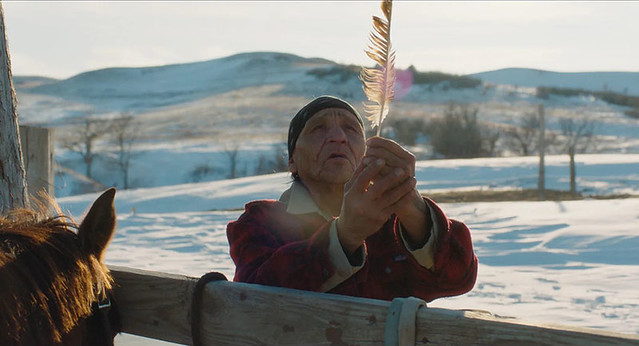
It turns out, the first part is movie within a movie, playing out on TV in a household in the Sioux reservation in South Dakota. More of a background noise for a Native American cop Alaina (Alaina Clifford) and her young basketball coach niece Sadie (Sadie Lapointe) as they get ready for their work. Alaina is taking her night shifts patrolling the neighborhood. Snowstorm is about to hit the area and she has to stop in, as her dispatcher send her to the origins of one distress call after another.

In a documentary style, we see the devastation of the Native American population living in the reservation - poverty, violence, incarceration and alcohol and drug use are everyday occurrence and Alaina being a good cop, she attends her job dutifully. Shot in a documentary style, the prolonged segment is as real as it gets. While white folks are playing out The Searchers fantasy for a century, the Natives are struggling with the bleak reality they inherited.

Mastroianni makes another appearance as a French actress researching the reservation life for a film who got stranded in a storm. She is our interlocutor, El Coronel, an unwitting bridge to the natives from as far back as Cortez days. Sadie visits her young cousin in jail, then goes to her grandfather's trailer. Grandfather tells her, "Time does not exist. It's a human invention." She says she is ready to go away. Her grandfather gives her an herbal tea which will make her sleep and wake up in another life. Say bye to everyone you know. He says. Lapointe, just like many of Alonso's non-actors, shines, as a young woman, who wholly embodies the terrible fate befallen to Native Americans in the 21st century.

Uncharacteristically for Alonso, we are presented with beautiful transition dissolves into the next segment, which takes place in Brazilian Amazon jungle, where a small tribe of peaceful natives who sit around and talk about their dreams. Their clothes and an old-style soda can tell us that this takes place in the past, during the Amazon's gold-rush days of the 1970s. A fight breaks out of their tranquil existence as jealousy between two men over a woman which results in stabbing and the stabber fleeing the village. The man then joins the gold-rush prospecting party nearby. El Coronel makes a third appearance, this time as a white man in charge of the prospecting operation. He is a typical middleman who would do anything for money. El Coronel tells the man that he doesn't belong there and would help him to get out of there.

With such a strong and engaging middle part with Alaina and Sadie, the third part of the film doesn't quite gel with the rest of the film. But overall, Eureka is always a fascinating watch with full of ideas swimming around your head long after you leave the theater.

Wednesday, March 11, 2015

Tender Side of Charlotte Gainsbourg

3 Hearts (2014) - Jacquot
 photo f281f23c-762b-47aa-969a-8f66dce4ed0a_zps9tw6ktpc.jpg
Marc (Benoit Poelvoorde), a shlumpy tax investigator, just missed the train back to Paris. He now has to spend the night in a provincial town whether he likes it or not. By chance, he meets and chats up lovely Sylvie (Charlotte Gainsbourg). The mutual attraction is there. Marc is glad that even though she seems a little anxiety stricken, she's willing to talk to him and show around the town in this sleepless night. Sharing smokes, they end up walking all night talking.

This wasn't like one night passionate tryst of strangers. The tender encounter was some kind of sign from above, as if they were meant to be together (but of course they don't say this out loud, for they are not love stricken teenagers). In the morning, without exchanging their numbers, they promise each other to meet in Paris in one week on Friday, at Eiffel Tower, no that's too corny, at the famous fountain in the park.

The encounter was so special, It becomes a deciding factor for Sylvie not to move to the US with her current boyfriend as she's been hesitant on the matter. But the Friday comes and goes: Marc misses the rendez-vous because he gets delayed by clients and has a mini stroke from stress. Without knowing all these, heartbroken Sylvie leaves for the US with her boyfriend. 


Marc is in town again, looking for Sylvie. He ends up helping out distraught Sophie (Chiara Mastroianni), Sylvie's sister, with her business tax problems without knowing that they are sisters. Sophie is a nervous wreck but very warm and attractive. The romance blooms. She introduces him to her mother (Catherine Deneuve) who cautiously observes him. For some reason, mom's a little hesitant about embracing him fully into the family yet.

Eventually Marc finds out that Sylvie and Sophie are very close siblings but whatever the reason, he decides to avoid contacting Sylvie and telling everyone the truth. Marc and Sophie marry. Marc awkwardly avoids Sylvie at the wedding. And she finds out for the first time, that it's him her beloved sister is marrying.

3 years pass by. 

Marc and Sophie now have an adorable son. For celebrating the 60th birthday of the mother, Sylvie comes home. She and her boyfriend are not doing well and Marc and Sylvie's passion rekindles in secret. Would their secret be discovered?

Benoit Jacquot is revered as 'women's director' for his rapport with many of the France's leading actresses (worked with Anna Karina, Catherine Deneuve, Isabelle Huppert, Isabelle Adjani, Sandrine Kiberlain, Sandrine Bonnaire, and catapulted the carreers of Virginie Ledoyen, Isild Le Besco, Judith Godreche, and Lea Seydoux). He comes back to a small scale, light-hearted, character driven adult romance after success of big period costume drama, Farewell My Queen.

3 Hearts, like all Jacquot films, is a showcase for female roles. But in this film, the star is undoubtedly Gainsbourg. Unlike the roles of her late (think her collaborations with Lars von Trier, where she plays against type), with her frail figure and worrisome face, Sylvie is well within her domain. She gives a nuanced, subtle performance as a woman shaken forever by a chance encounter and who's torn between loyalty and desire.

Not quite a 'what if" story but 3 Hearts is full of regret and melancholy. It's a fluff in the vein of old Hollywood romance but with the help of today's gadgets - skype and cell phones, the film works as a tension filled romantic thriller. You don't really believe two of the most alluring actresses of our time would fall for Poelvoorde's Marc, but hey, it's a man's fantasy and it works for me.

Jacquot has been busy. His new film Diary of a Chambermaid, a remake (of Renoir's classic in 1946, then again 1964 by Buñuel), starring Lea Seydoux just debuted at this year's Berlinale.

3 Hearts opens in New York on 3/13. National roll out will follow. Visit Cohen Media website for more info

Tuesday, October 22, 2013

"I Don't Need to be Put on a Pedestal": Claire Denis Interview

 photo b83e23e7-7a4c-4ed9-a2ce-a8a4549cb917_zps95c90cde.jpg
Claire Denis goes all-out noir in Bastards, a brooding, nocturnal thriller where innocents get punished and good men die. With a star studded cast, Denis creates a film experience so seductive and mesmerizing, it reminded me of the exhilaration that I haven't felt in theaters since, gosh, maybe Mulholland Dr.?

The film's strong sexual contents are stirring controversy since it debuted at Cannes (in Un Certain Regard section). It will be a divisive film for sure. But there is no question that the film demonstrates Denis as a filmmaker in her prime. I had a pleasure of chatting with her for the second time since her last outing to NYFF with White Material in 2010.

BASTARDS plays out like a hardboiled film noir in the vein of James M. Cain and reminiscent of CHINATOWN. I know it's co-written by your long time collaborator Jean-Pol Fargeau. Is the story based on anything?

Yes, it was based on something. I wanted to work once more with Vincent Lindon (they collaborated in Friday Night, 2003) and have him to play someone like James Caan or Toshiro Mifune -- someone solid, someone we can depend on. But I like seeing bad things happening to those hero types. So I started with some Kurosawa revenge movies from the [60s] -- Bad Sleep Well and High and Low. Then with Jean-Pol, we decided that if we wanted to do a noir that we will write it straight forward, scene by scene, brick by brick. Otherwise it wouldn't work because I have a tendency to revise again and again and again.

There is a plot but like many of your other films, it's all about the mood and atmosphere you create. I'm wondering how much of the script is translated on the screen?

In Bastards, the script was exactly the blueprint of the film. Nothing was invented on the set. One scene was cut and I wanted the killing of Marco to take place on the seaside. They were going to carry the little boy off by the boat and she (Chiara Mastroianni's character) shoots him and he falls into the sea. But that' about it. The weather was bad and it was going to cost too much. Other than that, there was really no big change made. Everything was planned well and it was different than shooting in other countries where I have no control over all those sudden changes. I love the locations and it was very easy shooting in Paris.

The mesmerizing soundtrack, once again, is composed by Stuart Staples (of Tindersticks). How does this collaboration work?

We are always in the process together. We go through the script and we discuss, then he sees the dailies. In this film, I told him about Tangerine Dream. I wanted something electronic, something inhuman.

It's really gorgeous.

The way Stuart helps me with the project, he is not only a working companion or musician. He's much more than that. He is someone who I trust so much. In White Material, he was the only one who made me cut out a scene. I wouldn't do it for anyone but he said, "I don't understand that scene," and I said, "Alright, if YOU don't understand it, I'll cut it out."

Wow.

No it's because...he is such a great poet, such a great musician. His feelings are so intense.

And his sensibility matches with what you are trying to do?

It's more like I try to match with him.

You are so modest.

I'm not modest, you know. When you are making films, you are clumsy because you have to take care of a lot of stuff. I'm not exaggerating about Stuart. A collaboration with him is like me flying and he is my co-pilot.

So the great Agnes Godard again shot your film. And for the first time you shot on digital video. I'd like to know what you think about the whole digital revolution that's been happening and if you liked the result shooting on video.

Of course, I like the result. We chose to shoot the film that way, so it had to work. I was happy to do it. I was thinking about shooting White Material on video already. But I thought the look of digital was too cold for the project. So we chose to shoot with low speed Kodak film with almost pinkish tone to express the heat on Isabelle [Huppert]'s face. This heat you can't get it on digital, unless you add it in [color] timing in post. But it's not the same. It still seemed too cold to me. The heat comes from the depth of field and the reaction to the film itself. For instance, when it's very hot, the RED EPIC camera won't work. You have to put an icepack around the camera. Because digital can't stand that kind of heat.

Right. The camera itself gets very hot.

Yeah and it needs to get ventilated all the time. And it's very noisy on the set. It only gets quiet when it's recording. It's like having a computer on set. It took me a week to recreate the relationship I had with Agnes because I don't like to watch film on monitors and I like to be close to the camera. So in the beginning, I felt I was outside the film for a while and I had to fight my way back!

Would you shoot on digital again?

Sure. The thing about shooting digital is trying not to make it look like film. If it looks like digital, it's fine with me.

BASTARDS is stunning though. I love how it looks. And I'm a film guy. But I teach college students how to use digital equipment now. And a lot of kids are not shooting film anymore and it makes me feel sad.

I've seen The Master by PT Anderson last year, shot on 70mm. I mean, wow--

Not many people are doing that though.

I know it's expensive and everything, but it's such a different experience. We should fight to keep them both.

We should.

Because it expresses something else.

I totally agree.

Let me move on to the actors. Whew, such a star studded cast in this one, including your regulars -- Vincent Lindon, Alex Descas, Michel Subor and Gregoire Collin and some actors you haven't worked with before -- Chiara Mastroianni and Lola Créton. I'm wondering if you had those actors in mind when you were planning this film.


I had Chiara in mind for such a long time. But we were shy about approaching each other. And she is an impressive actress, you know? Then we became very close. And Lola, I saw her in two films and I immediately wanted to work with her.

Was the process of working with those two any different than working with your regulars?

No. But I spent a lot of time together with Lola before shooting. I wanted her not to be afraid and trust me and to be the master of the ceremony. I didn't want her to be the victim. So I spent a lot of time with her for that. And Chiara, I know her well, so the trust was already there. But she is someone who doesn't need a lot of psychological explanation. She does it without being told. And it's good for me because I don't like explaining things. So it just the question of being together with those two.

But Vincent is different. He needs a lot of explanation. He always needs more and more. It's because he is such a generous actor. He's always afraid he is not giving you enough.

I saw Lola Créton last year at the festival here.

For Olivier Assayas'?

For Mia Hansen-Løve's GOODBYE FIRST LOVE.

Ah yes.

She was doing a Q&A session and she was so amazingly shy. But in GOODBYE FIRST LOVE, she just gives it all. I am wondering if it was the same for you.

She is shy but you can be shy at the same time as strong. She is both.

There was controversy this year at the Cannes Film Festival where people were protesting the lack of women filmmakers represented. Do you think those objections have merits?

I don't care if I don't win competition. I just don't have time to think about that. If I did, I would become furious. So I'd drop the thing completely and just accept everything I'm given. I remember once watching a Godard movie and afterward I was in a bar next to the theater with Agnes Varda, eating and drinking wine because Agnes was starving. Godard walked by us without giving us any attention and Agnes called him out, "Hey, Jean-Luc Godard doesn't even say hello to me?" So he turned around and said in a slightly sarcastic, slightly comical way "You expect to be decorated (like Legion d'honneur) eh?" as if wanting any acknowledgment was a sin. She said, "Look Jean-Luc, I'd accept everything I'm given." And from then on, I think, 'yes this is true: it's better to accept everything you are given and try not to contest'. It's a waste of time. The controversy about Bastards...I accept it too. I don't feel like a victim just because I'm a woman. I might be victim of myself but not of others.

The thing is, I really want you to be recognized at some point though. You are one of the great directors of our time and I feel sad you don't get that recognition.

Then, what the fuck?! You know what I mean? What can I do about that? Some people like my work and some people don't. Maybe my films are too weird. For some people I am important, but a pedestal I don't need.

Museum of Moving Image is doing mini retro of Claire Denis which culminates to the preview screening of Bastards on Oct. 22, a day before its release in New York. It has a limited release in theaters, VOD and Digital on Oct. 25. Please visit MOMI website and IFC Entertainment website for tickets.

Here is my short review for Bastards

My Claire Denis Interview Nov, 2010

Reviews:

Chocolat
Beau Travail
White Material
Vendredi Soir/Friday Night
35 Rhums
Monday, October 7, 2013

Unabashedly Noir

Bastards (2013) - Denis
 photo 693a88ec-d710-4c4d-ab97-c4a175f25db9_zps99f8ea9b.jpg
It's raining. Hard. The camera descend alongside the wall of a building glistening in water outside. The man in the building seems distressed. Then we cut to a naked, teenage girl (Lola Créton) walking down a wet street. She seems to be in trance. Then it's Marco (Vincent Lindon), a sea captain coming in to the harbor. This is how the film starts. With moody music by Tindersticks, I'm instantly hooked.

Denis goes all out noir on Bastards, a brooding, nocturnal thriller where innocents get punished and good men go die. With star studded cast - the mix of her regulars (Alex Descas, Vincent Lindon, Gregoire Collin, Michel Subor) and new to her clan (Chiarra Mastroianni, Lola Créton), Denis creates a film experience so seductive and mysterious which I haven't had since maybe Mulholland Dr. Its pulpy premise and fuzzy the ending didn't really bother me. I hear this was Denis' first foray into digital filmmaking, but with Agnes Godard at the DP helm, the images are just as mesmerizing as her previous films. Bastards played as part of NYFF. It will get theatrical releases in October 23rd here in New York and available elsewhere in theaters, VOD and digital on 25th. Don't miss it.

Here is Tangerine Dream inspired, mesmerizing soundtrack by Stuart Staples:

Thursday, August 16, 2012

Love in the Time of Hope, Love in the Time of Fear

Beloved/Les Bien-Aimes (2011) - Honoré
Beloved
After 2007's Love Songs, writer/director Christophe Honoré tackles musical comedy genre again, with a deeply personal film, Beloved. This time it's a period piece with the legendary Catherine Deneuve and the famed Czech director Milos Forman, along with his regular set of collaborators- Louis Garrel, Chiara Mastroianni and Ludivine Sagnier. Mastroianni, last seen in the title role of Lena in Honoré's 2009 non-musical, Making Plans for Lena, takes another leading role here, as a woman slogging through a messy love life in a sinister decade we call the 90s. As in Lena, she is mesmerizing in this.

The film also reunites real life mother-daughter team playing mother-daughter -Deneuve and Mastroianni appeared together in two films- André Téchiné's My Favorite Season and Arnaud Desplechin's Christmas Tale, but never in forefront and intimate way as their relationship is portrayed here.

The sprawling film examines loves in two different eras: Madeleine (portrayed by Sagnier and later by Deneuve) goes through somewhat naive yet free-love decade of the 60s and and Vera (Mastroianni), the AIDS and terror stricken 90s - 2000s, the time of fear in many ways. Honoré does a good job in conveying the former decade very economically and effectively, referencing his hero Jacques Demy's pastel color palette (shoes and raincoats) for Paris and a lone Soviet tank in the street for Prague (The Russian Invasion of Czechoslovakia, 1968).

So it's the 90s. Things are more complicated, if not emotionally but in being intimate with someone. After aggressively pursuing a handsome American musician Henderson (Paul Schneider), Vera finds out that he is gay. That doesn't stop them from having a meaningful, long distance relationship. But for Vera, it means a lot of fear, uncertainty and unhappiness.

Milos Forman, the esteemed Czech New Waver, known mostly for his award winning American films (One Flew Over the Cuckoo's Nest, Amadeus, People vs. Larry Flynt) turns up as Jaromil, Madeleine's old flame. Gregarious and uninhibited, Forman's performance gives an unexpected jolt to the film.

Beloved
is a dense, literary film that could've been a novel (a sizable 500 pager at least). Honore manages it in 135 minutes, still, the longest in his filmography. Not everything works perfectly- the period settings make the film less fluid and inhibited in terms of character dynamics compared to the present setting and immediacy of Love Songs.

At the end, despite the unconditional support and love from her parents, Vera, fraught with unrequited love, self destructs. Both of Honoré musicals turn out to be about grieving, not the happiest subject in musical comedy genre. But Alex Beaupain's music continues to be lovely and light and catchy lyrics reflect the feelings of these lovelorn characters very well.

Beloved
is an ambitious film and has a lot to admire, especially for its emotional resonance and unconventional playfulness. It's one of the more memorable French films I've seen in a long while.


Beloved opens Friday Aug 17 at IFC Center and Lincoln Plaza Cinema in NY. Director Christophe Honoré will be on hand for 6:55pm screenings on Aug 17- 18 at IFC Center. For more information and tickets, please visit IFC Center website.

Christophe Honoré Interview

christophe Honor�©
With his sprawling new musical Beloved, starring Catherine Deneuve, Chiara Mastroianni, Ludivine Sagnier, Louis Garrel and Milos Forman(!) getting a limited release in North America, I sat down with writer/director Christophe Honoré, a former columnist of Les Cahiers du Cinema and the French New Waver's heir apparent.


I went to the screening of Beloved with my mother-in-law, who is 70 years old and a big fan of musicals, Umbrellas of Cherbourg, Catherine Deneuve and all that. The film takes place in the 1960s and the 1990s spanning two generations. It's very literary, dense and much longer than your previous films. How did it all come about?


Before I answer that, what did your mother-in-law think about it?

She loved it.


Good. It's important for me to know because first and foremost, the film is from a first person's point of view. It concerns my parents' generation and mine. I can imagine what it was like but I can't be one hundred percent sure when it comes to portraying their perspective. So it is interesting for me to know how it rings for somebody who is actually from that generation.

She was saddened by the later part of the story. But we agreed after the film that there isn't really a difference in how we experience love no matter what decades we were in. She really loved it.


It was a project for me of course. In my parents' generation, there were the pills, the sexual liberation, etc., that the feeling of love was linked to hope. Where as for me whose sex life took off in the late 80s, it was a lot different. With AIDS, love was not associated with hope but with fear. We had to be watchful.

Now that I'm a father, I realize how nerve wracking it must've been to be a parent of an adolescent in that time period. Me as a gay person, starting to go out into the world, I can only imagine how my parents felt.

Even though we have this grand ideal that love is eternal and everything, but our intimate lives are shaped by our surroundings in that particular time. And that's why I was interested in this block of time to see how the characters were coping with their intimate lives.

This was the first time you were doing a period piece, correct?

Yes, but I'm not really sure there will be a next time.

Oh?

For me, it is very difficult to reconstruct a certain period. It is difficult for me because I realize that I like working in the present. Doing a period piece means that I have to artificially reconstruct whatever the time periods, and it's not something I really like to do.

Was choosing these two decades any way influenced by you being a father?

Of course, it's drawn from my life and anything I write is influenced by it. Though I guess what's missing from this film is the ensuing (younger) generation. I did have characters Justin in Montreal and Omar in London who are younger and have their particular relationships in regard to their homosexuality but a lot of their scenes are cut in the editing process.

The problem is that you still don't want to have that reflexive censoring of yourself when you have children and family. Before shooting Beloved I shot a short film called Man at Bath. It was shot during the course of a week and it's very sexual and absolutely not for children. I hope I'll never make something that is 'parent of a student' film, something that my daughter will be proud of me later on when she sees it. I'd prefer to make something that she'd feel a little ashamed of me. (laughs)

Nice!

It was good to see all the actors you worked with before again in Beloved- Ludivine Sagnier, Louis Garrel and Chiara Mastroianni of course. But I didn't expect to see Milos Forman there and singing! How did that come about?

Well I wanted a Czech actor who is Catherine Deneuve's generation. Unfortunately, there aren't many Czech actors from that generation still working. I kept saying, to casting directors that I needed someone like Milos Forman. Then I thought, 'Hey, I should just write to him and ask him'. And I think he was really happy to come back to France and to see Catherine again. Because when the (Soviet) tanks came into Prague, it was two French directors- François Truffaut and Claude Berri who drove up to Prague and rescued Milos and his family and brought them to France. So he has that relationship with French cinema. It was also the time when Truffaut was very close to Catherine. So I think all that played a role in him accepting my proposal.

What about the singing part? How did he react to the suggestion?

I had sent him my previous film Love Songs and he was gracious enough to tell me that he liked it. And I think he likes Beloved. He told me that I take a lot of risks in making films. I think he is someone who is very joyous in relationship to cinema. At no point on the set he made any comments that put pressure on me. I mean, he's done some amazing films and I was very self-conscious about him being there. But he is very much like Catherine- they both have a genuine respect for cinema and at the same time, they don't take it too seriously.

Once they realize that you hold the bar high and have high expectations, they jump right in and are very easy to work with. Because at the end of the day, you don't really know how exactly things will turn out in films.

How is the collaboration process with Alex Beaupain?

Alex is someone I've known since we were kids. He wanted to be a singer and I wanted to be a filmmaker and we feel very lucky that we've become what we wanted to be. So it's always fun to blend our stuff together and what better than a musical comedy.

I work in parallel with him from the beginning of the script and when I see a dialog that would work better as a song, I send it to him with general melodies I'm looking for. Since he is really fast, he sends me songs with some skeletal piano accompaniment within few days. And as I work on the script, I just integrate the songs into it, so when the script is finished, it's all there, ready to go.

I spent my twenties in the 90s. Everyone tells me that the 90s were the modern Dark Age for culture. I want to know what your take on that decade is.

I don't really agree with that sentiment. Certainly not in America since there were many great filmmakers in the 90s there. On the other hand in France, it's clear we were on the decline. Obviously French cinema is no longer a leader aesthetically or from an industrial standpoint. I would say Asian cinema was the leader in the late 90s and early 2000s.

When I started making films, there was a general reactionary movement harkening back to the old times. The values that are put on cinema today in France are the same as, I would say, during the war (WWII) and just after the war. What it means is that the filmmaking today is at odds with the spirit of the New Wave. So what I'm trying to say through my films is that the golden age of French cinema was the New Wave and I want to keep that spirit alive. But I realize that's a very minority viewpoint.

It is 2012 already and I wonder if there will be any difference in the post-Sarkozy era in French cinema?

In any case, French cinema that works abroad now is very Sarkozian cinema- like the Artist. If you look at the Artist, it corresponds with the idea of cinema that is really to the right of Sarkozy. I'd say right now the filmmakers who are revered, like Jacques Audiard, do very bling-bling kind of cinema. And that's not really what I strive for as an artist. But I have to say those kind of cinema works- it gets prizes and do well abroad, etc. So from the outside perspective they are what the best of French cinema can offer. I don't know if the change of political scenery will bring change in the value of cinema. But I don't think it's an accident that that kind of cinema is lauded when Sarkozy took over.

Let's hope it does.

Sunday, August 12, 2012

Sing Your Sorrows Away!

Les chansons d'amour/Love Songs (2007) - Honoré
chansons de l'amour
chansons de l'amour 1
So this is my second Honoré musical I saw about grieving. Unlike Beloved which was a time specific, period piece if you will (unless you count large plastered Sarkozy poster on the street), Love Songs feels more fluid and less cluttered (maybe not emotionally). Ismael (Louis Garrel) and Julie (Ludivine Sagnier) are involved in menáge a trois with Ismael's co-worker Alice (Clotilde Hesme). Julie's family with three grown up daughters likes goofy Ismael but can't really understand the relationship. One night at a club, Julie suffers a cardiac arrest and dies. Julie's family wants Isamael's help to cope with grief, especially the older sister Jeanne (Chiara Mastroianni), but he is having a hard time his own, trying to fill the vacuum with a young waitress or a smitten High School boy.

As usual, Honoré's strength is in the well developed, evenly important characters. No one seems out of place or two dimensional. Alex Beaupain's light music is quite beautiful and matches well with the poignancy of dialog- "I'm the bridge between your banks/Your quarrels leave me cold/Trample me and rub my flanks/I'll stay here and grow old," "Love me less/But love me a long time." The musical comedy genre makes things lighter and keeps the movie afloat from becoming too schmaltzy, but I love the idea of singing your sorrows away. A good one.