Showing posts with label Christophe Honoré. Show all posts

Wednesday, March 2, 2022

Rendez-Vous with French Cinema 2022 Preview

The 27th edition of celebrating the best of contemporary French cinema offers a star studded 23 film line up. And after going all virtual last year due to the pandemic, this year's Rendez-Vous is back at the beloved Walter Reade Theater, Film at Lincoln Center, NY. The festival runs 3/3 - 3/13.

Opening night film is a highly anticipated Berlinale winner, Claire Denis's Juliette Binoche and Vincent Lindon drama, Fire. Other notables include Mathieu Amalric's Hold Me Tight with Vicky Krieps as a grieving French housewife, Jacques Audiard's contemporary romance Paris, 13th District, Christophe Honoré's stage adaptation of Proust going awry during Covid-19 in Guermantes, Arnaud Desplechin's adaptation of Philip Roth's Deception, starring Léa Seydoux.

For showtimes and tickets, please visit FLC website.

Here are some notable films I was able to sample:

Deception - Arnaud Desplechin Deception Tackling on Philip Roth's autofiction, Arnaud Desplechin's Deception showcases Léa Seydoux's talent and charisma once again (they collaborated in his last effort Oh, Mercy, where she played a poor working class girl mired in crime).
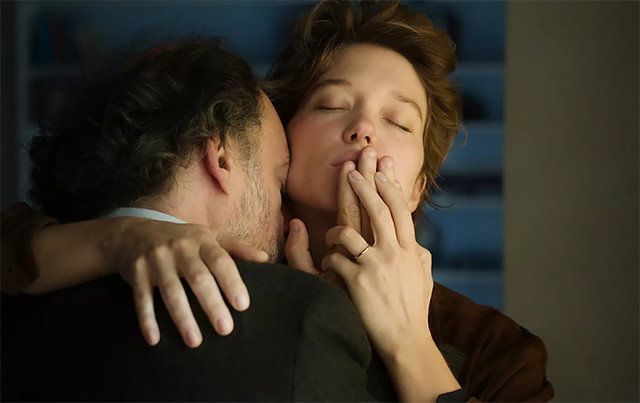
Here Seydoux plays a sophisticated Londonite whose unhappy marriage drives her into the arms of Philip Roth(Denis Podalydès), a London based American writer, also stuck in loveless marriage. In his London flat, they talk and make love. He jots down his thoughts about her in his trusty notebook for keepsake. They break up many times yet have a strong hold on each other and can't let it go completely. His wife suspects and accuses him of having an affair and he defends himself by saying that Seydoux character is just that, a character, a manifestation of a writer's imagination run amok. As usual for a Desplechin film, Deception is wordy and performance driven. And despite the setting and the characters nationalities, with the usual neurosis and everything, Deception is decidedly and predictably Desplechin and very French.

Hold Me Tight - Mathieu Amalric Hold Me Tight I've said many times that Mathieu Amalric is not only a great actor but great director as well. Yet again, he proves it with Serre moi fort/Hold Me Tight.

It starts out with Clarisse (Vicky Krieps) sneaking out of the house in the middle of the night, driving away in an old car, leaving behind her loving family - Marc, her hunky husband and two adorable children, Lucie and Paul. She tells herself that after a while they will not miss her. She is never coming back and they will have to accept the fact. But why is she running away? What is she running from?

Then the film becomes something else entirely. Krieps gives a gut wrenching performance in a film about grieving and letting go that is so portent and heartfelt than any other film I've seen in a long time. Constantly going back and forth with her and her family, feeling the absence of one another yet articulating the connection in a very ingenious way, Amalric perhaps makes the most heartfelt film as a writer/director.

Guermantes - Christophe Honoré guermantes The planned stage play of Guermantes, based on Proust's third volume of In Search of Lost Time (appropriate title for our pandemic times), is getting canceled, because of Covid. Director Christophe Honoré and a large cast of mostly theater actors, who's been rehearsing the play together for months, are devastated by the news. So they have two choices, stop the project, admit the defeat and go home, or continue to rehearse without a guarantee that the show will ever be staged in the future. After much debate, they continue their rehearsal.
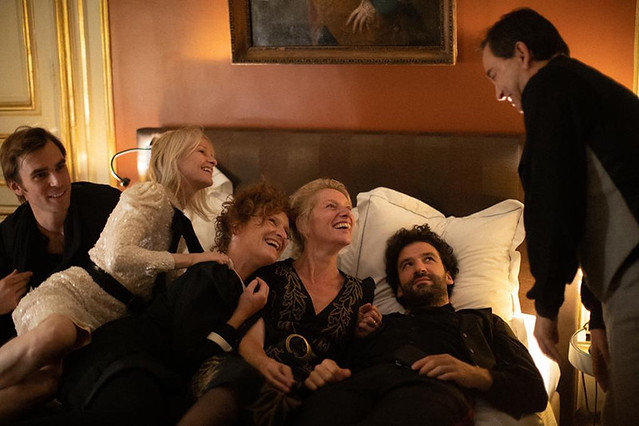
So starts this delightful, communal film of actors and a novice theater director rehearsing the Proust's labyrinthine texts while making the Théâtre Marigny and its lovely garden their home- sleeping, eating, singing together and make the best out of the world wide pandemic.

Unlike the play they are enacting which lacks many of the characters back story due to it being a chapter in a 7 volume book, Honoré explores many of the actors backstory and their lives, making the film much more than a mere documented rehearsal. It's obviously scripted cinematically playful and shot beautifully on film, by frequent collaborator Rémy Chevrin. A delightful salvo of a film that shows a power and resiliency of art in the pandemic era.

Paris, 13th District - Jacques Audiard PARIS 13TH DISTRICT Les Olympiads, the high-rise residential buildings named after the cities that hosted Olympics over the years, is a middle income housing built in the 70s, located in ethnically diverse 13th District in Paris. Audiard, known for his well crafted thrillers and highly emotive characters, tries his hands at a modern romance film with his sleek, staccato style, shot on beautiful black and white.

Webcam, dating apps and decidedly young attractive actors give Paris, 13th District, a fresh, vibrant look at the lives of young, ethnically diverse Parisians of today.

Breakthrough performance here is definitely Lucie Zhang as Emilie, a Taiwanese descent millennial looking for love while living off in her grandma's apartment in Chinatown, located in the 13th District. Zhang's uninhibited performance is contrasted by Noémie Merlant (Portrait of the Lady on Fire) as Nora, a 30 something Bourdeaux transplant running away from the grip of her husband to find herself in the city. Their lives cross paths through handsome Camille, played by Makita Samba, a public school teacher whose self-assured but arrogant demeanor both attracts and repels women. Co-written by Céline Sciamma, Paris, 13th District weaves a seductive, fresh tale of modern romance.

Thursday, March 23, 2017

Honoré's Metamorphoses is Dirty, Playful Romp

Metamorphoses (2014) - Honoré
image_metamorphoses_honore-001
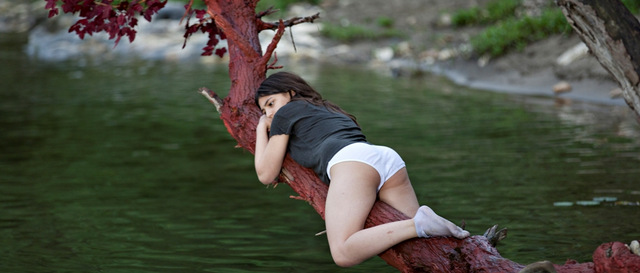
Christophe Honoré (Love Songs, The Beautiful Person, Making Plans for Lena)'s interpretation of Roman poet Ovid's Greco-Roman mythic tales of god and demigods starts out with a modern day hunter in the forest, running into a flame haired nude transgender person who graces him with pixie dust and turns him into a deer. The hunter becomes the hunted. From the get-go, Metamorphoses promises to be a very playful, dirty fantasy where anything can happen.

Filled to the brim with young nude bodies (usually full frontal), the film tells a high school girl, Europa (Amira Akili), skipping school and being kidnapped by Jupiter in the form of a charming truck driver. It's a sexual, spiritual awakening for Europa, as she mingles in turn with Jupiter, Bacchus and Orpheus.

Story within a story within a story plays out, some funny, some dark, but all enjoyable, putting emphasis on sexual ambiguity and transformation in human beings. The film is something like a dream of a horny teenager who has fallen asleep in a literature class.

As Honoré told me in an interview before that he is not the type of director who'd want to make nice movies to be remembered fondly by the next generation of film-goers. He's the sort of a filmmaker/dad who'd rather make things which his own daughter would be a little ashamed of. Working with mostly non-actors, he charges on bravely, with lots of nudity, challenging today's ridgid, conservative society and reminds us that, ironically, things were much more transgressive and open, more than two thousand years ago, when Ovid first wrote those poems.

Shot in widescreen and vivid colors by André Chemetoff (Our Day Will Come), featuring many salacious images, Metamorphoses is a great visual feast. It also includes a breathtakingly gorgeous under-water scene where Orpheus attempts to retrieve Eurydice from the underworld.

There are many idyllic nature settings, most of them near the water which is the running theme of the film. These ordinary settings take on a heavenly significance as young gods and demigods christening themselves in the torquois water. Diverse cast of young non-actors engage in tug-and-pull rituals of love and physical, feral courtship. One such dance-like courtship on a river bank involves the rising French star/circus trained actress Vimala Pons and it's a sight to see.

In death of the skateboarding Narcissus (Arthur Jacquin) chapter, you can see the same theme coursing through many of Honoré's films: a love-sick character's self-destructive demise (as the case in Love Songs, Beautiful Person and so on).

Playful, dirty, edgy, organic and beautiful in its micro-budget way, the film has a lot in common with Gomes's Arabian Nights Trilogy which came out a year after. Honoré doesn't bother with elaborate mise-en-scene or special effects. Human to Animal transformations are usually done in simple edits.

Honoré delved into many different genres over the years, working with who's-who in French cinema as well as non-actors, dipping back, from time to time, to his indepedent roots. I saw his adorable new film Sophie's Misfortunes at this year's Rendez-vous with French Cinema. Given that it's a straight up children's film right after Metamorphoses, it shows Honoré's dexterity as a filmmaker.

Metamorphoses works as a dreamy poetry. It's an ode to youth and an abashed celebration of amorphous nature of human sexuality. I am so glad it is getting a theatrical run here in the States. It's an absolute blast!

Tuesday, February 28, 2017

Sneak Preview: Rendez-Vous with French Cinema 2017

In its 22nd edition, Rendez-Vous with French Cinema at FSLC remains to be one of the main attractions for cinephiles in a crowded New York Spring film event season.

This year's lineup features 23 films from established filmmakers and newcomers alike, including - François Ozon, Bertrand Bonello, Bruno Dumont, Rebecca Zlotowski, Jérome Salle, Chrstophe Honoré, and the list goes on.

In conjunction with Rendez-Vous with French Cinema, FIAF presents Agnès Varda: Life as Art, taking place February 28–March 21.

A special exhibition imported from the esteemed photography festival Les Rencontres d’Arles will be on view in the Walter Reade Theater’s Furman Gallery throughout the festival, displaying newly discovered color photos from behind the scenes of Fellini’s black-and-white masterpiece 8 1/2, shot by the late Paul Ronald and accompanied by recollections from the film’s co-star Anouk Aimée.

And, for the first time, a Film Comment magazine presentation within Rendez-Vous with French Cinema: Julia Ducournau’s cannibal thriller Raw which titillated audiences at Toronto and Cannes.

The series runs March 1 - 12. Visit FSLC website for tickets and more info. And here are my samplings this year:

FRANTZ
 photo frantz_03_zpsa9aqmctd.jpg
Frantz is as usual for Ozon, a seductive concoction. Disguised as period costumes and sumptuous monochrome cinematography that bursts in to color in pivotal moments, but the film hold some sinister undertones of lost innocence and pain/joy of growing up.

Paula Beer, a young German actress is marvelous here to carry the whole movie on her shoulder. It's perfectly normal to see the film from a female perspective in Ozon's films, and obviously he flirts with sexual attraction and sensuality (albeit very subtly). But Anna being a German lost in unforgiving world of its enemy gives another layer.

Ozon, the master of a twisty narrative, packs much more interesting development in store in the second half- part detective story, part romance and part reflecting the current climate of the rise of nationalism where the relationship between two old neighbors - France and Germany and Europe as a whole is being tested. One of his very best films in years.


STRUGGLE FOR LIFE
 photo 69edb538-70e1-44e8-9cbc-464067f5f9a7_zps3zqtmvhx.jpg
Because of subway delays Chataigne (French comedian Vincent Macaigne), a thirty-something portly intern of Ministry of Standards, is assigned to French colonial Guiana to report on the progress of an absurd public works project titled Gui-snow, the first ski resort which will be built in the jungle of the tropical country. With a resilient tax agent mistaking him for tax evader and nothing really to live for, Chataigne head for Guiana with a second grade computer and a thick red French standard guide book. In Guiana, because he doesn't have a license, he is assigned a driver named Tarzan (Vimala Pons), another intern from the Ministry of Versailles, seeing over the completion of French style garden. With humidity, mud, millions of manacing insects, allegators, monkeys and other jungle elements hostile to humans, the duo soon gets lost in the jungle. They have to survive by their wits.

It's another madcap comedy by Antonin Peretjatko and starring Pons, a circus trained actress who worked with Peretjatko and Macaigne in The Daughter of 14th of July. Taking a jab at absurd notion of taming the jungle and the first world arrogance, Struggle for Life thrives on slapstick comedy and racy humor a la Woody Allen's Bananas and largely rides on the charm of Pons who dons hot pants with cigarette forever dangling from her pouty mouth. Macaigne is a very lucky man to be paired up with Pons and spend entire film with her in the jungle alone. Oh, Mathieu Amalric shows up as a swinging bureaucrat in charge of Project Gui-snow in Guiana.

DAYDREAMS
 photo 8aa4e07b-9cdf-4e5b-b3ef-4f095a3615d7_zpsgruf5hux.jpg
One year artist residency in an ancient villa in sunny Medici is the setting for a delicious daydream that involves a budding writer Camille (Clotilde Hesme) and a photographer Axéle (Jenna Thiam).

There are illicit affairs, artistic jealousy, moving statues and ghosts. Camile's older and more successful writer husband (Tchkéy Karyo) tags along for the trip with their young daughter. But soon she finds his presence overbearing. Axéle's affair with a married man doesn't lead her anywhere and she soon has an artistic identity crisis.

Daydreams has self-reflexiveness of Philippe Garrel (director Caroline Deruas' older, more established husband) and Ozon's playfulness. It's a very accomplished debut of a talented writer/filmmaker. Daydreams also allots ample screen time for Hesme's big green eyes in series of close ups. Great.

HEAL THE LIVING
 photo 3be38fdc-f345-4c8a-9960-c8fe91d4ae56_zps0ssy2oid.jpg
A young blonde boy, Simon, wakes. He kisses his girlfriend who's still in bed, sneaks out of the window to join his buddies to go surfing. It's winter. The whole beginning sequence of Katell Quillévéré's Heal the Living has a fluidity and detached youthful spirituality of Gus Van Sant movie.

It's an organ transplant weepee - 'An accident cuts a young man's life short and gives another a second chance in life' story. We've seen this before, many times. What elevates this lifetime movie of the week premise is its ensemble cast which includes Emmanuelle Seigner, Kool Shen, Tahar Rahim and Alice de Lencquesaing.

Through Simon, we see the glimpse of other's lives - both professional or private in equal measure. It's the space between the brain and the heart- which makes us human that Quillévéré explores. It would've definitely turned out corny in less assured hands. It's remarkable that Quillévéré, with just 2 other films under her belt achieves something so graceful and thoughtful.

SOPHIE'S MISFORTUNES
 photo 4379725_berlin-gaumont-brings-kiddie-lits-sophie_117a9a7e_m-1_zpslh4ps6ho.jpg
Sophie (Caroline Grant), a mischievous young girl leads a normal bourgeois life in a chateau with a beautiful but sickly mom (Golshifteh Farahani). Sophie's antics could be sometimes too much for her mom and friends who could tolerate her as girl with the too much imagination and energy. But her journey to the new world (America) ends in tragedy and leaves her orphaned. She now comes back to the country under the care of strict, unloving stepmother Mme. Fichini. She rejoins with her best pals and their kind hearted mother Mme. de Fleurville (Anaïs Demoustier).

After sexually charged interpretation of Greek mythology, Metamophorses in 2014, Honoré returns with unabashedly unadulterated kid's movie, Sophie's Misfortune, based on a beloved 19th century children's story by Countess of Segur. He gets mindbogglingly true to life performances by youngsters. It reminded me of Jacques Doillon's Ponet. Great use of seamless animation too to portray kid's imagination running amok. I didn't expect this from Honoré and it's a nice surprise.

Saturday, February 7, 2015

Hurting Game

La Belle Personne/The Beautiful Person (2008) - Honoré
 photo 81c64b12-a853-4652-9adf-9a7235aba87a_zpshitapi9m.png
 photo f73da5f3-e978-41e3-a4d1-c14bb9a337e0_zpsh4uqvv45.png
 photo f102bcbb-5232-46ea-9996-73ecc1c499bb_zpsbskehxzw.png
 photo ffa44972-544c-464d-a876-684704f95dff_zps4es77nr9.png
Juni (Léa Seydoux) is a new girl in school. She's Mathias's cousin who lost her mom not long ago. Mathias and his gang of friends are poised to set her up with saintly Otto (Grégoire Leprince-Ringuet of Love Songs). She also attracts the attention of her handsome, playboy Italian class teacher Nemours (Louis Garrel). Thrown in this Shakespearean melodrama, sullen Juni needs to figure out what she wants without hurting anyone and getting hurt herself. Otto doesn't understand why for Juni, it's not love at first sight like for him. Nemours breaks off all his female relationships in pursuit of Juni. He intellectually understands that she will never fall for him, but can't stop pursuing her. After reading a love letter that was mistakenly identified as written by Nemours, Juni makes up her mind.

Seydoux's loveliness dominates most of La Belle Personne. Her downcasted eyes, her melancholic expression suggest deep mystery. No she's not a naif, unlike the observation of a cafe owner, that teenage girls are as delicate as a glass (in warning Nemours). No matter what the circumstance, she is stronger than you and she can destroy you if she wants to. She is infinitely wiser than you. She understands that love doesn't last long and if she falls for it, it might hurt her. So she resists. Honoré too understands, about fleeting nature of love and its unfairness. His love stories are always sad, but also beautiful.

My interview with Christophe Honoré
Les bien-aimes/Beloved review
Les chansons d'amour/Love Songs review

Thursday, August 16, 2012

Love in the Time of Hope, Love in the Time of Fear

Beloved/Les Bien-Aimes (2011) - Honoré
Beloved
After 2007's Love Songs, writer/director Christophe Honoré tackles musical comedy genre again, with a deeply personal film, Beloved. This time it's a period piece with the legendary Catherine Deneuve and the famed Czech director Milos Forman, along with his regular set of collaborators- Louis Garrel, Chiara Mastroianni and Ludivine Sagnier. Mastroianni, last seen in the title role of Lena in Honoré's 2009 non-musical, Making Plans for Lena, takes another leading role here, as a woman slogging through a messy love life in a sinister decade we call the 90s. As in Lena, she is mesmerizing in this.

The film also reunites real life mother-daughter team playing mother-daughter -Deneuve and Mastroianni appeared together in two films- André Téchiné's My Favorite Season and Arnaud Desplechin's Christmas Tale, but never in forefront and intimate way as their relationship is portrayed here.

The sprawling film examines loves in two different eras: Madeleine (portrayed by Sagnier and later by Deneuve) goes through somewhat naive yet free-love decade of the 60s and and Vera (Mastroianni), the AIDS and terror stricken 90s - 2000s, the time of fear in many ways. Honoré does a good job in conveying the former decade very economically and effectively, referencing his hero Jacques Demy's pastel color palette (shoes and raincoats) for Paris and a lone Soviet tank in the street for Prague (The Russian Invasion of Czechoslovakia, 1968).

So it's the 90s. Things are more complicated, if not emotionally but in being intimate with someone. After aggressively pursuing a handsome American musician Henderson (Paul Schneider), Vera finds out that he is gay. That doesn't stop them from having a meaningful, long distance relationship. But for Vera, it means a lot of fear, uncertainty and unhappiness.

Milos Forman, the esteemed Czech New Waver, known mostly for his award winning American films (One Flew Over the Cuckoo's Nest, Amadeus, People vs. Larry Flynt) turns up as Jaromil, Madeleine's old flame. Gregarious and uninhibited, Forman's performance gives an unexpected jolt to the film.

Beloved
is a dense, literary film that could've been a novel (a sizable 500 pager at least). Honore manages it in 135 minutes, still, the longest in his filmography. Not everything works perfectly- the period settings make the film less fluid and inhibited in terms of character dynamics compared to the present setting and immediacy of Love Songs.

At the end, despite the unconditional support and love from her parents, Vera, fraught with unrequited love, self destructs. Both of Honoré musicals turn out to be about grieving, not the happiest subject in musical comedy genre. But Alex Beaupain's music continues to be lovely and light and catchy lyrics reflect the feelings of these lovelorn characters very well.

Beloved
is an ambitious film and has a lot to admire, especially for its emotional resonance and unconventional playfulness. It's one of the more memorable French films I've seen in a long while.


Beloved opens Friday Aug 17 at IFC Center and Lincoln Plaza Cinema in NY. Director Christophe Honoré will be on hand for 6:55pm screenings on Aug 17- 18 at IFC Center. For more information and tickets, please visit IFC Center website.

Christophe Honoré Interview

christophe Honor�©
With his sprawling new musical Beloved, starring Catherine Deneuve, Chiara Mastroianni, Ludivine Sagnier, Louis Garrel and Milos Forman(!) getting a limited release in North America, I sat down with writer/director Christophe Honoré, a former columnist of Les Cahiers du Cinema and the French New Waver's heir apparent.


I went to the screening of Beloved with my mother-in-law, who is 70 years old and a big fan of musicals, Umbrellas of Cherbourg, Catherine Deneuve and all that. The film takes place in the 1960s and the 1990s spanning two generations. It's very literary, dense and much longer than your previous films. How did it all come about?


Before I answer that, what did your mother-in-law think about it?

She loved it.


Good. It's important for me to know because first and foremost, the film is from a first person's point of view. It concerns my parents' generation and mine. I can imagine what it was like but I can't be one hundred percent sure when it comes to portraying their perspective. So it is interesting for me to know how it rings for somebody who is actually from that generation.

She was saddened by the later part of the story. But we agreed after the film that there isn't really a difference in how we experience love no matter what decades we were in. She really loved it.


It was a project for me of course. In my parents' generation, there were the pills, the sexual liberation, etc., that the feeling of love was linked to hope. Where as for me whose sex life took off in the late 80s, it was a lot different. With AIDS, love was not associated with hope but with fear. We had to be watchful.

Now that I'm a father, I realize how nerve wracking it must've been to be a parent of an adolescent in that time period. Me as a gay person, starting to go out into the world, I can only imagine how my parents felt.

Even though we have this grand ideal that love is eternal and everything, but our intimate lives are shaped by our surroundings in that particular time. And that's why I was interested in this block of time to see how the characters were coping with their intimate lives.

This was the first time you were doing a period piece, correct?

Yes, but I'm not really sure there will be a next time.

Oh?

For me, it is very difficult to reconstruct a certain period. It is difficult for me because I realize that I like working in the present. Doing a period piece means that I have to artificially reconstruct whatever the time periods, and it's not something I really like to do.

Was choosing these two decades any way influenced by you being a father?

Of course, it's drawn from my life and anything I write is influenced by it. Though I guess what's missing from this film is the ensuing (younger) generation. I did have characters Justin in Montreal and Omar in London who are younger and have their particular relationships in regard to their homosexuality but a lot of their scenes are cut in the editing process.

The problem is that you still don't want to have that reflexive censoring of yourself when you have children and family. Before shooting Beloved I shot a short film called Man at Bath. It was shot during the course of a week and it's very sexual and absolutely not for children. I hope I'll never make something that is 'parent of a student' film, something that my daughter will be proud of me later on when she sees it. I'd prefer to make something that she'd feel a little ashamed of me. (laughs)

Nice!

It was good to see all the actors you worked with before again in Beloved- Ludivine Sagnier, Louis Garrel and Chiara Mastroianni of course. But I didn't expect to see Milos Forman there and singing! How did that come about?

Well I wanted a Czech actor who is Catherine Deneuve's generation. Unfortunately, there aren't many Czech actors from that generation still working. I kept saying, to casting directors that I needed someone like Milos Forman. Then I thought, 'Hey, I should just write to him and ask him'. And I think he was really happy to come back to France and to see Catherine again. Because when the (Soviet) tanks came into Prague, it was two French directors- François Truffaut and Claude Berri who drove up to Prague and rescued Milos and his family and brought them to France. So he has that relationship with French cinema. It was also the time when Truffaut was very close to Catherine. So I think all that played a role in him accepting my proposal.

What about the singing part? How did he react to the suggestion?

I had sent him my previous film Love Songs and he was gracious enough to tell me that he liked it. And I think he likes Beloved. He told me that I take a lot of risks in making films. I think he is someone who is very joyous in relationship to cinema. At no point on the set he made any comments that put pressure on me. I mean, he's done some amazing films and I was very self-conscious about him being there. But he is very much like Catherine- they both have a genuine respect for cinema and at the same time, they don't take it too seriously.

Once they realize that you hold the bar high and have high expectations, they jump right in and are very easy to work with. Because at the end of the day, you don't really know how exactly things will turn out in films.

How is the collaboration process with Alex Beaupain?

Alex is someone I've known since we were kids. He wanted to be a singer and I wanted to be a filmmaker and we feel very lucky that we've become what we wanted to be. So it's always fun to blend our stuff together and what better than a musical comedy.

I work in parallel with him from the beginning of the script and when I see a dialog that would work better as a song, I send it to him with general melodies I'm looking for. Since he is really fast, he sends me songs with some skeletal piano accompaniment within few days. And as I work on the script, I just integrate the songs into it, so when the script is finished, it's all there, ready to go.

I spent my twenties in the 90s. Everyone tells me that the 90s were the modern Dark Age for culture. I want to know what your take on that decade is.

I don't really agree with that sentiment. Certainly not in America since there were many great filmmakers in the 90s there. On the other hand in France, it's clear we were on the decline. Obviously French cinema is no longer a leader aesthetically or from an industrial standpoint. I would say Asian cinema was the leader in the late 90s and early 2000s.

When I started making films, there was a general reactionary movement harkening back to the old times. The values that are put on cinema today in France are the same as, I would say, during the war (WWII) and just after the war. What it means is that the filmmaking today is at odds with the spirit of the New Wave. So what I'm trying to say through my films is that the golden age of French cinema was the New Wave and I want to keep that spirit alive. But I realize that's a very minority viewpoint.

It is 2012 already and I wonder if there will be any difference in the post-Sarkozy era in French cinema?

In any case, French cinema that works abroad now is very Sarkozian cinema- like the Artist. If you look at the Artist, it corresponds with the idea of cinema that is really to the right of Sarkozy. I'd say right now the filmmakers who are revered, like Jacques Audiard, do very bling-bling kind of cinema. And that's not really what I strive for as an artist. But I have to say those kind of cinema works- it gets prizes and do well abroad, etc. So from the outside perspective they are what the best of French cinema can offer. I don't know if the change of political scenery will bring change in the value of cinema. But I don't think it's an accident that that kind of cinema is lauded when Sarkozy took over.

Let's hope it does.

Sunday, August 12, 2012

Sing Your Sorrows Away!

Les chansons d'amour/Love Songs (2007) - Honoré
chansons de l'amour
chansons de l'amour 1
So this is my second Honoré musical I saw about grieving. Unlike Beloved which was a time specific, period piece if you will (unless you count large plastered Sarkozy poster on the street), Love Songs feels more fluid and less cluttered (maybe not emotionally). Ismael (Louis Garrel) and Julie (Ludivine Sagnier) are involved in menáge a trois with Ismael's co-worker Alice (Clotilde Hesme). Julie's family with three grown up daughters likes goofy Ismael but can't really understand the relationship. One night at a club, Julie suffers a cardiac arrest and dies. Julie's family wants Isamael's help to cope with grief, especially the older sister Jeanne (Chiara Mastroianni), but he is having a hard time his own, trying to fill the vacuum with a young waitress or a smitten High School boy.

As usual, Honoré's strength is in the well developed, evenly important characters. No one seems out of place or two dimensional. Alex Beaupain's light music is quite beautiful and matches well with the poignancy of dialog- "I'm the bridge between your banks/Your quarrels leave me cold/Trample me and rub my flanks/I'll stay here and grow old," "Love me less/But love me a long time." The musical comedy genre makes things lighter and keeps the movie afloat from becoming too schmaltzy, but I love the idea of singing your sorrows away. A good one.