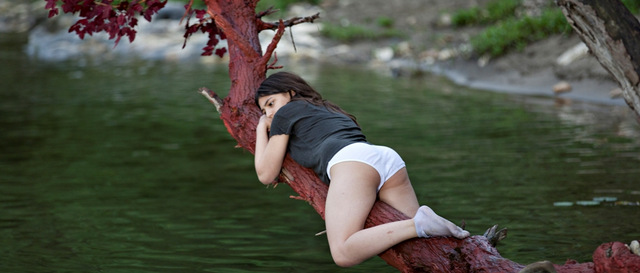
New York based, Belgian filmmaker, Vito Rowlands' feature Ovid, New York, had a world premiere at Brooklyn Film Festival over the weekend. It's based on the Metamorphoses, an epic poem by a roman poet Ovid, who wrote about Greek and Roman myths. Shot in various parts of New York state (including the town of Ovid), in different seasons over time, Ovid, New York is an anthology of sorts in 7 chapters, varying in tones and genre. But as they play out, you make out their intricate connections - it's as if the chapters are in conversation with one another, and it's loads of fun. The look of the film, in wide screen format, mostly shot on a now discontinued old, super grainy Agfa film stock, with its bleeding colors, the dirt and blemishes left in, along with lens flare aberrations, does not resemble anything that's shot with super sharp and clean digital technology nowadays.
First, we are introduced to a lonely hunter in wintry landscape in wide presentation. He is hunting deer in the woods. It invokes a Greek mythology of Actaeon, a hunter who was turned into a deer after spying on the goddess Diana bathing (which corresponds with the third chapter which has two talking sculptures (Hippolytus and Diana) in the park. The second involves a beautiful stage actress (Tina Makharadze) rehearsing Medea on stage. There are no infanticides, but it tells the tale of vengeful woman and her cheating husband. The fourth chapter is narrated in Japanese, shot in grainy hand printed monochrome picture. The fifth one features empty cicada shells and a talking praying mantis urging an entomologist to kill her pestering mother. The sixth tells a traveling hoover vacuum salesman who drowns in a bathtub full of green and very much alive caterpillars in a motel room. And the last one is about two bickering sharply dressed ferrymen twins advising a Belgian actor (played by director Rowlands in an inadequate costume and makeup) dressed as death from Ingmar Bergman's Seventh Seal.
Ovid's Metamorphoses is filled with myths and mythic creatures; animals, humans, gods, and demi-gods shapeshifting into one another in often bloody and violent ways. Rowlands’ Ovid, New York takes on these ancient tales and morphs them into reflecting the chaotic and tumultuous world we live in today, but with plenty of wry humor. I didn't expect the film to be this funny going in: especially a chapter with a talking homicidal mantis. The chapter ends in a hilarious blood-soaked dance in the field, evoking the non-sequitur opening dance scene from Bong Joonho's Mother. It's also very playful with its medium: using outdated technology- 8mm, 16mm and 35mm shot on obsolete film stock, the film renders not only its unique look on screen but also reminds the viewers of the tangibility of film and what cinema has evolved into these days- being described in words such as 'contents' and having 'that Netflix look.' The beautiful soundtrack (by Jordan Dykstra) closely resembles the work of great Michael Nyman (The Cook, The Thief, His Wife and Her Lover, Drowning by Numbers, Piano, Ravenous). Rowlands is also very much aware of cinema history, taking references anywhere from Sergio Corbucci's The Great Silence to Peter Greenaway, Ingmar Bergman and as mentioned before, Bong.
The clash of tone, texture, and sound (several different languages are spoken - English, Georgian, Japanese and Flemish) in Ovid, New York finds harmony, rather than chaos, all connected with theme of change. It's truly a unique film and one-of-a-kind viewing experience and I can't wait to see what Rowlands does next.