Showing posts with label Catherine Deneuve. Show all posts

Thursday, July 2, 2020

Familial Truth

The Truth/La Vérité (2019) - Kore-eda
The Truth
Born out of forever adventurous French actress Juliette Binoche's years of insistence to work with Kore-eda Hirokazu, The Truth marks the famed Japanese writer/director's first film shot outside Japan and in non-Japanese language with international cast. And still, it is, in many ways, a very much Kore-eda film: about family dynamics with thorns and all, yet unmistakably gentle and humanistic. The only departure from his filmography I detect (other than not being Japanese) is that the characters aren't ordinary middle to lower class people that he usually portrays in his films. But I guess the prospect of working with a legendary French film star, Catherine Deneuve, made Kore-eda taking on a different direction. If the appeal of Kore-eda's films is in their universality, especially concerning adults in his films such as Still Walking and After the Storm - the innate goodness in people, admitting their shortcomings, small redemptions and letting the past go, The Truth shows that no matter the class distinctions, the concept of a 'family' still rings true to all of us.

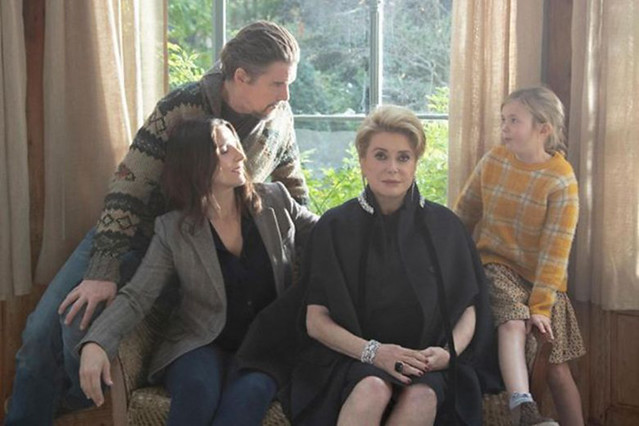
The story concerns Fabienne Dangeville (Deneuve), a legendary French film star and her screenwriter daughter Lumir (Juliette Binoche). Fabienne's memoir titled The Truth is coming out and to celebrate the occasion, Lumir and her American, second-rate TV actor husband Hank (Ethan Hawke) and their bi-lingual preteen daughter Charlotte (Clémentine Grenier) pay her a visit in a secluded grand mansion where Lumir grew up.

Upon reading the memoir, Lumir finds there are glaring omissions and falsehood from her childhood. For instance, Fabienne never picked up Lumir from school, like ever, unlike she says that she always picked her up even during her busy schedule. Fabienne's defense is , "Actors never tell the naked truth" in public. Everyone's memories are subjective anyway, she quips.

To make the matters worse, Luc (Alain Libolt), a long time devout assistant to Fabienne, calls it quits over not mentioning one word about him in the memoir. Now all the personal assistant duties fall on Lumir - receiving messages, accompanying Fabienne to movie sets, etc., whether she likes it or not- after all, she is her mother.

The catalyst for Fabienne happens when she takes an acting job, a supporting role in a low budget Sci-fi movie, aptly titled Memories of My Mother, by an unknown young director. Her co-star, a rising actress Manon (Manon Clavel), reminds her of her acting rival and close friend Sarah back in the day. It was kind-hearted Sarah who became a mother figure for young Lumir in Fabienne's absences.

Memories of My Mother, this movie-within-a-movie, is about a woman who is terminally ill, so she takes off to space in order to stop the advancing disease. She only comes down to earth every seven years to see her daughter, Amy, grow. She, herself forever young, gets to witness her daughter grow old. Fabienne is playing the old Amy part.

First, Fabienne tries to outdo her perceived rival in acting, scoffing and jabbing with pointy remarks at everyone around her, using her diva status indiscriminately. Then she realizes that Manon, like Sarah, is a genuinely warm-hearted soul and also a talented actress with great potential. This makes her to reassess her relationship with her daughter and people around her.

Is Fabienne character a thinly disguised reflection of Catherine Deneuve? Is The Truth a sly take on real life and movie industry and stardom in the likes of Postcard from the Edge? It is pretty clear that Kore-eda's interest is elsewhere. Given the opportunity to utilize a screen legend, he makes it larger than life, but at the core, The Truth is a superb family drama full of heart.

Fabienne says to Lumir in her defense things like, "I'd prefer to be a bad mother, bad friend but a great actress." It is true that we say the meanest, most hurtful things to those closest to us. Like it or not, we've all experienced it in our family. It's not because we mean it, but rather, because we can (and often shouldn't), precisely because we are family. For Kore-eda, who often examines the concept of family, understands this and creates beautiful, three-dimensional characters and great dynamics here. Deneuve is flawlessly in the role of aging diva. Binoche, a struggling daughter always in the shadow of her mother is also great. Ethan Hawke assumes his goofiness and brings in much needed (self-deprecating) humor and warmth.

With no huge emotional explosions and tearful scene-stealers, The Truth might come across as too subtle. But that's how Kore-eda always has been operating. Even though there is nothing Japanese about the film, he proves that there is universality in family dynamics anywhere. Quietly affecting with superb performances, The Truth is a welcome variation from always reliable Kore-eda.

The Truth opens July 3. Please visit IFC Films for more info.

Dustin Chang is a freelance writer. His musings and opinions on everything cinema and beyond can be found at www.dustinchang.com

Thursday, May 14, 2015

Not Without My Daughter

In the Name of My Daughter (2014) - Téchiné
 photo 60f0f78a-d6eb-44a7-844d-040b8c6640f3_zpsigcuoy3f.jpg
Based on the memoir of Renée Le Roux, about the disappearance of her daughter Agnes, André Téchiné, the French master of subtle psychological dramas, tackles real life intrigue with In the Name of My Daughter. The Le Roux case held on to French public's attention for the last 30 years and still retains some mystery. It is the esteemed director and Catherine Deneuve's 7th collaboration to date.

Deneuve plays Renée, a widow and owner of the last remaining casino that is not yet taken over by mafia. She is aided by her loyal lawyer Maurice (Guillaume Canet) to tread the troubling times. It's Maurice's cunning political maneuvering that makes Renée to take total control over the casino. But her daughter Agnes (Adèle Haenel, Water Lilies, House of Pleasures and this year's Cesar Award winner for Best Actress for Love at First Fight) arrives, expecting to cash in on her inheritance and set up a little business for herself. Athletic, sultry Agnes slowly but surely falls for studious and enigmatic Maurice who is married and also has a string of mistresses.

After getting rejected by Renée for advancement, Maurice, along with Agnes arranges for ousting of Renée from the leadership of the casino. Lovesick Agnes becomes completely dependent on him. Even though he tells her that he can never reciprocate the love she has for him, she leaves all her money matters to his able hands.

in the name of my daughter poster.JPGBut things aren't going well. Agnes, jealous of Maurice's other women, becomes suicidal and one day disappears without a trace. There are no evidences of foul play, except desperate phone calls made by Agnes to Maurice. Soon after, Maurice transfers all of Agnes's money to his account. After a long investigation, Maurice is cleared of any wrong doing.

Twenty years later, Maurice is flown back to France from South America where he lives now, to stand for the trial, accused of the murder and disappearance of Agnes, brought on by diligent work of Renée. Even though her daughter betrayed her along with him.

Building suspense or clear resolution is not what Téchiné's after in his films. Despite its terrible American title (its original title is L'homme qu'on aimait trop which means 'The Man Who Loved Too Much' which makes much more sense in the film's context), the film is yet another great example of Téchiné's astute examination of unpredictability/duplicity in human nature that he is known for.

All three principal actors are terrific in their own hammy roles. But it's Canet, whose becoming a major force in French cinema, steals the show. There is intensity and danger hidden behind his calm demeanor and small physique. He shines as a duplicitous Maurice, the inscrutable.

Beautiful French Riviera setting helps too, shot energetically by a veteran cinematographer Julien Hirsch (3 Hearts, Bird People, Godard's In Praise of Love and Notre Musique as well as Téchiné's Unforgivable and The Girl on the Train), the film is another strong outing from Téchiné.

In the Name of My Daughter opens in New York and LA in 5/15. National roll out will follow. Visit Cohen Media website for more info.

Wednesday, March 11, 2015

Tender Side of Charlotte Gainsbourg

3 Hearts (2014) - Jacquot
 photo f281f23c-762b-47aa-969a-8f66dce4ed0a_zps9tw6ktpc.jpg
Marc (Benoit Poelvoorde), a shlumpy tax investigator, just missed the train back to Paris. He now has to spend the night in a provincial town whether he likes it or not. By chance, he meets and chats up lovely Sylvie (Charlotte Gainsbourg). The mutual attraction is there. Marc is glad that even though she seems a little anxiety stricken, she's willing to talk to him and show around the town in this sleepless night. Sharing smokes, they end up walking all night talking.

This wasn't like one night passionate tryst of strangers. The tender encounter was some kind of sign from above, as if they were meant to be together (but of course they don't say this out loud, for they are not love stricken teenagers). In the morning, without exchanging their numbers, they promise each other to meet in Paris in one week on Friday, at Eiffel Tower, no that's too corny, at the famous fountain in the park.

The encounter was so special, It becomes a deciding factor for Sylvie not to move to the US with her current boyfriend as she's been hesitant on the matter. But the Friday comes and goes: Marc misses the rendez-vous because he gets delayed by clients and has a mini stroke from stress. Without knowing all these, heartbroken Sylvie leaves for the US with her boyfriend. 


Marc is in town again, looking for Sylvie. He ends up helping out distraught Sophie (Chiara Mastroianni), Sylvie's sister, with her business tax problems without knowing that they are sisters. Sophie is a nervous wreck but very warm and attractive. The romance blooms. She introduces him to her mother (Catherine Deneuve) who cautiously observes him. For some reason, mom's a little hesitant about embracing him fully into the family yet.

Eventually Marc finds out that Sylvie and Sophie are very close siblings but whatever the reason, he decides to avoid contacting Sylvie and telling everyone the truth. Marc and Sophie marry. Marc awkwardly avoids Sylvie at the wedding. And she finds out for the first time, that it's him her beloved sister is marrying.

3 years pass by. 

Marc and Sophie now have an adorable son. For celebrating the 60th birthday of the mother, Sylvie comes home. She and her boyfriend are not doing well and Marc and Sylvie's passion rekindles in secret. Would their secret be discovered?

Benoit Jacquot is revered as 'women's director' for his rapport with many of the France's leading actresses (worked with Anna Karina, Catherine Deneuve, Isabelle Huppert, Isabelle Adjani, Sandrine Kiberlain, Sandrine Bonnaire, and catapulted the carreers of Virginie Ledoyen, Isild Le Besco, Judith Godreche, and Lea Seydoux). He comes back to a small scale, light-hearted, character driven adult romance after success of big period costume drama, Farewell My Queen.

3 Hearts, like all Jacquot films, is a showcase for female roles. But in this film, the star is undoubtedly Gainsbourg. Unlike the roles of her late (think her collaborations with Lars von Trier, where she plays against type), with her frail figure and worrisome face, Sylvie is well within her domain. She gives a nuanced, subtle performance as a woman shaken forever by a chance encounter and who's torn between loyalty and desire.

Not quite a 'what if" story but 3 Hearts is full of regret and melancholy. It's a fluff in the vein of old Hollywood romance but with the help of today's gadgets - skype and cell phones, the film works as a tension filled romantic thriller. You don't really believe two of the most alluring actresses of our time would fall for Poelvoorde's Marc, but hey, it's a man's fantasy and it works for me.

Jacquot has been busy. His new film Diary of a Chambermaid, a remake (of Renoir's classic in 1946, then again 1964 by Buñuel), starring Lea Seydoux just debuted at this year's Berlinale.

3 Hearts opens in New York on 3/13. National roll out will follow. Visit Cohen Media website for more info

Monday, March 25, 2013

Dark Obsession

Pola X (1999) - Carax
pola x photo d1e31243-ed60-4f9d-8418-a451101959e8_zps18eb7c8d.jpg
pola x 1 photo 0fe2c14e-fc28-4b73-8601-b6bad4ca4339_zps1d1278fb.jpg
pola x 2 photo a6e529a6-b3fb-4042-9a90-5270e4f6e162_zps04426807.jpg
polax 4 photo 5b28b7ed-3a5f-4454-8d00-b828dbb6e12f_zps32e51ff0.jpg
pola x 3 photo 34ec27a0-ee31-4903-8ab2-68852a7cb39e_zps5ac55e0b.jpg
pola x 5 photo 35ce43fa-42ab-40b7-bbc6-1a25312f9817_zps560486cd.jpg
pola x 6 photo f471ab18-b95c-4a65-9506-7f2f784c3822_zps7c4632d8.jpg
pola x 7 photo 3620f5a8-7a31-4003-92d8-2fd6ca8ad57c_zpsc5cf1e4b.jpg
As I revisit Pola X for the first time since it's theatrical release in 1999, I realize that my misgivings were solidly based on my expectations of it to be another Lovers on the Bridge. I downright hated it. Didn't even give it a chance to register. So now, years later, after Carax's triumphant return with Holy Motors, after talking to the somehow 'wisen up' artist, I gave it another go. Surprisingly, Pola X is not about self reflection or a bitter misunderstood genius as I initially thought it to be. It's about dark obsession, a love story that is quite similar to his earlier films, but just without whimsical romanticism. It's not the graphic sex scene (albeit tastefully done and very very dark) that differentiate Pola X as a more mature work. Even though it features some beautiful young actors - Guillaume Depardieu at his most dashing and a dangerous beauty, Katherina Golubeva among them, being young is never verbalized or beholden to. For once, it's not about the first love.

Pierre the title character (Depardieu), is a successful writer who is about to get married. He and Lucie are very much in love. Everything is sunny and golden and light. Enter Isabelle (Golubeva), a dark war refugee and claiming to be his half-sister. Pierre is gripped by her magnetism, shuns his wealthy life in the country and his domineering mother (of whom he calls sister, Catherine Deneuve), moves into industrial ghetto in Paris, headed by enigmatic Sharunas Bartas (looking like a Diehard villain here). Now he's seen the darker side of life, he realizes that his past writings are trivial fluff. Things get complicated when sickly Lucie decides to move in, just to get closer to Pierre. Short on money, he makes a disastrous TV appearance where he was supposed to talk about his previous book and gets accused of being an imposter. Then his new dark writings get icy receptions from the publisher. It's all downward spiral.

As the the film unfolds, I realize my penchant for tragedy. I DO LIKE SAD MOVIES! Shot by Carax regular Eric Gautier with some seriously underexposed cinematography, Pola X is a decidedly dark, brooding film. And I liked it a lot more the second time.

Thursday, August 16, 2012

Love in the Time of Hope, Love in the Time of Fear

Beloved/Les Bien-Aimes (2011) - Honoré
Beloved
After 2007's Love Songs, writer/director Christophe Honoré tackles musical comedy genre again, with a deeply personal film, Beloved. This time it's a period piece with the legendary Catherine Deneuve and the famed Czech director Milos Forman, along with his regular set of collaborators- Louis Garrel, Chiara Mastroianni and Ludivine Sagnier. Mastroianni, last seen in the title role of Lena in Honoré's 2009 non-musical, Making Plans for Lena, takes another leading role here, as a woman slogging through a messy love life in a sinister decade we call the 90s. As in Lena, she is mesmerizing in this.

The film also reunites real life mother-daughter team playing mother-daughter -Deneuve and Mastroianni appeared together in two films- André Téchiné's My Favorite Season and Arnaud Desplechin's Christmas Tale, but never in forefront and intimate way as their relationship is portrayed here.

The sprawling film examines loves in two different eras: Madeleine (portrayed by Sagnier and later by Deneuve) goes through somewhat naive yet free-love decade of the 60s and and Vera (Mastroianni), the AIDS and terror stricken 90s - 2000s, the time of fear in many ways. Honoré does a good job in conveying the former decade very economically and effectively, referencing his hero Jacques Demy's pastel color palette (shoes and raincoats) for Paris and a lone Soviet tank in the street for Prague (The Russian Invasion of Czechoslovakia, 1968).

So it's the 90s. Things are more complicated, if not emotionally but in being intimate with someone. After aggressively pursuing a handsome American musician Henderson (Paul Schneider), Vera finds out that he is gay. That doesn't stop them from having a meaningful, long distance relationship. But for Vera, it means a lot of fear, uncertainty and unhappiness.

Milos Forman, the esteemed Czech New Waver, known mostly for his award winning American films (One Flew Over the Cuckoo's Nest, Amadeus, People vs. Larry Flynt) turns up as Jaromil, Madeleine's old flame. Gregarious and uninhibited, Forman's performance gives an unexpected jolt to the film.

Beloved
is a dense, literary film that could've been a novel (a sizable 500 pager at least). Honore manages it in 135 minutes, still, the longest in his filmography. Not everything works perfectly- the period settings make the film less fluid and inhibited in terms of character dynamics compared to the present setting and immediacy of Love Songs.

At the end, despite the unconditional support and love from her parents, Vera, fraught with unrequited love, self destructs. Both of Honoré musicals turn out to be about grieving, not the happiest subject in musical comedy genre. But Alex Beaupain's music continues to be lovely and light and catchy lyrics reflect the feelings of these lovelorn characters very well.

Beloved
is an ambitious film and has a lot to admire, especially for its emotional resonance and unconventional playfulness. It's one of the more memorable French films I've seen in a long while.


Beloved opens Friday Aug 17 at IFC Center and Lincoln Plaza Cinema in NY. Director Christophe Honoré will be on hand for 6:55pm screenings on Aug 17- 18 at IFC Center. For more information and tickets, please visit IFC Center website.

Christophe Honoré Interview

christophe Honor�©
With his sprawling new musical Beloved, starring Catherine Deneuve, Chiara Mastroianni, Ludivine Sagnier, Louis Garrel and Milos Forman(!) getting a limited release in North America, I sat down with writer/director Christophe Honoré, a former columnist of Les Cahiers du Cinema and the French New Waver's heir apparent.


I went to the screening of Beloved with my mother-in-law, who is 70 years old and a big fan of musicals, Umbrellas of Cherbourg, Catherine Deneuve and all that. The film takes place in the 1960s and the 1990s spanning two generations. It's very literary, dense and much longer than your previous films. How did it all come about?


Before I answer that, what did your mother-in-law think about it?

She loved it.


Good. It's important for me to know because first and foremost, the film is from a first person's point of view. It concerns my parents' generation and mine. I can imagine what it was like but I can't be one hundred percent sure when it comes to portraying their perspective. So it is interesting for me to know how it rings for somebody who is actually from that generation.

She was saddened by the later part of the story. But we agreed after the film that there isn't really a difference in how we experience love no matter what decades we were in. She really loved it.


It was a project for me of course. In my parents' generation, there were the pills, the sexual liberation, etc., that the feeling of love was linked to hope. Where as for me whose sex life took off in the late 80s, it was a lot different. With AIDS, love was not associated with hope but with fear. We had to be watchful.

Now that I'm a father, I realize how nerve wracking it must've been to be a parent of an adolescent in that time period. Me as a gay person, starting to go out into the world, I can only imagine how my parents felt.

Even though we have this grand ideal that love is eternal and everything, but our intimate lives are shaped by our surroundings in that particular time. And that's why I was interested in this block of time to see how the characters were coping with their intimate lives.

This was the first time you were doing a period piece, correct?

Yes, but I'm not really sure there will be a next time.

Oh?

For me, it is very difficult to reconstruct a certain period. It is difficult for me because I realize that I like working in the present. Doing a period piece means that I have to artificially reconstruct whatever the time periods, and it's not something I really like to do.

Was choosing these two decades any way influenced by you being a father?

Of course, it's drawn from my life and anything I write is influenced by it. Though I guess what's missing from this film is the ensuing (younger) generation. I did have characters Justin in Montreal and Omar in London who are younger and have their particular relationships in regard to their homosexuality but a lot of their scenes are cut in the editing process.

The problem is that you still don't want to have that reflexive censoring of yourself when you have children and family. Before shooting Beloved I shot a short film called Man at Bath. It was shot during the course of a week and it's very sexual and absolutely not for children. I hope I'll never make something that is 'parent of a student' film, something that my daughter will be proud of me later on when she sees it. I'd prefer to make something that she'd feel a little ashamed of me. (laughs)

Nice!

It was good to see all the actors you worked with before again in Beloved- Ludivine Sagnier, Louis Garrel and Chiara Mastroianni of course. But I didn't expect to see Milos Forman there and singing! How did that come about?

Well I wanted a Czech actor who is Catherine Deneuve's generation. Unfortunately, there aren't many Czech actors from that generation still working. I kept saying, to casting directors that I needed someone like Milos Forman. Then I thought, 'Hey, I should just write to him and ask him'. And I think he was really happy to come back to France and to see Catherine again. Because when the (Soviet) tanks came into Prague, it was two French directors- François Truffaut and Claude Berri who drove up to Prague and rescued Milos and his family and brought them to France. So he has that relationship with French cinema. It was also the time when Truffaut was very close to Catherine. So I think all that played a role in him accepting my proposal.

What about the singing part? How did he react to the suggestion?

I had sent him my previous film Love Songs and he was gracious enough to tell me that he liked it. And I think he likes Beloved. He told me that I take a lot of risks in making films. I think he is someone who is very joyous in relationship to cinema. At no point on the set he made any comments that put pressure on me. I mean, he's done some amazing films and I was very self-conscious about him being there. But he is very much like Catherine- they both have a genuine respect for cinema and at the same time, they don't take it too seriously.

Once they realize that you hold the bar high and have high expectations, they jump right in and are very easy to work with. Because at the end of the day, you don't really know how exactly things will turn out in films.

How is the collaboration process with Alex Beaupain?

Alex is someone I've known since we were kids. He wanted to be a singer and I wanted to be a filmmaker and we feel very lucky that we've become what we wanted to be. So it's always fun to blend our stuff together and what better than a musical comedy.

I work in parallel with him from the beginning of the script and when I see a dialog that would work better as a song, I send it to him with general melodies I'm looking for. Since he is really fast, he sends me songs with some skeletal piano accompaniment within few days. And as I work on the script, I just integrate the songs into it, so when the script is finished, it's all there, ready to go.

I spent my twenties in the 90s. Everyone tells me that the 90s were the modern Dark Age for culture. I want to know what your take on that decade is.

I don't really agree with that sentiment. Certainly not in America since there were many great filmmakers in the 90s there. On the other hand in France, it's clear we were on the decline. Obviously French cinema is no longer a leader aesthetically or from an industrial standpoint. I would say Asian cinema was the leader in the late 90s and early 2000s.

When I started making films, there was a general reactionary movement harkening back to the old times. The values that are put on cinema today in France are the same as, I would say, during the war (WWII) and just after the war. What it means is that the filmmaking today is at odds with the spirit of the New Wave. So what I'm trying to say through my films is that the golden age of French cinema was the New Wave and I want to keep that spirit alive. But I realize that's a very minority viewpoint.

It is 2012 already and I wonder if there will be any difference in the post-Sarkozy era in French cinema?

In any case, French cinema that works abroad now is very Sarkozian cinema- like the Artist. If you look at the Artist, it corresponds with the idea of cinema that is really to the right of Sarkozy. I'd say right now the filmmakers who are revered, like Jacques Audiard, do very bling-bling kind of cinema. And that's not really what I strive for as an artist. But I have to say those kind of cinema works- it gets prizes and do well abroad, etc. So from the outside perspective they are what the best of French cinema can offer. I don't know if the change of political scenery will bring change in the value of cinema. But I don't think it's an accident that that kind of cinema is lauded when Sarkozy took over.

Let's hope it does.