Showing posts with label Paula Beer. Show all posts

Saturday, October 4, 2025

Raft

Miroirs No. 3 (2025) - Petzold miroirs-no-3 Christian Petzold, after many recent films with diverse themes and genres, goes back to the theme of his earlier films (The State I am In, Ghosts and Barbara) - the concept of family with Miroirs No. 3. When I talked with him after his film Barbara (2015) came out, this is what he told me about the theme of his films back then:

"Say, there is a shipwreck, and people are scrounging up to build a raft out of what's left over. Since 2000, all my movies are about this structural collapse (both economic and familial) and people trying to build a lifeboat to survive. So what's happening on the raft.... All these films, they are trying to rebuild something you can live with, out of the ruins.... We have to find little survival structures and I think that's what my movies are about."

With the world that seems more chaotic than ever - genocide in Gaza and Sudan, prolonged war in Ukraine, periodic school shootings and political violence and intensifying commercial colonialsm, I believe Petzold is looking inwards, and finding that the concept of family more important as ever.

Petzold is a master storyteller and it's not uncommon that everything he does has elaborate back stories. He chose Miroirs No. 3 as a title of his new film from Composer Maurice Ravel's 5 piece piano suite Miroirs. No.3 being titled Une barque sur l’océan/A Boat on the Ocean. Hence, the film about a makeshift family, completely makes sense.

The film concerns a music student Laura (Petzold's frequent collaborator, Paula Beer). She is seen a little disoriented in her surroundings, lost in her thoughts near the water's edge. When she gets to her apartment, her boyfriend, Jacob, and other couple friends are waiting for her. They are supposed to go away to the countryside. While being driven in the car, she notices an older woman Betty (Barbara Auer, also a Petzold alum) on the side of the road. As if she had a premonition, at a gas stop, Laura tells Jacob that she wants to go back home. Disappointed Jacob relents to her demands. He will drive her to the nearby train station to go back home.

On the way to the station, Laura notices Betty again and the car crashes. Jacob's dead but Laura is unscathed. Betty runs to the crash site and Laura, for some reason, wants to stay with Betty in her empty house indefinitely. It turns out Betty lost her daughter to suicide and her family broke apart. She was in a mental hospital and her mechanic husband Richard (another Petzold regular, Mathias Brandt) and their son Max (Enno Trebs), moved out. She was painting picket fences of her house while witnessing Laura's car crash. Not knowing Betty's family history, Laura and Betty carry on their living arrangement.

With Laura staying in Betty's untouched dead daughter's room, the two women fall into daily routine - gardening and cooking, while some neighbors gossip outside their house. Laura insists on cooking for Betty's family and they invite Richard and Max, who reluctantly come. "Betty's off her medication," Richard and Max say in their worried voices and sideway glances. Then they meet Laura and get warmed up in her presence and they also carry on their daily routine. Laura visits them in their garage, riding their dead daughter's bike, fixing meals. As long as Betty's happy, they would carry on their make-believe family.

At various points, the family members attempt to tell Laura the truth. And when the truth comes out, it freaks out Laura. It's too creepy for her and her real father from Berlin picks her up. They would never see her again.

Music plays a pivotal role in Miroirs No. 3. It connects characters, not in a superficial, tugging at your heart strings way, but more of a shared experience, that unspoken acknowledgement and understanding among people. Petzold, in his usual economical ways, presents smaller, tighter films with only a few main actors and locations. In terms of scale, The film has the look and feel of his last film, Afire, taking place in a rural setting.

The melodic piano composition of Miroirs No. 3 reflects the sound of the gentle waves. Whatever the circumstances of the people who are lost at sea in that scenario, the music is soothing and calm, reflecting on the comfort of a family. The white picket fence that Betty is painting also reflects the yearning for ideal family life. As the title suggests, everything is a reflection of what should have been. It's the idea of a perfect family that haunts Petzold's characters, even though they never had it in the first place. And it is this tragedy in the modern world that Petzold keeps stressing with his films: yearning for the ideal world that never has materialized under the capitalist system.

Paula Beer is, as always, magnificent as a troubled young woman who is missing something in her life. So is Petzold regular Barbara Auer and Mathias Brandt in their roles as deeply scarred parents over the death of their child.

As usual, Petzold's Miroirs No. 3 is a compact, masterful filmmaking with affecting performances. One of the year's best.

Monday, June 12, 2023

Look Around, The World is Burning!

Afire (2023) - Petzold Afire As the Canadian wildfire rages on and its smoke, carried on by the wind, covers the entire US Eastern coastline in thick orange hazardous air last week, Christian Petzold's new film, Afire, playing in this year's Tribeca Film Fest and coming out in US theaters in July, is such a prescient film about the world we live in now. You think Petzold shifts gears and concocts a seemingly a lighthearted summer fling story during covid? No. Quite the contrary. His previous films, Phoenix, Transit and Undine are laced with potent German history and reflecting on 21 century living. But at a glance, Afire doesn't seem too concerned about the German history, but it's still very much steeped in Petzold's usual themes: guilt, shame, forgetfulness and loneliness. And the Baltic sea set Afire is very much about the present- the world on the brink of ecological catastrophy. Afire is distinctly a Petzold's version of a 'summer movie'.

We are introduced to Leon (Thomas Schubert) and Felix (Langston Uibel), unlikely friends going to the Baltic seaside where Felix's mom has a summer house. The car breaks down and they have to walk the rest of the way. It is apparent that Leon is the designated pessimist of the two; too serious for his own good kind of a guy. Once they get to the house, they find that it is already occupied by Nadja (Paula Beer). They learn that Nadja is a family friend and now they will need to share the house during their stay. Leon is doubly disgruntled because he needs peace and quiet to finish his second novel, incongruously titled, Club Sandwich, but Nadja's nightly activity with a local lifeguard Devid (Enno Trebs) is just too loud.

After meeting the other occupants a couple of days later, Leon keeps being a major A-hole and a party pooper every chance he gets; whenever asked to come to swim and join them, he coldly tells Nadja, "Work doesn't allow it." a phrase that he instantly regrets saying right after, which fills him with much self-loathing. He just can't help it. His arrogance and superiority complex always get the better of himself, while struggling with writing his 'masterpiece'. But, when alone, he bounces the rubber ball off the house wall and falls asleep on the patio in front of the house that he claimed as his workspace.

To Leon's surprise, there's a budding romance between Felix and Devid. It's more like Leon is too obsessed with his own little world, he hardly notices anything else around him. It's like a forest fire that is raging in the distant which lights up the part of the sky red every night. It won't reach us, they tell themselves.

Nadja gives Leon every chance to open up, but his stupid pride keeps walling off her friendly gestures. At one of those of her attempts, he reluctantly agrees for her to read his manuscript. She reads it in one sitting one afternoon, as he nervously walks back and forth from distance. She returns it to him, "It's bad and you know it too." What does she know? She is just a seasonal ice-cream seller at a nearby town. He bitterly tells himself.

When Leon's agent, Helmut (Matthias Brant) comes into town to go over his manuscript and decides to stay for dinner which Nadja provides, it is revealed that Nadja is a literary scholar doing her Ph.D. She recites Heinrich Heine's poem Asra, about an Arab tribe, who perish when they love. Felix, who's in love with Devid now, so moved by the poem, asks her to recite it again. Foreshadowing what's to come.

There's a striking scene, where the ashes of the nearby forest fire descending upon the group. It's a surreal moment - mixture of beauty and imminent danger. It's one of the showstopper in Petzold's cinematic world. Helmut collapses at the same moment and must be taken to the hospital. Fire is fast approaching, and Leon witness firsthand the destructive power of all consuming fire.

Afire is very much a Petzold's version of a summer film like that of Eric Rohmer's (which he says he watched a lot before conceiving Afire, during the covid lockdown) and other French summer fling films but with stinging message. Instead of summer love, we get Leon, our anti-hero completely blindsided by his self-centered world view and misses out on life. And even ecological disasters at his doorstep can't make him see what's in front of him.

The film tells a lot about the self-absorbed world in the face of climate change and global catastrophe unfolding. You might ask, 'Leon can't be that thick headed. How is he a friend with good natured, younger, optimistic Felix?' 'There's no chemistry between Leon and Nadja, how can he declare his love for her?' and so on. Afire is also about creative process and self-reflection. And it's beautifully, deliciously constructed by the master storyteller. It's as if Petzold saying get out of your head once in a while and look around you because if you don't, it might be already too late.

Tuesday, June 1, 2021

Interview: Form Follows Function: Christian Petzold on Undine

Christian Petzold

It is always a delight to listen to Christian Petzold, German director of such films as Barbara, Phoenix and Transit, because he is a master storyteller. I could listen to him for hours on end as he enthusiastically talks about his filmmaking process.

His new film Undine is his take on the fantasy genre - about a water creature which takes a human form and takes revenge on humans when her love is not reciprocated. Melding this fantasy with the tumultuous history of the city of Berlin, Petzold concocts another beautifully written and gorgeously realized film that is at once seductive and thought provoking.

Even though we were conducting our interview over a Zoom session due to Covid, his enthusiasm and exquisite storytelling abilities were not diminished in any way. Below is the result of our conversation that took place in May.

Undine hits theaters and VOD platforms via IFC Films on 6/4.


Where are you now at the moment?

I am in Brooklyn. Are you in Berlin?

Yes. Berlin in the chilly spring afternoon. Waiting for the summer, waiting for the end of the pandemic.


Yeah, I was wondering. I heard that it's still pretty bad in Berlin and in Germany in general.


No, I think the peek is behind us. I hope that the cinemas will open in coming weeks. I can't stand looking at my TV set anymore. I miss going to movie theaters and the loneliness of being in the big crowd.


I hear you. Everything's okay with you and your family?


Yes, thank you. You know, I had Covid one year ago around this time.

Oh no!

It was not too serious, but for a full week, I had to stay in bed. I changed my whole plans for the future and put my dystopia script away. It was based on this book that I have bought the rights to, but I'm not interested in dystopia anymore. I don't want to see walking dead in a desert world. I really can’t say I want to do that anymore.

During my time in bed, I read many books including many novellas of Chekov and saw many films. My distributor in France sent me the Eric Rohmer box set as a gift. I said, my god, I haven’t seen Rohmer since back in the school days! What is it called, La Collectioneuse! I was impressed how well it holds up. It’s been such a long time. We had a teacher at the film academy who told us that we have to make movies, so 20, 30 years from now people will know how we had kissed, how we had touched, how we had walked through the streets and how our social life was. I was so impressed by Rohmer’s films so I started writing a new story and I am now finished with the script. It's about a group of young people, in the summer at the Baltic sea, surrounded by forests and the forest are burning and their desire and their hearts are also burning, and the fire in the end is out of control. So this is what I wrote during Covid and I’d love to make it. Paula Beer will play the main female role. But I have to wait for the next summer because it's a summer story and I need the sun. I need a world where we can touch each other without being tested!


Christian, I love to see your summer movie. That sounds amazing! I watched Undine last year at the New York film festival. It's such a beautiful film and it's visually really stunning. I really, really enjoyed it. And I'm glad it's coming out in theaters. 

You always dealt with genre cinema to tell your stories - you’ve done noir, horror, pollcier, sci-fi even, with your last film Transit. Now you are taking on the fantasy genre. It’s really interesting to see you melding it with the history of Berlin. And I'm just wondering how that came about, in terms of the story.


Yeah. You know, I grew up in, near the river Rhine in west Germany and this part of Germany it's filled with myths and songs and old tales. And when I was 20, I leave for Berlin for school. West Berlin was a big laboratory of politics, acting, theater and all that. But you know, this is a very modern city without tales, without myths, without songs, it doesn't have anything. The only myth we have is Adolf Hitler. Maybe it’s an oversimplification but the point is it's a very modern city. And the people in Berlin, they know so much about tales and myths because they are people like me, coming from other parts of the world, because it's a city where people are connected with their stories and with their backgrounds and so on.

The place I was born (West German city of Haan) was between two rivers and also Berlin is a city of the two rivers, Havel and Spree. Yeah. But these rivers are very boring: they are small and very narrow. Nobody's really interested in these and there are no songs. I grew up in this part of Germany between, the river Rhine and the Wupper. The Rhine is a very, very big river. And it's filled with songs about myths and sirens. And also it's that river where you, as a child, would be standing in front of, and you are thinking about going away- to take a boat and go to the sea and perhaps go to America, for instance. We have that sentimental-journey feeling associated with the river Rhine. The Wupper, there are no boats on the water because it's a wild river. And there's a saying in German, “geh über die Wupper”/to go over the Wupper means you know, this is the river Styx, the river of death. Someone's going over the Wupper means he's going into the land of the dead.


So we have the Rhine, which means you are going far away and the Wupper you're going into the end of your life. I'm thinking that living between those two rivers also had something to do with cinema. There's a cinema, which says to you it’s a road movie. And there's also a breaking through a wall, to go over border, to go into another life or could be the death, could be a bank robbery, with a head shot at the end. And so, I thought about my rivers from my youth and my work on Undine started.


That’s amazing! Also, there are a lot of talks about architecture in the movie and how Berlin was built in such a way. And there is obviously a division of the east and west. Paula Beer’s lecture monologue was very interesting. What struck me was when she says, “form follows function.” Can you tell me about that?


That's a very good question, because Paula loved the sentence. I think she loved the sentence more than when she says, “If you leave me, I will have to kill you.” I think of Berlin as a raped city architecturally. Every 3 years someone is coming with new architecture plans. The concept is making money with very cheap buildings with retro style buildings and no form follows function. The idea is totally out. They just want to make money.  

Right.

Before you have a fascist architecture. That was a form following function. Now it’s for tourism. Nothing can grow here. There's no organic life here. But Berlin has always tried to defend itself. So we have these idealist and we have the defenders. I'm so disappointed because in 1989, Berlin had the chance: we had a whole city being united, which was now in the hands of the government, it was not a private property. It was our property. We could’ve made something beautiful. In five, six years, they sold it to people who are only interested in making money. And so Berlin is now raped by money, by the banks in the US. I must say that. 

And so this, someone like Undine who's been living here for centuries, with all these changes, she is like a sad witness of our changing times. So this was our idea.

I remember when we were shooting the (guide tour) scenes and Paula was very very anxious, I must say. It was a bit of a stage fright she had, because it was 18 pages of monologue in the script. I told her that all the extras in that architectural model room were intellectuals: I don't hire dumb extras for an hour. They were university students and professors. So she had to give a very convincing presentation and I liked this as a director, capturing her nervousness. 

The situation in that scene is that the city we are living in, we don't even know so much about it. But now at that moment, we understand what’s happening: it’s the Humbolt Forum. It's a museum in the form of a castle. And Paula is in there surrounded by intellectuals stating that form follows function. I am also commenting on the state of cinema: we haven't got this form follows function anymore. It’s a little disappointing.

Interesting. 

I have to say that the Paula and Franz (Rogowski) have amazing chemistry together. I enjoyed them immensely in Transit before, but there is really something to them in Undine. I’d like to know how it was working with them.

Yeah. I had the idea for Undine during filming Transit because of these two actors. I've never seen a couple like this before. Neither have the German stage theater education. They never worked for the stage as an actor in their careers. They are quite different in their movement and speech, there is certain innocence about them in that way that I like. Interesting thing is they both are dancers. Franz is a professional dancer. He is from a dance background. 

My experience in Transit, when we did rehearsals in the morning, the first two or three hours, they didn’t talk about their lines or talked with me about the script or psychology of the characters. For example when they enter the hotel room, they walk around and touch things - windows, bed and they danced around. It was more like Pina Bausch: their concerns were more like, what is the distance and when can we touch each other? For me it was a fantastic experience working with these two very physical actors. It was more like two young actors dancing their lines.

So when I was thinking about making Undine, I couldn’t think of anyone else but those two for the part. So when three of us were doing rehearsals, especially in the apartment scene, it was like the same rehearsals in Transit: Who is in the terrace? Who is going out of the terrace? Who is going to the window? It was more like they were swing dancing!

So the first six or seven days of shooting, we filmed scenes without any dialogue. This is in their bodies. It’s the movement of their bodies that tells the story - how she puts her head on his shoulder. I always had a feeling that their movements were as if they were filmed underwater.

Forgive me saying this: not that your previous films are not visually beautiful, but I find Undine absolutely gorgeous. Especially underwater sequences with the Big Günter, the catfish and everything. Did you have those scenes in mind when you were writing the script?

I have never done storyboards before. I do rehearsals and make the storyboard afterward. But for those underwater scenes, I needed to do storyboards. It was like doing a graphic novel. All the things I drew for the movie, they were from other films: The catfish comes in like the scene from Jaws where they go under water to investigate the broken ship and find the decapitated head coming out of the hole. I wanted to have the catfish appear like that. Or the scene from 20,000 Miles Under the Sea and Creature from Black Lagoon by Jack Arnold, where the creature almost touches the legs of the girl…. Underwater scenes in cinema are like a liquid memory room. You don’t invent new things but the images are lodged in your subconsciousness. That’s why I like them so much.

It’s really beautifully done.

I think my time is up but I wanted to tell you that the ‘Staying Alive’ scene was hilarious as well as very romantic.

They really use it in Germany. It is in the lessons for the lifeguards. My producers were begging me not to use it because it’s Bee Gees and it was in another movie, the rights to it cost 17,000 dollars. But I had to have it in the film. It was just too good!

Monday, October 12, 2020

Like Berlin, Old Folklore Gets a Makeover in Christian Petzold's Beguiling Undine

Undine (2020) - Petzold Undine Undine is a water nymph or spirit that appears in many folk tales and literature in Europe. One of its various versions is Little Mermaid, widely popularized by Hans Christian Anderson. It is said that she takes a human form only if she falls in love with a human. But when that human is unfaithful, he is fated to die. 
 
Christian Petzold, not a stranger to making films with strong female characters and using genre conventions to reflect the contemporary German issues, takes a stab at a fairytale romance involving the history of the city of Berlin in Undine. It starts with a breakup scene of a couple in progress at the terrace of a cafe. Undine (Paula Beer, seen in Frantz and Petzold's Transit), a historian at the city museum, is understandably upset when her smug boyfriend Johannes (Jacob Matschenz) announces that he is seeing someone else. She is on a break from her job across the street and she warns him that she will kill him if he doesn't say he loves her when she gets back. The threat is overly dramatic. She gives a talk to the museum visitors about the transformation of the city of Berlin over the years - West and East, what was lost and what was promised, laying out the theme of constantly changing and renewing state of affairs. When she gets back to the cafe, Johannes is gone. By chance, smitten Christoph (Franz Rogowski, who played opposite Beer in Transit) who was present at the museum tour, is there to ask her out for a coffee at that moment. All of sudden, the fish tank shatters, knocking them both off of their feet. Their rather wet first encounter rapidly develops into a sweeping romance where the two become inseparable. 

Water is the constant motif here that stands for change. Christoph happens to be an industrial diver and spends much of his time under murky water of the river Spree. His job is taking care of the leaky turbine and other maintenance issues under water. Once he encounters a big catfish, nicknamed Gunther by his colleagues in one of his dives. Is Gunther a fish or some sort of water spirit? 

Gunther the catfish makes another appearance when Christoph takes Undine diving on a date. He was there to show her a remnants of an old bridge under water that bears her name. In an unusually beautiful scene for Petzold’s standard, since he is not known for his visual excess- we see Undine without her scuba gear, swimming with Gunther, slowly passing over Christoph. On land, Christoph tries to revive unconscious Undine, singing "Staying Alive" by BeeGees under his breath. Later he explains to her, it's the rhythm of that song that is perfect for CPR. Their love affair is sweet and intimate. Undine plays out like a whimsical romantic comedy at this point. And chemistry between Beer and Rogowski is quite remarkable. They both are unbelievably good in their roles as ill-fated couple. 

There is another history lesson as Undine practices her presentation on Humboldt Forum, a museum that is a replica of Stadtschloss (Berlin Palace), at her small but practical apartment overlooking the said building. If you've been to Berlin, you had noticed that everything is rebuilt after WW2. Stadtschloss was rebuilt in the 21st century. Undine's presentation tells that modern architecture teaches that form follows function. But it's not the case with the museum in the form of the eighteen-century ruler's palace. That Germany's pragmatism doesn't quite coincide with people's wishes concerning reviving the soul of the city. 

The Story of Undine gets a 21st century makeover too. She was upset when she was betrayed, but she gets a second chance at happiness being truly loved. Petzold, a master storyteller, reinvents the mythical water creature story paralleling the history of the city of Berlin while acknowledging the past just underneath the surface. 

Its whimsy and romance works thanks largely to Beer and Rogowski's excellent performances. It's so good!

Thursday, November 8, 2018

Guilty Conscience

Transit (2018) - Petzold
Screen Shot 2018-11-07 at 11.24.10 PM
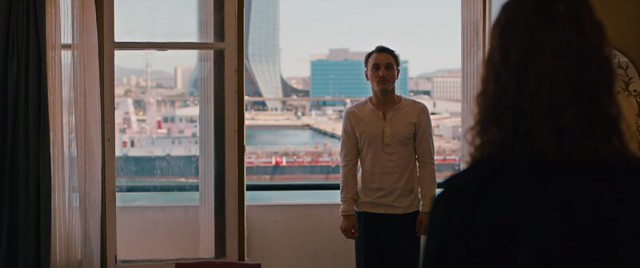
Transit is another tightly scripted high melodrama by Christian Petzold. Based on a 1942 novel by Anna Seghers based on her experience in France under Nazi Occupation, Petzold transposes its premise to modern day Maseilles, again under the Fascist Germans. With the rise of authoritarian right wing regimes and their nationalist rhetoric and anti-immigrant sentiments here and everywhere, it is frightening to think that this film is not a too far fetched scenario. It's one of the many reasons why the film is brilliant.

Georg (Franz Rogowski) is asked to deliver two letters to Weidel, a writer of some importance in Paris. It's a dangerous mission- there are police raids daily and it's harder to get around on the street without constantly being asked for proper papers. Everyone knows the major shit's gonna go down soon: there are people being dragged away in the streets by the heavily armed authorities- 'the purge' is at hand. But with some money promised, Georg is up to the challenge. But once he gets to Paris, he finds that the writer has committed suicide, leaving his documents and the latest manuscript behind. With others urging to take a sick man to Marseilles and notify the Mexican consulate of the death of Weidel, Georg hops on the train to the port city. The letters reveal that Weidel has a safe passage with his wife Marie (Paula Beer of Franz) to go to Mexico and that she will be waiting for him in Marseilles.

Once he arrives at Marseilles, he reluctantly assumes the identity of Weidel, make friends with an Arab immigrant boy whose dad (the sick man) died on the way. He also sees Marie everywhere, scouring the city for Weidel, her husband, day in and day out. She is involved with Richard (Godehard Giese), a doctor who has put his departure on hold because he doesn't want to leave her behind. No one wants to be the one who leaves. These characters are stuck in there, going around in circles, trapped by love, by sense of loyalty or simply by human decency.

Transit's got a lot to do with guilty conscience: Guilt of leaving someone behind. Guilt of forgetting. Guilt of being indifferent. With this, Transit is a great companion piece to Phoenix, the director's last film, taking place in post-WWII setting. It also is in line with Petzold's usual themes - people in transit, state of uncertainty caused by outside force, by something bigger than an individual, while not losing sight of its characters' humanity. Also because of this setting and themes, even though contemporary, it reminds me strongly of Nouveau Roman writers' works.