Showing posts with label Christian Petzold. Show all posts

Saturday, October 4, 2025

Raft

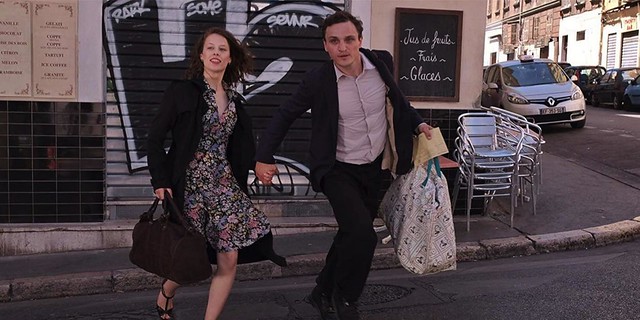
Miroirs No. 3 (2025) - Petzold miroirs-no-3 Christian Petzold, after many recent films with diverse themes and genres, goes back to the theme of his earlier films (The State I am In, Ghosts and Barbara) - the concept of family with Miroirs No. 3. When I talked with him after his film Barbara (2015) came out, this is what he told me about the theme of his films back then:

"Say, there is a shipwreck, and people are scrounging up to build a raft out of what's left over. Since 2000, all my movies are about this structural collapse (both economic and familial) and people trying to build a lifeboat to survive. So what's happening on the raft.... All these films, they are trying to rebuild something you can live with, out of the ruins.... We have to find little survival structures and I think that's what my movies are about."

With the world that seems more chaotic than ever - genocide in Gaza and Sudan, prolonged war in Ukraine, periodic school shootings and political violence and intensifying commercial colonialsm, I believe Petzold is looking inwards, and finding that the concept of family more important as ever.

Petzold is a master storyteller and it's not uncommon that everything he does has elaborate back stories. He chose Miroirs No. 3 as a title of his new film from Composer Maurice Ravel's 5 piece piano suite Miroirs. No.3 being titled Une barque sur l’océan/A Boat on the Ocean. Hence, the film about a makeshift family, completely makes sense.

The film concerns a music student Laura (Petzold's frequent collaborator, Paula Beer). She is seen a little disoriented in her surroundings, lost in her thoughts near the water's edge. When she gets to her apartment, her boyfriend, Jacob, and other couple friends are waiting for her. They are supposed to go away to the countryside. While being driven in the car, she notices an older woman Betty (Barbara Auer, also a Petzold alum) on the side of the road. As if she had a premonition, at a gas stop, Laura tells Jacob that she wants to go back home. Disappointed Jacob relents to her demands. He will drive her to the nearby train station to go back home.

On the way to the station, Laura notices Betty again and the car crashes. Jacob's dead but Laura is unscathed. Betty runs to the crash site and Laura, for some reason, wants to stay with Betty in her empty house indefinitely. It turns out Betty lost her daughter to suicide and her family broke apart. She was in a mental hospital and her mechanic husband Richard (another Petzold regular, Mathias Brandt) and their son Max (Enno Trebs), moved out. She was painting picket fences of her house while witnessing Laura's car crash. Not knowing Betty's family history, Laura and Betty carry on their living arrangement.

With Laura staying in Betty's untouched dead daughter's room, the two women fall into daily routine - gardening and cooking, while some neighbors gossip outside their house. Laura insists on cooking for Betty's family and they invite Richard and Max, who reluctantly come. "Betty's off her medication," Richard and Max say in their worried voices and sideway glances. Then they meet Laura and get warmed up in her presence and they also carry on their daily routine. Laura visits them in their garage, riding their dead daughter's bike, fixing meals. As long as Betty's happy, they would carry on their make-believe family.

At various points, the family members attempt to tell Laura the truth. And when the truth comes out, it freaks out Laura. It's too creepy for her and her real father from Berlin picks her up. They would never see her again.

Music plays a pivotal role in Miroirs No. 3. It connects characters, not in a superficial, tugging at your heart strings way, but more of a shared experience, that unspoken acknowledgement and understanding among people. Petzold, in his usual economical ways, presents smaller, tighter films with only a few main actors and locations. In terms of scale, The film has the look and feel of his last film, Afire, taking place in a rural setting.

The melodic piano composition of Miroirs No. 3 reflects the sound of the gentle waves. Whatever the circumstances of the people who are lost at sea in that scenario, the music is soothing and calm, reflecting on the comfort of a family. The white picket fence that Betty is painting also reflects the yearning for ideal family life. As the title suggests, everything is a reflection of what should have been. It's the idea of a perfect family that haunts Petzold's characters, even though they never had it in the first place. And it is this tragedy in the modern world that Petzold keeps stressing with his films: yearning for the ideal world that never has materialized under the capitalist system.

Paula Beer is, as always, magnificent as a troubled young woman who is missing something in her life. So is Petzold regular Barbara Auer and Mathias Brandt in their roles as deeply scarred parents over the death of their child.

As usual, Petzold's Miroirs No. 3 is a compact, masterful filmmaking with affecting performances. One of the year's best.

Monday, June 12, 2023

Look Around, The World is Burning!

Afire (2023) - Petzold Afire As the Canadian wildfire rages on and its smoke, carried on by the wind, covers the entire US Eastern coastline in thick orange hazardous air last week, Christian Petzold's new film, Afire, playing in this year's Tribeca Film Fest and coming out in US theaters in July, is such a prescient film about the world we live in now. You think Petzold shifts gears and concocts a seemingly a lighthearted summer fling story during covid? No. Quite the contrary. His previous films, Phoenix, Transit and Undine are laced with potent German history and reflecting on 21 century living. But at a glance, Afire doesn't seem too concerned about the German history, but it's still very much steeped in Petzold's usual themes: guilt, shame, forgetfulness and loneliness. And the Baltic sea set Afire is very much about the present- the world on the brink of ecological catastrophy. Afire is distinctly a Petzold's version of a 'summer movie'.

We are introduced to Leon (Thomas Schubert) and Felix (Langston Uibel), unlikely friends going to the Baltic seaside where Felix's mom has a summer house. The car breaks down and they have to walk the rest of the way. It is apparent that Leon is the designated pessimist of the two; too serious for his own good kind of a guy. Once they get to the house, they find that it is already occupied by Nadja (Paula Beer). They learn that Nadja is a family friend and now they will need to share the house during their stay. Leon is doubly disgruntled because he needs peace and quiet to finish his second novel, incongruously titled, Club Sandwich, but Nadja's nightly activity with a local lifeguard Devid (Enno Trebs) is just too loud.

After meeting the other occupants a couple of days later, Leon keeps being a major A-hole and a party pooper every chance he gets; whenever asked to come to swim and join them, he coldly tells Nadja, "Work doesn't allow it." a phrase that he instantly regrets saying right after, which fills him with much self-loathing. He just can't help it. His arrogance and superiority complex always get the better of himself, while struggling with writing his 'masterpiece'. But, when alone, he bounces the rubber ball off the house wall and falls asleep on the patio in front of the house that he claimed as his workspace.

To Leon's surprise, there's a budding romance between Felix and Devid. It's more like Leon is too obsessed with his own little world, he hardly notices anything else around him. It's like a forest fire that is raging in the distant which lights up the part of the sky red every night. It won't reach us, they tell themselves.

Nadja gives Leon every chance to open up, but his stupid pride keeps walling off her friendly gestures. At one of those of her attempts, he reluctantly agrees for her to read his manuscript. She reads it in one sitting one afternoon, as he nervously walks back and forth from distance. She returns it to him, "It's bad and you know it too." What does she know? She is just a seasonal ice-cream seller at a nearby town. He bitterly tells himself.

When Leon's agent, Helmut (Matthias Brant) comes into town to go over his manuscript and decides to stay for dinner which Nadja provides, it is revealed that Nadja is a literary scholar doing her Ph.D. She recites Heinrich Heine's poem Asra, about an Arab tribe, who perish when they love. Felix, who's in love with Devid now, so moved by the poem, asks her to recite it again. Foreshadowing what's to come.

There's a striking scene, where the ashes of the nearby forest fire descending upon the group. It's a surreal moment - mixture of beauty and imminent danger. It's one of the showstopper in Petzold's cinematic world. Helmut collapses at the same moment and must be taken to the hospital. Fire is fast approaching, and Leon witness firsthand the destructive power of all consuming fire.

Afire is very much a Petzold's version of a summer film like that of Eric Rohmer's (which he says he watched a lot before conceiving Afire, during the covid lockdown) and other French summer fling films but with stinging message. Instead of summer love, we get Leon, our anti-hero completely blindsided by his self-centered world view and misses out on life. And even ecological disasters at his doorstep can't make him see what's in front of him.

The film tells a lot about the self-absorbed world in the face of climate change and global catastrophe unfolding. You might ask, 'Leon can't be that thick headed. How is he a friend with good natured, younger, optimistic Felix?' 'There's no chemistry between Leon and Nadja, how can he declare his love for her?' and so on. Afire is also about creative process and self-reflection. And it's beautifully, deliciously constructed by the master storyteller. It's as if Petzold saying get out of your head once in a while and look around you because if you don't, it might be already too late.

Tuesday, June 1, 2021

Interview: Form Follows Function: Christian Petzold on Undine

Christian Petzold

It is always a delight to listen to Christian Petzold, German director of such films as Barbara, Phoenix and Transit, because he is a master storyteller. I could listen to him for hours on end as he enthusiastically talks about his filmmaking process.

His new film Undine is his take on the fantasy genre - about a water creature which takes a human form and takes revenge on humans when her love is not reciprocated. Melding this fantasy with the tumultuous history of the city of Berlin, Petzold concocts another beautifully written and gorgeously realized film that is at once seductive and thought provoking.

Even though we were conducting our interview over a Zoom session due to Covid, his enthusiasm and exquisite storytelling abilities were not diminished in any way. Below is the result of our conversation that took place in May.

Undine hits theaters and VOD platforms via IFC Films on 6/4.


Where are you now at the moment?

I am in Brooklyn. Are you in Berlin?

Yes. Berlin in the chilly spring afternoon. Waiting for the summer, waiting for the end of the pandemic.


Yeah, I was wondering. I heard that it's still pretty bad in Berlin and in Germany in general.


No, I think the peek is behind us. I hope that the cinemas will open in coming weeks. I can't stand looking at my TV set anymore. I miss going to movie theaters and the loneliness of being in the big crowd.


hear you. Everything's okay with you and your family?


Yes, thank you. You know, I had Covid one year ago around this time.

Oh no!

It was not too serious, but for a full week, I had to stay in bed. I changed my whole plans for the future and put my dystopia script away. It was based on this book that I have bought the rights to, but I'm not interested in dystopia anymore. I don't want to see walking dead in a desert world. I really can’t say I want to do that anymore.

During my time in bed, I read many books including many novellas of Chekov and saw many films. My distributor in France sent me the Eric Rohmer box set as a gift. I said, my god, I haven’t seen Rohmer since back in the school days! What is it called, La Collectioneuse! I was impressed how well it holds up. It’s been such a long time. We had a teacher at the film academy who told us that we have to make movies, so 20, 30 years from now people will know how we had kissed, how we had touched, how we had walked through the streets and how our social life was. I was so impressed by Rohmer’s films so I started writing a new story and I am now finished with the script. It's about a group of young people, in the summer at the Baltic sea, surrounded by forests and the forest are burning and their desire and their hearts are also burning, and the fire in the end is out of control. So this is what I wrote during Covid and I’d love to make it. Paula Beer will play the main female role. But I have to wait for the next summer because it's a summer story and I need the sun. I need a world where we can touch each other without being tested!


Christian, I love to see your summer movie. That sounds amazing! I watched Undine last year at the New York film festival. It's such a beautiful film and it's visually really stunning. I really, really enjoyed it. And I'm glad it's coming out in theaters. 

You always dealt with genre cinema to tell your stories - you’ve done noir, horror, pollcier, sci-fi even, with your last film Transit. Now you are taking on the fantasy genre. It’s really interesting to see you melding it with the history of Berlin. And I'm just wondering how that came about, in terms of the story.


Yeah. You know, I grew up in, near the river Rhine in west Germany and this part of Germany it's filled with myths and songs and old tales. And when I was 20, I leave for Berlin for school. West Berlin was a big laboratory of politics, acting, theater and all that. But you know, this is a very modern city without tales, without myths, without songs, it doesn't have anything. The only myth we have is Adolf Hitler. Maybe it’s an oversimplification but the point is it's a very modern city. And the people in Berlin, they know so much about tales and myths because they are people like me, coming from other parts of the world, because it's a city where people are connected with their stories and with their backgrounds and so on.

The place I was born (West German city of Haan) was between two rivers and also Berlin is a city of the two rivers, Havel and Spree. Yeah. But these rivers are very boring: they are small and very narrow. Nobody's really interested in these and there are no songs. I grew up in this part of Germany between, the river Rhine and the Wupper. The Rhine is a very, very big river. And it's filled with songs about myths and sirens. And also it's that river where you, as a child, would be standing in front of, and you are thinking about going away- to take a boat and go to the sea and perhaps go to America, for instance. We have that sentimental-journey feeling associated with the river Rhine. The Wupper, there are no boats on the water because it's a wild river. And there's a saying in German, “geh über die Wupper”/to go over the Wupper means you know, this is the river Styx, the river of death. Someone's going over the Wupper means he's going into the land of the dead.


So we have the Rhine, which means you are going far away and the Wupper you're going into the end of your life. I'm thinking that living between those two rivers also had something to do with cinema. There's a cinema, which says to you it’s a road movie. And there's also a breaking through a wall, to go over border, to go into another life or could be the death, could be a bank robbery, with a head shot at the end. And so, I thought about my rivers from my youth and my work on Undine started.


That’s amazing! Also, there are a lot of talks about architecture in the movie and how Berlin was built in such a way. And there is obviously a division of the east and west. Paula Beer’s lecture monologue was very interesting. What struck me was when she says, “form follows function.” Can you tell me about that?


That's a very good question, because Paula loved the sentence. I think she loved the sentence more than when she says, “If you leave me, I will have to kill you.” I think of Berlin as a raped city architecturally. Every 3 years someone is coming with new architecture plans. The concept is making money with very cheap buildings with retro style buildings and no form follows function. The idea is totally out. They just want to make money.  

Right.

Before you have a fascist architecture. That was a form following function. Now it’s for tourism. Nothing can grow here. There's no organic life here. But Berlin has always tried to defend itself. So we have these idealist and we have the defenders. I'm so disappointed because in 1989, Berlin had the chance: we had a whole city being united, which was now in the hands of the government, it was not a private property. It was our property. We could’ve made something beautiful. In five, six years, they sold it to people who are only interested in making money. And so Berlin is now raped by money, by the banks in the US. I must say that. 

And so this, someone like Undine who's been living here for centuries, with all these changes, she is like a sad witness of our changing times. So this was our idea.

I remember when we were shooting the (guide tour) scenes and Paula was very very anxious, I must say. It was a bit of a stage fright she had, because it was 18 pages of monologue in the script. I told her that all the extras in that architectural model room were intellectuals: I don't hire dumb extras for an hour. They were university students and professors. So she had to give a very convincing presentation and I liked this as a director, capturing her nervousness. 

The situation in that scene is that the city we are living in, we don't even know so much about it. But now at that moment, we understand what’s happening: it’s the Humbolt Forum. It's a museum in the form of a castle. And Paula is in there surrounded by intellectuals stating that form follows function. I am also commenting on the state of cinema: we haven't got this form follows function anymore. It’s a little disappointing.

Interesting. 

I have to say that the Paula and Franz (Rogowski) have amazing chemistry together. I enjoyed them immensely in Transit before, but there is really something to them in Undine. I’d like to know how it was working with them.

Yeah. I had the idea for Undine during filming Transit because of these two actors. I've never seen a couple like this before. Neither have the German stage theater education. They never worked for the stage as an actor in their careers. They are quite different in their movement and speech, there is certain innocence about them in that way that I like. Interesting thing is they both are dancers. Franz is a professional dancer. He is from a dance background. 

My experience in Transit, when we did rehearsals in the morning, the first two or three hours, they didn’t talk about their lines or talked with me about the script or psychology of the characters. For example when they enter the hotel room, they walk around and touch things - windows, bed and they danced around. It was more like Pina Bausch: their concerns were more like, what is the distance and when can we touch each other? For me it was a fantastic experience working with these two very physical actors. It was more like two young actors dancing their lines.

So when I was thinking about making Undine, I couldn’t think of anyone else but those two for the part. So when three of us were doing rehearsals, especially in the apartment scene, it was like the same rehearsals in Transit: Who is in the terrace? Who is going out of the terrace? Who is going to the window? It was more like they were swing dancing!

So the first six or seven days of shooting, we filmed scenes without any dialogue. This is in their bodies. It’s the movement of their bodies that tells the story - how she puts her head on his shoulder. I always had a feeling that their movements were as if they were filmed underwater.

Forgive me saying this: not that your previous films are not visually beautiful, but I find Undine absolutely gorgeous. Especially underwater sequences with the Big Günter, the catfish and everything. Did you have those scenes in mind when you were writing the script?

I have never done storyboards before. I do rehearsals and make the storyboard afterward. But for those underwater scenes, I needed to do storyboards. It was like doing a graphic novel. All the things I drew for the movie, they were from other films: The catfish comes in like the scene from Jaws where they go under water to investigate the broken ship and find the decapitated head coming out of the hole. I wanted to have the catfish appear like that. Or the scene from 20,000 Miles Under the Sea and Creature from Black Lagoon by Jack Arnold, where the creature almost touches the legs of the girl…. Underwater scenes in cinema are like a liquid memory room. You don’t invent new things but the images are lodged in your subconsciousness. That’s why I like them so much.

It’s really beautifully done.

I think my time is up but I wanted to tell you that the ‘Staying Alive’ scene was hilarious as well as very romantic.

They really use it in Germany. It is in the lessons for the lifeguards. My producers were begging me not to use it because it’s Bee Gees and it was in another movie, the rights to it cost 17,000 dollars. But I had to have it in the film. It was just too good!

Sunday, December 20, 2020

Time is a Flat Circle: Temporal Dissonance and Trauma in Christian Petzold’s Transit

Time is a Flat Circle: Temporal Dissonance and Trauma in Christian Petzold’s Dystopian Tale: Transit

Time is a Flat Circle         I’m thinking about Nietzsche’s concept of eternal return when I think about Christian Petzold’s film Transit. Eternal return/eternal recurrence is a concept that the universe and all existence and energy have been recurring and will continue to recur, in a self-similar form an infinite number of times across infinite time and space. “Time is a flat circle,” is a phrase uttered by Rust Cohle, a character who has a very pessimistic view on human existence in an HBO show True Detective, when he is reminiscing about an old, unsolved case, “Someone once told me time is a flat circle. Everything we’ve ever done, or will do, we are gonna do all over again.” He is suggesting that we are destined to relive the same experience over and over, past and present melding into one another. And this is the case with Transit which takes place in a hypothetical world where fascist Germany is occupying France once again and its characters, traumatized by the unfolding events, enter into a sort of fugue state where there is no escape.

        All characters in Petzold’s films are in a state of uncertainty: they are forced to embark on a journey by the outside forces, rather than by their own volition like in Wim Wenders films or the works of Novalis or Hölderin of German Romanticism. In effect, the title Transit, can be used in all his films, interchangeably, making it a perfect title that emblemizes his work. With Transit, I’d like to examine how temporal, spatial dissonance causes the lasting trauma in people’s psyche and how Petzold and the Berlin School filmmakers use genre conventions to reflect on the post-wall neoliberal Germany as well as its nazi past.

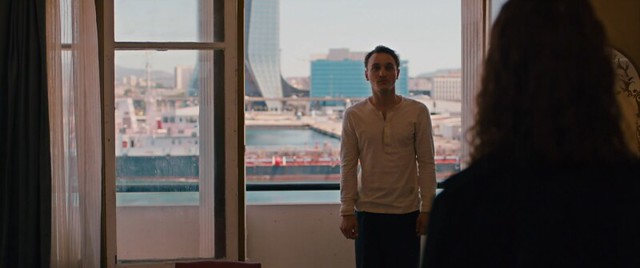
Transit         Transit is a novel written by Anna Seghers based on her own experience in France under the nazi occupation in 1942. Petzold transposes its setting to contemporary Europe; a modern day Marseille. The film’s setting can be interpreted as either an alternate reality or a very near future where Germany has become a fascist state yet again. But Petzold goes about presenting this slyly, often blurring the boundaries between past and present - there are no discernable historical/cultural markers in the film- no swastikas, propaganda posters or incendiary slogans on banners in public squares. But the motor-vehicles and police in riot gear suggest that the film takes place in the present day. Pinpointing the film’s timeframe is a tricky business. Judging by the conversation held by characters about a movie about zombies- that even the dead not having much imagination by going to a shopping mall, it alludes to taking place post-1978 or even 2004 (the release year of George Romero’s classic Dawn of the Dead and Zach Snyder’s remake respectively). Curiously, there is no sighting of mobile phones anywhere, adding more confusion to the film’s timeline. There are also no lamentations by any of the characters on how history repeats itself. It’s as if Germany’s dark war past has been deliberately erased from history or invoking its history is a taboo subject. Yet for us audiences, hearing the sound of jackboots marching, a talk of ‘cleansing of the Jews’ and seeing police rounding up people in the streets are familiar sight and sound from countless World War II films set in the cities under nazi Germany. Seeing and hearing this in the present setting is jarring and disorienting. There is a definite temporal dissonance. It’s an interesting choice for Petzold to directly invoke Germany’s nazi past to reflect on the current state of Germany and Europe.

        Transit was released in 2018 under the shadow of the foiled assassination plot on the German Chancellor Angela Merkel in 2016 and after the extreme right-wing nationalist party AfD (Alternative für Deutschland) gained 12.6 percent of the seats in the German Parliament in 2017 (later it became the largest opposition party). Germany’s white nationalist movement has seen a steady growth since the fall of the Berlin Wall in 1989. With the influx of over 1.2 million immigrants (not counting 3 million Turkish descent German citizens who have been living there since the 60s), the racial violence against ‘outsiders’- meaning, against people of the Middle-Eastern and African origin as well as German Jews, has been increasing over the recent years. According to the Interior Ministry data, xenophobic acts of violence saw 19.7 percent jump in 2017 from the previous year.

        Christian Petzold, as a leading figure in the Berlin School which is Germany’s most significant film movement since the New German cinema of the 60s and 70s and a prominent voice in a recent surge of German cinema in the global stage, has been making films that reflect the cultural & political landscape and collective German psyche in the post-wall, neo-liberal era Germany. The Berlin School is a term given to a group of loosely connected filmmakers who attended German Film and Television Academy (DFFB) in the late 80s and early 90s, namely Thomas Arslan, Christian Petzold and Angela Schanelec - known as ‘The First Wave’. Ulrich Köhler, Valeska Grisebach, Christoph Hochhäusler, Maren Ade and many more were considered and later added to the growing list of like-minded filmmakers. The main themes these filmmakers share in their work are: loss of identity, guilt, aimlessness and dislocation under neo-liberal Germany. One of the main themes they often deal with is, as Marco Abel puts it, ‘sehnsucht’ (longing): a longing for Germany that has never materialized under neoliberal capitalism. The Berlin School, in effect, is about ‘reseeing’ Germany.

        Utilizing genre conventions and twisting them to reflect on the current state of the post-wall Germany is a tendency of many filmmakers of the Berlin School: Heist films/thrillers/noir are bread and butter for many - The City Below, The Lies of the Victors (Christoph Hochhäusler), In the Shadows (Thomas Arslan), The Robber (Benjamin Heisenberg), The Dreileben Trilogy (Höchhausler, Dominic Graf and Petzold). They also dabbled in Western - Gold (Arslan), horror - Yella (Petzold), Sci-fi - In My Room (Ulrich Köhler) and fantasy - Undine (Petzold), just to name a few. Although many critics emphasized the Berlin School’s presentist and realist approach – the contemporary world observed in almost obsessive detail, Petzold has been deeply concerned with history in various ways throughout his filmography. Especially with his last four output - Barbara (2012) a period film that takes place in East Germany in the 80s, Phoenix (2014), set in the aftermath of WWII, Transit (2018), set in the near future/alternate present where Europe is in the grips of Fascist German regime once again and Undine (2020), his take on folklore/fantasy genre, investigating Berlin’s tumultuous past just underneath the surface of fast changing city, Petzold, unlike most of his compatriots of the Berlin School, does not shy away from Germany’s ugly war past and have found innovative approaches to address the same inquiry through genre conventions the unfulfilled desire of finding a collective utopia that is ‘Deutschland’.

        Gilles Deleuze talks about ‘time out of joint’ in Cinema 2: The Time-Image. It was the Second World War that changed cinema from movement-image to time-image based medium. It signifies that time is no longer subordinated to movement, but rather movement to time. This break happened because of the devastation the war brought: atrocities in situations we no longer knew how to react to, rubbles in spaces we no longer knew how to describe. In these leveled cityscapes, a new race of characters was born: they saw rather than acted- they were seers. Transit starts with Georg (Franz Rogowski) being asked to deliver two letters to Weidel, a writer of some importance in Paris by an acquaintance at the bar. It's a dangerous mission- there are police raids daily and it's harder to get around on the street without constantly being asked for proper papers. Everyone knows a major crackdown is about to happen: already there are people being dragged away in the streets by the heavily armed authorities- 'the purge/cleansing' is just around the corner. But with some money promised, Georg is game. Georg is a typical (anti)hero of the Berlin School films - unmotivated, lost, just going through the motions, like a ghost among his fellow citizens. He is an observer, not a participant. He scoffs at the notion of “danger visa,” when the acquaintance tells him why he can’t make the delivery himself since he is deemed ‘dangerous’. Georg is nobody special. Just a face in the crowd. Petzold makes sure that he is not the narrator of his own story by inserting a voice over of a man, completely unrelated to the main characters, who turns out to be a bartender in Marseille later on. Once Georg gets to Paris, he finds out that the writer has committed suicide, leaving his documents and the latest manuscript behind. With some more money promised, he reluctantly takes a sick man wanted by authority along with him on a train (as stowaways) to Marseilles. Once he gets there, he is to notify the Mexican consulate about the death of the writer. Weidel’s documents reveal that he had a safe passage arranged for him and his wife Marie (Paula Beer) to go to Mexico. The letter Georg was supposed to deliver to Weidel is from Marie, declaring that she is leaving him.

        Once he arrives in Marseilles, Georg assumes the identity of Weidel as he is mistaken for the dead writer at the Mexican Consulate. He makes friends with an Arab immigrant boy whose dad (the sick man) died on the way. He also sees Marie everywhere, scouring the city for Weidel, her husband, day in and day out. Her search is intensified since Georg assumed her dead husband’s identity. So she thinks he is still alive, but avoiding her. This is where Transit embraces a full noir/thriller genre. Petzold’s penchant for genre cinema is pretty well known, as his films often borrow major aspects of their plots from the “cemetery of genre cinema, from the remainders that are still there for the taking.” For example, Jerichow is his adaptation of Jame M. Cain’s pulp noir Postman Always Rings Twice, with the victim switched to a successful small-time Turkish businessman. With Yella, the director takes direct cues from an American b-horror movie Carnival of Souls. In Something to Remind Me and Phoenix, the plots play out like an inverted Vertigo with the loss of identity/false identity playing a big role (also in Transit). His love for the noir/thriller genre is well known; his recent praise of generic American heist thrillers such as Den of Thieves confirms this fact. They are also present in his TV work (Polizeiruf 110), as well as most of his films.

CE_Transit2         Transit’s alternate reality fits the description of Deleuze’s modern cinema very well. “As for the distinction between subjective and objective, it also tends to lose its importance, to the extent that the optical situation or visual description replaces the motor action. We run in fact into a principle of indeterminability, of indiscernibility: we no longer know what is imaginary or real, physical or mental, in the situation, not because they are confused, but because we do not have to know and there is no longer even a place from which to ask. It is as if the real and the imaginary were running after each other, as if each was being reflected in the other, around a point of indiscernibility.” Marseille is ‘any-space-whatever’ Deleuze talks about in Cinema II as well. In Transit Marseille is not quite the rubble or empty factories that lay waste in the aftermath of WWII. But it’s not the bustling second largest French city with shops and beaches either. In the film, it is a sparsely populated, lifeless place where lost people in transit converge, waiting to set sail for their new destinies. It is a mere place to pass through. Waiting however, is exactly what these people do which seems eternal. Marie is involved with Richard (Godehard Giese), a doctor who has put his departure on hold because he doesn't want to leave her behind. No one wants to be the one who leaves. These characters are stuck in there, trapped by love, by the sense of loyalty, by guilt. Transit's got a lot to do with guilty conscience: guilt of leaving someone behind. Guilt of forgetting. Guilt of being indifferent. Time seems to stand still in Marseille, as characters run around in circles, day after day, waiting for what they desire that will never materialize, while the ‘cleansing’ is inching closer to them (the rumour has it, the cleansing is happening in nearby Avignon).
         

        ‘Wartender/Waiting’ happens to be the title of Weidel’s last manuscript that Georg carried from Paris to Marseille. It turns out to be a good reflection of what Georg and Marie are experiencing. Out of boredom in transit to Marseille, Georg reads the manuscript and has an opportunity to tell its story to an arrogant consul at the American embassy when asked about his/Weidel’s new book. In this ‘story within a story’, the main character is dead and waiting to register in hell at the gate. The waiting turns from hours to days to weeks to months to years. After many years have passed, the character asks the gatekeeper just when he will be admitted to hell. The gatekeeper tells him, “Why man, this IS hell!” 

71-la-douleur-duras

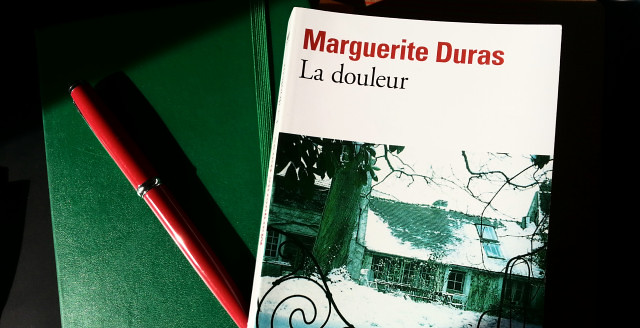
        Experiencing any war is painful. Its effect lingers for a long time - maybe for decades, over generations. The American Psychological Association defines trauma as the lingering psychological and emotional response to a singular traumatic event that threatens injury, death, or the physical integrity of self or others and also causes horror, terror, or helplessness at the time it occurs. The French literary giant Marguerite Duras, in an introduction to her memoir with a very literal title- La Douleur/The Pain, culled from her essays and diaries in the occupied France during WWII, as she was involved in the resistance movement and waiting for her husband’s return from a concentration camp, she claims that she doesn’t remember writing those words, "When would I have done so, in what year, at what times of day, in what house? I can't remember." The emptiness left by the absence of her loved one is so great, she would lose herself.

        If there were another title that can encapsulate the theme of all of Petzold’s films other than Transit, it would be ‘ghost’. Some critics grouped three of his earlier films ‘The Ghost Trilogy - The State I am In (2000), Ghosts (2005) and Yella (2007) for portraying characters who have to contend, one way or another, with the economic hardships and invisibility in post-wall neoliberal Germany. But his subsequent works, along with the theme of transient lives, Petzold’s protagonists suffer from loss of identity and invisibility also. Burdened with terrible secrets they can’t reveal, they tread their paths as if on eggshells - like the East German doctor who hides her intentions to defect to the West in Barbara, a disfigured concentration camp survivor who has to go along with her new identity in Phoenix, Georg who assumes the dead man’s identity but can’t reveal his secret in Transit. It might be a different pain: one caused by economic hardship in highly capitalistic society, the other caused by violence of war. But they both make ghosts out of people who experience them. The economic disparities and characters with lost identities in Petzold’s earlier films and many other works by the Berlin School filmmakers can be attributed all the way back to atrocities of the nazi Germany in WWII. Losing oneself, losing one’s identity is deeply entwined with the survivors’ guilt, the guilt of leaving others behind/betraying others. That guilt for those who remember the past, never really went away. They have been the theme of Duras and many of the Nouveau Roman writers as well as all Petzold’s films and many of other directors in the Berlin School.

Syrian refugees         Let’s put the film in context of the world events in 2017-18; the Syrian civil war was still raging and the refugee crisis was deepening, Trump enacted the Muslim Ban restricting visas from 7 predominently muslim countries, started to build the wall in the southern border with Mexico, the Israel-Palestine conflict intensified, just to name a few. It is not difficult to see what is reflected in Transit is not far from what’s been happening on the news on TV every night. The future is already here: the film’s premise, the ugly past repeating itself and its temporal dissonance says a lot about the highly advanced capitalist, neoliberal society. The world is moving too fast, while humanity has a little time to reflect on the past. I see Transit as an allegory of Germany’s war past and its citizen’s collective, willful amnesia, caused by the war itself. Hence, the merry-go-round of war - trauma - collective amnesia - war - trauma - collective amnesia being repeated. Suffering from an identity crisis, Georg desperately tries to save Marie while concealing the bitter truth that Weidel is dead and gone all in the midst of fascist takeover: Georg is a stand-in for Germany, Weidel for the utopia that never materialised and Marie for the country’s future/younger generation. Going back to Sehnsucht/longing for the utopian Germany that never was, and regarding Germany’s dark history repeating in Transit, I believe Petzold is telling us that however painful it is, we will have to face the past in order to understand trauma so we don’t repeat it.

Sources Consulted 


1. Abel, Marco. ​The Counter-Cinema of the Berlin School​. Boydell and Brewer, 2013: 1-28, 69-110

2. Chang, Dustin. “I Envision All These Great Small Movies in the Ruins of Hollywood: Chrsitan Petzold Interview, Screen Anarchy, December 12, 2012

https://screenanarchy.com/2012/12/i-envision-all-these-great-small-movies-in-the-ruins-o f-hollywood-christian-petzold-interview.html

3. Deleuze, Gilles. Cinema 2: The Time-Image, University of Minnesota Press, 1989: xi, 1-67

4. Hamann, Hilary Thayer. “A Harsh Tale of War, But Unforgettable Read,” NPR, February 16, 2011

https://www.npr.org/2011/06/29/133811002/a-harsh-tale-of-war-but-an-unforgettable-read

5. Mirthy, Vikram. “Christian Petzold on Transit, Kafka, His Love for Den of Thieves and More,” RogerEbert.com, February 24, 2019

https://www.rogerebert.com/interviews/christian-petzold-on-transit-kafka-his-love-for-den-of-thieves-and-more

6. Mudd, Cass. “What the stunning success of AfD means for Germany and Europe,” The Guardian, September 27. 2017

https://www.theguardian.com/commentisfree/2017/sep/24/germany-elections-afd-europe-immigration-merkel-radical-right

7. Staff. “Germany sees extremely alarming rise in racist and anti-semitic hate crime,” The Local, May 14, 2019

https://www.thelocal.de/20190514/germany-sees-extremely-alarming-rise-in-racist-and-anti-semitic-hate-crime

Monday, October 12, 2020

Like Berlin, Old Folklore Gets a Makeover in Christian Petzold's Beguiling Undine

Undine (2020) - Petzold Undine Undine is a water nymph or spirit that appears in many folk tales and literature in Europe. One of its various versions is Little Mermaid, widely popularized by Hans Christian Anderson. It is said that she takes a human form only if she falls in love with a human. But when that human is unfaithful, he is fated to die. 
 
Christian Petzold, not a stranger to making films with strong female characters and using genre conventions to reflect the contemporary German issues, takes a stab at a fairytale romance involving the history of the city of Berlin in Undine. It starts with a breakup scene of a couple in progress at the terrace of a cafe. Undine (Paula Beer, seen in Frantz and Petzold's Transit), a historian at the city museum, is understandably upset when her smug boyfriend Johannes (Jacob Matschenz) announces that he is seeing someone else. She is on a break from her job across the street and she warns him that she will kill him if he doesn't say he loves her when she gets back. The threat is overly dramatic. She gives a talk to the museum visitors about the transformation of the city of Berlin over the years - West and East, what was lost and what was promised, laying out the theme of constantly changing and renewing state of affairs. When she gets back to the cafe, Johannes is gone. By chance, smitten Christoph (Franz Rogowski, who played opposite Beer in Transit) who was present at the museum tour, is there to ask her out for a coffee at that moment. All of sudden, the fish tank shatters, knocking them both off of their feet. Their rather wet first encounter rapidly develops into a sweeping romance where the two become inseparable. 

Water is the constant motif here that stands for change. Christoph happens to be an industrial diver and spends much of his time under murky water of the river Spree. His job is taking care of the leaky turbine and other maintenance issues under water. Once he encounters a big catfish, nicknamed Gunther by his colleagues in one of his dives. Is Gunther a fish or some sort of water spirit? 

Gunther the catfish makes another appearance when Christoph takes Undine diving on a date. He was there to show her a remnants of an old bridge under water that bears her name. In an unusually beautiful scene for Petzold’s standard, since he is not known for his visual excess- we see Undine without her scuba gear, swimming with Gunther, slowly passing over Christoph. On land, Christoph tries to revive unconscious Undine, singing "Staying Alive" by BeeGees under his breath. Later he explains to her, it's the rhythm of that song that is perfect for CPR. Their love affair is sweet and intimate. Undine plays out like a whimsical romantic comedy at this point. And chemistry between Beer and Rogowski is quite remarkable. They both are unbelievably good in their roles as ill-fated couple. 

There is another history lesson as Undine practices her presentation on Humboldt Forum, a museum that is a replica of Stadtschloss (Berlin Palace), at her small but practical apartment overlooking the said building. If you've been to Berlin, you had noticed that everything is rebuilt after WW2. Stadtschloss was rebuilt in the 21st century. Undine's presentation tells that modern architecture teaches that form follows function. But it's not the case with the museum in the form of the eighteen-century ruler's palace. That Germany's pragmatism doesn't quite coincide with people's wishes concerning reviving the soul of the city. 

The Story of Undine gets a 21st century makeover too. She was upset when she was betrayed, but she gets a second chance at happiness being truly loved. Petzold, a master storyteller, reinvents the mythical water creature story paralleling the history of the city of Berlin while acknowledging the past just underneath the surface. 

Its whimsy and romance works thanks largely to Beer and Rogowski's excellent performances. It's so good!

Friday, January 24, 2020

Post-Wall Cinema of Christian Petzold: The Berlin School and Beyond

Post-Wall Cinema of Christian Petzold: The Berlin School and Beyond - Mapping Germany’s Past, Present and Future

Screen Shot 2020-01-24 at 3.45.39 PM
Gespenster/Ghosts (2004) is a great introduction for getting into the world of German director Christian Petzold. The film’s cold and unforgiving atmosphere, daring split narrative structure, economy of its camera movements and edits, the acute representation of its female protagonists’ disconnection and loneliness, comments on Germany’s political & cultural landscape and collective German psyche in the post-wall neo-liberal Germany. With his latest, 15th feature length film Transit, getting a wide distribution in the States in 2019, I decided to examine the impact his films have made in modern German cinema and his representation of Germany’s past, present – both east and west, and future through 4 specific films from his filmography. 

68er Studentenprotest Debatte Generation
In order to talk about Christian Petzold’s films and the Berlin School, in which he is considered as one of the key figures, one needs to talk about 68er Bewegung/German Student Movement of 1968. Around 1966, fueled by violent police crackdown and encouraged by other student protests across the globe, German university students, dissatisfied with the conservative, authoritarian policies of those in power (many of them from Nazi era), began organizing massive sit-ins and street demonstrations which started in Freie Universität Berlin/Free University Berlin, then spread around the country. They were rallying against the silence for the US imperial war in Vietnam, restrictions on civil rights and press and enacting authoritarian laws, which was seen as the revival of fascism. The protests peaked in May 1968 with massive demonstrations resulting in the death of 2 students and declined after the coalition government passed the Emergency Acts, which gave a power to the government to curb any dissident activities during national emergencies. This is also the time when New German Cinema was formed. Getting their inspiration from French New Wave and British New Wave, New German cinema strove for reflecting politically and artistically meaningful subjects and rebuffed the standard film production process. Its directors such as Alexander Kluge, Harun Farocki, Hartmut Bitomski, Werner Herzog, Wim Wenders, Rainer Werner Fassbinder, Magarette von Trotta and many others projected their frustrations over artistic and political stagnation in the midst of the economic miracle, which was built on the backs of migrant labor. But however invigorating and thought provoking New German Cinema movement appeared to be, its legacy, made up a handful of internationally revered auteurs, was overshadowed by its financial failure and the fact it was mostly ignored domestically in favor of commercially viable albeit mediocre films. With strong influence of private and public television companies and the proliferation of home videos, the enthusiastic spirit of New German cinema had all but died out by mid-80s. 

What came after that was so called “cinema of consensus”, termed by scholar Eric Rentschler. He argued that the vast majority of German film productions in the nineties consisted of light fare meant to please and placate audiences. This trend toward uncomplicated storylines with agreeable resolutions becomes all the more prominent if one compares German cinema of the nineties with that of the seventies. Rentschler applauded New German Cinema directors who in the seventies “interrogated images of the past in the hope of refining memories and catalyzing changes.” By contrast, Rentschler saw contemporary German cinema as lacking “oppositional energies and critical voices.” A decade went by which saw the fall of the Berlin wall and the directors who were born in the 60s came of age. 

Header-Petzold-Introduction-750x400
Christian Petzold with Harun Farocki

The Berlin School is considered the most significant film movement in Germany since the New German cinema. The first wave of its directors including Angela Schanelec (b.1962), Thomas Arslan (b.1962) and Petzold (b.1960) all attended Deutsche Film- und Fernsehakademie Berlin/The German Film and TV Academy Berlin (DFFB). It’s name, the Berlin School, first coined by film critic Merten Worthmann in describing Schanelec’s Passing Summer (2001) and later critics at Cahier du cinéma started grouping them as Nouvelle Vague Allemande, the Berlin School is loosely connected group of filmmakers (the second wave of Berlin School directors don’t necessarily come from DFFB) who were countering what mainstream German cinema had become- the cinema of consensus. They’ve been working in each other’s projects and constantly in communication through interviews and publications (Revolver - an influential film magazine, founded by the second wave directors of the movement, Christoph Hochhäusler and Benjamin Heisenberg, which gave the Berlin School its further legitimization in the industry). Their films are not easily defined and can’t be readily be explained with few words, but the main theme these filmmakers are grappling with in the post-wall Germany is “sehnsucht” (longing)- a longing for Germany that never materialized under neoliberal capitalism. The Berlin School, in effect, is ‘reseeing’ Germany without being tied to its war past, without exploiting history. It’s the ‘here and now’ of unified Germany. Even though the Berlin School’s output doesn’t very much resemble those of New German Cinema and by the disciples of Oberhausen Manifesto, a declaration of 26 young German filmmakers to establish ‘a new German feature film” in 1962. I would argue that the connection between New German Cinema and the Berlin School runs deeper than both just countering mainstream cinema. There is definitely a strong leftwing political lineage, if not in teacher-student relations (Harun Farocki and Hartmut Bitomsky were DFFB Faculty), but in films of Petzold, Ulrich Köhler, Christoph Hochhäusler and many others the fighting spirit of counter cinema, as Köhler articulates that the job of art is not to be political (qua content) but to produce politically.

Although many critics emphasized the Berlin School’s presentist and realist approach, Petzold has been concerned with history in various ways throughout his filmography. With his last three films, Barbara which takes place in East Germany in the 80s, Phoenix, set in the aftermath of WWII and Transit, set in the near future/parallel present where Europe is in the grip of Fascist German regime once again, Petzold, unlike his compatriots of the Berlin School, does not shy away from Germany’s ugly past and finds new and innovative approaches to address the same inquiry – unfulfilled desire of finding a collective utopia that is ‘Deutschland’. By approaching Petzold’s four films in the years they were released rather than historical timeline, we gain insight to Petzold the filmmaker, evolving over time as a writer/director: 

die innere sicherheit
The first feature Petzold directed outside TV, Die innere Sicherheit (2000) tells a story of a young girl named Jeanne whose parents belong to the far-left militant organization (unsaid in the film, but most likely Red Army Faction; RAF). This was a breakout film by a filmmaker from the Berlin School and garnered a critical and commercial success for the first time. When the film starts, this nuclear family is on the run in Greece. Always extremely cautious of their surroundings – in colorless attire, not trusting anyone, constantly on the move in their comfy confines of their white Volvo, they lead voluntarily invisible lives. Jeanne has lived on the road all her life, thus never experienced a ‘normal life’. Now that she is a teenager, she questions her predicament for the first time. She wants to attend school. She wants to ‘hang out’ at the mall and buy new clothes. She wants to fall in love. She wants to do and be like any other girl her age in a neo-liberal, capitalist society. She rebels against her parents even though she understands that there is no way she would ever leave her parents. They are the only family she’s known. After finding out the bundle of money in Deutsch Marks they just dug up from the hidden place where their comrades had buried long ago is too old and rendered useless in the time of Euros, they decide to rob a bank. Despite the screwed up situation, Jeanne has no choice but to stick with them. There is a heartbreaking scene that takes place in their Volvo: Jeanne’s parents find out that she fell in love with a boy her age during one of their stops, that she might have spilled too much information about who they are. Now Jeanne is a liability. The parents decide to ditch her with some relatives. They justify it by saying that it’s time she needs to lead a normal life. Jeanne protests back, “You decide that after 9 years? You shouldn’t have had me then! You can't take that back now!” When she pleads that she will never love anyone again, the parents relent. Perhaps it’s because deep down, Jeanne knows the contemporary life in West Germany is superficial and there is no meaning to any of it. She understands that her parents, who have been violently resisting the status quo of capitalism since the 68er Bewegung, are right ultimately, even though her young life is wrecked. Again, like in many of the Berlin School films, the atmosphere is bleak and claustrophobic. Edit in the cuts are almost brutal, accentuating the fact that the family is always on the run and their emotions are in check. Julia Hummer, a young actress who also shines in Gespenster, embodies the angst of a new generation stuck between the ideals of the generation before her in the neoliberal capitalist society, forever vacillating where to put her allegiance. Der innere Sicherheit does, like Petzold’s other films before and after it, examine sensucht, the longing for that unrealized utopia in West Germany.

image-asset
Barbara (2012) marks Petzold’s first deviation from presentist tendencies of the Berlin School. It is set in 1980 in East Germany, which was 9 years before the fall of the Berlin wall. It’s his first ‘period film’ depicting the life under German Democratic Republic (GDR)- the place of his parents. He himself never experienced growing up. It’s an entirely “A-picture” according to Christoph Höchhausler, a fellow filmmaker of the Berlin School and admirer. But the film is not a scathing indictment of the failed socialist state that was GDR. It depicts people, despite limited mobility and freedom, who try to find their sense of home as its title character chooses to do at the end of the film. And unlike German heritage films of the 90s, in which periodic details and costumes overshadow its political implications of the past, Barbara doesn’t feel like it’s a period film. Petzold’s view of the East is not a vilified view of the nightmarish failed state as it is often depicted. It’s a melodrama with the “slow realism”. 
True to the Berlin School aesthetics, the film relies on unconstructed reality of effervescent beauty of everyday life. Barbara (played here by Nina Hoss) is a city doctor who gets banished to the country as a punishment when she applies for her exit visa to go west. All the while planning her escape to the west into the arms of her wealthy West German lover. 
She meets a young, good-natured fellow doctor Andre (Ronald Zehrfeld). He slowly wins her trust with his talent and sincerity. It turns out that he shares a similar history. There is a mutual attraction between them growing but things get a little more complicated when Stella, a teen runaway from a nearby labor camp is admitted to the hospital. She immediately latches on to Barbara. The official policy is to send her back to the camp as soon as she is well. As the planned escape date approaches, Barbara's personal ethics and morality are being challenged. 

Rembrandt-Anatomy-Lesson-Dr.-Tulp-1024x775
Petzold elegantly uses a famous painting to drive the point home in the middle of Barbara. Andre uses Rembrandt's painting The Anatomy Lesson of Dr. Nicolaes Tulp as an analogy for what it's like to be living under communist regime in the 1980s: you want to divert the attention of the spectators (or in this case, of nosy government officials) to obtain a little bit of relief/freedom in a rigid society which applies to Barbara's situation as well. The painting depicts the picture of the corpse of Aris Kindt, a convicted felon laying on the autopsy table, and Dr. Tulp explaining the musculature of the dead man’s denuded right hand (as opposed to the left, to be anatomically correct) to other medical professionals. Their gazes are fixed upon the opened anatomical textbook presented in the far corner of the painting, not on their subject, the dead man or his wrong hand. In a broader sense, Andre, knowingly or not, is showing the unrealized promise of socialist utopia – the gazes are fixed on the textbook and not on the subject, suggesting the GDR’s socialist theory neglected its own people.

phoenix
If Barbara was considered a period film, then Phoenix (2015), taking place just after World War II, takes the cake for being the real period film and ‘heritage picture’ (historical drama) in all of Petzold’s work. It’s a clean break from his insistence throughout all his filmography focusing his cinematic gaze on the present rather than past. The film is also unabashedly a genre cinema. Like many of the Berlin School filmmakers, Petzold is known for his use of genre filmmaking mould to tell stories. Yella (2007) is his take on American obscure indie horror Carnival of Souls (1962) and Jerichow (2008) is a reimagining of James M. Cain’s noir Postman Always Rings Twice. He once said in an interview, “I have the feeling that I make films in the cemetery of genre cinema, from the remainders that are still there for the taking.” He willfully contributes his talents to directing TV crime series Polizeiruf 110 and professed his love for Hollywood heist genre fare like Den of Thieves (2018) at a Transit screening Q & A session in New York. Taking obvious cues from Hitchcock’s Vertigo (1959), Delmer Daves’ Dark Passage (1947), Phoenix is a noir/melodrama to the highest degree. Clocking in at a very lean 98 minutes, the film revolves around a concentration camp survivor named Nelly, played once again by Nina Hoss, in her sixth collaboration with the director. Nelly returns to Berlin, now occupied by American GIs, with the aid of Lene (Nina Kunzendorf), a case worker for the newly established Jewish State, who keeps urging Nelly to leave Germany and go to Palestine, and start anew as soon as her bandages come off. Badly disfigured by a gunshot to the head in the camp, Nelly is told by doctors to choose any face for reconstruction or 'recreation' - perhaps a face of a movie siren or to be a different person altogether. Despite the urging of others, Nelly insists on having her old face back. Even though she was told that her husband Johnny (Ronald Zehrfeld of Barbara) gave her up in order to save his own skin, Nelly can't stop searching for him, for she still loves him. In the film, they were a famous musical duo before the war, Nelly a chanteuse and Johnny a piano player. Her search for him leads to Phoenix, a cabaret where Johnny now works as a busboy. She is shattered when he doesn't recognize her. But there is enough of a passing resemblance that triggers Johnny to enact his scheme: he wants Nelly, now Esther, to pretend to be his wife who miraculously survived the camp and is now back, so as to get money from her estate (he secretly divorced her right before her arrest). Still deeply in love with Johnny, she goes along, keeping her emotions in check, pretending to learn old Nelly's behaviors, speech and writing (or just being herself), in order to see if he recognizes her in time. This might need a total suspension of disbelief from the audience, but in Petzold's assured hands, its melodrama is kept to a minimum.

Petzold plays around with the idea of forced forgetfulness. After the atrocious war, many Germans wanted to erase its shameful history from their minds. It's Nelly and Lene who can't let go. Once she reemerges, she asks Johnny how to answer when the others ask about the camp. Johnny simply tells her, "They won't." But it's as if Johnny doesn't want to recognize her, even though she is right in front of him - buried and gone. At first, it's very hard to believe that a woman as striking as Hoss, with her penetrating blue eyes and sharp cheekbones, would be unrecognizable to anyone despite the disfigurement. Petzold's regular theme of loss of identity also plays a big role here. Nelly never had to be conscious of being Jewish before, but Nazi Germany made her do so, in a drastic way. She literally loses her face, but she longs for her old self even though she learns along the way that nothing is the same anymore. With these heady ideas in the background, the film moves along in its stunningly economic pace, without sacrificing beautiful period details or complexities of characters. In preparation for Nelly's comeback from the dead (to legitimize the inheritance), Johnny divulges about how his neighbors and friends turned away from them once Nelly was being hunted by the Nazis. The film perfectly builds up to its emotionally cathartic ending. 

Phoenix further shows Petzold’s direct confrontation with Germany’s past, using the B-movie genre mold. He digs up the sensitive subject of collective guilt and forgetfulness and challenges of the rise of white nationalism in post-wall, supposedly cosmopolitan Germany. The film is further evidence that the filmmaker is charting new territory and away from the establishing tenet of the Berlin School.

transit-3
Based on a 1942 novel by Anna Seghers on her experience in France under Nazi Occupation, Transit (2019) is another first in growing Petzold filmography. It is a film not originally written by the writer/director. It transposes its premise to modern day/near future Maseilles, again being under the Fascist Germany. With the rise of authoritarian right wing regimes and their nationalist rhetoric and anti-immigrant sentiments across Europe and everywhere, it is frightening to think that this film is not a far-fetched scenario. This time Petzold uses a sci-fi/noir mold to paint people who are again, on the run, pushed by outside forces. Georg (Franz Rogowski) is asked to deliver letters to Weidel, a writer of some importance in Paris. It's a dangerous mission- there are police raids daily and it's harder to get around on the street without constantly being asked for proper papers. Everyone knows a major raid is about to go down soon: there are people being dragged away in the streets by the heavily armed authorities- 'the purge' is at hand. But with some money promised, Georg is up to the challenge. But once he gets to Paris, he finds that the famed writer has committed suicide, leaving his documents and the latest manuscript behind. With others urging to take a sick Arab man to Marseilles and notify the Mexican consulate of the death of Weidel, Georg hops on the train to the now occupied port city. Petzold brilliantly equates this dystopian scenario with the current Syrian refugee crises. He also alludes the holocaust using trains as a human transport. The letters reveal that Weidel was promised a safe passage with his wife Marie (Paula Beer of Franz) to go to Mexico and that she will be waiting for him in Marseilles. Once he arrives at Marseilles, he reluctantly assumes the identity of Weidel, makes friends with an Arab immigrant boy whose dad (the sick man) he accompanied on the journey died on the way. He also sees Marie everywhere, scouring the city for her husband, day in and day out. She is involved with Richard, a doctor who has put his departure on hold because he doesn't want to leave her behind. No one wants to be the one who leaves. These characters are stuck, going around in circles, trapped by love, by the sense of loyalty or simply by human decency.

Transit's got a lot to do with guilty conscience: Guilt of leaving someone behind. Guilt of forgetting. Guilt of being indifferent. In this, the film is a great companion piece to Phoenix. It also is in line with Petzold's usual themes - people in transit, state of uncertainty caused by an outside force, by something bigger than an individual and again, the question of identity. Even though Petzold again uses the noir/sci-fi mold for his narrative, being an adaptation from the 40s, it resembles strongly of Nouveau Roman writers' works and feels closer to Alain Resnais’ contemplation on memories and forgetfulness.

Looking over the course of Petzold’s mid-career filmography, there are unmissable thematic consistencies coursing through all his work. Although he shares many similar themes with fellow filmmakers of the Berlin School, he deviates from presentist tendencies of the School and actively, engages in inquiries about what it means to be German into past and future. Petzold might be the fiercest and bravest of the bunch. Mapping Germany from east to west and from past to present and future, Christian Petzold continues to distinguish himself not only as a gifted storyteller but also as a keen observer of German history. 


Sources Consulted

Abel, Marco. ​The Counter-Cinema of the Berlin School​. Boydell and Brewer, 2013: ​1-28, 69-110

Baute, Michael, Ekkhard Knrer, Volker Pantenberg, Stefan Pethke and Simon Rothhler​. “​The Berlin School - A Collage.​” Senses of Cinema, ​Issue 55 (July 2010) http://sensesofcinema.com/2010/feature-articles/the-berlin-school-%E2%80%93- a-collage-2/

Cook, Roger. “The Texture of History: Petzold’s Barbara and The Lives of Others.” Senses of Cinema, Issue 84 (September 2017) http://sensesofcinema.com/2017/christian-petzold-a-dossier/the-texture-of-history/

Fisher, Jaimey. “Petzold’s Phoenix, Fassbinder’s Maria Braun, and the Melodramatic Archaeology of the Rubble Past.” Senses of Cinema, Issue 84 (September 2017) http://sensesofcinema.com/2017/christian-petzold-a-dossier/petzold-fassbinder/

Fisher, Jaimey, Marco Abel. “Christian Petzold: A Dossier.” Senses of Cinema, Issue 84 (September 2017) http://sensesofcinema.com/2017/christian-petzold-a-dossier/christian-petzold-introduction/

Hjort, Mette, Scott MacKenzie eds. Cinema and nation. London; New York: Routledge, 2000: 260-278

Hochhäusler, Christoph. “The Protestant Method.” Senses of Cinema, Issue 84 (September 2017) http://sensesofcinema.com/2017/christian-petzold-a-dossier/the-protestant-method/

O’Brien, Mary-Elizabeth. ​Post-Wall German Cinema and National History: Utopianism and Dissent.​ Boydell and Brewer, 2012.

Petzold, Christian. “The Cinema of Identification Gets on my Nerves: An Interview with Christian Petzold.” by Marco Abel, Cineaste, Vol 33, No 3 (2008) https://www.cineaste.com/summer2008/the-cinema-of-identification-gets-on-my-nerves

Prager, Brad. “No Time Like the Present: The Edges of the World in Christian Petzold’s Barbara.” Senses of Cinema, Issue 84 (September, 2017) http://sensesofcinema.com/2017/christian-petzold-a-dossier/christian-petzolds-barbara/

Roy, Rajendra and Anke Leweke. ​The Berlin School: Films from the Berliner Schule​. Museum of Modern Art, 2013


Thursday, November 8, 2018

Guilty Conscience

Transit (2018) - Petzold
Screen Shot 2018-11-07 at 11.24.10 PM
Transit is another tightly scripted high melodrama by Christian Petzold. Based on a 1942 novel by Anna Seghers based on her experience in France under Nazi Occupation, Petzold transposes its premise to modern day Maseilles, again under the Fascist Germans. With the rise of authoritarian right wing regimes and their nationalist rhetoric and anti-immigrant sentiments here and everywhere, it is frightening to think that this film is not a too far fetched scenario. It's one of the many reasons why the film is brilliant.

Georg (Franz Rogowski) is asked to deliver two letters to Weidel, a writer of some importance in Paris. It's a dangerous mission- there are police raids daily and it's harder to get around on the street without constantly being asked for proper papers. Everyone knows the major shit's gonna go down soon: there are people being dragged away in the streets by the heavily armed authorities- 'the purge' is at hand. But with some money promised, Georg is up to the challenge. But once he gets to Paris, he finds that the writer has committed suicide, leaving his documents and the latest manuscript behind. With others urging to take a sick man to Marseilles and notify the Mexican consulate of the death of Weidel, Georg hops on the train to the port city. The letters reveal that Weidel has a safe passage with his wife Marie (Paula Beer of Franz) to go to Mexico and that she will be waiting for him in Marseilles.

Once he arrives at Marseilles, he reluctantly assumes the identity of Weidel, make friends with an Arab immigrant boy whose dad (the sick man) died on the way. He also sees Marie everywhere, scouring the city for Weidel, her husband, day in and day out. She is involved with Richard (Godehard Giese), a doctor who has put his departure on hold because he doesn't want to leave her behind. No one wants to be the one who leaves. These characters are stuck in there, going around in circles, trapped by love, by sense of loyalty or simply by human decency.

Transit's got a lot to do with guilty conscience: Guilt of leaving someone behind. Guilt of forgetting. Guilt of being indifferent. With this, Transit is a great companion piece to Phoenix, the director's last film, taking place in post-WWII setting. It also is in line with Petzold's usual themes - people in transit, state of uncertainty caused by outside force, by something bigger than an individual, while not losing sight of its characters' humanity. Also because of this setting and themes, even though contemporary, it reminds me strongly of Nouveau Roman writers' works.

Saturday, July 25, 2015

Masterful, Lean Film Noir

*Originally published on 3/2/15 for this year's Film Comment Selects Series. Phoenix is currently in theaters in NYC. For tickets and showtimes, please visit IFC Center and Lincoln Plaza Cinemas.


Phoenix (2014) - Petzold
 photo 3ecef6f5-98dd-47a2-b81f-5928074e54e3_zpsczbtm45z.jpg
Christian Petzold, (Gespenster, Barbara) perhaps one of the most gifted storyteller working in cinema today, strikes gold again with a Hitchcockian postwar noir revenge flick, Phoenix. Clocking at very lean 98 minutes, the film tells about a concentration camp survivor Nelly (beautifully played by Petzold's muse Nina Hoss in her 6th collaboration with the director), coming back to now American GIs occupied Berlin with the aid of Lene (Nina Kunzendorf), a case worker for the newly established Jewish State, who keeps urging Nelly to leave Germany and go to Palestine and start a new, as soon as her bandages come off. Badly disfigured by a gunshot wound in the camp, Nelly is told by doctors to choose any face for reconstruction or 'recreation' - perhaps a face of a movie siren or to be a different person altogether. Despite the urging of others, Nelly insists to have her old face back if at all possible. Even though she was told that her husband Johnny (Ronald Zehrfeld of Barbara) gave her up in order to save his own skin, Nelly can't stop searching for him, for she still loves him. They were a famous musical duo before the war (Nelly a chanteuse, Johnny a piano player).

Her search for him leads to Phoenix, a cabaret where Johnny now works as a busboy. She is shattered when he doesn't recognize her. But there is enough of a passing resemblance that triggers Johnny to his scheme: he wants Nelly, now Esther, to pretend to be his wife who miraculously survived the camp and back, to get money from her estate (he secretly divorced her right before her arrest). Still deeply in love with Johnny, she goes along, keeping her emotions in check, pretending to learn old Nelly's behaviors, speech and writing (or just being herself), in order to see if he recognizes her in time. This might need a total suspension of disbelief from the audience. But we do it with Vertigo anyway in order to go along for the ride. In Petzold's assured hands, melodrama is kept to a minimum in this rather hokey premise.

Hoss is superb as a conflicted woman, hiding a terrible secret in front of unusually unsuspecting husband. You can detect her bottled up emotions in her expressions without losing her composure. It's just a marvelous acting. Unlike his kindly doctor in Barbara, Zehrfeld's Johnny is a cold-hearted man whose priority is surviving. Kunzerdorf has a real presence, as a woman deeply scarred by the atrocity. Her Lene is the real tragic figure in the film. Stefan Will's jazzy bass score adds to the era it's portraying and helps setting the mood of the film. Cole Porter and Kurt Weill's music dominate its soundtrack and Hoss's rendition of Speak Low at the end is at its most haunting.

Petzold plays around with the idea of forced forgetfulness. After the atrocious war, many Germans wanted to erase its shameful history from their minds. It's Nelly and Lene who can't let go. She asks Johnny how to answer when the others ask how the camp was, once she reemerges. Johnny simply tells her, "They won't." But it's as if Johnny doesn't want to recognize her even though she is right in front of him - buried and gone. At first, it's very hard to buy that a woman as striking as Hoss, with her penetrating blue eyes and sharp cheekbones, would be unrecognizable to anyone despite the disfigurement. Petzold's regular theme of identity also plays a big role here. Nelly never had to be conscious of being Jewish before, but the Nazi Germany made her to, in a drastic way. She literally loses her face, but she longs for her old self even though she learns along the way that nothing is the same anymore. With these heady ideas in the background, the film moves along in its stunningly economical pace, without sacrificing beautiful period details or complexities of characters. In preparation for Nelly's comeback from the dead (to legitimize the inheritance), Johnny divulges about how his neighbors and friends turned away from them once Nelly was being hunted by the Nazis.

The film perfectly builds up to its emotionally cathartic ending. And what an ending! Phoenix is a deeply moving, deeply satisfying film by an incredibly talented director at the top of his game.

Wednesday, December 19, 2012

I Envision All These Great Small Movies in the Ruins of Hollywood: Christian Petzold Interview

ChristianPetzold
Christian Petzold's fantastic new film Barbara opens in the US on December 21, after garnering critical acclaim; Petzold won the Best Director award at Berlin International Film Festival this year and the film is the German entry for the Best Foreign Language Oscar. It was exciting to talk to one of the key figures in new German cinema at NYFF this past September. 

I have to admit that I wasn't really familiar with new German cinema until recently. My idea of German cinema always has been that of the 60s and 70s by directors like Schlendörff, Fassbinder and Wenders.

That's also my experience. That's the time I was brought up. Back then we never went to see a German film in theaters. When we did, it must've been to see Jaws or something like that. My first 70s German movie experience happened to be Alice in the Cities by Wim Wenders, partly shot in Wuppertal, the town I grew up in and the music by one of my favorite bands, Can. It was my town and my music! But it was a kind of strange reflection of Germany I knew in the seventies. That was the movie that opened my eyes for the first time.

I met Wenders later on and I told him my story. He told me that Germans are always attracted to something that is very close to them yet strange. I think GDR (East Germany) is just that- very close and very strange.

Far away, so close.

Yes, exactly.

This is very interesting because when you think of Wim Wenders's films and the current crop of German films, Berlin School if you will, there is this ongoing theme of transient life: people are always going somewhere or they are forced to move. I mean, in BARBARA, it's the same. She is being punished for trying to go to the West, so she is sent to a small town ...

But there is a difference. The thing you just brought up is very interesting. I'm sorry but now it's on my mind...

No, please go ahead.

In the 70s, everyone was rich in Germany. We thought that we've won 68' and we thought we could change the society...

Right, right.

Films by directors like Wenders- when they are on the road; they are on the road not because of economic reasons or pressure. They are like Novalis or Hölderlin. They are on the road because they are romantics.

There is a connection to the 70s in Berliner Schule (Berlin School) movies but people are not on the road because they are looking for something. They are on the run; they are migrant workers or refugees. They can't stay in one place.

There is also a theme in your movies that is in relation to the 60s and 70s. More of a reaction I should say. With the social upheaval of that time, the traditional family structure had broken down. In your movies there is a yearning for this ideal family life. Usually it's a mother figure in your films that is needed - Barbara somehow ends up as a mother figure to the young girl who ran away from the labor camp. That theme also plays a pivotal role in GESPENSTER (Ghosts).

That is interesting. When we made Die Innere Sicherheit (The State I Am In) in 2000, the metaphor was something to do with the sea. Say, there is a shipwreck, and people are scrounging up to build a raft out of what's left over. Since 2000, all my movies are about this structural collapse (both economic and familial) and people trying to build a lifeboat to survive. So what's happening on the raft? In Barbara, there isn't a father figure anymore. There is no love (at least for now) between the doctors. In Ghosts, the woman is not the girl's mother. All these films, they are trying to rebuild something you can live with, out of the ruins. Obviously we can't rebuild, say, Russia. The capitalist system is in the ruins. Fascists tried to nationalize the whole world and failed, we can't blame our woes saying Greeks are lazy and Muslims are the enemies and so on. We have to find little survival structures and I think that's what my movies are about.

It's amazing how complex your movies are. At a first glance, they are full-on melodramas and don't seem political at all. But more and more I think about it, it is very political and everything's got to do with the German society. And it fascinates me, especially BARBARA.

It's something to do with me being a novelist. But making film is different. Not everything that you see on screen is on my mind when I write a script. I'm not Orson Welles. The film you see is not the realization of what's in my head. I have an open, short story and the group of people I work with, the (acting) ensemble, the team (crew), we discuss it for weeks before the shooting begins - we go on long walks and to libraries together. The whole team and the actors, we go to cinema together ten times. For instance, Jerichow, about this Turkish immigrant worker, who tries hard to be a German, by reaching that German Dream - fantastic cars, a big house and a beautiful wife. But he becomes stranger and stranger still. Very melodramatic. It's not based on a novel that I've written. But it was born out of our collective, as we built upon it. You realize how the political side of it is scurrying around just beneath the surface, that our collective work makes everything not too in the face. But to have that kind of result, it takes a lot of work and time.

That leads me the next topic. Nina Hoss. What an amazing performance!

She is so disappointed that she can't be in New York. I think, in two hours, she needs to be on stage in Hamburg. You know, theater in Germany is very important. In Germany, film is like a dilapidated house and theater is like our Parliament. It's the culture: the distinctions between the two disciplines are very big. I hate that. But she is the most famous actress on stage in Germany right now. She really hates not being here but like Barbara, she can't leave. (laughs)

She is really amazing. From what I've read about you, you make a big distinction between what is written (script) and actual filming process. That your filmmaking is all about communication. So when you are not rolling the camera, you are constantly talking to each other?

Yeah. For our first meeting (for Barbara), we met at this fantastic loft building and everybody was sitting there and I talked for three hours. I was really exhausted. I don't think I talk too much but others have different opinions about that. (laughs) I told them the chronology of the project - how I found the story, what I thought about it, what I've made in the last half years, what music I listened to when I was writing it. Chopin... why I used Chopin's Nocturne because in The Deer Hunter by Cimino, this barkeeper plays Nocturne when Walken and De Niro and others are all lying around there in the bar. They hear Chopin, mind you that they are all working class steel mill workers. Their lives destroyed by the war and for that little moment while listening to Chopin, they realize something. But it's too late. And around the same time (Barbara is set in 1980) in GDR, Barbara's playing the same music. But she is playing it like a weapon to keep those Stasi police away. So I put on a Pollini's Nocturne CD and we listened the whole thing together. These are the things I love so much.

That's really fantastic.

It is not a typical film shoot. I consider it as a collective.

I've  got to ask you about the Rembrandt painting, The Anatomy Lesson of Dr. Nicolaes Tulp. I totally get that it is the reflection of the character André as he shows Barbara the painting. He made a mistake and he is pointing to something else to evade the eyes of authorities. But the whole time I was thinking that you were saying something about the folly of Communism.

Yeah, it is a metaphor for Communism.

So I wasn't wrong about that. How did putting that Rembrandt in the film come about?

I've read a book Rings of Saturn by Sebald. In the novel, he is thinking about this Rembrandt. For him, Rembrandt is criticizing the Age of Reason- Descartes, Kant, "We are now the owner of our fate," "We build our own society." attitude. And we got it for free without violent upheavals like the French Revolution. But we lost something on the way- faith, respect and so on. In this picture by Rembrandt, there is a group of scientists who haven't got any empathy nor sense for the complexity of life, but just looking at the anatomy book with pictures. For them the world has to be like the pictures. That kind of thinking creates violence. Communism is the direct result of Descartes and Kant, so as our current capitalistic society.

That's exactly right.

Right now new German cinema is not really well known in the States. A good friend of mine introduced me to your work and other German directors' films. So that's how I found out about Berlin School. But their films are not really available even though I want people to know and watch these films.

Yeah, there will be a big retrospective of Berlin School next year at MoMA. I just had a lunch with the curator there. It will be in September some time.

That's great. I'll definitely cover that.

Let me give you an example: Kelly Richardt's, Meek's Cutoff is a fantastic movie. I think it's the best Western I've seen in years. We have two cinemas playing that in entire Germany. We have about five cinemas playing a Gus Van Sant movie. Yes, Americans don't know about Berlin School but I think there is a crisis in cinema internationally. There is no relationship anymore that existed in cinema in the 30s, 40s, 50s, and 60s or even in the 70s- Truffaut was in a Spielberg movie and Arthur Penn got to direct Bonnie and Clyde because Truffaut hadn't had the time. They were in connection. They were looking at each other's work. When an American director met a German director, they talked about movies. This relationship was interrupted at some point. And it's not the fault of the directors but this big industrial structure we call the film industry. American companies own all movie theaters in Germany, so they have 800 theaters playing this and 800 theaters playing that. There is no room or time for small films. I read a lot about some great American movies but I can't see them. Margaret was a fantastic movie but you can't see it in Germany. You have to buy DVD online. We have all these resources, we really have to open the channels again and communicate with each other.

Would you ever consider doing an American production if you were asked?

They did ask me two times now. But I don't know anything about America really. I've read Howard Zinn's book...

People's History of the United States?

Yes, and I grew up in this Americanized culture but I'm still a German. I don't really know how to tell the story there other than maybe the Germans in America. But as far as doing an American film, I don't really see it happening.

You are not going Hollywood and doing big movies as Tom Tykwer does?

My goal has never been Hollywood. I'm dreaming of the new Hollywood. I don't live in the 50s. I'm not a retro man. I envision all these great small movies in the ruins of Hollywood.

Barbara Review