Showing posts with label Philosophy. Show all posts

Sunday, December 20, 2020

Time is a Flat Circle: Temporal Dissonance and Trauma in Christian Petzold’s Transit

Time is a Flat Circle: Temporal Dissonance and Trauma in Christian Petzold’s Dystopian Tale: Transit

Time is a Flat Circle         I’m thinking about Nietzsche’s concept of eternal return when I think about Christian Petzold’s film Transit. Eternal return/eternal recurrence is a concept that the universe and all existence and energy have been recurring and will continue to recur, in a self-similar form an infinite number of times across infinite time and space. “Time is a flat circle,” is a phrase uttered by Rust Cohle, a character who has a very pessimistic view on human existence in an HBO show True Detective, when he is reminiscing about an old, unsolved case, “Someone once told me time is a flat circle. Everything we’ve ever done, or will do, we are gonna do all over again.” He is suggesting that we are destined to relive the same experience over and over, past and present melding into one another. And this is the case with Transit which takes place in a hypothetical world where fascist Germany is occupying France once again and its characters, traumatized by the unfolding events, enter into a sort of fugue state where there is no escape.

        All characters in Petzold’s films are in a state of uncertainty: they are forced to embark on a journey by the outside forces, rather than by their own volition like in Wim Wenders films or the works of Novalis or Hölderin of German Romanticism. In effect, the title Transit, can be used in all his films, interchangeably, making it a perfect title that emblemizes his work. With Transit, I’d like to examine how temporal, spatial dissonance causes the lasting trauma in people’s psyche and how Petzold and the Berlin School filmmakers use genre conventions to reflect on the post-wall neoliberal Germany as well as its nazi past.

Transit         Transit is a novel written by Anna Seghers based on her own experience in France under the nazi occupation in 1942. Petzold transposes its setting to contemporary Europe; a modern day Marseille. The film’s setting can be interpreted as either an alternate reality or a very near future where Germany has become a fascist state yet again. But Petzold goes about presenting this slyly, often blurring the boundaries between past and present - there are no discernable historical/cultural markers in the film- no swastikas, propaganda posters or incendiary slogans on banners in public squares. But the motor-vehicles and police in riot gear suggest that the film takes place in the present day. Pinpointing the film’s timeframe is a tricky business. Judging by the conversation held by characters about a movie about zombies- that even the dead not having much imagination by going to a shopping mall, it alludes to taking place post-1978 or even 2004 (the release year of George Romero’s classic Dawn of the Dead and Zach Snyder’s remake respectively). Curiously, there is no sighting of mobile phones anywhere, adding more confusion to the film’s timeline. There are also no lamentations by any of the characters on how history repeats itself. It’s as if Germany’s dark war past has been deliberately erased from history or invoking its history is a taboo subject. Yet for us audiences, hearing the sound of jackboots marching, a talk of ‘cleansing of the Jews’ and seeing police rounding up people in the streets are familiar sight and sound from countless World War II films set in the cities under nazi Germany. Seeing and hearing this in the present setting is jarring and disorienting. There is a definite temporal dissonance. It’s an interesting choice for Petzold to directly invoke Germany’s nazi past to reflect on the current state of Germany and Europe.

        Transit was released in 2018 under the shadow of the foiled assassination plot on the German Chancellor Angela Merkel in 2016 and after the extreme right-wing nationalist party AfD (Alternative für Deutschland) gained 12.6 percent of the seats in the German Parliament in 2017 (later it became the largest opposition party). Germany’s white nationalist movement has seen a steady growth since the fall of the Berlin Wall in 1989. With the influx of over 1.2 million immigrants (not counting 3 million Turkish descent German citizens who have been living there since the 60s), the racial violence against ‘outsiders’- meaning, against people of the Middle-Eastern and African origin as well as German Jews, has been increasing over the recent years. According to the Interior Ministry data, xenophobic acts of violence saw 19.7 percent jump in 2017 from the previous year.

        Christian Petzold, as a leading figure in the Berlin School which is Germany’s most significant film movement since the New German cinema of the 60s and 70s and a prominent voice in a recent surge of German cinema in the global stage, has been making films that reflect the cultural & political landscape and collective German psyche in the post-wall, neo-liberal era Germany. The Berlin School is a term given to a group of loosely connected filmmakers who attended German Film and Television Academy (DFFB) in the late 80s and early 90s, namely Thomas Arslan, Christian Petzold and Angela Schanelec - known as ‘The First Wave’. Ulrich Köhler, Valeska Grisebach, Christoph Hochhäusler, Maren Ade and many more were considered and later added to the growing list of like-minded filmmakers. The main themes these filmmakers share in their work are: loss of identity, guilt, aimlessness and dislocation under neo-liberal Germany. One of the main themes they often deal with is, as Marco Abel puts it, ‘sehnsucht’ (longing): a longing for Germany that has never materialized under neoliberal capitalism. The Berlin School, in effect, is about ‘reseeing’ Germany.

        Utilizing genre conventions and twisting them to reflect on the current state of the post-wall Germany is a tendency of many filmmakers of the Berlin School: Heist films/thrillers/noir are bread and butter for many - The City Below, The Lies of the Victors (Christoph Hochhäusler), In the Shadows (Thomas Arslan), The Robber (Benjamin Heisenberg), The Dreileben Trilogy (Höchhausler, Dominic Graf and Petzold). They also dabbled in Western - Gold (Arslan), horror - Yella (Petzold), Sci-fi - In My Room (Ulrich Köhler) and fantasy - Undine (Petzold), just to name a few. Although many critics emphasized the Berlin School’s presentist and realist approach – the contemporary world observed in almost obsessive detail, Petzold has been deeply concerned with history in various ways throughout his filmography. Especially with his last four output - Barbara (2012) a period film that takes place in East Germany in the 80s, Phoenix (2014), set in the aftermath of WWII, Transit (2018), set in the near future/alternate present where Europe is in the grips of Fascist German regime once again and Undine (2020), his take on folklore/fantasy genre, investigating Berlin’s tumultuous past just underneath the surface of fast changing city, Petzold, unlike most of his compatriots of the Berlin School, does not shy away from Germany’s ugly war past and have found innovative approaches to address the same inquiry through genre conventions the unfulfilled desire of finding a collective utopia that is ‘Deutschland’.

        Gilles Deleuze talks about ‘time out of joint’ in Cinema 2: The Time-Image. It was the Second World War that changed cinema from movement-image to time-image based medium. It signifies that time is no longer subordinated to movement, but rather movement to time. This break happened because of the devastation the war brought: atrocities in situations we no longer knew how to react to, rubbles in spaces we no longer knew how to describe. In these leveled cityscapes, a new race of characters was born: they saw rather than acted- they were seers. Transit starts with Georg (Franz Rogowski) being asked to deliver two letters to Weidel, a writer of some importance in Paris by an acquaintance at the bar. It's a dangerous mission- there are police raids daily and it's harder to get around on the street without constantly being asked for proper papers. Everyone knows a major crackdown is about to happen: already there are people being dragged away in the streets by the heavily armed authorities- 'the purge/cleansing' is just around the corner. But with some money promised, Georg is game. Georg is a typical (anti)hero of the Berlin School films - unmotivated, lost, just going through the motions, like a ghost among his fellow citizens. He is an observer, not a participant. He scoffs at the notion of “danger visa,” when the acquaintance tells him why he can’t make the delivery himself since he is deemed ‘dangerous’. Georg is nobody special. Just a face in the crowd. Petzold makes sure that he is not the narrator of his own story by inserting a voice over of a man, completely unrelated to the main characters, who turns out to be a bartender in Marseille later on. Once Georg gets to Paris, he finds out that the writer has committed suicide, leaving his documents and the latest manuscript behind. With some more money promised, he reluctantly takes a sick man wanted by authority along with him on a train (as stowaways) to Marseilles. Once he gets there, he is to notify the Mexican consulate about the death of the writer. Weidel’s documents reveal that he had a safe passage arranged for him and his wife Marie (Paula Beer) to go to Mexico. The letter Georg was supposed to deliver to Weidel is from Marie, declaring that she is leaving him.

        Once he arrives in Marseilles, Georg assumes the identity of Weidel as he is mistaken for the dead writer at the Mexican Consulate. He makes friends with an Arab immigrant boy whose dad (the sick man) died on the way. He also sees Marie everywhere, scouring the city for Weidel, her husband, day in and day out. Her search is intensified since Georg assumed her dead husband’s identity. So she thinks he is still alive, but avoiding her. This is where Transit embraces a full noir/thriller genre. Petzold’s penchant for genre cinema is pretty well known, as his films often borrow major aspects of their plots from the “cemetery of genre cinema, from the remainders that are still there for the taking.” For example, Jerichow is his adaptation of Jame M. Cain’s pulp noir Postman Always Rings Twice, with the victim switched to a successful small-time Turkish businessman. With Yella, the director takes direct cues from an American b-horror movie Carnival of Souls. In Something to Remind Me and Phoenix, the plots play out like an inverted Vertigo with the loss of identity/false identity playing a big role (also in Transit). His love for the noir/thriller genre is well known; his recent praise of generic American heist thrillers such as Den of Thieves confirms this fact. They are also present in his TV work (Polizeiruf 110), as well as most of his films.
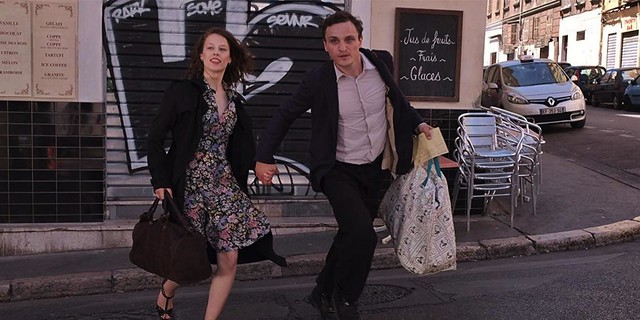
CE_Transit2         Transit’s alternate reality fits the description of Deleuze’s modern cinema very well. “As for the distinction between subjective and objective, it also tends to lose its importance, to the extent that the optical situation or visual description replaces the motor action. We run in fact into a principle of indeterminability, of indiscernibility: we no longer know what is imaginary or real, physical or mental, in the situation, not because they are confused, but because we do not have to know and there is no longer even a place from which to ask. It is as if the real and the imaginary were running after each other, as if each was being reflected in the other, around a point of indiscernibility.” Marseille is ‘any-space-whatever’ Deleuze talks about in Cinema II as well. In Transit Marseille is not quite the rubble or empty factories that lay waste in the aftermath of WWII. But it’s not the bustling second largest French city with shops and beaches either. In the film, it is a sparsely populated, lifeless place where lost people in transit converge, waiting to set sail for their new destinies. It is a mere place to pass through. Waiting however, is exactly what these people do which seems eternal. Marie is involved with Richard (Godehard Giese), a doctor who has put his departure on hold because he doesn't want to leave her behind. No one wants to be the one who leaves. These characters are stuck in there, trapped by love, by the sense of loyalty, by guilt. Transit's got a lot to do with guilty conscience: guilt of leaving someone behind. Guilt of forgetting. Guilt of being indifferent. Time seems to stand still in Marseille, as characters run around in circles, day after day, waiting for what they desire that will never materialize, while the ‘cleansing’ is inching closer to them (the rumour has it, the cleansing is happening in nearby Avignon).
         

        ‘Wartender/Waiting’ happens to be the title of Weidel’s last manuscript that Georg carried from Paris to Marseille. It turns out to be a good reflection of what Georg and Marie are experiencing. Out of boredom in transit to Marseille, Georg reads the manuscript and has an opportunity to tell its story to an arrogant consul at the American embassy when asked about his/Weidel’s new book. In this ‘story within a story’, the main character is dead and waiting to register in hell at the gate. The waiting turns from hours to days to weeks to months to years. After many years have passed, the character asks the gatekeeper just when he will be admitted to hell. The gatekeeper tells him, “Why man, this IS hell!” 
71-la-douleur-duras

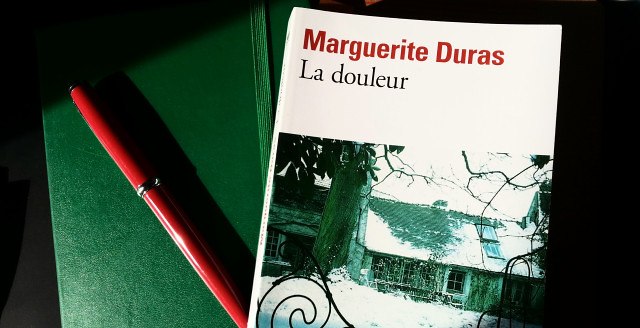
        Experiencing any war is painful. Its effect lingers for a long time - maybe for decades, over generations. The American Psychological Association defines trauma as the lingering psychological and emotional response to a singular traumatic event that threatens injury, death, or the physical integrity of self or others and also causes horror, terror, or helplessness at the time it occurs. The French literary giant Marguerite Duras, in an introduction to her memoir with a very literal title- La Douleur/The Pain, culled from her essays and diaries in the occupied France during WWII, as she was involved in the resistance movement and waiting for her husband’s return from a concentration camp, she claims that she doesn’t remember writing those words, "When would I have done so, in what year, at what times of day, in what house? I can't remember." The emptiness left by the absence of her loved one is so great, she would lose herself.

        If there were another title that can encapsulate the theme of all of Petzold’s films other than Transit, it would be ‘ghost’. Some critics grouped three of his earlier films ‘The Ghost Trilogy - The State I am In (2000), Ghosts (2005) and Yella (2007) for portraying characters who have to contend, one way or another, with the economic hardships and invisibility in post-wall neoliberal Germany. But his subsequent works, along with the theme of transient lives, Petzold’s protagonists suffer from loss of identity and invisibility also. Burdened with terrible secrets they can’t reveal, they tread their paths as if on eggshells - like the East German doctor who hides her intentions to defect to the West in Barbara, a disfigured concentration camp survivor who has to go along with her new identity in Phoenix, Georg who assumes the dead man’s identity but can’t reveal his secret in Transit. It might be a different pain: one caused by economic hardship in highly capitalistic society, the other caused by violence of war. But they both make ghosts out of people who experience them. The economic disparities and characters with lost identities in Petzold’s earlier films and many other works by the Berlin School filmmakers can be attributed all the way back to atrocities of the nazi Germany in WWII. Losing oneself, losing one’s identity is deeply entwined with the survivors’ guilt, the guilt of leaving others behind/betraying others. That guilt for those who remember the past, never really went away. They have been the theme of Duras and many of the Nouveau Roman writers as well as all Petzold’s films and many of other directors in the Berlin School.

Syrian refugees         Let’s put the film in context of the world events in 2017-18; the Syrian civil war was still raging and the refugee crisis was deepening, Trump enacted the Muslim Ban restricting visas from 7 predominently muslim countries, started to build the wall in the southern border with Mexico, the Israel-Palestine conflict intensified, just to name a few. It is not difficult to see what is reflected in Transit is not far from what’s been happening on the news on TV every night. The future is already here: the film’s premise, the ugly past repeating itself and its temporal dissonance says a lot about the highly advanced capitalist, neoliberal society. The world is moving too fast, while humanity has a little time to reflect on the past. I see Transit as an allegory of Germany’s war past and its citizen’s collective, willful amnesia, caused by the war itself. Hence, the merry-go-round of war - trauma - collective amnesia - war - trauma - collective amnesia being repeated. Suffering from an identity crisis, Georg desperately tries to save Marie while concealing the bitter truth that Weidel is dead and gone all in the midst of fascist takeover: Georg is a stand-in for Germany, Weidel for the utopia that never materialised and Marie for the country’s future/younger generation. Going back to Sehnsucht/longing for the utopian Germany that never was, and regarding Germany’s dark history repeating in Transit, I believe Petzold is telling us that however painful it is, we will have to face the past in order to understand trauma so we don’t repeat it.

Sources Consulted 


1. Abel, Marco. ​The Counter-Cinema of the Berlin School​. Boydell and Brewer, 2013: 1-28, 69-110

2. Chang, Dustin. “I Envision All These Great Small Movies in the Ruins of Hollywood: Chrsitan Petzold Interview, Screen Anarchy, December 12, 2012

https://screenanarchy.com/2012/12/i-envision-all-these-great-small-movies-in-the-ruins-o f-hollywood-christian-petzold-interview.html

3. Deleuze, Gilles. Cinema 2: The Time-Image, University of Minnesota Press, 1989: xi, 1-67

4. Hamann, Hilary Thayer. “A Harsh Tale of War, But Unforgettable Read,” NPR, February 16, 2011

https://www.npr.org/2011/06/29/133811002/a-harsh-tale-of-war-but-an-unforgettable-read

5. Mirthy, Vikram. “Christian Petzold on Transit, Kafka, His Love for Den of Thieves and More,” RogerEbert.com, February 24, 2019

https://www.rogerebert.com/interviews/christian-petzold-on-transit-kafka-his-love-for-den-of-thieves-and-more

6. Mudd, Cass. “What the stunning success of AfD means for Germany and Europe,” The Guardian, September 27. 2017

https://www.theguardian.com/commentisfree/2017/sep/24/germany-elections-afd-europe-immigration-merkel-radical-right

7. Staff. “Germany sees extremely alarming rise in racist and anti-semitic hate crime,” The Local, May 14, 2019

https://www.thelocal.de/20190514/germany-sees-extremely-alarming-rise-in-racist-and-anti-semitic-hate-crime

Thursday, September 24, 2020

A Prophetic Vision of Europe in Philosophical Terms

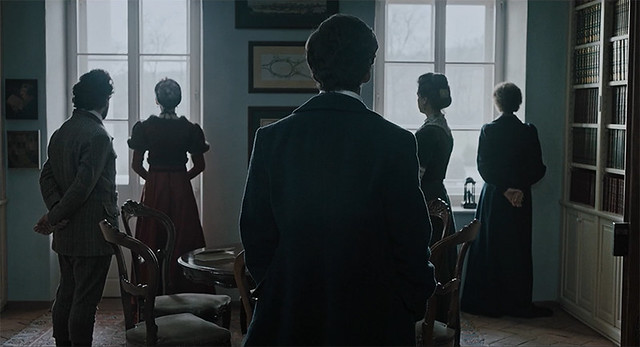
Malmkrog (2019) - Puiu Malmkrog Cristi Puiu, a director closely associated with the Romanian New Wave, of realist films like The Death of Mr. Lazarescu and Aurora, take a very different approach with Malmkrog, a three hour twenty minute verbose chamber piece and a formalist cinematic daring-do that will certainly try patience of its viewers. Based on Russian philosopher's Vladimir Solovyov's texts in turn of the twentieth century, prior to WWI, Malmkrog's five main characters extensively engage in serious religious and political discussions in six chapters, named after the characters and István, the head of the servants in the wintry manor the film takes place in. 

There are three heady discussions they are engaging in: war and peace, grand vision of unified Europe and the existence of good and evil. It takes a dramatic turn and there is a big tonal shift after the second discussion. The last one-third of the film could be interpreted as a dream or imagined but Puiu decidedly leave it opaque. Malmkrog starts out in a large, opulent manor in the middle of a wintry forest. The structure is in pastel pink, giving it a whimsical fairytale look at its first impression. 

Inside, within very long takes in meticulous blocking, the actors crisscross the screen as they speak on and off screen. Camera pans slowly here and there, but otherwise it's stationary. Ingrida (Diana Sakalauskaité), a wife of a Russian war general starts the film with her indignant support for military might. There is a good war and there is a bad peace, she exclaims. Her view is pitted against the youngest member of this wealthy, aristocratic group, Olga (Marina Palii). Olga is a good Christian and a staunch pacifist. And because of that, she becomes a target of constant belittling, albeit politely, especially by Nicolai (Frédéric Schulz-Richard), a former seminary student and the host of the manor they are gathered at. The group splits in either defending Olga or chiding her. Ingrida receives and reads a letter from her husband announcing victory over Ottoman soldiers on the frontline. In a letter, he justifies slaughtering the enemies in the most grotesque manner because they roast babies in front of their mothers in the villages they raided. She enforces her assertion that the war is necessary. Olga disagrees. With her faith, she could've turned those 'savages' around by praying. Near the end of discussion just before lunch, in an intense interrogation in defense of her position on pacifism, Olga faints. 

Lunch is served. They are back in another deep discourse. Edward (Ugo Broussot), a wealthy merchant and a gambler, espouses the grand vision of unified Europe. He says because Europeans are the most advanced, progressive, therefore they are superior civilization. And Russia can play a big role because of its proximity to Asia in fending off the influence of Asian nations. Then the discussion turns to the existence of good and evil with Nicolai chiding Olga with her interpretation of the bible verses. 

Of course, in accordance with the era and society, all dialogue is conducted in very proper French. Only other language spoken (very briefly) is German, when Nicolai cryptically whispers to Olga travel paths. Did he see what was coming? Is he planning an escape with the young believer? 

As the second discussion draws to a close, a drastic incident happens to break the otherwise tranquil gathering of the high society: a broken childish song that sounds like coming from a gramophone plays in loop all of sudden and all the servants disappear or not answer Nicolai's ringing bell. Panicked, our guests leave the room only to be gunned down from an unseen force. Next scene is a wide shot of the snowy landscape outside and people calling out Ingrida, who seems to be treading the snow away from the manor. Puiu keeps everything ambiguous from beginning to end. 

The next scene is business as usual. All the guests seem to be alive and well and carry on the subject on good and evil. How do we know that god is good? He can preach us to be good. But is he himself good inside? Olga is pushed to defend her positions. She seems composed but not able to speak anything remotely compelling. This dinner scene with five characters speaking back and forth, is a fine example of how you do coverage and make Bohemian Rhapsody's Oscar winning editing to shame. 

 I don't doubt that Malmkrog's script being as thick as Dostoevsky's Brother's Karamazov. It deals with dense, heady philosophical musings from another century. But context is everything. What these characters are discussing has relevance in pre-revolution, WW1 Europe as well as the age we are living in. 

Veering off the Solovyov's texts, Puiu reinforces its prophetic, dystopic view of Europe - decadent, spiritually hollow, hubristic, jingoistic and also on the cusp of violent upheaval. Puiu being Romanian, growing up in a country in the Soviet Bloc, Solovyov's texts are a good fit for him against anti-spiritualism associated with communism along with many other ills Europe and Russia are suffering right now. 

Malmkrog is a slog of a movie. But it’s truly one of a kind. If you are an adventurous spectator like me and stick to it, with a bit of background knowledge beforehand, the film is a very rewarding and satisfying cinematic experience. This will make a great double feature with Lázló Nemes's Sunset, as a frustrating yet richly rewarding cinematic history lesson and a prophetic vision of Europe.

Saturday, February 6, 2016

Scott Barley Interview

scott barley
I've come across many visual artists/filmmakers since I started this blog. Most of them have been for Twitchfilm during film events, such as festivals, promotions for their film releases, etc. An interview usually lasts 15 to 20 minutes. I get 30 minutes if I am lucky. The PR firms usually keep a tight schedule and you have to be very alert and ready to get what you want out of these artists. It's not always easy. There are always huddles- the New York traffic, the timing of the day (early vs later interviews), weather, technology malfunction (cell phones, skype and my 10 year old ipod with a microphone), individual characters of the artists themselves. But I'm not really complaining. I get to meet some of my heroes and discover many interesting artists. Since I've been doing this for a while now, I think I'm getting pretty good at asking the pertinent questions to satisfy my preoccupations. But at the same time, I've always felt 20 minutes is nary enough to scratch the surface: to find out someone's artistic point of views or artistic processes or personalities or crafts or philosophy on their practices, or anything for that matter.

I've come across Scott Barley's work at a film torrent site. The screen caps and description of the film look intriguing. And it was marked as KG Artist (filmmakers who upload their own work on Karagarga torrent site). Watching Barley's Hunter for me, was a watershed moment. I was immediately drawn to his beautiful, mesmerizing images. The mood and mystery and melancholy he conveyed in that short, majestic film was exactly what I've been looking for in films both as an adventurous spectator and occasional practitioner. I pm'd him immediately and to my surprise, he responded. And that's how our correspondences began.

As much as I love narrative filmmaking, I strongly believe film is a sensory medium first and foremost. And the medium still remains to be the most exciting art form, still founding its ways and holds a lot of possibilities. As I go through Barley's films one by one, they give me a strong sense of assurance in my belief that it is not foolish to think that film is not only not dead but only just have begun living despite all the naysayers.

Preparing for Barley's interview, I decided to take a different approach: I'd send him questionnaires and he'd take time to reply. There'd be less pressure and it would be more in-depth. Indeed. What you are about to read is quite a long and completely unedited correspondence, between an interviewer who is very much excited about discovering an artist & his practice and the subject who generously pouring his heart out.

Barley is a prolific artist whose background conveys wide range of artistic practices - painting, music, literature, constantly working, outputting his thoughts and visions in many forms. I just finished watching Closer- his David Bowie tribute film/poem. It's achingly beautiful. Wise and intelligent beyond his years, it has been a truly inspirational experience to communicate with him. For that, I thank him from the bottom of my heart. So without further a do:


For the readers, I can't not mention how I found your work first - at an elite film torrent site. Therefore I can safely assume that your cinephilia runs deep. For many filmmakers I know, there was one defining moment in their lives how viewing of a particular film turned them into being a filmmaker. You mentioned Stan Brakhage, Phil Solomon and Michael Snow at some point in your career. I am wondering if there was such a film that made you pursue your career as a filmmaker. And who are some of your biggest influences on your work?

Scott Barley: Well, there have been quite a few “milestones” in my life that have really defined a strong sense of a creative path for me; not just films. Please bear with me, as I trudge sporadically through them - and the in-betweens.

Cinema actually came quite late to me, when I was 14. On a whim, I went to see Pan’s Labyrinth in the cinema with my father. I had never seen a foreign film before then, and had no idea going in to the theatre what Pan’s Labyrinth was about, or even that it was in another language. But the film spoke directly to something nebulous yet very concrete, beyond the surface of my self, in a way that no film I had seen before had done. It transcended language. It was an epiphanic moment for me; this understanding: language was no longer necessary to understand or feel on a fundamental level. It was more fundamental than language. It was simply humanness. I was not a big “film person”, and Pan’s Labyrinth changed everything. I didn’t know that films could do this to you. It moved me to tears, and while watching the film, I felt like my heart stopped several times. I remember getting so frustrated with friends in school, who dismissed or ridiculed the film, simply because it had subtitles. Pan’s Labyrinth taught me something which I’ve lived by very strongly to this day, and will continue to do so for the rest of my life: let art and experience wash over you like an ocean. Submit to it. Don’t think too much. Just feel.

I felt very alone in my teenage years, and art - however - or rather, the more - dissonant, stygian, and difficult - became my refuge. I am a romantic, very sensitive and idealistic to this day, and art felt purer than the exterior world, and more in line with my own interior world. I liked simply “feeling”, whereas the exterior world - however insidiously - seemed to portray this notion that feelings were a superfluity.

Before Pan’s Labyrinth, I wrote a lot. I used to write many poems and stories. I was obsessed with language. For many years from the age of 7, I would go to bed each night, reading the dictionary from page to page, memorising the words and their definitions. I would practice my cursive for hours on end, on the same letter, for no reason other than my own unorthodox recreation. I loved the ability to express myself with exactly the right word, even if others didn’t necessarily understand what I meant; at least I knew that I was being earnest, truthful, and precise. From the age of 7, I read a lot of King and Poe. I loved Poe in particular; his eruditeness and (what the philistines call) ’verbosity’, but also the rigour to it. That has remained the same to this day; my love for Krazsnahorkai, Proust, and Joyce in particular knows no bounds. Naturally, being a lover of Poe, I was drawn to the darkness. I am a nyctophile; both literally and metaphorically. I feel most at ease under the cloak of darkness, adrift within tenebriousness and the undeterminable. I had a rule: I would only ever create, or watch, or read at night; for that was when I was at my most percipient, and when I felt most in-tune with the experiential resonance of the “art world”. The only oil that I burned was Midnight’s.

Ethereal-Melancholy-of-Horses-in-the-Cold
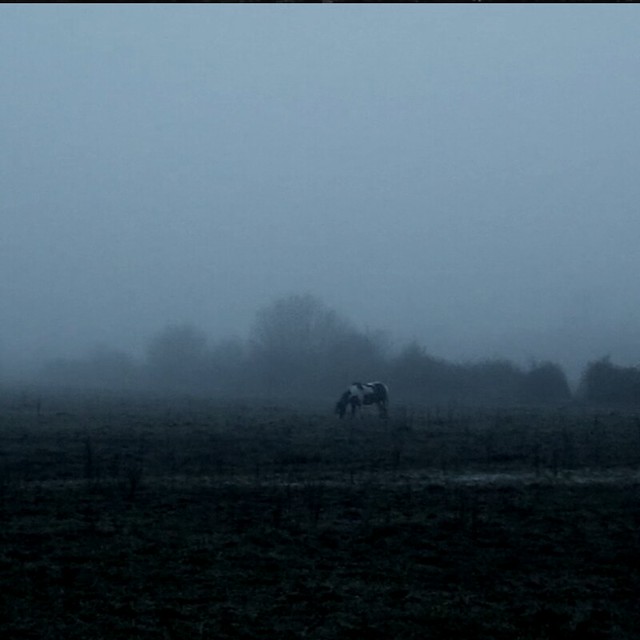
The Ethereal Melancholy of Seeing Horses in the Cold

I was not particularly interested in or understanding of visual arts before Pan’s Labyrinth. But after that film, I became very passionate about it, as well as mood, experimentation, and allegorical work, but I was not yet making films; not for another 5 years or so. I left writing behind a little, and from 15 on-wards, I was doing a lot of painting instead. I loved Bacon, Auerbach, Kossoff, Kiefer: the masters of emotional darkness and texture. For a little while, I was simply regurgitating the things that I loved in a lesser form. But as time went on, I found that I was able to truly draw from my own feelings, and still inherently capture what drew me to those artists in the first place: the personal, art that scarred, art that acted as a nepenthe or catharsis, and the obfuscation - either through texture, or the literal Latin origin of the word: ‘fuscus’, meaning, the ‘dark’. I believed that genuine art could only be created when you submitted yourself to - and embraced your own - vulnerability, and to be entirely authentic and honest; essentially, you had to pour your soul into it. That has remained the same ever since, and is probably the most important element of my own creative praxis. To paraphrase Cassavetes: you must dare yourself to fail. Why bother, if you’re not going to put yourself on the line?

When I was 16, I discovered Bergman. I think Persona is THE gateway drug for cinema lovers. That film changes you biologically, and by the time the film reel in the film stops, and the light goes out, your DNA is different; you are then far more perceptive to - for a lack of better words - “artistic” or “difficult” cinema. I am drawn to that sort of work: art that changes you from who you were before you experienced it. After Persona, my love for cinema became akin to a snowball gathering speed as it descends from the summit. I would watch up to 40 films of varying lengths in a weekend. I would do nothing else. It’s a miracle that deep-vein thrombosis didn’t set in. Then I discovered Tarr, and perhaps more so than any other of my personal experiences with art, it changed me. Upon experiencing Werckmeister Harmonies, I felt like I had an out-of-body experience. My body surrendered and I saw my soul, stark, fragile and utterly naked before me - for the first and only time in my life. It moved me to tears. I shook a lot. It completely changed me. Words cannot do any justice.

The-Sadness-of-the-Trees-2014-0005
The Sadness of Trees Part 2

In my first year of university, I became obsessed with avant-garde, particularly lyrical avant-garde, like Phil Solomon, Stan Brakhage, Jean-Claude Rousseau, and Nathaniel Dorsky, and they remain my favourites to this day.

As for elite film torrent sites, like Karagarga - they interest me. I don’t always fully agree with what is shared on there. An artist needs to be paid for their work, just like anybody else, but I feel very passionate about the idea of bringing down the walls of economic elitism and socio-political censorship that prevent a lot of people from accessing vistas of great esoteric cinema, music, and literature. But I still think that sites like Karagarga could do a lot more to ameliorate that problem. I would never share any other artist’s work on Karagarga. I only upload my own work - as that is the only work I have the moral authenticity and legitimacy to share with others online. I do share a lot of my cinephilia with my friends and younger students though, and throughout my degree I organised film screenings such as La Région Centrale, La Vallée close, American Falls, Meshes of the Afternoon… lots of Antonioni, Brakhage, Bresson, Godard, Yoshida, Epstein, a lot of Eastern European cinema from the 50s 60s and later too (that was my most earnest passion during that time) like Vláčil, Wiszniewski, Jan Jakub Kolski, Bartas, Tarr, Fehér, Stonys etc.

I was fighting for a more artistic environment that sadly, my university did not convey. It was a very philistine and anti-intellectual environment actually - not that I am an intellectual by any means, but I yearned for that sense of being a scholar, not simply a “regurgitatior" of other people’s “old” ideas. I wanted to embrace the new and unique, the daring. Lots of people, including the majority of the tutors, sadly, were afraid of feeling or of mystery - whereas for me, those are two of the most empowering elements of art - along with hope. Thankfully I was able to create a small Bande à part of friends who shared my passions and interests and that stopped me from going under.

As for literary influences in my life, they include Georges Bataille, Nietzsche, Camus, Barthes, Sartre, Hegel, Deleuze, Freud, Deleuze, Sontag, Blake, Beckett, Stanley Donwood, Joyce, László Krasznahorkai, Daphne du Maurier, Baudelaire, Pynchon - off the top of my head. Bataille and Sartre in particular are very present in my what I consider to be my best work (Nightwalk, Hunter, Shadows) but I don’t consciously consider any of these things when making a film. I just “feel” my way through the dark - much like the (visual) content of the films themselves.

Nightwalk-2013-0039
Nightwalk

I realise this may come across as being pretentious, but I have made a list of the filmmakers that I most admire, in the order they came from memory: Jean-Claude Rousseau, Béla Tarr & Ágnes Hranitzky, Phil Solomon, Nathaniel Dorsky, Michelangelo Antonioni, Pedro Costa, Pere Portabella, Yoshishige Yoshida, Barbara Meter, Stan Brakhage, Philippe Grandrieux, Sharunas Bartas, Wojciech Wiszniewski, Peter Hutton, Jack Chambers, Franco Piavoli, Jan Jakub Kolski, Maya Deren, Pier Paolo Pasolini, Éric Rohmer, Artavazd Peleshyan, Ingmar Bergman, Veiko Õunpuu, Konstantin Lopushansky, Dimitri Kirsanoff, Jean-Sébastien Nouveau, Jean-Pierre Melville, Zoltán Huszárik, Jean-Luc Godard, Aleksandr Sokurov, Robert Bresson, Marguerite Duras, Wang Bing, Bruce Baillie, Audrius Stronys, Kaneto Shindô, Jan Němec, Chantal Akerman, Andrzej Żuławski, Paweł Łoziński, Mikhail Kalatozov, Jean Marie Straub & Danièle Huillet, Amy Kravitz, Bill Viola, Guy Sherwin, Robert Beavers, Harun Farocki, Florence Pezon, Ben Rivers, Elem Klimov, Lav Diaz, Djordje Kadijevic, Jean Epstein, Raúl Ruiz, Dušan Hanák, Bert Haanstra, Mário Peixoto, Robert Todd, Tengiz Abuladze, Yorgos Lanthimos, Margot Benacerraf, Roy Andersson, Peter von Bagh, Abel Gance, David Gatten, Darezhan Omirbaev, Aleksandr Kajdanovsky, Walter Hugo Kouri, Pierre Perrault, Joris Ivens, František Vláčil, Michael Haneke, Yves Allégret, László Moholy-Nagy, Philippe Garrel, Allain-Robbe Grillet, Sergei Eisenstein, Larry Gottheim, Frans Zwartjes, Harmony Korine, Sava Trifkovic, Marjorie Keller, Grzegorz Królikiewicz, Andrei Tarkovsky, György Fehér, Mário Peixoto, Christian-Jaque, James Benning, Teinosuke Kinugasa, Nicolas Rey, Sara Driver, Piotr Dumala, Devin Horan, Terrence Malick, Wallace Berman, Jonathan Glazer, John Frankenheimer, Sohrab Shahid-Saless, Leighton Pierce, Maurice Pialat, Vitali Kanevsky, Vittorio De Seta, Vojislav Rakonjac, João César Monteiro, Jospeh Cornell, Jean Vigo, Werner Herzog, Bill Morrison, Jan Schmidt, Jean Daniel Pollet, Raymond Salvatore Harmon, Dore O., F.W. Murnau, Frank Borzage, Jacques Tourneur, Ken Jacobs, Jonas Mekas, Aleksandar Petrović, Sergey Loznitsa, Albert Serra, Charlie Chaplin, Jem Cohen, Saul Levine, David Perlov, Georges Franju, Werner Nekes, Miguel Gomes, Alan Clarke, Mike Leigh, Julian Schnabel, Aleksei German, Juraj Herz, Peter Nestler, José Val Del Omar, Martin Arnold, Djibril Diop Mambéty, Krzysztof Kieślowski, Dušan Makavejev, Jesse Richards, Matthew Allen, Mikel Guillen, Alfred Hitchcock, Stanley Kubrick, David Lynch, François Truffaut & Sylvain George.

Can you tell me the philosophy behind Remodernist Film Movement and how you incorporate it in your practice?

Well the story of how I got involved in Remodernist film is a very strange one. It was in my first year of university and one of the few good lecturers was discussing different film movements, and he somewhat threw shade on the Dogme 95 movement and said that a more recent movement, Remodernist film, was more interesting. Remodernist film seemed to speak to me very profoundly - what the founder, Jesse Richards talked about: the authenticity, the embracement of nuance and human fallibility, the autodidactic. That was very interesting. Anyway, later that same day, I was in a careers advice meeting, and I saw that I had several Facebook notifications come through on my iPad - and they were from a guy called, “Jesse Richards”. I couldn't believe it. It was uncanny, perhaps even fate. He had found my Facebook page of my paintings and early film work the same day I had learnt about him in university. I messaged him, telling him what a crazy thing this all was, and very quickly we became good friends, and we have worked on several projects together since. I consider him to be an idol of mine, a mentor, and yet he is the most down to earth person you could ever meet. A truly great, great man who has his heart and brain wholly in the right place. I am very interested in autodidactism, wabi-wabi, making yourself vulnerable, the anti-elitist element, the purity and liberation of it all really; the idea that the most perfect image cannot exist, but if it did, it would be imperfect anyway. It’s reassuring and a breath of fresh air. I think those things are littered both in front and behind the camera throughout my filmography.

Evenfall-2015-0017
Evenfall

Certain melancholia and sadness are always present in your work, how much of it is related to your surroundings? How big nature figures in your work?

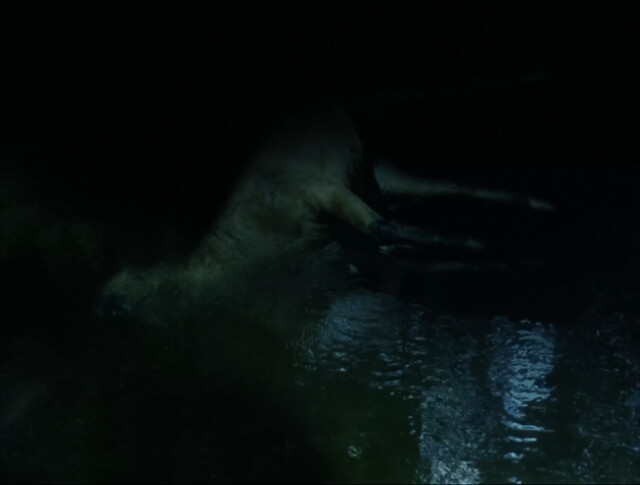
It’s related to my inner environment. I try desperately hard to speak from the soul, and for it to never be conceited. I try not to make anything if I don’t have something to say. Like I said previously, I am drawn to the darkness, I feel most comfortable in darkness, and so my films convey that, literally and metaphorically. And I believe in an interconnectedness within the universe, and so what I feel inside, I anthropomorphise and project on to the trees, the water, “the hand”, “the horse” etc. …There is an uncanny semblance of man in the spirit of the horse - the simultaneity of elegance and vulgarity… and also pathos - so I am naturally drawn to that creature in my work.

I also think that people who are self-aware can feel too much, and I am one of them, and so I purposely place myself in a vulnerable position when making films, so hopefully the process will act as a catharsis or nepenthe for what I am experiencing. It is a good way to combat negative feelings, in my experience. Whatever makes you afraid or anxious, just go for it! Hunter was a a very important film for me. I was suffering with very debilitating depression and that film perhaps saved my life. It sounds stupid, but it’s true. It gave me something to live for - just making something kept me occupied, and I poured all my feelings of utter aimlessness into something cohesive. The film itself is a mirror and meta-retrospective of my previous films and my own personal filmmaking praxis, as well as a comment on my own existential anxieties as a person and as an artist... It also mirrors life's evolution. From water, to land, to sky.

Shadows
Shadows

I remember that I had been editing Hunter for a few months - every day, all day (I am a perfectionist when it comes to editing) and I was stuck on the shot of the horse, and I knew that that shot couldn't be the ending. I was frustrated. I didn't know how to end the film. So I went to sit outside in the garden. It was nighttime. I looked up at the stars, which were very clear and bright that night, and then quite suddenly an idea came to me, that gave me a sense of purpose - however tenuous it was: We know that science has proven that we are made of stars. We are literally stardust. And we also know that if we look at the Sun, we are witnessing it in the state it was just over 8 minutes prior to how it is in reality, now - because of how far the light has to travel. And then I thought, is it possible, that we could, on a clear night, look up at the vistas of constellations and see the very star that gave birth to us?; a ghost of our former self? And it gave me a sense of purpose, that perhaps, our only aim in the vastness of time and the universe, is to one day return to the stars that gave birth to us. And it was that thought that made me decide upon the ending of Hunter that you see in the film. I try to turn my melancholy in to something beautiful, but still keep it true. I think that people don't always realise just how vicinal sadness and beauty, or horror and beauty truly are. They are very closely aligned. They can blend into each other.

Polysemy is a big thing for me too with my work, and I encourage it. I think that polysemy is too often regarded as being a weakness rather than a strength in art. Some people seem to think that when a piece of work is interpreted in divergent ways that it says something about the lack of articulation in the artist. I couldn't disagree more. Whilst all my films have very strong personal meanings for me, I embrace multifarious interpretations, and often adopt stream-of-consciousness and intuition in my praxis. To be entirely honest, I have in the past, made an entire film, released it and still not known what it was, or why I did it “that way”. But a few months later, I understand - for me. I love the feeling of being lost when I create, or when I experience art. It permits you to search deeper in to your self. Your feelings know better than your logic. People think too much. We should learn to trust ourselves more. I have a vision – but I am not a dictator, and I don’t wish to assume or force anything. I love that people are able to project their own feelings, searches and life experiences on to my work. One person in particular got into contact with me, to tell me when he watched Hunter, he saw the hand as himself, reaching out for the woman he idolised and loved, whom he felt was always out of reach; she was the beyond: the water, the mountains, the stars. Since then, we have become good friends, and he recently told me that Hunter has inspired him to make a film of his own, to communicate his feelings for/to her. I’ve have been privileged enough to have been contacted by a few people, telling me how my films have changed their life, and even inspired a few of them to pick up a camera and make a film for the first time. You cannot ask for more than that. Hearing from people you have never met, and them sharing these personal feelings with you is ineffable. It makes “whatever-it-is-that-I-am-doing” worthwhile. In a way, I make films out of hope. And hope is a tenuous but underrated thing. It’s one of the most profound and precious of all things.

In my view, the filmmaking process is mine. Once the film is finished it is no longer mine. It is yours; it is anybody’s, and it can be whatever they wish it to be, and whatever suits, pleases, disgusts, angers, or I daresay, helps them. And of course, the creation of a film or any work of art is only the very beginning. It mutates and changes, and lives on in different, brilliantly unique people, within their mind, soul, dreams… under closed eyelids. Simply, it lives… It lives on - isn’t that wonderful?! I would not have it any other way.

Polytechnique
Polytechnique

Loved the soundtrack on Polytechnique. Can you tell me your collaboration with Easychord on Polytechnique and how important is music in your artistic endeavor?

Music is a huge influence on my work too. The musician, Grouper (Liz Harris) has perhaps influenced my praxis more than anybody else. It’s that obscuration, the textures, the dark, the ethereality, the mood, and the catharsis that comes from unravelling pain and other emotions in one’s life. I could never thank her enough for what she gave me with her music. Also Radiohead, Portishead, Scott Walker, King Crimson, David Bowie, Neil Young, Ligeti, Penderecki, Death Grips - they are all very “cinematic” artists. They create worlds, characters…atmospheres. The rhythms of my films are based around music too. It is why some of my films are silent, and others are not. You have to feel the rhythm. I want to create “visual music” with my films. For me, cinema - in its purest form - is closer aligned to music and architecture in praxis than any other mediums.

For Polytechnique, I was contacted by Roberto Siguera (Easychord), asking me if I would make a film for some of his new music. It was a pleasant surprise. We had not communicated previously. For a while, we talked about what we were both interested in… I remember James Benning coming up a lot at the time, and before I had the music, I had the impression that Roberto wanted something in a similar vein to my first film, The Ethereal Melancholy of Seeing Horses in the Cold. But when I heard the music he had produced - this wonderful, low-frequency, pulsating echo chamber that resisted the corporeal and the concrete - I realised I couldn't make a film like “…Horses in the cold” for him. The music immediately made me feel like I was listening to my own body, as if I was a microscopic, lost traveller, traversing internal bodily terrain. I had recently been doing some purely recreational research into phenomenological concepts such as prisoners cinema, as well as concepts like astral planes, fundamental entity, and the primordial body (something which has become a huge part of my work as time has gone on), and I realised that the music had this quality to it of being dimensionless, but very present, abstract yet lucid too, so I worked around that when making the film. It took about four months to make, if I remember correctly. We never ever talked about it as a music video. It was always an “audio-visual collaboration”. We were both having fun, but we were serious about the project at the same time. It’s actually one of my favourite pieces of work that I have been involved in. I recently released a blu-ray of my work via my website for sale, and seeing and hearing Polytechnique on blu-ray was a revelation for me. I saw these details, light streaks, textures, and abrasions in the film that I forgot I had put in. It’s also me at perhaps my most abstract. It was an honour for both of us that Polytechnique was hand selected by Kim Kascone (assistant sound director on Twin Peaks) for his Drone music cinema film festival in The Netherlands. It has that dark, drone-like quality, I think. I would love to do another collaboration with Roberto at some point. We discuss it now and again. I’m sure it will happen. It’s just finding the right time, and music, and idea.

3200254a-3a7b-4526-a62a-92dfbed96449_zpsr6wtr3b4
Hunter, Shot entirely on iphone 6 Plus

Hunter is absolutely stunning. Considering it is your more recent work and having seen your (relatively) older work on your vimeo page, I can see the progress/evolution of your style if you will. I feel that there is more stately and formalist approach in Hunter. Even though I take each of your film as its own entity singular piece of work, I'd like to know, as an artist how you yourself perceive the change and your directions with each project.

First of all, thank you. There is certainly a progression there. More rigour (I hope), more attention to detail, but still very much part of the same idea, the minimalism, the nature etc. Perhaps, more than anything, I am just paring back what was there before.

I think I have somewhat distanced myself, and I think Jesse has too - perhaps not consciously - from remodernist film more recently. Remodernist film still exists, but it has changed shape and matured. The remodernist element of my early work was more superficial - more to do with the “look” of the film. I wanted it to “look” autodidactic, amateurish, and nuanced. Hunter is still very much a remodernist film, but it has transpired beyond that into something that can only be found in the cracks, in the dark - if you look for it. The films have become more professional and polished, but the human sensibility, the human searching is still very much present. The abrasion and nuance doesn’t live so much in the actual film’s images anymore, but more so in what the images project in the spectator. The films have become more liminal. They're on the threshold of something. Darkness? The unknown? There’s something mercurial beyond the threshold that I want to make palpable when people watch Hunter and my more recent films… a hidden tension, but a powerful one, perhaps. It’s become much more about the “in-betweenness” for me now. As time has gone on, I understand that “aesthetic” can become a dangerous word, because I’ve realised that great art can only exist when you cannot separate the aesthetic from the form or the substance of the piece. They co-exist, and exist as one. Without the other, the other cannot be. So nowadays, the aesthetics of my films alter from film to film, but that is because they are governed by the substance of the film itself; the idea. They are innate and inseparable; born at the hip, as it were. Some films like Shadows actually change aesthetic, canon, mood, style and form, as the film progresses - because the actuality, context and meaning of the film dictates it so. I am not really in charge - the film is. The film tells me what to do.

How does the new technology figure into your working method? Is it just another way for artists to express themselves or is it necessity in 21st century?

Artists cannot always express everything that they wish, or need to convey in just the one medium. As an example, for me, I write, I paint, I make films, I make music. There are things I can do with film that I cannot do in writing, but at the same time, there are things that I can do in writing that I can’t do in film. That excites me: having a genuine reason to explore a different medium for your expression. That is what is so wonderful about film: it is a bastard. It is a bastardised medium, and so there is more “headroom” as it were to express yourself. I embrace all kinds of tech. I see different types of tech as akin to different mediums. They can be surprisingly independent of each other, depending on how you utilise them. I’ve shot stuff on a 240p camera with a 0.3 megapixel censor, through to an ARRI Alexa. Some of those who have the money to afford expensive kit think that suddenly makes them professional. Nothing could be further from the truth. It’s nothing to do with the kit. It’s all about how you choose to use it. And sadly, those people who think it’s all about the kit usually have no creative personality. They are faceless, forgettable, and very boring. The medium and tech you choose should be governed by what you wish to express. And so, no, I don’t think new technology is a necessity - outright. It all depends on what the artist is wishing to express, and what will enable them to have that suitable form of expression. I am really enjoying trying to push the tech of the iPhone at the moment. Hunter was completely shot on an iPhone 6 Plus, and it felt really liberating, going to an iPhone after lugging a heavy ARRI Alexa around on the previous project.

A project I am working on at the moment also features some of my hand-drawn illustrations composited into actual film imagery, so that’s exciting too. I’m just experimenting, and trying to avoid complacency. I embrace digital, but love film too. It’s all great, but they are definitely two separate mediums, and I think that we are only beginning to truly see what makes them different in a formal sense, or to begin to see artists truly utilising the differences of digital to film to achieve something that was unachievable with film. Take James Benning’s Nightfall for instance, or Godard’s Adieu au Language, or Phil Solomon’s Rehearsals for Retirement. These projects are incredibly exciting - because these artists are fully embracing a medium, rather than having one foot in digital and one foot still in film. They have a courageousness and embracement for the new and unknown that most filmmakers lack.

Stills and artwork from Sleep Has Her House:
Sleep-Has-Her-House-3
sleep Screen Shot 2016-12-07 at 10.05.23 PM
592953425
Tell me about new projects you are working on.

A few different things. I’m working on what might end up being my first feature, Sleep Has Her House. It plays out very differently to my other work, in a formal sense. It's a very, very slow moving film. 10 minute takes. No camera movement. Only movement within the frame. An observation of the more profound elements of life that we don’t often pay attention to: The wind carrying the clouds across the sky… the light changing over time… animals moving through a scene… the moon being obscured by the clouds… and of course silence!… even nothing! That’s something I want to explore more: what qualities or elements does “nothing” harbour? I want to focus on that particular kind of nothing in my future work.

It is a film that I hope people will give themselves over too, and let it wash over them like an ocean. I embrace the idea of people falling asleep whilst watching it, and waking up later on - without that being a problem. I want it to have that very strong meditative quality. In a sense, it’s my idea of the apocalypse: how I see the world ending. It wouldn’t be violent or fast - not right at the end. People would already be long gone. The last few animals would dwell in the hills, in the fog. The film follows that idea. The animals sense that the end is coming and retreat deep into the forest. They cry out in the dark, as they fade into the black. That’s how it will end. A quiet, slow death. Not explosions or tears. Just a long quiet trill… like an elegy. Perhaps the quiet cry of the last animal, as they fade into the dark… into the ground. That’s all.

Too young to die
Too Young to Die

I have a very bad attention span, so at any time, I’m working on about half a dozen different films - most that never see the light of day. I like to switch between each project as I work through them, or when I start questioning myself too much - almost like when you stare at or repeat a word for so long that it no longer makes sense somehow. It also helps me improve each piece, as one technique that I use on one film may inspire me to do something that I had not thought of previously on another project that I had hit a creative block on. I’m sure some people will say it’s a terrible creative process, but it seems to work for me. So right now, Too Young to Die is on hold (what originally was going to be my first feature), and Sleep Has Her House is something I’m more focused on - but that might change!! I’m working on about four features right now, simultaneously.

I’ve also just finished a poem for an anthology book to celebrate the legacy of the late David Bowie. It will be published in the next couple of months, and all proceeds go to the charity, Cancer Research UK.

Closer-2016-0009
Closer, shot in 4K, in 1:1 aspect ratio

Hunter is getting a screening at The Museum of Modern Art, Mar del Plata, in Argentina on 12th February, 2016. That is a big deal for me. I started making films just a little over 3 years ago, and to have come to this point where my work is being screened in that sort of environment means more to me than I can eloquently put into words. It was around 2 years ago, that Phil Solomon and I became friends, and I am now screening a film of mine alongside his film, Rehearsals for Retirement (in my view, the most sublime digital film ever made - and one of the most embracing of the digital medium too) at The Museum of Modern Art. I can't really get my head around that, and I have so much to thank Phil for, not least his comradeship of being part of this screening along with the "little fish" like myself.


Please visit Scott Barley's website and support his artistic endeavours. Then go on over to vimeo and check out his work.

Tuesday, October 29, 2013

Žižek Remains Hopeful, So Should You

The Pervert's Guide to Ideology (2013) - Fiennes
 photo b6e87d84-d965-45d1-8427-c89aeb112cd0_zps187d4e80.jpg
Why is it easier for us to visualize the end of the human race, than the end of the free-market capitalism? This is the driving question behind the latest collaboration between Slavoj Žižek, the superstar philosopher/psychoanalyst/cultural critic of our time and director Sophie Fienne's in their new documentary, The Pervert's Guide to Ideology. It's their second film since the widely successful The Pervert's Guide to Cinema in 2006. Clocking at 135 minutes, Ideology is arguably less entertaining than its predecessor despite the charming presence of the famed philosopher in several iconic movie backdrops, gesticulating wildly and sounding like the Eastern European Sylvester the Cat. But this film is a denser, more serious examination of our consumerist society that asks many of the important questions of our time, and will require your full attention. As the film jumps briskly through various components of ideology, I suggest seeing the film more than once to absorb Žižek's whole thought process.

For a person who grew up in Communist Slovenia during the Cold War, and hailing from a Marxist/Anarchist perspective, Žižek is equally critical of all ideologies -- the Soviet Communism, Fascism, Capitalism and religion. With various examples of Soviet era war films and Nazi propaganda, he demonstrates the manipulative nature of ideology.

While this film is intellectually complex and sometimes hard to follow, there are many brilliant moments that you just have to nod and smile. One of these is in the beginning, with John Carpenter's hidden gem of the Hollywood Left, They Live. Žižek begins his dissertation by the dumpster in a back alley in LA, where the epic fist-fight between Roddy 'Rowdy' Piper and Keith David takes place, because David's character refuses to put on the sunglasses that will let him see the hidden messages used by the yuppie aliens to control the human race ("Obey", "Money is your God" etc - all the good things about the Reagan years). Ideology is essentially the filter that we see the world through.

Žižek uses different cultural examples to demonstrate how historic ideological movements manipulate the masses. Beethoven's 9th Symphony -- Ode to Joy, a world famous melody associated with a vision of fraternity amongst all human beings, has been appropriated by many political movements: Nazis, Marxists, Maoists and even the Shining Path -- believe it or not, these were all 'utopian movements' in their own minds. It was the national anthem of the apartheid government of Southern Rhodesia (present day Zimbabwe) and is now the anthem of the European Union. After the long historical montage, you are relieved to see Žižek sitting in the Korova Milk Bar from Clockwork Orange. The genius of Beethoven is not only utopian vision in music, but the realization that there are those who will always be excluded from this utopia, as illustrated by the carnivalesque version of the symphony's fourth movement heard in the scene where Little Alex prowls the shopping mall.

Žižek dissects our advanced, capitalist system using Freudian psychoanalytic terms and Western philosophy, giving variety of cultural examples for the laymen: Sound of Music, Kinder Eggs, Starbucks, coke, Titanic.... He takes us to the Mojave Desert -- the gravesite of derelict airplanes, for us to witness the amazing amount of waste created by the current economic system. For those who are not familiar with Plato's Republic, he sites Dark Knight to explain the 'Noble Lie', a conservative view of the society where it is necessary for the rulers to lie because the public can't handle the truth.

All this heady, intellectual inquiries are at times too much. Fiennes deftly moves from one iconic movie setting to another connecting the dots and continuing visual threads to keep up with our motor-mouthed host and keep the film afloat. The movie settings are perfectly matched with the originals and the visual gags are clever and funny.

Capitalism is the only revolution that survived because it thrives on economic crises and social turmoil. Why do people loot during the riot? Žižek uses an example of the London Riots of 2011. In our consumerist system, people's frustrations in social and economic injustice can be only expressed by stealing objects. We go back to his main question for the finale:

Why do we so easily envision asteroid hitting the earth or the end of days rather than seeing a moderate change in our economic system?

I saw him speaking eloquently about the possibilities of envisioning a different kind of world for our future at the Zuccotti Park, during Occupy Wall Street protests in 2011. With The Pervert's Guide to Ideology, he is suggesting us to examine the past, learn from mistakes and be a little bit of a realist in seeing the world.

The Pervert's Guide to Ideology opens 11/1 at the IFC Center followed by other markets.
Slavoj Žižek and director Sophie Fiennes in person Fri Nov 1 & Sat Nov 2 for Q&As following 6:45 shows.

Plus book signing with Žižek for his new book Less Than Nothing: Hegel and the Shadow of Dialectical Materialism, Sat Nov 2 at 9:45pm – books on sale at lobby concessions stand.
Please visit IFC website for tickets.