Sunday, June 12, 2011

Feline Curse

Kuroneko/Black Cat (1968) - Shindo
Photobucket
Photobucket
The film starts with the farmers- mother and her daughter-in-law, gang raped and their house burned down by a band of lawless samurai. The women's black house cat ringers around their charred corpses. The setting is warring medieval Japan.


When they appear again, they are beautifully dressed courtesans luring the samruai in to the bamboo forest in the middle of the night and sucking their blood dry. Distressed leader sends the rising young samurai to destroy these monsters. The fate would have it, the young samurai happens to be the son and the husband of the two farmers who were raped and killed.


As shown in his Onibaba, Kaneto Shindo again, shows his hatred for the ruling warrior class and greed. Black Cat follows the best Japanese ghost story traditon, a la Ugetsu. Also it is the rape revenge story that is far more artful and elegant. The theatrical set and dramatic lighting are beautifully composed. It also features some great wire work and beautiful day for night shots. Very worth checking out.
_________________

Friday, June 10, 2011

What is Flesh Alone?

Je Vous Salue, Marie/Hail Mary (1985) - Godard
Photobucket
Photobucket
Photobucket
Photobucket

Photobucket
Photobucket
Photobucket
Photobucket
Godard's take on Virgin Mary might have been seen as an assault on Christianity and the idea of Immaculate Conception but it's actually about one of his usual themes- body/soul dichotomy. What's refreshing about Hail Mary is it's also about relationship between two young people being tested: can they love one another without touching? I can see the film's influence on many younger filmmakers whom I once religiously followed, namely Leos Carax and Hal Hartley with their brooding anti-heroic archetypes.


Hail Mary is perhaps the most beautiful color film I've ever seen. Punctuated by amazingly graceful nature photography and anchored by Myriem Roussel's Marie, a high school basketball player and a virgin who finds herself being pregnant. Marie's questioning "what is flesh alone...?" and her struggle to keep herself chaste is touching and deeply felt. It's the presence of Roussel that differentiates Hail Mary from Godard's post-Anna Karina cynicism.


From what I hear, Hail Mary is one of the last films before Godard turned his direction toward visual essays of the 90s which I find dry and uninteresting. Call me old fashioned, but for me ideas are still best conveyed through stories and characters, not in the lecture halls(movie theaters) that Godard still seems to preside over. Cinematically no one can top Godard's playfulness in the 60s, not even Godard himself. But this is a gorgeous stuff. Easily a top ten material for me.

To Hellman and Back

Road to Nowhere (2010) - Hellman
Photobucket
As a fan of Monte Hellman, the famed director of the 70's seminal counter-culture classics such as Two Lane Blacktop and Cockfighter, it is very hard for me to report to other Hellman fans that Road to Nowhere, his new film in more than twenty years, is...umm...absolutely...dreadful. There I said it. Such is the burden of being the messenger of bad news.


Prior to the screening Hellman told the audience the advice he got from someone once- 'never explain your film, never apologize for your film and never reimburse tickets.' He succeeded in getting couple of laughs out of that. In retrospect, he wasn't joking. It was his ominous preemptive strike.


The film concerns a young, esteemed Hollywood director Mitchell Haven (Tygh Runyan) adapting a real life story involving intrigue, corruption and double suicide, dug up and sold by a young blogger (Dominique Swain). Haven finds his muse in an amateurish actress named Laurel (Shannyn Sossamon) and becomes infatuated with her while the rest of the cast and crew get increasingly frustrated by his devotion to her.


Road to Nowhere fancies itself to be a meta movie of sorts. It's a movie within a movie, life imitating art imitating life. Laurel might be the real person she is portraying, so is the film's co-star (Cliff De Young). There is an insurance investigator/film consultant (Waylon Payne) who can't seem to distinguish fiction from reality.


Written by Steven Gaydos (executive editor of Variety), the film's Hollywood savvy, corny dialog is just too earnest to be taken as ironic. All the actors involved are not skilled enough to improvise with the given material, making their characters unbearably vapid.


Hellman's contemplation of filmmaking as realizing one's dream in the age of internet and HD photography, gets lost in its trite, tabloid worthy premise. As the film ends with an amazingly terrible song sung by some Bruce Springsteen impersonator, one realizes that even the greatest director needs a good script (doesn't have to be written by Rudy Wurlitzer) and good actors to pull off a DIY style vanity project to be halfway decent.

Thursday, June 9, 2011

Splatter from The North Pole

Play God (2010) - Nikki
Photobucket
[Play God plays as part of DocPoint NYC, a program of 47 films hosted by its New York partners: The Museum of Modern Art (MoMA), Scandinavia House, 92YTribeca, UnionDocs and the Tribeca Film Institute, on June 10th at 7pm]

A successful Helsinki based commercial director, Teemu Nikki looks back on his failed attempt at making the first Finnish splatter movie, Play God. This 38 minute, behind-the-scene, inside look at filmmaking gone awry doc is sort of 'making of' featurette on a movie that never happened.


There have been quite a few documentaries in the past that highlighted the trials and tribulations of filmmaking. Burden of Dreams: Making of Fitzcarraldo and more recently Best Worst Movie: Making of Troll 2, immediately come to mind. Keith Fulton and Louis Pepe's Lost in La Mancha chronicled the disintegration of Terry Gilliam's Don Quixote. However entertaining that documentary was, it depressed a lot of burgeoning filmmakers including myself. I mean, what chance did we have if no one was willing to finance a Gilliam movie? The process of the making Play God documented here seems like a therapy for the director- to be rid of the omen that's been gnawing at him for several years. And he seems to have a sense of humor about the whole experience.


Growing up with the steady diet of splatter films on VHS, Nikki's foray into filmmaking is akin to that of many American indie filmmakers. Seeing homemade footage of Nikki and his Finnish compatriots making their own brand of splatter movies with their dad's video camera in their backyard reminded me of how universal the film geekdom is.


Play God, a shoot'em-up chop'em-up superhero movie in epic proportions (Sci-Fi backdrop, large number of extras, battle scenes and a chainsaw wielding Evil Santa) with an incomprehensible storyline and the puzzling English dialog, was all enthusiasm and not much else. Nikki's plan was simple: shoot the first 20 minutes of the film, show it to the possible investors who would then naturally be blown away by its brilliance and would dole out the money to make the rest of the film, then off to a successful career in Hollywood.


With extremely bad weather conditions (minus 40 Celsius degrees) and everything else going wrong, the production of the movie hit the wall from day one and never really got off the ground. The cast and crew, all Nikki's friends and family members, just as enthusiastic but all novices in filmmaking, faced some very treacherous working conditions. Without the script and direction to guide them while working hard for free, they slowly lost faith in Nikki. Then people started turning on each other. Yes, it can be frustrating when you're not able to cut Evil Santa in half with a chainsaw. But stop crying forgodssakes!


Interviewing various cast and crew members, Nikki faces some biting criticisms from his friends and family face to face. The movie didn't happen. The project was way too ambitious to pull off. And he blamed everyone but himself. Thankfully, the doc is also filled with plenty of awesome footage from Play God. There are definitely times in the film that you wonder whether it is a mocumentary or real. It is a playful, funny as hell and endearing documentary. And by the slick look of the trailer Nikki finally made, Play God could've been really an awesome splatter movie. I am hoping that Hollywood will take notice of now 'mature and competent' Teemu Nikki, and actually help him make Play God for real, starring, Mickey Rourke perhaps.


For tickets and more information please visit MoMA Presents: DocPoint

Monday, June 6, 2011

First Contact

The Andromeda Strain (1971) - Wise
The Andromeda Strain 1
The Andromeda Strain 2
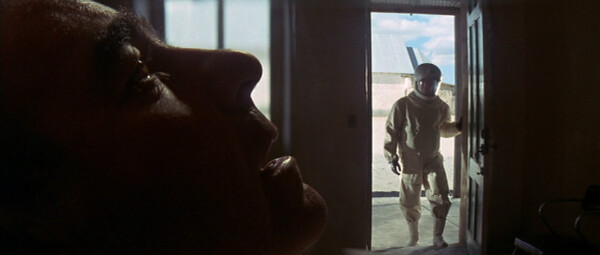
Wasn't too sure about watching this. I remember it as boring ass movie as a child and indeed, the 2/3 of the film is purely procedural - in Michael Chrichton's 'I have to explain this made up world to you in detail' way. But once you settle in, it is a very enjoyable ride.


What if our first contact with alien species is with a too small organism our naked eyes can't see(which is the most probable scenario anyway) and deadly to us? After a satellite probe crashes into small town Nevada and kills off townspeople in their daily tracks, the US gov't assembles top scientists to an undisclosed superslick Nevada underground facility to determine whether to nuke the town. It's the usual gambit- the time is running out, perspiration, contamination, red lights, countdown, laser beams, the key...


Robert Wise goes town with the whole gov't top secret mumbo-jumbo stylings here - split screens, color coded floor corridors, mechanical arms, plus Doug Trumbull's innovative, pre-computer graphics FX. Now I can see where all the SCI-FI/spy films parodies originated from. It is super silly but at the same time, awesome.

Sunday, June 5, 2011

The Defiant One

The Loneliness of the Long Distance Runner (1961) - Richardson
Photobucket
Colin (Tom Courtenay) is a bitter young man from a poor household. His dad is dead and his mom is blowing dad's insurance money while his body's still warm. He is sent to a reform school for stealing 75 quid from a bakery. The governor of the institution (Michael Redgrave) takes a shine on him because of his running ability. He unwittingly becomes enemy of many people in there but he doesn't want to play anyone's game. As the film builds up to its climax where he and the lads go up against privileged public school running team, we get to know more about Colin. It's his stare that pierces one's heart.


Richardson's British class observation is very acute. At one point, Colin retorts when asked about getting a job, "It's not that I don't like work. It's just that I don't like the idea of slaving me guts out so the bosses can get all the profits. Seems all wrong to me."


The Loneliness of the Long Distance Runner is the ultimate F U to the system movie and I really loved it. Glad finally got to see the greatness of Courtenay. Compare to Malcolm McDowell's all-knowing cynicism, his anger and loneliness seem genuine and all the more innocent. Gotta seek out more of his performances.


The film also features twitty (even back then) James Fox as the nemesis runner at the end.

Saturday, June 4, 2011

Curiouser

Alice in Wonderland (1966) - Miller
Photobucket
Photobucket
Photobucket
Photobucket
Photobucket
Photobucket
Photobucket
Photobucket
This trippy BBC production of the Lewis Carroll's classic tale of a girl's journey to womanhood is quite remarkable in its subtle ingenuity and weirdness that could only possibly be produced in Britain in the 60s. Its B&W photography is no hindrance at all to tell this colorful story. And it's pretty straight forward in presentation(no costumes or masks). There are many familiar faces making appearances here- Michael Redgrave as Caterpillar, Michael Gough as March Hare, Peter Sellers as King of Hearts and John Gielgud as Mock Turtle. And it's a beauty to behold. Oh and Ravi Shankar provides the groovy soundtrack.

Thursday, June 2, 2011

Growing Pains

Mary Marie (2010) - Roxo
Photobucket
In the beginning of the film, Mary (Alana Kearns-Green) and Marie (Alexandra Roxo) spend the night at the grandpa's house at the wake of their mother's passing. Mary insists on sleeping in the same bed with the old man. This sweet, innocent gesture sets the tone of Mary Marie, an erotically charged yet gentle 'growing up' film by writer/director/star Roxo.


The two girls resume their lives in a suspended state of childhood in a big house filled with the family artifacts and memories. They take baths together, sleep in the same bed, and play dress-up. This fragile, temporary/eternal tranquility is disturbed as Peter (Tim Linden), a local handyman hired to take care of the house, enters the picture. After initial flirting, Peter and Marie hit it off and leave Mary in the lurch. Is this just a summer fling or the beginning of the end of the unnaturally tight bond between the girls?


With its scenic summer pastoral backdrop, Mary Marie's ethereal world is stunningly photographed by Magela Crosignani (The Imperialists are Still Alive!). The film resembles, in many ways, Sophia Coppola's enigmatic Virgin Suicides. But whereas the Lisbons are unreachable fantasy creatures admired from afar, here we are invited to share the intimate moments between Mary and Marie. Their lives are otherworldly but not impenetrable. The strength of Mary Marie lies in its intimacy created by its two brave principal actors without much dialog. They are at once immature and wise, prude and sweet, secretive and open, seductive and silly, delicate and bold. Building on a seemingly simple love triangle premise, Roxo and her team successfully realize the state of the two young women with burgeoning sexuality (still teetering on the edge of childhood) and their desire not to let go.


Mary Marie is a competent and beautiful first feature by a new major talent and I'm very much looking forward to see more from Roxo and Kearns-Green in the near future.


Mary Marie screens on June 4th and 10th at 8pm as part of Brooklyn Film Festival, for more information and tickets' please click here

Mary Marie trailer from Alexandra Roxo on Vimeo.

Tuesday, May 31, 2011

Mary Marie: Alexandra Roxo & Alana Kearns-Green Interview

Photobucket
[Mary Marie, a no budget, erotically charged, DIY style new film by talented young filmmaker Alexandra Roxo, is premiering at the Brooklyn Film Festival on the 4th of June. I sat down with director/actor/writer Roxo along with the film's co-star and collaborator Alana Kearns-Green (via Skype) for a spirited chat.]

Congratulations on Mary Marie getting into Brooklyn Film Festival. I saw it last night and it was very impressive. You guys did a tremendous job.

Alexandra: Thank you. It was made on a penny.

Alana: A penny broken in half. (laughs)

Can you tell me a little bit about your artistic background and how you met and collaborated with each other?

Alana: Well, I went to NYU with Alex and we collaborated on two plays in college and many other projects. Then I went to LA to pursue acting, but Alexandra and I continued our artistic relationship. I've been involved in indie filmmaking for a while in LA.

Alexandra: I went to school for acting and started working at NYU Film Production Center and saw the creative possibilities in filmmaking. Then I started doing photography, to sort of transitioning into visual storytelling. Alana was the model of 90 percent of my work, because she was up for anything. I think it's important to have a collaborator who is that fearless. I'd go, "Ok, Alana, Take off all your clothes and crack this pomegranate in half with your hands and bite into it. Make sure the juice gets all over you." (While standing on a cliff on a brisk fall day). And she'd be, "Ok, let's go, let's go!" I'd tell her, "How about you lay down naked in this white water river holding a doll?" and she'd say, "I'm in!" I mean, not many people would be down for that. I think that attitude was very important for both of us as developing artists.

Alana: I owe a lot to Alexandra. It was her drive and passion that saw me through a lot of things we started. Through Mary Marie, I got to taste the artistic freedom, something I wouldn't have had otherwise.

Where did you shoot Mary Marie?


Alexandra: In Harrisburg, PA and Beavertown, PA.

The reason I ask is that the film is very small town Americana. Quite surprising knowing Alex's background a little.

Alana: I am actually from Pennsylvania and that's how we ended up shooting there. We shot in both of my homes where I grew up. That's how we got the hookup. I just told my family we were going to shoot a movie there for a month. (Laughs)

Alexandra: Luckily they're are not coming after me right now, because we moved a lot of furniture around and misplaced quite a few things. (Laughs) We had already done a photo shoot in the house in Beavertown and the place was very inspiring. It had that old timey, nostalgic, faraway feeling. The inspirations for the movie came from that first shoot, and being there together in a magical space. And it also had family history with Alana. We liked the pastoral, summery setting. I think that's where that Americana feel comes from, even though we both are kind of international- my dad is from Brazil and Alana's grandmother is Puerto Rican. So though we look like two normal American girls we both have a bit of Latina in us.

And that's how Mary Marie came about?


Alexandra: Yes, that's what happened with Mary Marie. We were at the stage where we were out of school for a bit and just wanted to make something happen. Neither one of us had any experience making a feature film before let alone had written a narrative or raising money for a film. We had absolutely no idea what we are getting into. No idea. (Laughs) I've heard people doing it for cheap, so I said to myself, "I don't see why we can't. We should at least try. The worst thing that can be is that we fail." We learned a lot from it. And that's how you develop as an artist. Or we just wait for the right time or the big money. You know? But we just dove right in.

How did you construct the film?


Alexandra: We wanted to act together in something. We just pulled archetypes from many different sources to create the characters. I'd write a scene and then Alana would write a scene. It was kind of an experiment we've never done before.

Alana: Alex had an idea. We took turns building on it. I was in LA, so we just wrote scenes and sent them back and forth to each other. And things started taking shape.

Alexandra: I don't know about how other films are made, but this was a giant collaboration among four of us: Alana, Rachel (Rachel Earnest, producer), Magela (Magela Crosignani, cinematographer, The Imperialists are Still Alive!) and me. Rachel and Magela were big part of writing and editing process of the film. Our first draft was very different than the actual movie. There were flashbacks and this complex sexual history of the girls. Magela and Rachel helped us edit the script. Their input was very important. They helped us really simplify to meet time and budget constraints.

Was it already decided that Alex would play Marie and Alana would play Mary?

Alana: I think from the beginning we knew whom we'd play and wrote the parts accordingly.

Did you ever think about switching the roles?

(Both laugh)
Alana: No, we've never thought about that.

Alexandra: Part Two!

Alana: Or was it Marie Mary?!

Alexandra, how was directing and acting at the same time?

Alexandra: We wanted to make the film on a super small scale believing that would give us a lot of freedom artistically, as well as be within our means. But the film crew grew a little bigger, and we had to sacrifice some room to improvise because of time constraints and sheer number of people on the set. You know, it can be distracting when you are lying in the bathtub naked, crying and there are 15 other people in the next room. As you know there are quite a bit of scenes where Alana and I are acting together, and since Rachel and Magela were involved in writing the film too, it was pretty natural they would step in some times (and that's why Rachel Earnest is credited as "additional direction" as well).

How was it being directed by Alexandra?

Alana: It was different than our one on one collaborations we've done over the years. The scope was bigger and there were time constraints. But since we've established the working relationship, it was quite easy. Of course there were some tough scenes but Alexandra was very encouraging and assuring and lead me where I needed to go.

Were there disagreements or fights?

Alana: Difficult challenges arise in any kind of collaborative process. Alex had to make executive decisions and vice versa. But it was really intense working like that, giving it all for 40 days.

Alexandra: It was 14 days of shooting, but we were there prepping prior to that. And you are looking at the clean up crew right here (pointing at herself and Alana). We really turned that place upside down. (laughs) Collaborations are hard. There were thing we needed to cut out. With time and money limits, you just had to make compromises. There are some scenes we really regret cutting, but in the end it was all worth it.

Can you tell me some of your influences?

Alana: Prior to the shoot, we started to compile lots of images and photos for visual ideas and aesthetics. We wanted to have a clear visual idea before the shooting started. It was always Alex's forte.

Alexandra: I love photography. I started gathering all sorts of references images, a lot of fashion photos that captured the feeling we wanted to create. I wanted to capture the erotic tension between the two girls, and later with Peter (the other main character), through imagery. We tried to show the love triangle in a way that we haven't seen before, with more focus on the love between the two girls. There is a sense of arrested development in the way these girls lead their lives.

There is obviously 'girls becoming women' theme. Can you elaborate on this a little bit?

Alexandra: We wanted to create a sense of a suspended childhood with these girls caused by the mother's passing and their desire to remain in their own world, so to speak. They play dress up and share baths. But they are obviously not children. They are young women with blossoming sexuality, trying to find their places in the world. Mary Marie is our attempt to share that certain kind of unseen world through these girls. We are glad that came through.


For more information and tickets to see Mary Marie, visit The Brooklyn Film Festival
Visit the Mary Marie official website
Follow Mary Marie on Facebook

Saturday, May 28, 2011

Dark Night

Night of the Demon (1957) - Tourneur
Photobucket
Photobucket
Photobucket
An American psychiatrist, Dr. Holden (Dana Andrews) is summoned to London to help investigate a satanic cult involved in the death of a farmer. There he encounters the insidious cult leader Karswell (Niall MacGinnis) and Joanna (Peggy Cummins), a niece of a freshly deceased, corresponding British scientist. Very skeptical of anything hocus pocus, Holden nevertheless is embroiled in supernatural, coincidental happenings all around him. Karswell's prediction of his death on certain date doesn't help his state of mind either.


Not unlike Jacques Tourneur's better done films that deal with supernatural (I Walk with a Zombie, Cat People), Night of the Demon (Curse of the Demon is the US release title) is filled with Tourneur signature atmospheric lighting and eerie mood throughout. I hear he was dead against and lost the battle in showing the close up of the demon which appears in the beginning and end of the film. And it's totally understandable why he was opposed to it. But still, the special effects (the demon materializing from the smoke in the sky) are pretty spectacular for its day and pretty unsettling.

Cat People Review

Thursday, May 26, 2011

Love Fiend

Fellini's Casanova (1976) - Fellini
in pictures:
Photobucket
Photobucket
Photobucket
Photobucket
Photobucket
Photobucket
Photobucket
Photobucket
I've been looking for Fellini's Casanova for a long time ever since I saw the profile of Donald Sutherland as the famed lover, looking like a drag queen. The film is fantastically absurd to the max. We follow our hero- poet, philosopher, scientist and all around enlightened man who happens to have a stamina of a stallion, as he conquers every female in his path throughout Europe. Fellini's penchant for big women and circus are in full bloom here. Sutherland is at his freakish best.

Monday, May 23, 2011

Man Bites Dog

Missing Person (2008) - Lee
Photobucket
Missing Person is screening for free tuesday, May 24 at 7:00 PM, as part of Korean Movie Night at Tribeca Cinemas. You can find more details and information on the Subway Cinema site.


Milan Kundera once said, "Mankind's true moral test consists of its attitude towards those who are at its mercy: animals."


Startling in its moral depravity, writer/director Lee Seo's Missing Person is a deeply disturbing film. Winner of the Best Film at Jeonju Film Festival and Artistic Achievement Award at the Thessaloniki International Film Festival, it tells a story of master and his subject in an urban slum. Won-yeung (Choi Myeung-su), a sleazy owner of a small real estate business, is first seen lecturing on the importance of one's gaze in survival to an unnamed, small, funny looking man (Kim Gyu-nam) on all fours with a dog collar around his neck. "You gotta stare like a tiger, with your teeth showing!" He then proceeds to chain the man and beat him. This is their arrangement.


While Won-yeung spends most of his days gambling with his co-workers or screwing an inattentive single mom, In-ae (Kim Ki-yeon), the nameless man earns a pittance kidnapping and killing dogs, then pasting missing dog signs around the neighborhood. The man is a fascinating case: he assumes the role of a dog (to Won-yeung) without question. When his master needs to lash out his frustration against the unfair world, he is there to receive the punishment. In a rather heavy handed metaphor, Lee shows that the man lives like a dog in a shack, sharing food with his dog from the same bowl.


Owning a pet is a status symbol even among the poor. In-ae goes hysterical when she loses her pet dog while totally neglecting her wailing young daughter. As the missing dog signs are replaced with the missing person signs, the film gets even darker. When Won-yeung, tired of his messy love life and tired of his boorish ways himself, finally shows his tender side, his 'dog' turns on him.


Missing Person paints a bleak picture of social hierarchy of violence with the strong preying upon the weak, who in turn preying upon the weaker. Further, the film suggests that morality is only for the people who can afford it. No one in the film acknowledges the existence of our little man or his pain. He is worse than a dog. In Lee's view, we are failing Kundera's moral test badly. And the underprivileged of the society are as inconsequential as that of those discarded missing person signs.

Friday, May 20, 2011

Ode to Tati

The Illusionist (2010) - Chomet
Photobucket
Photobucket
Photobucket
Photobucket
Silvain Chomet (Triplets of belleville) pays gentle tribute to Jacques Tati and it's beautiful to look at. With no discernible dialog, The Illusionist tells a simple story of an aging magician traveling to Scotland. On his way to Edinburgh, he makes an impression on a country girl and unbeknownst him, she tags along for the ride.


I always thought Tati's material is better suited for animation. Just like other Tati films, it's about changing times. His vaudevillian humor and Chaplinesque sight gags surrounding klutzy M. Hulot never really appealed to me. But in The Illusionist, things are decidedly subdued and nostalgic. The animation is beautifully done though, conveying melancholic mood of the yesteryear. And there is that undeniable Tati's gooey humanistic touch. It resembles Satoshi Kon's warm hearted anime Tokyo Godfathers, more so than Chaplin's The Kid.

Monday, May 16, 2011

Darko Days

S. Darko (2009) - Fisher
Photobucket
However convoluted and flawed Donnie Darko was, I can't help being teary eyed at the brooding teen's sacrifice to save the world every time I watch it. Now some fanboys try their hands on the story (albeit smaller in ambition and scale) and fail miserably.


7 years after her brother's untimely death, Sam Darko (Daveigh Chase), last seen as the member of Sparkle Motion dancing to Duran Duran's Notorious, is a sultry 17 year old, running away from home, on the road with the daisydukes and not much else wearing best friend Corey (Briana Evigan). They are marooned in some small sleepy Cali town when their car breaks down. Sam still has haunting memories of losing her brother and the Darko doomsday gene is still prevalent in her. While interacting with the locals, she will have to solve mysterious happenings all around town.


First of all, there are no good characters. And it completely lacks wit which made Donnie Darko a lot more identifiable and enjoyable. The film has a lot of nice looking scenes and wallflowers but so does the Twilight saga. Soundtrack is pretty decent too, but there is no weight or poignancy tied to it. Donnie Darko was a great period piece. The presence of Iraq Jack is not gonna replace the 'Smurf' talk.

Sunday, May 15, 2011

Slow Motion

Sauve Qui Peut/Every Man for Himself (1980) - Godard
Photobucket
While his usual themes- capitalism/prostitution/filmmaking are still present, this film is a giant leap forward from his sixties stuff which are filled with grand, in your face metaphors and loud political ideology that I constantly find prolonged and boring (but I still have soft spot for Week End). Every Man for Himself, with its 87 minute running time is more concise and extremely watchable (whether it was Godard's intention or not). It concerns a tv producer Paul Godard (Jacques Dutronc) and a prostitute, Isabelle (Isabelle Hupert). Paul is juggling with his ex-wife and daughter, girlfriend (Natalie Baye) and work. He is a pretty typical modern male in Godardian universe - an asshole who can't express love and when he does, it only comes out violently (to be fair, he gets his hair pulled, slapped in public and meets a grisly death).


Godard's sardonic tendencies are still very much pronounced, especially in a frank and graphic voice-over conversation between two fathers about their daughters over the image of a pre-adolescent girl (Paul's daughter). Isabelle and her younger sister's 'getting into business' talk is also effectively disgusting. Then there is 'aye-ah-hey' human Rube Goldberg sex contraption- the visualization of capitalism and commerce, which is hilarious and sickening at the same time (sicker than Human Centipede).


Godard's use of the slow motion is intentionally abrupt and disjointed. Rather than using it to smooth the action or show time passing, he accentuates the violence. Soundtrack is used in the same way, whenever characters are trying to draw conclusions or about to say something meaningful to each other, they are interrupted by phone calls, sudden music, train, etc. Endlessly amusing and very watchable, Every Man for Himself is a good introduction for me to get in to more 80s Godard.

Friday, May 13, 2011

Seven Samurai times two minus one

13 Assassins (2010) - Miike
Photobucket
Takashi Miike does a restrained, classical samurai flick. The result? Pretty badass!


It's the tail end of Shogun era, and its prolonged peacetime made samurai class soft and almost obsolete. Lord Doi, a senior consultant to Shogun, is worried about sadistic Noritsugu, who's next in line to reign. He's too crazy and evil to be in charge. He will bring chaos to Japan. Miike gets done with the freak show early on (with Noritsugu's limbless plaything). Doi devises a plan and recruits a master swordsman samurai Shinzaemon (Koji Yakusho) to assassinate Noritsugu. The team of a few good men is assembled (typical fill-in-the-blanks archetypes - stoic, young, one with the spear, samurai hating peasant, etc. Described as not the most strong nor the best, but the man who never gives up, Shinzaemon is a methodical man akin to a master go player.


The final battle in a small town against 200 men is quite spectacular. Good to see always stoic Yakusho exercising some mad glee in his expression. Also delcious is morbid Noritsugu's "Today is the most exciting day of my life" death scene. The ending should've been about 10 minutes shorter as Miike fumbles on how to end it gracefully. But all in all, 13 Assassins is a very entertaining, good old fashioned sword epic.

Wednesday, May 11, 2011

Hunting the White Man

Naked Prey (1966) - Wilde
Photobucket
A manager of the white man's hunting party (Cornel Wilde, director/producer/star) in South African jungle knows the area and the customs of its natives. When the party encounters a seemingly friendly tribe, who asks for offering to their chief, the insolent, fat white man who only wants to shoot elephants in the face for sport and go in to slave trade rejects the tribe's bribe despite our manager's urging.


After successful elephant hunting, the party is raided and captured by the same tribe they insulted. Many meet grisly death - covered in clay and roasted alive, feathered and tarred and clubbed to death by the entire topless tribal women, trapped in a fire pit with a snake, etc. Our manager is saved for the last - stripped down and given a little bit of head start for 'hunting of the white man'.


The rest of the movie is pretty much a long cardiovascular activity. Our hero is not particularly resourceful but he sure can run. While he's killing and outsmarting many pursuers, we are introduced to many African nature settings - baboon fighting off cheetah (ooh, symbolism?), lion snatching off a speared gazelle, etc, etc.


The most poignant moment comes later, when our hero stumbles upon a tribe getting seized by another slave trading tribe. The sole survivor, a little girl, thanks to our hero's diversion, in turn saves him from drowning. They share food and fire and exchange songs.


Naked Prey is an oddity. It clearly says something about race, but rather concentrates its energy on the chase. But it's not overtly racist and videogamey as Apocalypto, nor as lyrical as Walkabout. Our hero is no McGyver either. He suffers from starvation, exhaustion and stomachache. The mutual respect is felt by the end and I enjoyed it.

Monday, May 9, 2011

Cultivating Loneliness

Wrong Move (1975) - Wenders
Photobucket
Photobucket
Photobucket
Photobucket
A young, volatile wannabe writer Wilhelm (Rüdiger Vogler), first seen breaking the windows of his bedroom with his fists, leaves home at his mother's urging. On the way to Bonn, he encounters allegorical assortment of people who accentuate his (non) character. They are: old man who was a marathon runner in 1936 Berlin Olympics, his young mute companion- Mignon (13 year old Nastassja Kinski being very Loiita), an actress Therese (Hanna Schygulla) and a fat Austrian poet who tags along.


This early Wenders and Peter Handke collaboration is beautifully framed by Robbie Müller and is filled with these people pairing among themselves, talking philosophically while being on the road together. Wenders succeeds at creating a melancholic character, a young man without qualities, who can't commit to his object of desire and writing at the same time, who struggles with Germany's ugly past, who wants to experience life but doesn't quite know how. With the film's elliptical end, Wilhelm isn't even sure if he made the right decisions about everything thus far. He remains to be an observer of the world, detached, basking in his loneliness. Vogler has quiet intelligence to his approach and Wenders sets the tone right for his protagonist. I liked this gentle, contemplative film.

Nanking

City of Life and Death (2009) - Lu
Photobucket
Tackling a heavy subject matter, such as the rape of Nanking on film, is not an easy task. In City of Life and Death, director Lu Chuan (Mountain Patrol: Kekexili) does a skillful balancing act in this narrative treatment of the infamous event in history. It's not a nationalistic, didactic film by any means, but rather an uncompromising account of life and death in wartime. Shot in stark black and white and with many hand-held scenes, the film recreates what it must've been like in Nanking, the former capital of China under siege by Japanese aggressors, in 1937-38.


The film starts with a young, learned Japanese Lt. Kadokawa (Hideo Nakaizumi) exhausted and dazed from the constant march, far away from home, looking at the walled city in the distance. Then the shelling begins and brutal fire fight ensues between the invading Japanese soldiers and the ragtag of pre-communist Chinese Kuomintang fighters in the streets of rubble and dead bodies. The scenes are just as intense as the ones in Saving Private Ryan. Outnumbered and outgunned, Nanking is overtaken by the Japanese in 3 days in somewhat messy fashion. After massacring all the Chinese men who they deemed as soldiers by shooting, bayoneting, burying alive and decapitating, the Japanese army then proceeds to rape and pillage the city. John Rabe, a German businessman and a member of the Nazi party and his Chinese subordinates create an international zone where they house many Chinese civilians. And they become subjects to an unbelievable pressure by the occupying Japanese. They fend off the Japanese army in the beginning, but succumb to the victors' inhumane cruelty.


In Coppola's Apocalypse Now!, Capt. Willard is told to proceed his mission with 'extreme prejudice'. It is hard to watch the cruelties inflicted by the Japanese soldiers on the Chinese population, treating them as if they are sub-human: throwing a child out of the window to her death in front of her parents, making locals to choose one hundred women to be 'comfort women' in order to save the whole population, making women to choose only one family members to save, and the list goes on and on. When it's all said and done, the historically documented estimate puts the civilian death numbers at 330,000.


A big success in mainland China, but the film and its director Lu Chuan weren't immune to the public scrutiny by somewhat humanizing Japanese, by way of Kadokawa, who is the quiet witness of the whole atrocity. Well researched with many historical and personal accounts (including former Japanese soldiers), what Lu is trying to show us is that we all are capable of such acts in the face of war. Unflinching and devoid of melodrama in its representation, with great all around performances (Fan Wei and Qin Lan as Mr. & Mrs.Tang, Nakaizumi, along with many others) City of Life and Death is an important film that needs to be seen and discussed.


City of Life and Death is distributed by KINO INTERNATIONAL in the US and has its US premiere at Film Forum starting May 11th through 24th.