Call it a silver lining in the midst of unrelenting global pandemic, that we are blessed with not one but two Valentyn Vasyanovych's films this year. Atlantis, after winning Orizzonti (Best Film) at Berlinale 2019 and being included in the late edition of New Directors/New Films in 2020, the film saw a brief streaming release through New York's Metrograph early this year. With his new film Reflection, having a world Premiere at Venice just now, we get to witness the major new voice in the world cinema emerging. Mark my word: Vasyanovych is a real deal. He will be regarded as a new master with the release of his each new film in the future. His almost surrealist formalist approach to filmmaking is akin to the works of Swedish master Roy Andersson sans humor combined with the gravitas and emotional punch of Andrey Zvyagintsev. Reflection, a sort of companion piece to Atlantis, is a truly impactful and impressive filmmaking.
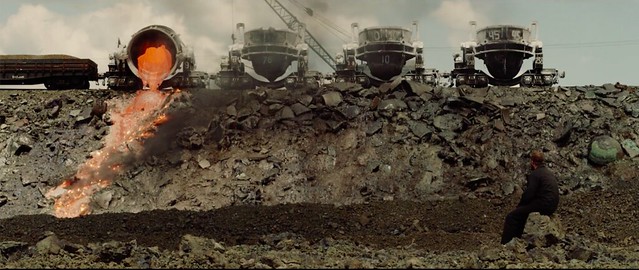
Just like Atlantis, Reflection is only composed of wide, static long takes - the camera only moves when necessary with no cutaways or coverage. There are about 27 shots all together in its two-hour running time. We do not see close ups of actors faces, unless they come closer to the camera. The depth and isolation of its characters, without many words uttered, are all told visually.
The film starts with an absurd scene: Serhiy (Roman Lutskyi), a surgeon, is meeting up with his ex-wife Olha (Nadiya Levchenko) and their teenage daughter Polina (Nika Myslytska) and Olha's new beau, Andriy (Andriy Rymaruk of Atlantis), a soldier, in what seems to be a large industrial indoor playpen. But Polina is suiting up in white HAZMAT suit before disappearing behind the giant glass window. It turns out that playpen is a large indoor paintball court. The teenagers in groups are shooting paintballs at each other while parents outside watch them while talking about the war in Donbas, the south-eastern Ukraine, as the glass window is slowly but surely adorned with bubblegum colored paintball shots. The year is 2014, at the start of the Russo-Ukrainian War.
The next scene is Serhiy in the hospital operating table tending to the badly wounded soldier coming from the front line. But it is too late. He bled out.
The film is divided in two: the war and its aftermath. Serhiy voluntarily joins the war effort, then being captured and tortured by Russian troops. Since he is a surgeon, deemed by Russians to be useful, he is spared and given an assisting role in checking and determining if the tortured Ukraine captives are dying or not. There he encounters Andriy, who is almost dead after a power drill torture session.
The power lies in its long takes and imposing compositions. Vasyanovych possesses an impressive eye for architecture and symmetry, In Atlantis, it was industrial wasteland and outdoor scenes that were the main draw. In Reflection, its oppressive, bunker like industrial indoor spaces the director/cinematographer utilizes for creating dread - whether it's the hospital operating table, torture chamber, portable furnace Russians use to cremate their victims and a pigeon crashing into a high-rise apartment window.
The first half, showing horror of war is relentlessly bleak and dark. The second half concerns Serhiy, thoroughly traumatized by the war experience, trying to get a grip on life where everything is pretty normal. Andriy is regarded as missing in action where no one can find his body; guilt stricken Serhiy has to deal with Olha and Polina. Polina, being a teenager and affected by Andriy's absence, become distant and withdrawn while Serhiy tries to overcompensate it with gifts and horseback riding lessons.
If Atlantis was dealing with fictional scenario of the future ecological devastation and human toll from the prolonged war, Reflection using gray landscapes and claustrophobic interiors, delves into the psychological damage of on-going conflict and threat from the neighboring ominous superpower. Sly metaphors, like dead pigeon, makeshift pyre, ravenous stray dogs are all present. But as with Atlantis, there is a glimmer of hope in Reflection. This time, it's not the love between a man and a woman, but that of father and daughter. Known to use non-actors in his films, Vasyanovych uses his own daughter to play Polina. She in turn, gives a great performance in long takes, engaging in religious and spiritual discussion with Lutskyi who plays her father. Her innocence shines through in a dreadful industrial, monochrome winter Ukraine landscape. Daring in its cinematic language, and unflinching in its presentation of the present, Reflection makes you impossible to ignore the state of the on-going conflict in that part of the world.