

 The pitfall of political filmmaking in general, in my view, both
fiction and non-fiction, is its didacticism that turns people off,
however well intentioned and informative it might be. Without fail,
these films come across as snobbish and classicist. It is doubly
difficult as we live in an era where irony is dead and satire is getting
harder and harder to pull off when the real world already feels like a
grotesque satire of itself.
The pitfall of political filmmaking in general, in my view, both
fiction and non-fiction, is its didacticism that turns people off,
however well intentioned and informative it might be. Without fail,
these films come across as snobbish and classicist. It is doubly
difficult as we live in an era where irony is dead and satire is getting
harder and harder to pull off when the real world already feels like a
grotesque satire of itself. Good filmmakers know
how to use genre filmmaking in order to tell a topical, timely and
socially relevant stories. In the recent surge of those films - Bacurau and Transit
come to mind, filmmakers brought down sci-fi closed to home -
political/economic instability & ecological devastation into a
revenge thriller against first world, and a fascist takeover (history
repeating itself) into an identity crisis, directly referencing the
current state of Brazil and Germany/Europe respectively. These sci-fi
genre tropes gave the filmmakers a lot of freedom to reflect on the
current state of affairs while giving themselves a bit of distance to
play around and even have some fun, while regarding them as if they are
mere sci-fi and works of imagination, not socio-political realist films.
Writer/director/cinematographer Valentyn Vasyanovych (who lensed The Tribe) is one of those good filmmakers. And his stunning new film, Atlantis,
proves that a science fiction can be both visually arresting and also
socio-politically relevant to the present. In this case, it concerns his
home country of Ukraine.
The subtitle in the
beginning says it's the year 2025, a mere 4 years in the future. The
Ukraine-Russian war seems to be over but wintry industrial landscape
suggests that the war devastated the ecosystem and made a large swath of
its land uninhabitable. The human toll both physically and emotionally
is even greater, as we are introduced two PTSD ailing former soldiers
whose sleepless nights are spent on driving around and shooting at
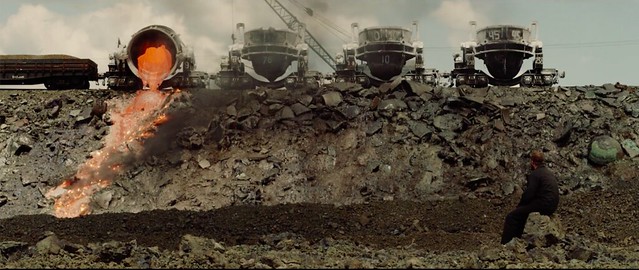
makeshift targets planted on frozen tundra. The steel mill they both
work at is taken over by multi-national corporation: an English-speaking
figurehead on a giant screen talks of the bright future while pumping
up Soviet style propaganda reminiscent of 1984. Many are fired from the job because of the automation of labor.
After
his PTSD buddy's fiery suicide T2 style into the furnace at the steal
mill, Sergiy (Andriy Rymaruk) moves on and gets a job as a water tanker
driver - water became scarce since the bombardment and landmines planted
during the war contaminated much of the country's water supply. On the
road, he meets Katya (Liudmyla Bileka), a volunteer for a humanitarian
group which identify the war dead by digging them up from half-frozen,
muddy mass graves. It's a gruesome process, but it will give a lot of
people closures, she says.
Talk of homeland takes a center stage. Ukraine might appear to be an unforgiving, desolate wasteland now, but where else would its inhabitants live? Sergiy is offered to work for an international organization and go abroad by a woman he rescued from a landmine wreckage. He says resolutely, "This is my home. Where could I go?"
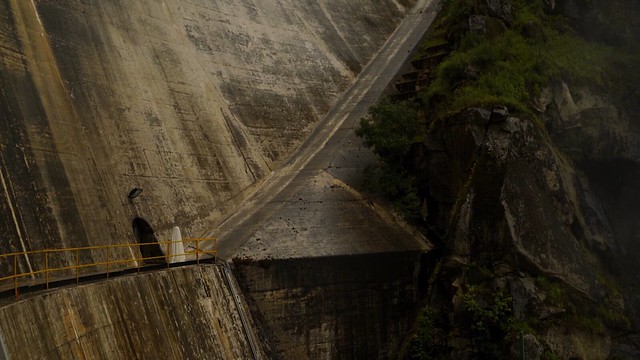
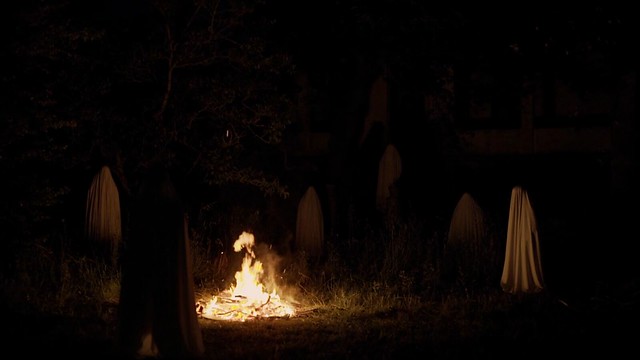
The visual symmetry in wide ratio shot Atlantis
is awe-inspiring. The industrial landscapes and machinery, as well as
decay of abandoned houses (think of decay porn of Detroit, but doubling
here as the war aftermath) have common with Ed Burtynsky's photographic
documentations of the late stages of capitalist society - Manufactured Landscapes (2006), Anthroposcene (2018) and
other documentaries that focuses on ecological devastation and human
footprints on earth. Charting the country's recent history with human
elements, Vasyanovych also finds common spirits with Jia Zhangke, the
master chronicler of China and its people.
Vasyanovych
unsubtly comments on Russian expansionism as seen in the annexation of
Crimea in 2014 and Western commerce influence, but the film is not
without hope. Working with non actors (Rymaruk is a former soldier,
Bileka is a medic), the director imbues real life experiences within
their fictional characters to give sense of connection, sense of
national identity. The bare bone romance between Sergiy and Katya with
the cold and unforgiving backdrop hints at the glimmer of hope, human
resilience and connection despite dire circumstances. It's there, even
if we are only able to detect it through infrared camera footage.Atlantis marks the arrival of the first great film of 2021.
Please visit Metrograph for virtual tickets. The film opens on 1/22.