Showing posts with label Spain. Show all posts

Wednesday, June 24, 2026

Family Secrets

Romería (2025) - Simón Romeria In Catalan filmmaker Carla Simón's new film, Romería, the focus is, once again, her family history, just like her debut, Summer 1993 (2017). This autobiographical film tells a story of Marina (Llucía Garcia), an 18 year old orphan, traveling to the Northwestern port city of Vigo, to reconnect with her paternal family. The year is 2004. She hopes to gain recognition as a legitimate daughter of her dead father on paper, so she can get a scholarship to study film. Navigating knotty family relations with her mother's diary as a guide, Marina learns the truth about her deceased parents and how they were treated by the family when they were alive.

Marina is greeted by her uncle Lois, his wife and three sons who live on a houseboat. She would be staying with them while visiting Vigo. Nuno (Mitch Martin), one of Lois's sons, being around the same age as Marina, becomes close. After meeting various aunts and uncles and cousins, Marina discovers many discrepancies in their stories about her parents and what she was told growing up and also her mother's diary. For instance, Lois tells her that her parents lived in an apartment in Playa Samil, a beach overlooking the isle of Cie, but her mother's diary indicates that they lived in the nearby isle of Toralla, and she finds out that her father died in 1992, not in 1987 like she was told when she was growing up.

Marina grows closer to uncle Iago (Alberto Garcia), a motorcycle riding, black sheep of the family, as he reminds of them of Marina's father. She gets a cold reception from her grandmother while her grandfather gives her an envelope full of cash for her studies. She refuses, but relents when he persists. She is disappointed to learn that her grandparents kept her sick father in the house, isolated, away from prying eyes, after he contracted AIDS and dying. Iago explains that back then, it was a taboo subject and people hid their sick family members in order to save face.

Marina sneaks out of the houseboat one night with the help of Nino and sneaks into her grandparents' house to return the cash envelope. Then Marina takes a rowboat to visit Toralla, where her parents once lived.

Now we are introduced to her parents in the 80s, played by Garcia and Martino, playing double roles, living their carefree, bohemian life on the beach. It becomes increasingly clear that they were both heroin addicts and Iago was in the scene as well, but survived but Marina's parents didn't.

Romería is a pretty film, despite its heavy subject. Shot by the great French cinematographer Hélène Louvart (La Chimera, Never Rarely Sometimes Always, The Beaches of Agnés), the film captures the sunkissed Atlantic coast of Vigo, as well as naturally lit interiors. The dream-like sequence in Toralla, where young lovers (Marina's parents) spend their carefree days is gorgeous to look at. The camera adores luminous LIucia Garcia, who is in every scene, often in her red dress with her cute bangs, walking around with her little digital camera.

But Romeria is a little too precious and picture-perfect for me to fully embrace. The film's visual beauty undercuts its serious subjects - The heroin addiction and AIDS crisis in the 80s and the society's collective shameful response to it. Romería is Simón's personal reconstruction of the incidents that ultimately robbed her childhood. But as with Summer 1993, it feels like a heavily sanitized version of recounting a family history from a doe-eyed, little goody two-shoes innocent child's point of view.

Romerîa opens in theaters June 26 in New York and July 1 in Los Angeles. National rollout to follow.

Tuesday, December 30, 2025

Endless

Ariel (2025) - Patiño Screen Shot 2025-12-28 at 8.07.30 AM Screen Shot 2025-12-28 at 8.24.32 AM Screen Shot 2025-12-28 at 8.20.43 AM Screen Shot 2025-12-28 at 8.31.53 AM Screen Shot 2025-12-28 at 8.32.11 AM Screen Shot 2025-12-29 at 9.25.59 AM Screen Shot 2025-12-29 at 9.28.04 AM Screen Shot 2025-12-29 at 9.30.36 AM Screen Shot 2025-12-29 at 9.32.24 AM Screen Shot 2025-12-29 at 9.34.03 AM Screen Shot 2025-12-29 at 9.37.27 AM Screen Shot 2025-12-29 at 9.52.28 AM Screen Shot 2025-12-29 at 10.01.20 AM Screen Shot 2025-12-29 at 10.04.20 AM Screen Shot 2025-12-29 at 10.06.19 AM Screen Shot 2025-12-29 at 10.09.39 AM Screen Shot 2025-12-29 at 10.17.30 AM Screen Shot 2025-12-29 at 10.19.04 AM Argentine actress Agustina Muñoz (seen in many of Matías Piñeiro's films playing various Shakespearean characters), is on her way to Azores in mid-Atlantic in the Spanish-Portuguese co-production staging of Tempest. She is supposed to play Ariel. But when she gets to the volcanic island, she can't get in touch with anyone. Her phone keeps telling her that no such numbers of her contacts exist and everyone on the island is speaking lines from the Shakespear plays while doing their daily chores - shopping at the supermarket, pumping at the gas station, etc. Agustina understandably gets very annoyed by everyone who's acting as if in trance. Then she meets Ariel, played by Spanish actress Irene Escolar, and finds out that the inhabitants of the islands are all characters from the bard's various plays, acting out their plays from beginning to end. At sunset, they must finish their plays and the next day, they start anew, playing the same characters over and over again.

Irene, who has no knowledge of being a real-life actress, is thrown into an existential crisis after Agustina sowing the notion that Ariel shouldn't just follow Prospero's orders because the character's a rebel and they all need to chart their own destiny. In the meantime, Agustina is trying to get out of the island to no avail. She is resigned to help Ariel to finish off the rest of the plays around the island - Hamlet, Tempest, Macbeth, Romeo & Juliette, etc. There is even a Becket character marooned there - because he landed on the wrong island (Becket's characters' island is the next one over this one), walking around alone, mumbling Becket lines.

Lois Patiño, a Spanish visual artist/filmmaker, plays around with the idea of 'life is a stage', with his trademark crossfades with multiple images and static frames breaking up to reveal what's behind the images we are seeing. At one point, the characters, instigated by Augustina, openly question the role of 'creator' and plan to steal Prospero's (and in turn Shakespear's) book and destroy it and write themselves their own destiny and question the man behind the camera even, by breaking the 4th wall.

With stunning Azores' backdrop and his signature color tinted images, Patiño creates another hypnotic, dreamy film that is both thoughtful and whimsical.

Wednesday, October 8, 2025

Slave to the Rhythm

Sirât (2025) - Laxe Screen Shot 2025-10-07 at 5.08.57 AM Screen Shot 2025-10-07 at 5.37.06 AM Screen Shot 2025-10-07 at 6.02.05 AM Screen Shot 2025-10-08 at 4.44.02 AM Screen Shot 2025-10-08 at 4.33.41 AM Screen Shot 2025-10-08 at 4.43.47 AM Screen Shot 2025-10-08 at 4.41.15 AM Screen Shot 2025-10-08 at 5.05.43 AM What starts out as The Searchers type allegory of taming the untameable, this Moroccan desert set film by Spanish helmer Oliver Laxe (Fire Will Come), morphs into an existentialist experimental film that defies categorization. It's at once tragic and riveting at the same time. And you can't look away in this downer for two hours. And I respect Laxe for orchestrating the power over us.

The first thing we see is the great expanse of canyon walls of the Moroccan desert as a large, but well worn speaker system is set up. Soon, it's the rave scene of the weathered, sinewy, dusty bodies gyrating to the heavy bass of the techno music. This is not the Burning Man kind of rave, the group is decidedly older with gnarly teeth, braids and bits of limbs missing. Among them, we see Luis (Sergi López) and his pre-teen son Esteban (Bruno Núñez), moving from one raver to another, handing out a 'Missing Person' sign. They are looking for Luis's daughter Mar, whom they last heard from five months ago. Someone told them that she might be at this particular rave. But no one there knows her.

A raid from local police breaks up the gathering, and instead of following the caravan of cars to evacuate, ragtag of French ravers - Steff, Josh, Bigui, Jade and Tonin breaks off from the crowd with their decked out RVs and Luis and Esteban follow them in their minivan. So starts a road movie of sorts that's filled with death and explosions and unimaginable grief.

The title card indicates that Sirât in Arabic means a narrow bridge between heaven and hell. And that is what the film portrays. A purgatory that plays out in the backdrop of the world in chaos, the inescapable reality of indiscriminate deaths and misery even in the remotest places on earth. Yep, we are all in this, experiencing the end of the world, together.

The improbable sound of techno beats (scored by French musician Kangding Ray) against nothingness of the desert, move the film along and play pivotal roles in key moments of the film.

Sirât is part Madmax, part Sorcerer, part Antonioni, contemplating where Cormac McCarthy's The Road left off. It's not making a grand statement about the hopelessness of the state of the world. It shows how random death stalks, that grief is universal, that we can't ignore the suffering of others because, again, we are all in this together.

Wednesday, October 2, 2024

Balls, Tassels, Panty Hose and Death

Afternoons of Solitude (2024) - Serra photo After garnering global critical acclaim of his South Pacific Cold War espionage thriller throwback, Pacifiction, Albert Serra, the Catalan "enfant terrible" of cinema, offers a documentary on bullfighting. A self-professed non-lover of the genre, Serra goes on to show the gory, testosterone and blood-filled world inside the bullring through the eyes of Andrés Roca Rey, a famed bullfighter from Peru. But again, this is Albert Serra film, so it is no ordinary documentary. In fact, it's nothing but.

Filmed almost entirely in close-ups in and around the bullring, It is clear that Afternoons of Solitude's aim is quite different. With the help of Serra close collaborator Artur Tort (Pacifiction, Death of Louis XIV) helming at the camera and also serving as an editor, the film has a striking consistency and rhythm to it. The bullfight is a highly ritualized endeavor: the getups - the montera (the Mickey Mouse hat that toreros wear), the tassels, the sparkly elaborate embroidery on the jacket, the pink pantyhose, the dainty satin shoes that resemble a ballerina's. And the actual bullfighting - with horse mounted lancers and the whole cuadrilla first attacking the bull and tire them out until matador steps in and finishing the job.

It's also highly gruesome business- stream of blood on the beast's back, the dirt, mud, mucus, the staring, strutting, and hollering, then death. The sight is not for the squeamish or animal lovers. There are multiple deaths of the bulls in the film. This highly ritualized killing has been a controversial tradition, criticized and protested from animal rights groups for years. Rightly or wrongly, Serra narrowly concentrates on what's in and around the ring, nothing else. This means nothing about Roca Rey, his entourage, the bulls, nothing. And this is what makes Afternoons of Solitude fascinating.

The sound we hear are heavy breathings of the beast and Roca Rey, his team feverishly singing the praises in the ring over and over again: You got the biggest balls! You are the greatest! You are the most beautiful human being in the world! With the pouty gaping mouth, Roca Rey stares down his beasts, while strutting like Mick Jagger. The battles are tense and the danger imminent. He gets gored a couple of times yet sustain only minor injuries. He hears other toreros with broken ribs over conversations.

Afternoons of Solitude has more common with Lucian Castraing Taylor (Leviathan, Sweetgrass) and the rest of the Sensory Ethnography Lab (SEL) filmmakers' outputs, portraying haptic images on screen. Plus, examining machismo of the Spaniards associated with the bullfighting, not narrated but shown directly with no guise or insinuation. Serra's aim is capturing the purity: the purity of the ritual, the purity of the filmmakers who haven't had any prior experience with bullfighting, the purity of worship, the purity of self-assurance. It's a hard to sit through experience but another worthy effort from one of the most adventurous filmmakers of our time.

Thursday, May 23, 2024

Sad King

Cerrar los ojos/Close Your Eyes (2023) - Erice Screen Shot 2024-05-23 at 12.33.05 PM Screen Shot 2024-05-23 at 11.49.44 AM Screen Shot 2024-05-23 at 10.21.33 AM Screen Shot 2024-05-23 at 1.27.02 PM Screen Shot 2024-05-27 at 12.56.50 PMScreen Shot 2024-05-23 at 1.47.13 PM It's been 50 years since Victor Erice made The Spirit of the Beehive where he introduced a wide eyed, then 6-year-old, Ana Torrent to us. And it's been 40 years since his last feature, El Sur came out. So, what does the now 83-year-old director come up with, after all these years? Close Your Eyes is a masterpiece that celebrates the history of cinema and its workers- directors, actors, editors and even researchers. It brings the big emotional ending that shows the power of cinema as well, not in a grandiose, self-congratulatory way, but somber, melancholic way he always has done in the past. And it’s beautiful.

Set up like a mystery and a film within a film, Close Your Eyes tells a retired filmmaker, Miguel, in search of an actor and friend Julio, who disappeared on the last day of filming his never finished film, The Look of Farewell. It a producer of a TV show, Unresolved Cases, that initiates Miguel to talk about his famous actor friend, Julio, who vanished 30 years ago, leaving his daughter Ana (Ana Torrent, now 57 years old) to grow up fatherless. It stirs up Miguel's past as he digs up memorabilia from the storage spaces for the production of The Look of Farewell and reconnect with not only Ana and his old flame but with his editor friend who owns impressive number of films in film cans including footages from his unfinished film.

He comes back from Madrid to his tranquil existence in a small coastal fishing village where he tends to his dog, vegetable gardens and spends his days fishing. But the news of Julio's reappearance disturbs his tranquility, and he is on the road again to locate his old friend. Julio who doesn't remember his past, has been working as a handyman in a retirement home run by nuns. With the help of nuns and the worker of the facility, Miguel approaches his old friend who doesn't recognize him. There's an old remnant of him, carrying a picture of a Chinese girl who was in the film, and a tango tune he whistles. Miguel is determined to have Julio's memories back, with Ana's help and showing him the footage of his unfinished film starring Julio.

More than anything, Close Your Eyes is a tribute to cinema- the strange power of it that mesmerizes and enraptures us. Erice understands the iconic power of image. He understands time passing and its melancholy as well. Sad king indeed.

Saturday, June 17, 2023

Six Love

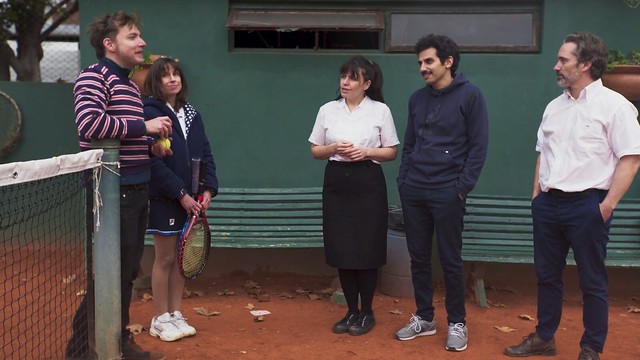
Smog en tu corazon (2022) - Seles Screen Shot 2023-06-17 at 10.00.38 AM Lucia Seles's wry comedy about a Tennis club and its employees and their romance may sound like a premise of a TV sit-com, but its presentation is nothing but. The editing style of Smog is truly innovative. With cutting between parallel actions, long sequences, jump cuts and repetitions, the film is jarring at first until you settle into its own rhythm, as we get invested on the characters. Most of them are neurotic mess: the owner of the place is Manuel, who is affable enough but still wants to present himself as a boss, Lujan, an employee with a penchant for classical music and her precious 16 CD collections precariously stacked on her tiny desk, Javier, a nervous accountant who likes to gather the team around and announce his incongruous findings about the world, Sergio, Manuel's childhood buddy who just came from San Juan to help the business out and Martha, a former player who is hired to give lessons and very sensitive about being called other than 'tennis player'.

As their daily activities play out with their silly and amusing anecdotes and stories, we find everyone is in love with someone else and the feelings are not reciprocal at all and no one is brave enough to come right out and say what they feel. In many ways, Smog en tu corazon is like a Shakespearean screwball comedy or Chekhovian chamber piece that takes place in a rundown small tennis club in Spain. It also reminds me of the sprawling yarn that has been coming out of Argentina in recent years- La Flor and Trenque Lauquen. It's good trend to have these little small films with no budget sprouting up.

Smog en tu corazon is most notable in its editing. It's not tethered to having an extra meaning or used as some sort of signifier; it presents a different cinematic language and rhythm. And I am surprised at myself how easily I get sucked in to these lives and completely forget about the formalist presentation. Enjoyed it immensely.

Sunday, May 21, 2023

Frightening Female Sexuality

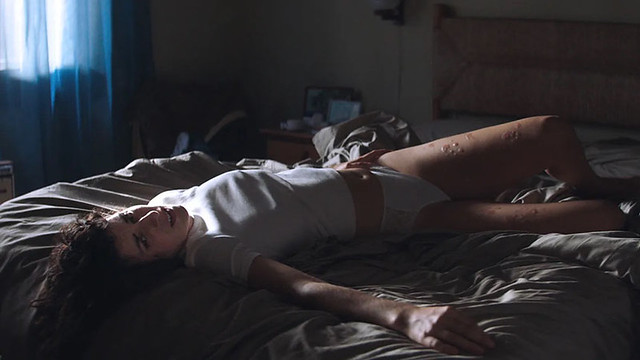
Creatura (2023) - Elena Martin Gimeno Creatura A subtle observation on female sexuality by Catalan director/writer/star Elena Martín Gimeno, Creatura examines a childhood sexual repression manifesting in physical form on the body of Mila (played by the director herself).

The film starts with Mila and her mild-mannered boyfriend Marcel (Oriol Pla) moving into the house of Mila’s parents, Gerard and Diana, as the old couple moves out. It’s the house by the sea that she grew up in. Mila is always horny, but her demands are met with Marcel’s frustration because he doesn’t know what Mila really wants. Mila in turn, gets hives all over her body because of the stress. She says to him she got the condition from her childhood.

The lengthy flashback in the middle concentrates on Mila as a 15-year-old girl. With her more promiscuous bestie Aina, they discover boys and explore sticky situations, as well as anonymous internet messengers for voyeuristic sexual encounters. But it’s still all normal stuff that teenagers are into.

Mila experiments with a hunky boy that she has hots for, but it doesn’t end well. She finally hooks up with a neighborhood boy whom she has known all her life. But when she asks for permission for a sleepover at his house, her father, usually very calm and loving, angrily rejects the idea. Again, Mila breaks into hives all over her lower body.

Creatura is an interesting film about how the female sexuality frightens men. The word 'uncomfortable' gets repeated twice with both Mila’s father and her boyfriend who can’t handle it whenever she expresses her desires.

In a patriarchal society, the idea that girls are either sluts or virgins, depending on their level of curiosity in sex, is embedded early on, while boys grow up expecting, at least, to get a handjob from a girl who shows even the slightest interest in you.

Martín Gimeno goes even further back to find the origin of Mila’s physical conditions with her as a pre-pubescent child, spending the summer days with her parents on the beach. She develops a strong attachment to her father, as he gives her a piggyback ride and giving her swimming lessons in the ocean.

It’s a man stroking his female companion’s bum on the beach that sears into little Mila’s head. She asks her parents to stroke her bum so she can sleep. At first, the parents are not alarmed about her clingy behavior. But her display of learned behavior frightens her father deeply, as it is not ‘normal’ for a girl to behave in what can be construed as sexual in any way.

Her father gets upset when little Mila barges into their bedroom demanding to see him naked. She breaks out in hives and it’s her mother’s turn to console her and wash her in the sea, because sea water cures it all.

After the adult Mila’s role-playing sexual game gets too uncomfortable for Marcel, he leaves. Then Mila gets to spend time with her parents alone, as they come back to console her. Now a grown woman, Mila asks her dad, who is still uncomfortable around her, if he ever felt physically affectionate toward her. This talk is a revelation to him, as he never thought about it in his life.

Creatura delves into a difficult subject to many men: female sexual desire and its brutal suppression early on. Martîn Gimeno gives a committed, bracing performance and bares it all in a film with a difficult subject matter, taking a nuanced yet frank approach, without sensationalizing its subject.

Creatura is a selection in The Director's Fortnight at this year's Cannes Film Festival.

Tuesday, January 12, 2021

Role Play

 La Madriguera (1969) - Saura

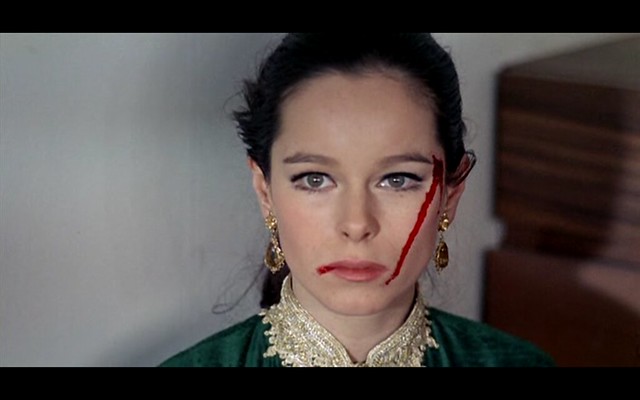
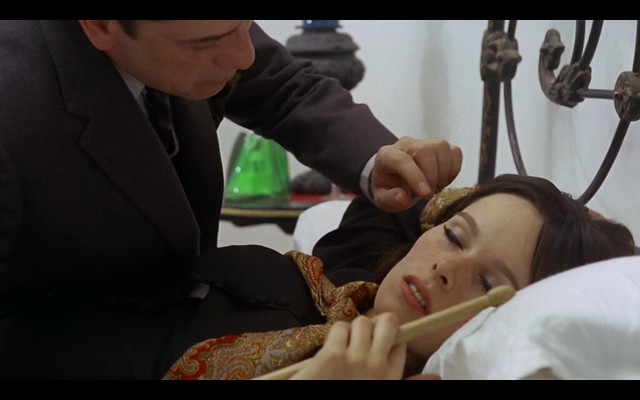
Screen Shot 2021-01-12 at 10.48.37 AM Screen Shot 2021-01-12 at 10.59.53 AM Screen Shot 2021-01-12 at 11.56.09 AM Screen Shot 2021-01-12 at 11.56.38 AM Industrialist Pedro (Per Oscarsson)'s life is work, coming home to his ultra modern concrete and glass house, saying how tired he is and going to sleep. His young wife Teresa (Geraldine Chaplin) has some deep seeded issues from her childhood (her parents died in a plane crash), attached to her old furniture and suffers from nightmares and sleepwalking. Their childless marriage of 5 years is not going well. After indulging her in daddy issues and reliving her childhood in role playing, the couple goes into a full self-isolation - sending maids home and literally drawing curtains to the outside world, even pretending to be not home when their gossipy couple friends stop in with their children in tow. Pedro and Teresa engage in elaborate role-playing where he is Richard, Teresa's childhood sweetheart, a father of Teresa, and a St. Bernard dog saving sleeping beauty in a blizzard. Teresa is always a young girl, often dressed in Tartan miniskirts like a school uniform. But when it comes to real fantasy, like dressing in sexy black dress and lingerie, she refuses to consummate. After one such role-playing game, they end up in a maid's room with pictures of movie stars on the wall. And it seems they can only express their innermost thoughts, even class-consciousness, when they are playing a role. But their full-blown adult play game is obviously destined to end badly. Again, like a bourgeois satire of Buñuel, La Madiguera portrayal of upper-class decadence, contrast of old and new in the Franco era Spain is biting. Yet the portrayal of these couple by Oscarsson and Chaplin are deeply human and nuanced. This is a great film.
Sunday, January 10, 2021

Approximation

Peppermint Frappé (1967) - Saura Screen Shot 2021-01-09 at 10.51.18 AM Screen Shot 2021-01-09 at 10.58.19 AM Screen Shot 2021-01-09 at 11.24.31 AM Screen Shot 2021-01-09 at 11.28.17 AM Screen Shot 2021-01-09 at 11.33.27 AM Screen Shot 2021-01-09 at 11.34.32 AM Screen Shot 2021-01-09 at 11.45.12 AM Screen Shot 2021-01-09 at 11.54.39 AM Screen Shot 2021-01-09 at 11.56.40 AM Screen Shot 2021-01-09 at 11.58.13 AM Screen Shot 2021-01-09 at 11.59.00 AM Screen Shot 2021-01-09 at 12.08.26 PM
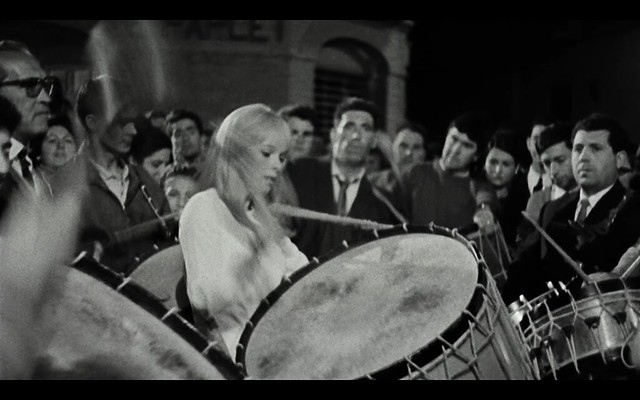
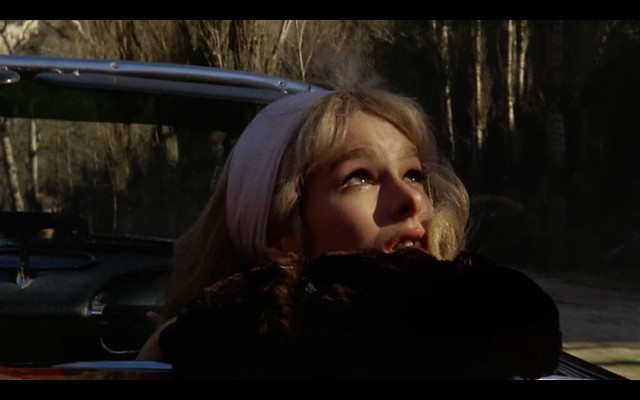
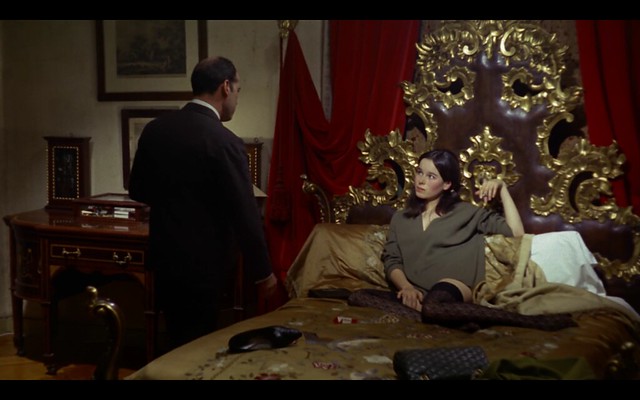
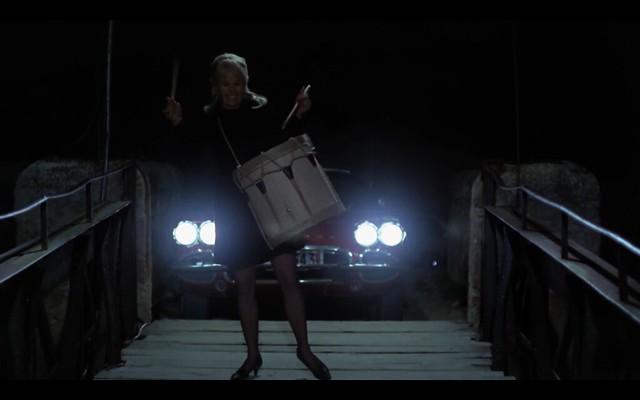
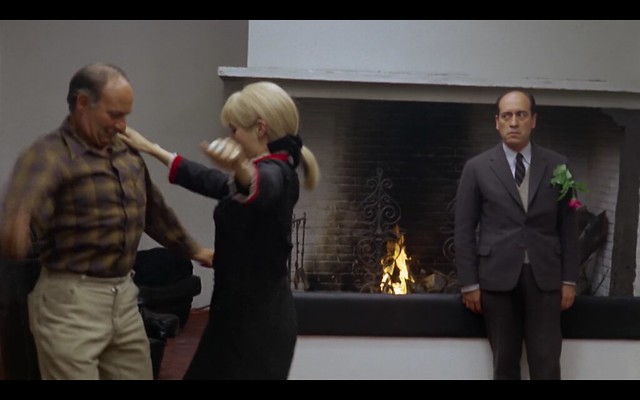
Geraldine Chaplin plays double roles in Carlos Saura's deliciously perverse Peppermint Frappé. A repressed radiologist Julián (José Luis López Vázquez) zooms in on his childhood friend Pedro's young coquettish young blonde wife Elena (Chaplin). Convinced that they've met before, Julián can't help but obsessing over flirtatious and outgoing Elena.

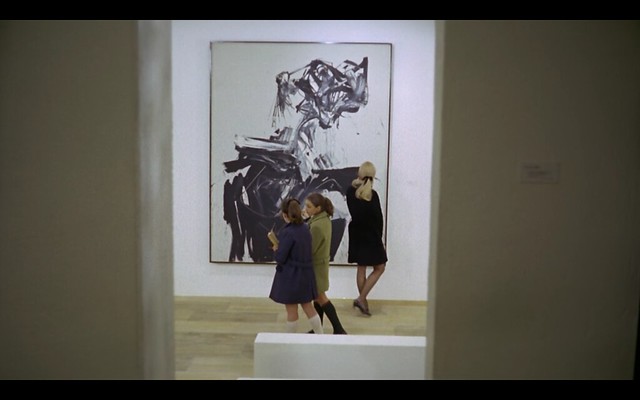
While Elena's teasing continues, Julián moves in on his introverted brunette assistant Ana (also played by Chaplin). It is precisely because Ana's resemblance to Elena that Julián seduces her, to approximate her to his sexual obsession.

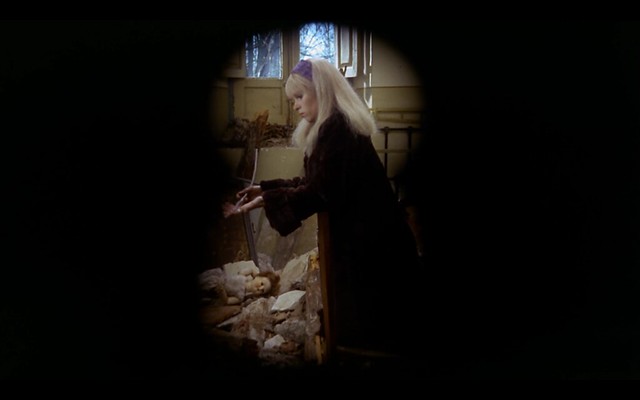
Dedicated to his idol Buñuel, the film's surrealism and Catholicism's grip on Spain, satire on bourgeoisie are all on display: Pedro and Julián grew up in a health retreat run by Julián's aunt who was a nun. They kept themselves busy by looking through the keyholes to satiate their raging hormones. It was Pedro who was always a dominant one. Driving a sports car with young blonde wife, Pedro still dominates square and meek Julián to this day. What's worse, Elena, a teaser with a mean streak, relentlessly plays with Julián's emotions and plays pranks on him with Pedro. Something's gotta give.

Peppermint Frappé closely resembles Vertigo in its sexual obsession and perverted desire of replacing unattainable with its approximation. A woman's identity is something Buñuel also plays with in his last film That Obscure Object of Desire which would make a fine triple feature.

Chaplin is quite enchanting in playing the double role. I might have to binge on some more Saura/Chaplin combo.