Showing posts with label Albert Serra. Show all posts

Wednesday, October 2, 2024

Balls, Tassels, Panty Hose and Death

Afternoons of Solitude (2024) - Serra photo After garnering global critical acclaim of his South Pacific Cold War espionage thriller throwback, Pacifiction, Albert Serra, the Catalan "enfant terrible" of cinema, offers a documentary on bullfighting. A self-professed non-lover of the genre, Serra goes on to show the gory, testosterone and blood-filled world inside the bullring through the eyes of Andrés Roca Rey, a famed bullfighter from Peru. But again, this is Albert Serra film, so it is no ordinary documentary. In fact, it's nothing but.

Filmed almost entirely in close-ups in and around the bullring, It is clear that Afternoons of Solitude's aim is quite different. With the help of Serra close collaborator Artur Tort (Pacifiction, Death of Louis XIV) helming at the camera and also serving as an editor, the film has a striking consistency and rhythm to it. The bullfight is a highly ritualized endeavor: the getups - the montera (the Mickey Mouse hat that toreros wear), the tassels, the sparkly elaborate embroidery on the jacket, the pink pantyhose, the dainty satin shoes that resemble a ballerina's. And the actual bullfighting - with horse mounted lancers and the whole cuadrilla first attacking the bull and tire them out until matador steps in and finishing the job.

It's also highly gruesome business- stream of blood on the beast's back, the dirt, mud, mucus, the staring, strutting, and hollering, then death. The sight is not for the squeamish or animal lovers. There are multiple deaths of the bulls in the film. This highly ritualized killing has been a controversial tradition, criticized and protested from animal rights groups for years. Rightly or wrongly, Serra narrowly concentrates on what's in and around the ring, nothing else. This means nothing about Roca Rey, his entourage, the bulls, nothing. And this is what makes Afternoons of Solitude fascinating.

The sound we hear are heavy breathings of the beast and Roca Rey, his team feverishly singing the praises in the ring over and over again: You got the biggest balls! You are the greatest! You are the most beautiful human being in the world! With the pouty gaping mouth, Roca Rey stares down his beasts, while strutting like Mick Jagger. The battles are tense and the danger imminent. He gets gored a couple of times yet sustain only minor injuries. He hears other toreros with broken ribs over conversations.

Afternoons of Solitude has more common with Lucian Castraing Taylor (Leviathan, Sweetgrass) and the rest of the Sensory Ethnography Lab (SEL) filmmakers' outputs, portraying haptic images on screen. Plus, examining machismo of the Spaniards associated with the bullfighting, not narrated but shown directly with no guise or insinuation. Serra's aim is capturing the purity: the purity of the ritual, the purity of the filmmakers who haven't had any prior experience with bullfighting, the purity of worship, the purity of self-assurance. It's a hard to sit through experience but another worthy effort from one of the most adventurous filmmakers of our time.

Wednesday, February 15, 2023

I am Here to Create the Most Fascinating Images Possible: Albert Serra Interview

AC_Website Event Hero 620 x 348  (3) - Albert Serra Headshot Albert Serra is a mad man. His latest, Pacifiction was my favorite of 2022. Its almost stupid bravado took my breath away. It's all in his digitally captured decaying grandeur of the first world; the remnants of colonialist spy game playing out in paradise, was perhaps the most audacious cinema I've experienced in a long while. Serra is a real auteur in every sense of the way. He might come across as arrogant at first, but listening to him at length, talking about his methods, you find that he is an adventurous soul, always looking for the ways to find images that goes beyond earthly concerns, yet deeply humanistic. It was a privilege to talk to him for the second time, even via Zoom.

Pacifiction opens this Friday, 2/17, Film at Lincoln Center in New York.

How are you?

I am good. I am in Dublin now. It’s late.

Are you working on something there?

I am just checking out the possible locations. Just randomly. I haven’t written any script or anything. But I shot here some years ago. (Singularity, for Venice Biennale, 2016) I dunno…I like some places I’ve seen and wanted to come here and see there’s something inspiring. I have some ideas. Sometimes I have this real place in mind. It’s an interesting thing. It helps to make the process more organic.

Was it the same for you with Pacifiction?

Well not the same because as I said, I couldn’t travel because of Covid, but in the end it was almost the same result. I couldn’t go but I was inspired by some books, you know? But some ideas are mine. Possible nuclear tests were mine! I never heard it or read it anywhere. It was totally an invention but became a visionary, because Russia invading Ukraine and all the talk of nuclear war became popular again.

True.

Everyone has forgotten it. Now it’s the center of the topic again. We went there to shoot, and I shoot very fast. With 4 weeks of preparation, we started shooting- preparation meaning, casting there, looking for locations. We do it very fast. But it was 2020.

Covid.

Because of Covid, on the third week, we had to leave.

Wow.

Because everything was locked down. So, we came back. Then I was thinking about the film in more concrete terms. I knew some of the locations and a little bit of casting and from what I saw there. So, before we started to shoot, already I had some cumulated volume in my head. But the film started very artificial, with plot being on the edge of being ridiculous. But I found it organic in a way. This is the balance I try to find: very artificial idea and setup, with the performances, the wilderness of its surroundings. It makes actors believe in everything they do even though its half humorous, half ironic, half visionary, half political, half serious…I don’t know.

Unlike your other films, this one takes place in the present. But it almost has an aura of the Cold War era paranoia and the colonial past. You said it was partly based on what you read. It feels very much like Conrad or Graham Greene.

Graham Greene perhaps. Conrad, I haven’t read it. It’s a strange thing I haven’t read the Heart of Darkness because it’s very important and good and I read a lot. Of course, there’s a link with Apocalypse Now! with this strange character that Marlon Brando plays because you don’t know if he’s good or bad – whether he is the beginning of something very bad or the end of something very good. But I think there’s something that is connected with his mental state. I don’t know if that is something specifically colonial. My film is more on the contemporary side where the savior/villain has no face. Nowadays everything is spread out, like a virus. Everything is based on total opacity of power – who makes decisions? What are the reasons behind these decisions? And which are the interest parties behind these decisions? Before, there were good people and bad people. Coppola’s film was the end of that illusion. Kurtz was the beginning of that ambivalence. Now we are in this era, and everything is flatter. Everything is less interesting, it’s more like the internet, you know. Real life dissipates, everyone has no face, and things are still going wrong and getting worse. And everyone feels it. Inequality and wealth gap keeps getting bigger and bigger. Everyone knows it and feels it. And no one knows how to correct it. This lack of humanistic approach to solve the problem brings something purely technical, they don’t take account to the souls of people therefore they don’t solve anything. Maybe to you the film feels like Conrad but it’s very contemporary. It’s something that is happening now.

How did you like Tahiti?

I don’t care. I try to force myself to think against cliché. For example, I try to think that these people are not victims of history. Because they do nuclear testing there, so they suffer from this and that. That they lead a very simple and quiet life and suddenly colonizers are sending these nuclear scientists and doing tests in paradise, whatever. But why do I want to tell that story? To say something about these injustices? These are things even a child knows. Everybody agrees. Then I force myself to go there and look for the faults of these people. Sure, they may be victims of history. But they might have bad genes and are lazy. Or maybe they receive a little too much aid. You know where I am going with this. But in order to see things the way they truly are, I have to let the images flow, let the images flow without control and without any meaning from my end. The idea that they are some hapless victims, it would be a cliché. But the reality is not so easy, especially nowadays. So, when I am in a place like this, I try to think the opposite, just to make things more complex and not to reduce the complexity of the matters. And I think it works. That everyone sees that things are unbalanced. When everyone thinks and goes the same direction, and I present the opposite, something happens. It’s a more faithful way to paint that place that you are in. I get the real inputs from the place just because I use this technique. I put myself in the position that I don’t have anything to say. I am here to create the most fascinating images possible.

Talk about being there and finding something. The character Shanna fascinated me. I am very interested in how you casted Pahoa Mahagafanau in that role and what her character means in the film?

She’s a non-professional actor, like all the indigenous people on the island. I have an intuition for people who are interesting and quite natural. They look natural and spontaneous, and I like them as human beings, you know. This is the main thing when I choose actors. There should be something in them I like as human beings. Something I respect, in order to start disrespecting them and start creating my own idea against them, but there should be this equilibrium between us. Not as much as collaborating with them but to abandon them to their own devices and this creates a little bit of tension and that generates interesting images in the film. In her case, I like her very much. She is very spiritual. This idea of transgender, from a strictly visual point of view, not moral or political point of view or anything, I think there’s some purity and ambiguity in her that was extremely fascinating and photogenic. The extraordinary thing is that there is no contradiction in her, not one single moment of tension between two human beings in one. One that was before and the one that is now. There is this pure way of being in her and I like that very much. Transgender thing always has to do with makeup and costume and attitude, you know. They don’t decide to be transgender, it's a family decision in their culture. For example, if they have two boys, depending on the places, if the third one is also a boy, they dress them and raise them as a girl. They do this at a very young age, so they don’t realize all the stigmas that we modern society have on transgender people. They don’t distinguish gender like us. There is no vindication. There’s no gender politics.

I have to ask you about the scene where the surfing contest takes place in the water. It’s so stupendous and surreal, I couldn’t stop laughing at its bravado.

Why not?

It’s so fascinating and spectacular–

It’s spectacular because he (De Roller, played by Benoit Magimel) is there. If you search YouTube, I am sure you can find much more spectacular surfing videos with great waves than this one. But you are not a motivated spectator unless you are a professional surfer. It’s because the actor is in there riding the waves. As you said, it is grotesque and makes you laugh. But at the same time, you are still fascinated by it because the actor is still not breaking out of his character. You question yourself what kind of film you are watching. It questions you a lot of different things. And this is my aim. The plot is very plastic with submarines and all that. You know him looking for a submarine with a torch light at night. And at the shady discotheque where things get very paranoid. It’s very ridiculous and dangerous and extremely cynical. It’s a mixture of all kinds of different things and layers and tonality. At the same time, it’s very compact. It’s hypnotic on the edit and the flow. For me this was the main discovery of the film. The possibility of mixing all these impossible things. And it still works.

Is this how your work usually is - you finding out as you go along?

Yeah. But other films were mainly historical, and you have to be a little bit more respectful. You couldn't open it too much for other tonalities. If it was too grotesque, it would’ve destroyed the credibility of historical ambience. You had to be much more careful with those. Too risky. too risky.

Did it take a long time for you to set that wave scene up?

One morning. 3-4 hours.

Wow.

The whole thing? 24 days of shooting. 1 day of reshoot. 25 days total.

That is fast!

Yes, that is fast. when I was 18, 19, I was working as a construction worker. My boss, who was teaching me, told me one good lesson. He said, “You have to work good and fast!” It stuck with me, and I do the same with cinema, 20-30 years later.

Pacifiction kept reminding me of Kubrick’s Dr. Strangelove.

Yes. Here is what I said before. The grotesque element is there. The political element is there. The scary future of the war is there. The humor is there but it’s a fiction and that makes him a total liar. Therefore, it's less hypnotic, less fascinating, less complex and there is less mystery. The mystery comes from how close to the truth it is or how close to the real show or fake show. The kind of images you see in Kubrick films are much clearer. I work with digital images. There is less control and therefore could be more dangerous. It means they can really capture things that are around that are even out of my control. This content can reveal something that is not so nice. I think it is important to keep the door open. But it’s also a commitment. It’s not that easy.

This is not a political question, but I am wondering is this how you see that it will all end? Unbeknownst us, a bomb goes off without warning?

Iam very pessimistic. I can tell you. Capitalism is spinning in a very harmful way. With the internet it’s even worse. All the human relationships among people are already damaged and the internet just accelerated the damages. The financial inequality and wealth gap grows exponentially and there is no way to stop it. And the tensions grow, and the revolution is not possible because power has all the instruments. The people in the colonies and who are still colonized understand this because that’s how they lived all their lives like that.

I don’t know. Maybe I will do a comedy musical next. Where people dance around and sing happy songs.

Thursday, October 6, 2022

Stupid Brave

Pacifiction (2022) - Serra PACIFICTION - TOURMENT SUR LES ILES (2022) Lush in its widescreen presentation, Albert Serra's Pacifiction is perhaps the most cinematically ambitious film I've experienced in a long time. Thoroughly absorbing from beginning to end, its 2hr 45min runtime is completely justified in my book.

Rotund Benoit Magimel (The Piano Teacher) plays a sleek French High Commissioner named De Roller on the French Polynesian island. I'm convinced that all hunky sharp featured young French actors would eventually hit middle age and end up looking like Gerard Depardieu, without fail. He has to navigate through the angry locals, outside interests, a Navy commander and his marauding troops, to find out whether there is any truth to an international conspiracy that they, whoever they are, will be resuming nuclear bomb testing in the South Pacific.

De Roller, sweating profusely in pimpy white suit and loudly flower patterned shirt hanging out in his hotel resort and clubs, thinks he is wheeling and dealing, making deals to prevent, in the name of the Republic, what’s coming. It’s a glamorous game. At one point one of the character says it's like a James Bond movie but without all the explosions and action and stuff. But they don't get far. The suspects are too tight lipped and not easily swayed by all De Roller offers. You feel that there is a futility in his actions. That he is in way over his head. That whatever it is, is beyond his scope. Where are these men taking local prostitutes out on a boat in the middle of the night? Are there nuclear submarines lurking under the turquoise water? With this thin narrative, Serra paints his own Hearts of Darkness with big brush strokes.

Pacifiction is not dissimilar to Claire Denis's White Material or her most recent Stars at Noon, when it comes the hubris of White colonialism in its misguided superiority complex, and manifest destiny. But Serra's narrative scarcity makes Denis's films feel like reading a dense instruction manual for a washing machine by comparison.

But what's offered in Pacifiction is its grand scope and risk-taking in cinematic filmmaking, much like braving the unrelenting massive waves in the film - the surfing competition in real time with actors actually braving the choppy water, wakes your cinematic senses and wonder; the scene is so unbelievably stupid brave and stupid dangerous, you wonder out loud if this spectacle was meticulously organized or improvised on the spot (the after screening Q&A indicates the latter).

As the wild goose chase ensues for another two hours after the surfing competition scene, you are hooked, as if hypnotized by all the colors and beauty that only South Pacific can offer.

The cold war is never over in the minds of white colonizers. It's a dated stupid game they play, even in paradise. Yet as the world is hurtling towards the global climate catastrophe and a possible nuclear war, Pacifiction doesn't seem too far-fetched or too fictional. I loved every minute of it. It is undoubtedly my favorite film of the year so far.

Sunday, September 29, 2019

Night of Sexual Escapade

Liberté (2019) - Serra
Liberté
Catalan director Albert Serra has been practicing his brand powdered-wig costume dramas in cinema, art galleries and on stage (not particularly in that order) for quite some time now. First conceived as a gallery performance art, his The Death of Louis XIV and its companion piece Roi Soleil were either stroke of genius cinematic daring-dos or insufferable indulgence pieces depending on whom you ask in the cinema circle.

Then comes Liberté which started out as the stage opera first commissioned by Berlin’s Volksbühne in 2018, Serra seems to take advantage on the film medium and expound/expand his horizon of the limitless possibilities of ways in presenting the same subject. And he seems to be relishing it in this film version.

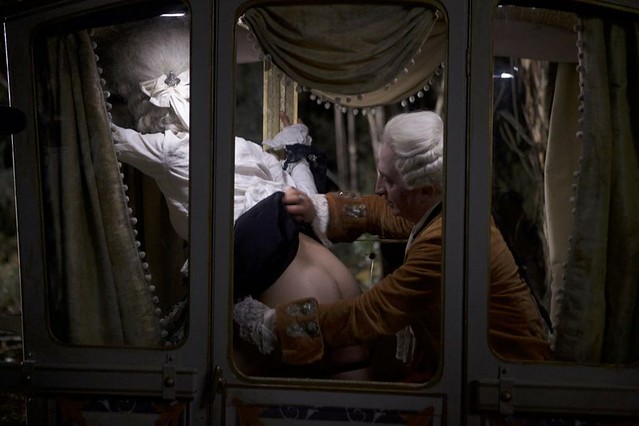
In Liberté, we are introduced to a group of French ex-patriots in the woods at night in ornate hand-drawn carriages fleeing on the eve of the revolution. They are on the run in Germany, where they hope to spread a philosophy of moral, political and sexual indulgence. They are regrouping with the help of Duc de Walchen (played by Helmut Berger of Visconti films). Slowly but surely, the group engages in voyeurism, all sorts of pan-sexual and s&m activities all night until dawn.

The film is intentionally minimally lit. It's in the woods, there are trees and leaves everywhere to obscure the views. And it's criminally dark. If grandiose and ornate production design and suggestive nature were the point of his stage version of Liberté, It’s the darkness and restraint from showing too much is the point in his film version. Yet the film is still filled with graphic sexual imagery.

It slowly starts with these libertines lurking and spying on each other in underbrush. Placid penises appear here and there. Mind you, these are not the most attractive people. What we can make out, many of them are hideously overweight, deformed and amputated. They whisper to each other some of the most pornographic scenes imaginable.

Serra is making the most out of cinematic medium here that he couldn't dare do on stage - graphic sex scenes obscured and not full on porno level but are still very shocking nonetheless: close ups of vaginas, pissing, flogging, bondage, etc. And in turn, he makes voyeurs out of all of us. And it goes on and on and on. The hushed moaning and screaming are mostly drawn out by the chorus of insects at night.

But these repetitive and prolonged sequences reminded me of the effects of repeated sex scene in Cronenberg’s Crash. You don’t see the eroticism anymore after a while. You become numb. Like most of Serra’s work, there is a hint of parody in these shenanigans. I mean, it’s actors in wigs stroking themselves in the woods in a movie called ‘freedom’. I think with Liberté, Serra reached the new height in his formalist approach to costume dramas. He is an artist who will run amok with his approach when given a chance and Liberté is probably the best example. I do like the playfulness in his method when it comes to parody when seeing the past with irony. Liberté goes on a little too long but it’s still a fascinating ride.

Thursday, March 30, 2017

Interview: Albert Serra on The Death of Louis XIV and His Beautiful Method

albertserra
I saw Albert Serra's new film The Death of Louis XIV at New York Film Festival last year. The French New Wave legend Jean-Pierre Léaud plays the title chracter which is unusual for Serra, who mostly works with non-actors in his previous films. As part of FSLC's 20 film Léaud retrospective: From Antoine Doinel to Louis XIV (which runs from 3/29 - 4/6), the film opens this friday 3/31.

Serra is batshit crazy. Once he starts talking, there is no stopping him. As an admirer of his singular artistry, it was a pleasure talking to him at length, even though he did most of the talking. Fair warning. He might sound a tad bit arrogant or non-sensical in this interview. Bear in mind the English is not his first language. But he is a true artist and very passionate about his goal to create something that is truly different and original. He is a searcher and explorer of the cinematic realm. And I respect that.

I’ve been enjoying your work over the years. Bird Song was about the story of Magi, History of My Death was about Casanova & Dracula and now you have The Death of Louis IV. You take inspirations from literary and historical figures both imagined and real. I’ve read about your filmmaking approach where you said ‘Living the present through the past’. What does that mean?

That’s a beautiful quote.

Well, that’s your quote.

It's beautiful. This is true in The Death of Louis IV. You start by asking questions - how the Thirty Years’ War was, what happened or I don’t know, the problems of the state… all these things are like information or clichés. The point is that these meanings are created in front of you when you are shooting the film - OK, you have obviously have to dress an actor like Louis XIV. But then who was really Louis XIV? How did real Louis XIV move? How did he look at people? I don’t know. This has to be created within… I don’t have any idea about that. So the idea that the past can be lived with the same kind of mystery as if it were in present times without any kind of information about the future. So now we are living the past but as we know the future of the past is our present so we can use this.

But to come back and try to live this past in present time with all the innocence and all the mystery of living in the present… this was the point.

So in this sense Jean-Pierre was very good to do that in the film because he keeps the mystery alive. It doesn’t matter how much information you have on Louis XIV. You have the real Louis XIV. Because you never had a moving image of Louis XIV.

This is true.

The only true Louis XIV in cinema is he. Not anything we have in our minds. It was also because of my methodology of using 3 cameras because he (Jean-Pierre) has a really deep relationship with the camera. Since the very beginning we didn’t talk about the subject of the film or even about his character. We didn’t do any rehearsal. It was him realizing facts on set- three cameras, very long takes- chaotic because cameras are moving independently during the shots. So he really couldn’t establish relationship with the camera. As an actor, with one camera you establish relationship and you know what the camera is doing. You want to offer something to it. You want to give something. With all the experiences you have as an actor, you might want to fall back on that relationship you had before because you want to give something concrete. Then it’s quite easy to you fall into cliché to something you already know.

Jean-Pierre was so used to shoot with one camera set up, and suddenly he discovered that there were three cameras- he didn’t know which camera we were rolling, the cameras had freedom to move for the best positions because it’s impossible to move the position with one camera because of the lighting.

So it’s very dark and sometimes I don’t say anything- it was like a performance in some sense. Because there was no previous meaning that he could think about. There was no meaning he can build something around with.

So those two things: Not being able to establish relationship with the camera and not being able to give something made him introspective. Yet all the connections, his link to Louis XIV physically and spiritually was there within him. I imagine he was obsessed playing that role and he gave us all these peripheral, off the frame content that was not cliché, more interesting. He created new gesture for anything. Everything was new. And it’s not even linked with his persona as an actor.

Just one single time or two I allow him to give some of his traces, but in general he was living and breathing the past in present time.

Was Jean-Pierre you only choice for this role?

Yes.

I am wondering how the project came about, because I heard that it was an on going process for four five years.

Yes because it was a commissioned by the Pompidou museum to do it as a performance with Jean-Pierre as Louis XIV dying live in front of the visitors of the museum and we were there shooting also. In a crystal cage with the bed blahblahblah.

But then it was canceled five years ago and we forgot it a little bit and then a producer said two years ago, 'OK why don’t we do it in cinema?' But the idea was a live performance. You know, death and life live. So the film was by chance. It was done in fifteen days. So it was more like performance. I mean it wasn’t shot chronologically obviously because of practical reasons but also I prefer not to shoot chronologically.

I don’t know it was really ambitious spirit of a performance. To look at the history as it was, I don’t know, opaque, no? All the information regarding the death of Louis XIV was opaque. There was nothing really relevant on the subject. Only relevant thing there was was in front of us: Jean-Pierre himself, his body, the decor… there was no meaning, just some three or four facts but without meaning, to have something to do, to shoot--

Medical facts?

Medical facts, you know it’s quite historical. But… So Okay, we will fulfill all this traces of history not as transparent offering as meanings but we will create. We will put volume on it in a very spontaneous way.

Got it.

It’s a historical film. A brilliant film but it’s much more interesting than typical historical dramas. People, not cultivated people who are not specially cinephile are there and really, really into it. I don’t know, It’s the mystery of the performance itself. What is the meaning of everything - the movement, the gesture, every sentence, everything. He gradually moves less and less into total immobility.

What I take away from the film is that everyone dies at the end. Even the king of France who rule the kingdom for more than 70 years dies a horrible death that could have been prevented with modern medicine.

Yeah.

This film is very different from your other films. Your two films I’ve seen, the bird song and the History of My death both take place in mostly outdoors. This one is very confined.

The nature is another character isn’t it? I think as my methodology evolved and matured, I thought I could do different things. It’s the same chaos and same craziness if you think about it. The nature helped in previous films. And there was some kind of spiritual approach. But as my methodology evolved and became more sophisticated, I felt confident that I can do the same kind of things here. Maybe it feels different because it’s a little bit more controlled because the subject demands you more control. If it was Casanova, it doesn’t matter what you do, you can always apply ‘Casanova’ to him- he can do almost everything and get away with it. You can’t do that with Louis XIV. For French people, that would be a sacrilege. Not because it’s not historically accurate, but it’s not…

(I started to laugh)

You know what I mean.

Yes.

You can’t show Louis XIV using toilet.

No no.

I could’ve done something a little crazy and unexpected way, like my other films, more ironical and more physical, more lyrical to break the narrative. But it seemed too risky on this project to do that. Without that, film has some unity of space-time and action. So this is more coherent and calm and sensitive.

It is more coherent.

But it’s wild. (laughs) Shooting with Jean-Pierre was wild. The edit was very well done and it’s very smooth. All the crazy things and the irony are on the side of the doctors.

Irony. Yes.

But I love what was said about the film. The originality of the film is in the clinical approach to death, but the death of very important and dramatic historical figure. It’s quite uncommon to apply clinical approach to human. I like what the New York Film Festival’s catalog said about the movie - there was a beautiful sentence that said it’s a film about the banality of the court and the final moment of the king, but also a film about the banality of death itself.

That’s right.

It’s not something that is applied to Louis XIV.

Tell me about Vicenç Ataio. He is not only hilarious in this but he was great as Casanova in History of My Death. I hear he’s not an actor. He is a scholar, poet and the director of a museum. How did you get him act in your films?

Well because of the physical likeness: I saw some drawings of Casanova. Physically with his face and his nose and everything, he looks a little bit like Casanova. I do like working with non-professional actors because their lack of knowledge of methodology in cinema. It was important to use actors who don’t know how the film was done.

I do have a good intuition for that I think. I never make big mistakes in casting: maybe with secondary actors but never with the leading roles. It’s more challenging. The problem working with professional actors is that they always put some images they already have in their minds between you and them. With unprofessional actors, that doesn’t exist. It’s very beautiful. You work with them without and barriers in a very artificial environment, so you have to be very precise but the end result is very, how to say, it’s more. These characters are born in front of your eyes. It’s really something.

He is really fantastic.

Yeah, yeah. He is the best Casanova ever and probably the best libertine ever in the history of cinema. First or second best. But the best Casanova for sure. This is because of speed. I’ve read Memoirs of Casanova. He is always doing four things at the same time - I’m thinking about this - moving and controlling some women and eating, telling anecdotes and filling categories and going back to anecdotes all at the same time. Living this bright sensation of the moment, mixing great ideas and transforming everything...and this is gorgeous stuff.

You can have this only with actors who have no preconceived ideas, then you can deal with his body and his mind directly.

Was it a lot different directing such an iconic movie legend, Jean-Pierre Léaud?

There was a lot of respect. Even though I didn’t have a lot of authority but to Jean-Pierre, a director is like myth, a god. Because he was born in the era auteur cinema, of the New Wave. For him, the director really creates style of the film. So for him, director is god. But even with that, out of respect I have for him, I couldn’t push him as much as I wanted to. With other professional actors and such, he wasn’t there just because of me. Me but also for himself- because of his career. I mean he worked with the greatest filmmakers in cinema history.

If there were some mistakes in the film, if there was, it was not because I didn’t push him hard enough. It’s just because, I don’t know, chance or something else. And with this methodology I told you- shooting with three cameras, long takes, not telling him exactly what we are shooting, never repeating the same shot again, always mixing the content of different scenes and making variations. It was a fluid atmosphere. Blurring psychologically, blurring narrative, blurring movement, no?

The force of this methodology is so messy. But even an actor with previous experience and knowledge can’t go against that. You can stand up but can’t go against it or you fall down. It’s just a matter of time. He resists. And his resistance becomes the form of the film. He tries something different, yet he doesn’t know what.

In my point of view this film is very deep, very mysterious and very original. He was opposed to that. He couldn’t be in the same exact direction with me. But I hate when they go on same direction as me in the film. It’s a lot more interesting when people go against me. Growls. They give you much more interesting, subtle performances when that happens. But it’s not possible to win for the actors with me.

Are you going to use the same methodology in your next film? I don’t know what you are planning…

Every time it will be evolved, more sophisticated. That is my goal to create something new that’s never been seen before. There are several scenes like that in History of My Death: atmosphere was known because you have seen some of that same atmosphere in other films. Subject wise it shares with other films too. It’s beautiful and well done but it’s not completely new. There are scenes in that film that is completely new, that is not tethered to anything- the acting, the atmosphere, everything.

I really love that film.

I would say 6 or 7 scenes in that film. In Louis XIV maybe two or three.

What’s next for you?

It’s called I am an Artist. It’s about a young artist in present day. It’s the portrait of the contemporary art world.

Wow, OK.

It deals with important subjects - what’s the role of art in our society. Sometimes it’s grotesque but sometime we have frankness of true artist? So I don’t know. It’s tricky.

The Death of Louis XIV opens on Friday, March 31 at the Film Society of Lincoln Center concurrent with Léaud Retrospective.

My review of The Death of Louis XIV

My review of History of My Death

My Review of Bird Song

Wednesday, October 12, 2016

Death and Irony

The Death of Louis XIV (2016) - Serra
 photo c085995e-e958-42e5-8f4a-e15d28b59158_zpszw5d8s18.jpg
Death is a grisly business. It comes to all of us. Even if you happen to be the King of France who's been reining the kingdom for 72 years. From all the documented evidence indicates Louis XIV died of gangrene on his leg caused by diabetes. The year was 1715, without modern medicine, he died a painful, horrible death surrounded by physicians who were perplexed by his conditions.

Catalan filmmaker Albert Serra has been tackling literary/historical figures in his films -- Don Quixote in Honor of the Knights, The story of Magi in Birdsong, Casanova and Dracula in The Story of My Death; approaching them in minimalist, aggressively formalist fashion. Armed with extensive court medical documents and writings of Duke Saint-Simon and the French New Wave icon Jean-Pierre Léaud as the king, Serra sets out to make a straightforward account of the last days of Louis XIV.

Except for the first few minutes of the film where we see the king on the carriage outside, coming back from a hunting trip, the entire film takes place in the stuffy ornate interior bedroom of the Versailles. Gangrene has set in on the king's left leg and physicians are rubbing it with herbs, hoping it will go away. The old king mumbles and shouts in pain while eating grapes and sweets administered by the same physicians who argue endlessly among themselves what to do about the situation. People try to entertain and laugh at everything his Highness says, priests are called in to give the last lights but then sent back because he feels better, and so on. Even the learned physicians of the Sorbonne have no idea about the king's illness. His leg starts to stink and turns completely black. Everyone's waiting on the inevitable.

There are some funny bits with a snake oil salesman played by great Catalan poet and art critic Vicenç Altaió (whose turn as Casanova in The Story of My Death was hilarious) with his 'cure all' tonic made out of bull's sperm and other animal parts. After the initial success of the king's improving health after taking the tonic, the condition worsens and they order the phony physician's arrest.

Léaud, 72, has been keeping his restless, adventurous New Wave spirit alive by working with many daring contemporary filmmakers (Tsai Ming-liang, Bertrand Bonello, Olivier Assayas just to name a few) over the years. Here, he accepts the physically confounding role and fully collaborating with Serra, whose filmmaking charts new territories in cinema.

Perhaps the most poignant moment of the film is forever bedridden Louis XIV receiving his 5-year old great-grandson (the future Louis XV) and giving him advice. Having seen countless war and suffering of people in his time, he recommends the young kid to relieve his people’s suffering and avoid war as far as possible.

Even though Louis XIV’s health deteriorated quite rapidly in a month, the film feels like an eternity. But Serra never waivers in his aesthetics and keeps a straight face until the end.

The irony of the king's death is heightened by its straightforward presentation and procedural approach. The Death of Louis XIV is a very singular formalist filmmaking in its highest order.

The Death of Louis XIV is acquired by Cinema Guild for Spring 2017 release. please check their website for more details.

Tuesday, July 12, 2016

Three Kings

El cant dels ocells/Birdsong (2008) - Serra
 photo bbe1460b-76f3-47de-bb7a-dc4709504266_zpsbrll2sxw.png
 photo 4e73a770-b1a4-49ff-8af9-4a4b4c4eb561_zpslehzhfsn.png
 photo da2c3c5c-999d-4f81-8e4d-05628aef5935_zps5lcckusv.png
 photo 2c86515b-ac6f-4fc2-96bd-4df244075bca_zpsxzkc3w8g.png
 photo bca4d0c8-0375-4a55-b402-49b2fb13de58_zpsjtlptlmf.png
 photo 841c13c7-a0f9-4eeb-9056-877eec1f2b40_zpszdgpcbom.png
Albert Serra's minimalistic approach to a semi-literary figures doesn't really concern itself with its subjects much. The star of his films are its surroundings - the changing weather, drifting clouds that casts shadows upon what's below, the light and darkness. Shot on beautiful black and white, Birdsong tells a story about three kings crossing the desert and sea to pay tribute to the birth of the son of god. On their way, they complain about the rocky terrain and uncomfortable sleeping arrangements. Since everything is shot outside, Serra completely depends on the daylight. When the sun goes down, we can hardly make out the three figures. It's like Three Studges road trip on foot, only the presence of a short haired angel in cassock reminds everyone that this is the story of biblical Three Kings. Once they get to their destination, at the foot of Mary and the humble stone house in nowhere, the music swells, giving some sort of energy. But it dies down. Joseph says something about fleeing to Egypt before the Romans come, and it's time to go home for the trio. They talk about their absurd dreams in the woods while angels watch down from a tree. Beautiful, delightfully minimalistic, Albert Serra is one of a kind filmmaker.

Sunday, November 8, 2015

Casanova Vs Dracula


Història del la meva mort
(2013) - Serra
 photo 5f8ade98-0713-4715-93e7-1fa261748033_zpshkaoer3a.png
 photo fffdb8a7-ea76-4b5e-a711-37832ee022ab_zpsdg4krxks.png
 photo 8c260a16-94b4-4617-8c8a-0692639dd79c_zpsbxvgy7xl.png
 photo 2d6b0604-0a5b-46da-a917-cb63c65b3679_zpsrj0e2ubx.png
 photo f804b18d-a12f-4fed-8b24-d0266113cdd0_zps44xljem1.png
 photo 695be4fe-b9a9-4911-b1e0-892d3122527a_zpsyy61ncu7.png
 photo 758e6298-9e2b-4c20-8438-af57cd18810e_zpsmiohl0qe.png
 photo 7a99c209-f10d-40c7-923a-ce2cce7f031e_zpsqhraxtrf.png
 photo 3c983e22-d64c-42c4-b1b1-8a98e54a46a5_zpsvabzzjlx.png
Casanova (Vicenç Altaió) is getting old. His forever powdered wig and face can't hide his aging vessel. But he's still obsessed with food, sex and defecating. He is now also contemplating death and afterlife. He takes off from his stuffy, opulent mansion to the countryside with his faithful servant, Pompeu (Lluís Serrat). Staying in the cottage of an old river raft operator with his melancholic daughter and her two scrumptious young servant girls, Casanova and Pompeu try to win over hearts. Thrown in the mix much late in the film is a bearded Dracula (Eliseu Huertas) who screams in agony whenever he takes a life (or turns one into a vampire).

The candle/bonefire lit, grainy cinematography just barely sketches out human forms and faces. Non actors in period costumes do their duties with solemnity. It might be oxymoron but Albert Serra seems to be striving for authenticity that is pure both in form and spirit in literary characters. The result is an often hilarious, leasurely paced yarn that has some really beautiful painterly moments. Història del la meva mort is an interesting experiment that strips down these well known literary archetypes to the bone and have them play it straight and lets the thin narrative reach its own internal logic's end