As an adventurous spectator of cinema who writes about films and very much interested in where cinema is headed as an art form, I can say enough that Art of the Real, a film series that showcases innovative, daring, non-narrative films, has been a great wealth of resource and a place of discovery over the years.
Since its inception in 2013, Art of the Real at New York's Film Society of Lincoln Center has been celebrating genre-bending, non-narrative filmmaking. In its 6th year, the series presents new such works by filmmakers from around the world, plus retrospective by Japanese experimental filmmaker Toshio Matstumoto's non fiction work and a tribute to the late Lebanese filmamker Jocelyne Saab. If you are a curious about the possibilities of cinema as an art form, and hungry for something new and thought provoking as well as entertaining, Art of the Real series is the place to be.
The series runs 4/18 - 4/28. For tickets and more info, please visit
FSLC website.
Closing Time

Swiss filmmaker Nicole Vögele's observational film
Closing Time focuses on a tiny late night food stall owned by Mr. Kuo and Mrs. Lin, under freeway overpass in Taipei. The film leisurely explores the surroundings of this night neighborhoods - an arcade parlor owned by a young couple, a dollar store next door, a wayward dog waiting for its long lost owner, a late night/early morning market where Mr. Kuo shops. Stragglers converse over a rice porridge with side dishes about the weather - the recent strong typhoon destroyed domestic produce, leaving not too much choices for Mr. Kuo to shop for ingredients, about the changing neighborhoods, about working too much... The couple prepares and cooks 6 nights a week. We barely get to see them in daytime. The sky is always dawn violet, the street is filled with thousands of mopeds, traffic lights and signs of the shops reflected on the puddles, with the sounds of the night. You get used to the rhythm of this working class microcosm. It's quiet and somnambulistic.
On his moped, Mr Kuo takes off on the road in the later part of the film and ends up in a small town down in the south of the country. We don't know what conspired for him to take this path. Was he tired of his daily routine? Did he want to get away? Don't matter. We are afforded to a lush scenery of Taiwan's countryside. Beautifully composed in Super 16mm in a rainy season of Taiwan,
Closing Time is a contemplative film shedding a light on a part of the world that rarely gets attention.
Those Who Desire
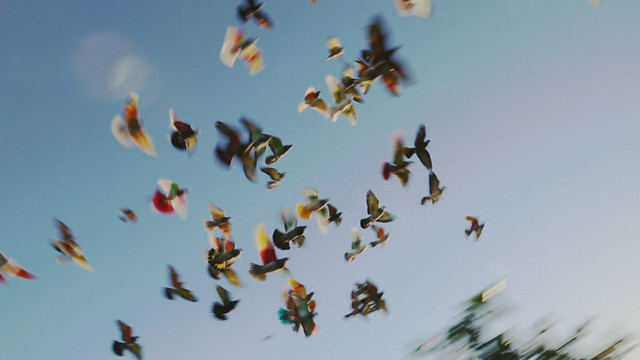
Valencia in southern Spain is a home of the Colombicultura, an exclusively male subculture where brightly colored male pigeons train and compete. Filmmaker Elena López Riera who grew up in the region, documents one of these competitions. The lone female pigeon is released in the air. Soon all male pigeons take to the air, chasing after her. There are amazing amount of rules and all these judges with walkies, watch intently every single move of these horny pigeons. It's not the speed, the narrator say, but lust and ability to conquer. I don't know what that means exactly. We see the swarm of pigeons in the air, on the ground. It's an orgiastic sight. But the competition ends due to bad weather before anything is determined.
Those Who Desire is the grossest projection of macho culture I've ever seen, but it's also fascinating.
Karelia: International with Monument

Karelia, the Northwest republic of The Russian Federation, bordering Finland has a rich cultural, political history. It had been occupied by Sweden, Finland and Russia. Spanish filmmaker Andrés Duque tries to link the cultural significance- the origins of Finnish epic where legends and magic with today's Karelia and ends up with documenting Orthodox Christian family, the Pankratevs, living in the remote area surrounded by nature, practicing some of the shamanism rituals handed down from generations. This first part of planned two part film about the region, Duque also digs up the not so flattering history of Stalin era massacres that took place in the same woods where Pankratev children play, and the Putin regime's effort to rewrite the history. Interesting history lesson contrasts with idylic family life in Karelia.
Movement of a Nearby Mountain
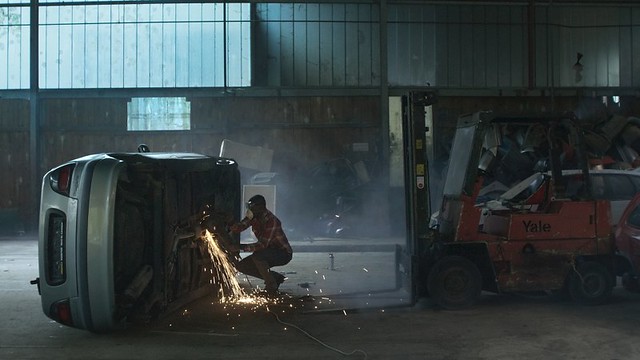 Movement of a Nearby Mountain
 starts with a narration which tells a water fairy who was captured by hunters. In order to free from impending enslavement, the fairy promises the eternal riches pointing to the mountains. Iron. "Gold lasts a breath, silver lasts a lifetime and iron lasts forever". Soon as fairy was let go, it disappears into the water laughing. Its laughter forever lingering in the forest. This narrations repeats at the end of the film. Once in German, the other in Igbo.
Cliff is a Nigerian man who owns and operates a chopshop in the Austrian Alps. He works there, cooks and eats there, shaves there - seems like his spends his waking life there. He buys cars, refurbishes, sells them whole or parts and also exports them to Nigeria. He deals with Hungarians and other Eastern European customers, sometimes in English, sometimes in German. Sometimes things heat up haggling the prices, but he seems to have his usual customers and well liked. But he is usually alone, spending days working. He sings Christian hymns under his breath.
We see a man of two worlds, bound by metal. The chorus of insects in the Nigerian jungle at night carries over the driving shot in the snowy Austrian Alps on autobahn. Sebastian Brameshuber's contemplation on these contrasts and the intimate portrait of one man against the stunning forest backdrop speaks volumes without saying much.
Swarm Season
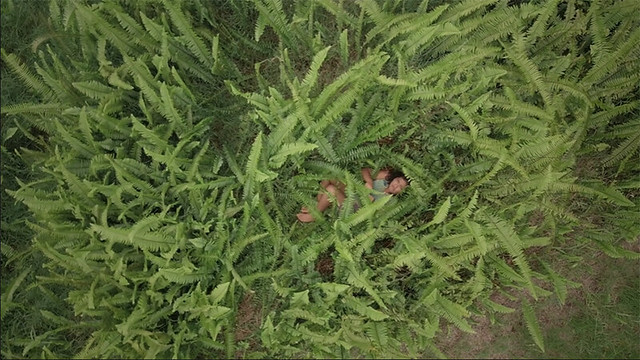
Hawaii's Big Island at a glance, is both a paradise and hellscape: the luscious vegetation along the coast contrasting vast black volcanic field created by overflowing volcanic activity inland that resembles the surface of Mars. Filmmaker Sarah Christman examines the intersection of elemental and superficial, nature and technology, ancient traditions and development, looking inward and space exploration, extinction and survival through the eyes of Manu, a preteen girl and her family who are in beekeeping business.
Manu helps out with her mom's honey producing by tracking wild bees and locating their beehives and relocating them. But she is also an average girl of her age, playing with My Little Pony toys in the sand and daydream while laying in the field. There are biologists collecting queen bees from the hives to study their swarming patterns and their survival.
Manu's dad is a tribal activist protesting the construction of another large telescope on top of the sacred volcanic mountain, Mauna Kea (13,803 ft). Then there is a group of astronaut training for Mars exploration in isolation on the mountain- ideal training ground because of similar climate (lack of oxygen and rough, barren terrain).
Swarm Season features some spectacular scenery of molten lava flowing out to sea, miles of barren black field created by volcanic eruptions, the underwater explosions as well as intimate tender moments with Manu and her family. The film's philosophical musings and seeing the bigger picture don't overshadow its anthropological study of its people and surroundings. It's a great film.
Accession

I've seen filming process as germination in one other film recently. It was Anocha Suwichakornpong's superb
By the Time It Gets Dark. Where as the idea of film relating to germination was more of metaphorical one in
By the Time, Tamer Hassan, Armand Yervant Tufenkian's
Accession is more of a literal one. 13 correspondences in letter form about sending seeds are read mostly by someone related to the persons who wrote it, in various places and times in America, over the lovely hand processed 16mm footage. There are no other diegetic sound or effects sound to accompany these images and the narrations.
Accession is a testament of America as an agricultural society. Seed keeping, passed down to generations in families, is a dying tradition, so is the celluloid. Bringing forth new life year after year and the nurturing those who sow is somewhat equated here with the tradition of filming and creative process of so called 'experimental films'. Lovely, melancholic and resonant,
Accession is a lovely piece of cinema.
Acid Forest

Curonian Spit, a scenic peninsula in Lithuania is a Unesco Heritage site. It's also the home of Curonian Spit, a scenic peninsula in Lithuania is a Unesco Heritage site. It's also the home of
Acid Forest, a swat of forests full of dead pine trees occupied by thousands of big, black, migrating cormorants who made those trees their homes. It's a tourist attraction. There is an elevated wooden platform to take in the scenery. Many tourists from all over the world climb up the wooden stairs to witness the devastating view. They all have something to say in their native language. Some comments that it looks like a nuclear fallout, or tornado aftermath. The guide explains to gaggle of Japanese tourists that trees died of the birds shitting on them constantly, to their amazement. Some invokes Hitchcock's Birds.
Many of these observations and amateur theories are downright hostile. Many jokes about having a gun and shooting them all down. Many complain that the birds are protected by the EU laws. Filmmaker Rugilė Barzdžiukaitė observes all the human activities from above, from a bird's eye view. Constant fly over shots of the whitened branches of the pine trees reveal thousands of these birds making home in Curonian Spit, oblivious of human crowing with their opinions down below.
A biologist is heard explaining to a TV crew that many of misconception about the birds are untrue, making a point that cormorants have existed since the ages of dinosaurs and it's not only their droppings that kill the forests. But we see the human interference at the end as we control much of our nature's destiny, unfortunately.
Walden
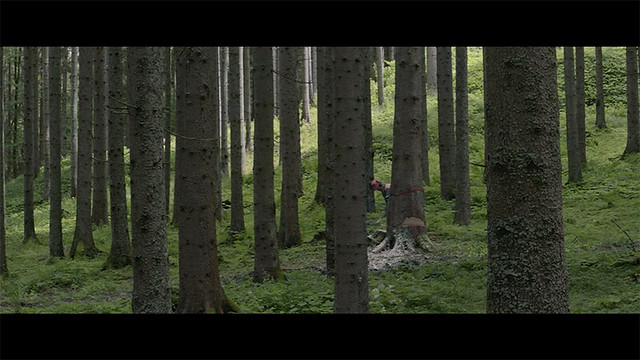 Walden
 consists of 13 slow 360° controlled panning shot from left to right. Each shot lasts about 10 minutes. It starts from Austrian forest where trees a being cut down with a buzz saw. Then the lumber is transported by trains, trucks, boats all the way to the Amazon, the lumber is finally transported by hands deep into the jungle. The film can be a slog for someone craving for a narrative or character to hold on to, but the key here is giving yourself up to the flow as the panning, moving picture creates its own steady velocity.
Each stage strategically stationed and shot in wide format and 50 fps for maximum coverage and the smooth movement, Swiss filmmaker Daniel Zimmerman's film takes an ironic, paradoxical look at a journey of timber in a global economy we are living in, done in a vigorously formalist approach.

