Showing posts with label Book adaptation. Show all posts

Tuesday, June 10, 2025

Deep Time

Underland (2025) - Petit Underland Caves, underground waterways, mines, catacombs, scientific labs are some of the locations featured in Robert Macfarlane's bestselling non-fiction book, Underland. His prose, at once scientific, lyrical and philosophical, has been an open invitation and demystification of 'the awful darkness inside the world'. Traveling through the dizzying expanse of geologic time, the book is a revelatory dive into deep time, a contemplation of our fear of the dark void, reflection of a paralleled world underneath, the myths and memories and our deep connections to the unseen environment.

Underland happens to be one of my all-time favorite books. So, when it was announced that Robert Petit, a visual collaborator of MacFarlane - they did a short film, Upstream together, which features an aerial view of the Cairngorms Mountains and River Dee of Scotland, is directing it, it became one of my most anticipated films to see this year.

Narrated by actress Sandra Hüller whose clear and calm voice is a great match for the material, and voiced by archeologists, urban explorers and scientists, the film takes liberty from the book and sets this visual poem in 3 different locations in 5 chapters: a cenote and its labyrinthine cave systems in Mexico, Underground storm drains in Las Vegas and a science laboratory 2 kilometers underneath Canadian Rockies, each invoking heady metaphors, myth and human connection with our surroundings.

It starts in a black and white grainy pictures of an ancient ash tree, just like how the book starts. The ash tree is located in Mendip Hills of Somerset, where Macfarlane's childhood was spent. Beneath the tree presents the subterraneous passage into the underworld cavern.

Following Fatima Tec Pool, a Mexican archeologist and her team, into the 'entrance to the underworld', - an elaborate cave system where her Mayan ancestors congregated, Petit and his team - cinematographer Ruben Woodin Dechamps and producer Lauren Greenwood, crawl through the rocky, slimy, dark limestone caverns. With all their modern equipment, the archeologists wonder aloud how it must have been with Mayan explorers with only torches some thousands of years ago. For Pool, it's a personal journey to connect with her Mayan ancestors who treated the caves as a sacred place.

We are introduced to an urban explorer Bradley Garrett, who descends into the storm drain system under Vegas Strip. He explains the smell and texture of the system, a distinct sensory experience in an Anthropocene age. All these will be future caves, the remnants from our current civilization, he muses. There's a cryptic note on the concrete wall, warning the rise of water level when it rains.

Garrett witnesses the remnants of life in the drain system. People live down there: the undesirable, unseen people above ground making their way down to escape from the elements, even if that means risking drowning when flooded. It's not only humans, but underland is also filled with discarded materials - cars, washing machines, everything our modern world want to get rid of and make it out of sight.

Then there is Mariangela Lisanti, a theoretical physicist who is in search for Dark Matter, an unseen material that consists of 65 percent of all of our universe. It was her musings as a child looking up at the starry sky, wondering what we are made of. She and her colleagues find the suitable space to test, in which dark-matter particles bump into target material and scatter off atomic nuclei, resulting in a measurable nuclear recoil, 2 kilometers down in an underground laboratory, away from elements and noises. She knows well that her experiments might not result in finding the existence of Dark Matter in her lifetime. Nevertheless, she perseveres, with her childlike curiosity and wonder intact.

Petit and his team capture some glorious images of the subterranean world, conjuring not only physical but spiritual side of our understanding of the hidden world. The past, present and future mingle seamlessly as a sensory experience. As Pool's team reaches the end of the cave, they discover the ancient palm prints left on the wall by Maya people thousands of years ago. She stretches her hand to meet the old palm prints and, in that stillness and silence, deep down underground, we experience deep time.

Underland might be short on the political urgency in nature preservation of Macfarlane's book, but it is at once sensorial, philosophical experience to be had, preferably in a darkened theater.

Underland had its world premiere at Tribeca Film Festival and will also play at DC/Dox on 6/12.

Wednesday, September 6, 2023

Cinematic Vs Literal

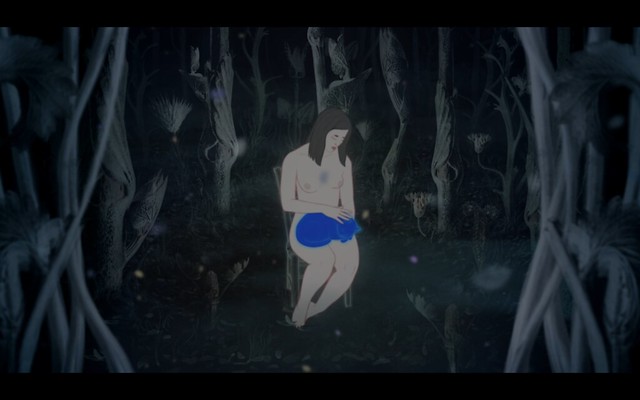
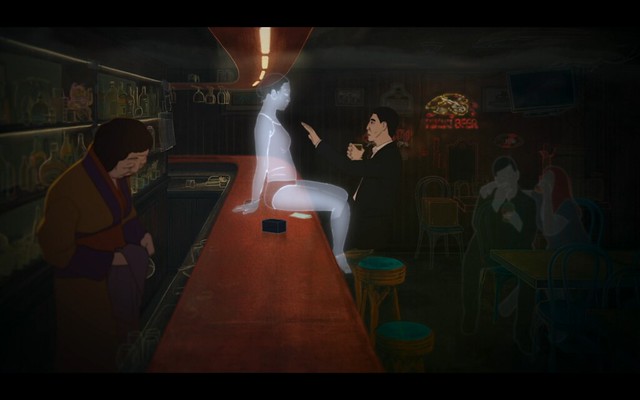
Blind Willow, Sleeping Woman (2022) - Földes Screen Shot 2023-09-02 at 10.28.08 AM Screen Shot 2023-09-02 at 10.28.51 AM Screen Shot 2023-09-02 at 10.52.26 AM Screen Shot 2023-09-02 at 11.15.47 AM Screen Shot 2023-09-02 at 11.19.54 AM Screen Shot 2023-09-02 at 11.23.05 AM Screen Shot 2023-09-02 at 11.45.56 AM Screen Shot 2023-09-02 at 11.47.40 AM Based on several stories written by famed Japanese author Haruki Murakami from 3 different short story volumes, the animated feature Blind Willow, Sleeping Woman has the same qualities of Murakami's droning writing style. It has some fantastical, lyrical moments, like a giant talking frog, flies from a willow tree burrowing into a woman's ear or giant fish swimming in the ceiling of a love hotel, but it doesn't really justify why full on animation project is called for, for the Murakami style of writing and its wordiness. It's especially challenging considering the stories, however carefully selected to be interweaved, are very much literal adaptations, unlike the recent masterpieces by international auteurs who more freely, adventurously adapted the essence of Murakami far better - Burning by Lee Chang-dong and Drive My Car by Rusuke Hamaguchi, respectively.

Because of their literalness, the animated stories in Blind Willow accentuates the somnambulistic nature of Murakami's prose. The wife of one of the main characters who one day just packs up and leaves, leaving a note saying, "Living with you was like living with a chunk of air," encapsulates my feeling of watching the film and perhaps how I become regarding Murakami's writing over all in general.

It's not only Murakami's forever oblique prose that gets to me, but his women characters, over the years, bug me as well. They are there to be served only as objects of male desires and only to have casually sex with them or talk about sex in very frank manners. I mean, come on man, who asks, how sex with your wife was or why would they divulge intimate information about having sex while sounding alarm of a bear attack in the woods, to a total stranger? Women, in his writings, seems incapable of communicating with his male protagonists other than through sex.

From what I understand, Blind Willow, Sleeping Women was first wholey filmed in live action, capturing the movement of actors in 'play acting', then animated and heads are added and character expressions, animated. I can't quite decide if they are racist caricatures of Asian faces or just plain weird with their features exaggerated. While I appreciate that they are not illustrated in cute anime style, I can't help wondering over the filmmakers' decision-making in depicting what they see as authentic 'Japanese' faces.

I think the film being done in animation to display the surrealistic qualities of the author's writing robs of our imagination in this case. If the unreachable distances between man and woman, emptiness of modern world, 'searching one's self' in droning prose on paper that goes on for hundreds of pages sounds shallow and boring, they are boring in animation as well, unfortunately.

Tuesday, January 11, 2022

Little Human Connections

Hytti nro 6 (2021) - Kuosmanen compartment 2 Compartment 1 compartment 6 compartment 3 compartment 4 Compartment 5 A Finnish student (Seidi Haarla) is traveling alone from Moscow to see the 10,000 year old petroglyphs in the Arctic north in Russia, after her Russian professor/lover, Irina backs out of the trip. Last night in Moscow gives and impression that Irina, the worldly older woman tightly wrapped our shy and awkward heroine around her fingers. She is taking a crowded Russian railroad all the way to Murmansk, a small town near the Finnish border. Her bunkmate happens to be Ljoha (Yuriy Borisov), a brusk, blue color worker heading to the same destination for work in the mines. It's a big change for our unnamed Heroine, after hanging out in Irina's intellectual circle of friends in her fabulous flat full of antiques, books, music, meaningful conversations and laughter. She has to quell the sexual advances and lewd jokes from Ljoha. She contemplates quitting the trip and go back to Bourgie bossoms of Irina, but the thought of appearing weak in front of her mentor/lover is too much to bear.

Even though they are very different, this little Russian man’s presence slowly warms up to our heroine. A sort of traveling companion camaraderie develops in an impossibly small train compartment. The train stops overnight in a small town on the way to Murmansk, Ljoha invites her to his babushka (grandma? Aunt?)'s house. She experiences unexpected companionship and human warmth, sharing strong drinks and listening to the old woman's stories. They almost miss the train as they oversleep the next morning.

When our heroine helps out a fellow Finnish traveler who doesn't speak the language, by inviting him to their shared compartment 6, Ljoha is obviously unhappy and jealous. The hipster traveler with a guitar is everything Ljoha is not. She asks (in Finnish) the traveler if he ever feels lonely, and he says that everyone's alone.

Compartment No.6 has everything I love about cinema - Wanderlust, human connection, loneliness, trains, cold weather. Juho Kuosmanen, working from a novel by Rosa Liksom, finds a delicate balance in chiseling out beautiful moments of human connections without unnecessary backstories or dramatics. It's a little romance without all the fuss and stylings, but only warmth and silent understanding.

As the saying goes, it's the journey, not the destination. Our heroine gets stuck in the small town in a foreign land without any guide. It's winter and there is no one to take her to see the petroglyphs. She might have overestimated her relationship with Irina since she is not that helpful with her conundrum. It's only Ljoha who is crazy enough to arrange the snowy, supposedly dangerous trip without any hesitation. They climb on the wrecked ship in the blizzard after seeing not very impressive 10,000 year old scrawls on the rocks. They talk about Titanic. "Why? Are we about to die?" "No, Rose survives." "Well, she dies later." Yes everyone is alone and everyone dies. But what matters is the little moments of human connections and feeling the warmth of other human beings along the way and Compartment No. 6 captures them beautifully. Haarla and Borisov's guileless performances are also aces. Loved it.

Thursday, January 7, 2021

Hyper Sensory World

The Reason I Jump (2020) - Rothwell

The reason I jump Autism is not a dirty word anymore. We all know someone in our lives who are deemed autistic. But even though our society may have gotten better at treating people on the spectrum over the years (relatively speaking of course), our understanding of how a person with autism views the world has been rudimentary at best. It wasn't until 2013, when, a then 13-year old autistic Japanese boy named Higashida Naoki wrote a memoir called The Reason I Jump and British author David Mitchell (Cloud Atlas) translated the book with his wife into English, the whole world, for the very first time, had a chance to get a glimpse of how people on the spectrum perceive the world. The book has been a revelation for many, and helped thousands of anxious parents who for years had to cope with having autistic children without much guidance on the subject. Then again, it was those parents - their persistence, dedication and unconditional love that made this breakthrough possible; for it was Naoki's mother who devised a handmade Japanese alphabet grid so her non-verbal son could finally express himself in words and eventually write the book. I read his memoir a long while ago and it was truly an eye-opening experience.

The Reason I Jump is loosely adapted by documentarian Jerry Rothwell. With jumbled home movie footage and recent events with the help of immaculate sound design by Nick Ryan, the film succeeds in presenting the world of autism as an audiovisual sensory experience. As Naoki explains in his words (in voice over narration by Jordan O'Donegan)that he, as an autistic person, experiences time differently - not in linear fashion, but in spurts: what he experienced when he was little can be present right next to what happened two minutes ago- with all the emotions he felt then come rushing in with it. This explains autistic people's seemingly abnormal behavior - sudden outbursts of shouts, anger or laughter or unexpectedly stopping in their tracks, as if lost in their own worlds. The film also does a fine job of zooming in and superimposing images, approximating how an autistic person concentrates on details of an object and gradually figure out what he/she is seeing in front of them. Obsession, repetition and attachment to an object are also the signs of being on the spectrum, as they give them a sense of security in ever-changing surroundings.

The film start with a cute, button-nosed Japanese boy (Jim Fujiwara) wondering around the woods. With the whimpering noise he makes here and there, you can tell he is autistic. It seems that everything he sees, hears and feels is new and wondrous experience for him. He and the narrator in Naoki's words are coherent threads that guide us through the film.

We are introduced to five of those on the spectrum - Amrit in India, Joss in England, Ben and Emma in the US and Jestina in Sierra Leone. We also meet their parents who care for them. Amrit, although non-verbal, creates colorful, beautiful figure paintings from her surroundings and on her way to have her first gallery exhibition. With Joss, we get to see the progression of an autistic child growing into a man with uncertain future and their devout parents struggling with the fact. Ben and Emma are childhood friends and, unbeknownst each other's parents, have been communicating non-verbally for years and planning their future together. Jestina and her parents, struggling in a society where people with autism were considered possessed by demons and social stigma is stronger, help find a community and finally establish a school for autistic children.

The film acknowledges the horrendous social stigma associated with having an autism and doesn't disguise our atrocious past in treating autistics as subhuman by playing the audio clips of eugenicists and 1938 Nazi propaganda where they advocated for ending those 'invalids'' miserable existence. There are many heartbreaking moments but one of the most searing one is Jeremy, Joss's dad talking about his son's future and breaks down contemplating what's going to happen to his son when he is not around to take care of him anymore. And I am pretty sure that's the worries of thousands of parents who have kids who are on the spectrum.

Produced by Jeremy Dear and Stevie Lee, two of the parents of the autistic children in the film, The Reason I Jump is also a tribute to those parents who give unconditional love and care. The film asks for understanding and, above all, patience by showing how autistic people perceive the world. But perhaps the most moving part of the film is when Naoki says in the narration at the end that if he could get a chance to do it all over again, he wouldn't change a thing. The point being that Naoki and countless others experience the world differently, even better way than we 'normal people' do - a hyper sensory world we can only approximate on film.

The Reason I Jump opens virtually on Friday 1/8 nationwide. Please visit Kino Lorber website for more info.

Tuesday, July 23, 2013

Meaningless Eternal

The Possibility of an Island (2008) - Houellebecq
 photo c6fbf5c3-cd2b-497e-bc92-7e993d49d8a2_zps839a09fa.jpg
 photo 03c1b4b7-bfb1-41c7-992f-171bef800d10_zpsd719a20e.jpg
 photo 1827757a-7ca9-4835-be67-188b3fb8439b_zps0498d5ea.jpg
 photo 754296b9-92c9-4b69-b8e5-28b822e05c02_zps2435ba94.jpg
 photo e8efe3b0-c69d-49b1-8244-7e4eb959d267_zps91386e35.jpg
 photo a308dfd1-1b4c-4e2f-8d1b-4807935630b5_zps582d7725.jpg
 photo a24203ac-f463-46f4-b513-15d6d2ace5d9_zpsb0b6c8be.jpg
 photo 93ddffda-1731-40d1-a8b2-760fd71cfe93_zps173db2a5.jpg
 photo 56de5456-927f-4baa-b4d4-b571e3698a3c_zps69c9f4d2.jpg
The Possibility of an Island, directed by the author of its source material, the Europe's premiere literary enfant terrible, Michel Houellebecq, even in this severely truncated film version, retains much of his theme nonetheless- our absolute aloneness, meaninglessness of human existence. But most of the venom and deviant sexual nature of the book are replaced by Mozart and Beethoven blaring soundtrack and uncharacteristic sentimentality, the film could easily come across as indecipherable, pretentious mess for the viewers who are not familiar with his work. What it does have though is some stunning locations doubling as the earth after apocalypse(s) and retro looking sci-fi sets that are reminiscent of both Tarkovsky and Renais. Daniel the hate spewing, womanizing comedian and a media celebrity in the book is gone. The social commentaries and banality of human life are only reflected (not so effectively) in the few scenes in the beginning with a bikini contest where a fifteen year old Russian girl shakes her booty in front of ugly old people in some mediterranean island resort that Daniel (Benoit Magmiel, looking like a hairless mole rat)is staying in. The Possibility concerns a religious guru (Patrick Bauchau) who promises eternal life with the backing of a scientist who finds a way to clone adult beings with one's memories and behaviors intact and with no dietary organs (they only need water and the sun to photosynthesize). Daniel is a reluctant follower and later becomes designated heir to the ailing guru. But after some hundred years, with everyone gone and no one to connect with, Daniel the clone no. 25 (in the book, never specified in the film) learns the life his predecessors led by reading ipad tablet like journals, finally gets out of his cocoon existence and embark on a search for a woman (Ramata Koite) or the idea of the woman the original Daniel once knew in a barren landscape.

With minimal dialog and rather ungraceful filmmaking, the film obviously doesn't have the same resonance of the book. But it's still an interesting Sci-fi with some gorgeous cinematography.

Sunday, June 23, 2013

Deathwish on Wheels

Crash (1997) - Cronenberg
 photo 948390fc-f4a0-42a1-aa61-eb38adfb7bab_zps7cb96f28.jpg
After seeing it at its release in 1997, where I witnessed many walkouts (including some of my friends), I got to see this in theater again today. However controversial it was back then, the graphic sex scenes aren't as shocking, repetitive nor boring as I perceived the first time. Autoeroticar in this is pretty darn hot actually. And I find the movie still brilliant. Based on J.G. Ballard's book of the same name, Cronenberg, no stranger to the human body/technology relationship, confidently tackles our post-war era fascination with cars. These shiny metal objects not only signify wealth and power but our hidden desire for destruction and death. Along this perverted ride are James Spader, Deborah Kara Unger, Holly Hunter, Elias Koteas and Rosanna Arquette, bravely charting the dark underbelly of the human progress built on destruction and shame. Crash seems immune to aging compared to other tech-oriented Cronenberg movies.

Monday, January 2, 2012

Adapting Norwegian Wood: Tran Anh Hung Interview

Photobucket
When I heard that Tran Anh Hung, the Vietnamese-born auteur of Scent of Green Papaya, Cyclo and I Come with the Rain, was going to be adapting Haruki Murakami's Norwegian Wood back in 2008, I couldn't be happier. I honestly couldn't think of a better match and have been eagerly anticipating its release. With the film's North American release finally slated for January 6th, I had a chance to sit down with Tran for an interview.


As we all know, Haruki Murakami is a literary superstar. How did you get involved with this high-profile project?


I read Norwegian Wood in 1994 and since then, every time I visited Japan I wanted to talk to someone about adapting it. But there was no one to talk to. It turned out that Murakami didn't allow any movie adaptations of his books. Then about 5-6 years ago, the distributor (Sony Pictures) of my film Vertical Ray of the Sun, got in touch with me. They remembered my desire to adapt the book and told me that Murakami just allowed one of his short stories (Tony Takitani) to be adapted, that it might be a good time to try again.

They advised me sending a personal letter to Murakami and that's exactly what I did. He responded, "Okay, come and meet with me in Tokyo." So I spent two days in Tokyo with his team. There were about 12 people at this round table, asking me all kinds of questions in preparation for me to meet with him. But the actual meeting between us was pretty simple. As soon as I started talking about how much I liked the book and why I wanted to adapt it, Murakami stopped me and told me that he wouldn't give the permission to anyone else but me.

Obviously there was a mutual respect between you too.

I think he saw something in my movies that fit with his writing. He made it clear that he was giving it to me, not to the producers. He was very clever putting me in that strong position. He also wanted to read and approve the script and asked for the budget figure.

This was your first time adapting someone else's material. How was that process?


It's quite interesting, because when you are writing your own script, you have to discover various characters' emotions step by step, as you write along. But if you are adapting someone else's, the emotions are already laid out. You just have to translate that on to the screen. It's different.

But it wasn't my first adaptation. There were other projects that didn't happen. That explains why there was 5 year gap between Cyclo and Vertical Ray of the Sun and I Come with the Rain 8 years after that.

I was always wandering about the fact that there are only 5 Tran Anh Hung movies in the last 20 years! Obviously not enough for your fans! What was the project that fell apart? If you don't mind me asking.

It was a great book called Night Dogs by Ken Anderson, about a Vietnam vet, set in 1975, Portland, Oregon. After I read the book, one of those eureka moments happened. I got up one morning and my head was filled with Jimi Hendrix songs. (Claps his hands) Bang! I really wanted to use about 11 Jimi Hendrix songs for that adaptation. It would've been great. It had Adrien Brody, Holly Hunter, Elias Koteas and Harvey Keitel attached...

What happened?


Well, Adrien Brody won the Oscar and didn't want to do it anymore. (Laughs) Actually it was more complicated than that. Canal +, which initially greenlit the project went through a management change. And the new guy said, "If there is any change in this project, we are axing it". Then Adrien dropped out.

Norwegian Wood is essentially a Japanese period film: shot in Japan and with Japanese cast. Did you do any research on that period (1960-70s) of Japan?


No. Not at all. My wife Yen Khe (Tran Nu Yen Khe, luminous actress in all Tran's other films) did costumes and production design for the movie. So we talked a little bit about that. But all the research was for her to do. I didn't feel I needed any research for the characters at all.

I didn't want to have that 'vintage' movie. I didn't want the audience to come out of the theater and go, "I really want that jacket." Same with the furniture. (laughs) For me, it was all about actors and how they convey those emotions.

You worked with Mark Lee (Lee Ping Bin, mainly known for his work in Hou Hsiao Hsien films and Wong Kar Wai's In the Mood for Love) on this project.

Yes. We worked together on Vertical Ray of the Sun and I really wanted him again for the project. When he moves his camera, the psychology of the characters are always on his mind. That aspect of him is quite precious to me. And he is like a big brother. When I'm ever in doubt and need a shoulder to cry upon, he's there for me.

How was directing all Japanese cast?


Very easy. When they are good actors, it's not really much of a problem. I never tell them 'do this or do that'. We talk about the scenes and on the set, I ask them to show me and we go from there. When I asked her (Rinko Kikuchi) to cry in one of the pivotal scenes [when Toru Watanabe (played by Kenichi Matsumura) and Naoko (Kikuchi) make love for the first time, then she disappears the next morning] while, how do you say, not showing too much with her face, you know, while keeping a straight face, she understood in preserving that beauty of the moment. She could pull it off because she is a great, intuitive actress.

The reason I loved the book so much was that it is (for me) the best book I've ever read about the first love experiences. Is that what rang true to you?

Yes, of course. There is an element of danger when you fall in love for the first time. The way you act, each word you say, each gesture, everything you do is so delicate and precious. There is definitely danger in that relationship, like Kizuki (played by Kengo Kora) and Naoko's and later with Watanabe's.

You used Radiohead's music number of times in your previous films and Jonny Greenwood did the soundtrack for this movie. How did it come about?

It was after I heard what Jonny did on There Will be Blood that I had to bring him in. It sounded so different from anything else. Jonny is a serious man and his music reflects that. But he can pull beauty out of the darkness.

So what are you working on now?


It's a complete French movie. It's another adaptation from a book. Honestly, this project will change the way I make movies. But I can't divulge much about it because we are still in negotiations. After that, my producer will need to raise money and all that.

Hopefully I can expect another Tran movie in 2-3 years, sooner maybe?


Yes, lets hope.


My Review of Norwegian Wood


Norwegian Wood opens January 6th in New York, Washington DC and in other cities on January 20th. Check on the movie's official website for more info

Sunday, June 26, 2011

Rageaholic

Under the Volcano (1984) - Huston
Photobucket
Al Finney's boosy Brit diplomat the south of the border is fun to watch. But it's a bit too melodramatic for me. I've heard a lot about Malcolm Lowry's book that the film is based on, filled with symbolism, details and whatnot about the looming WWII. The ominous vocano, white horse, Day of the Dead are all there in the background but they don't make that much of an impact on the story of a man who can't get over his wife's infidelity. Solidly done, and Finney's great. But I couldn't get over how a scrumptious woman like Jacqueline Bisset would come crawling back for pale, flabby man who is drinking himself to hell. He gets away with saying hurtful things because he is drunk. I've always hated that passive aggressive tendency about drunks. It still makes me curious about the book.