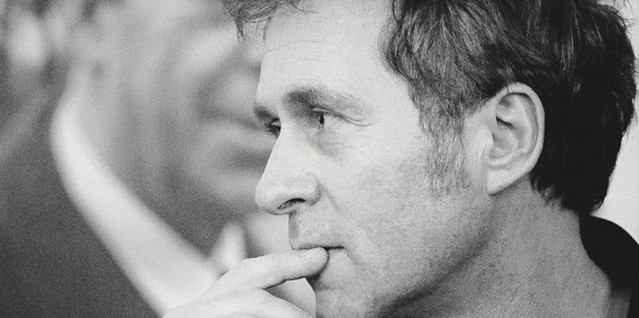
Austrian filmmaker Hubert Sauper, known for his scathing documentaries on devastating effects of post-colonial, globalized world - Darwin's Nightmare (Tanzania) and We Come as Friends (South Sudan), changes his direction and focuses his attention on Cuba this time with Epicentro. While the island nation has been a constant subject for cinema for a long time, Sauper's film blends in the commentary on globalization and cinema history through the voices of extremely articulate and bright children. The result is a engrossing, intimate documentary that is poetic and playful as well as biting. This 2020 Sundance Grand Jury prize winner is seeing its virtual opening in the US on 8/28.
I caught him as he was traveling by rail in France. Even with bad reception and constant background noise, I was able to ask him questions about his filmmaking and the world wide pandemic we are experiencing right now.
It’s a crazy time we are living in. I was thinking that this worldwide pandemic seems like a good subject for Hubert Sauper, since you make films about globalization of the world. What do you make of the current state of the world?
Hubert Sauper: It is a crazy situation because the last three years I’ve been making this film about the beginning of cinema and Covid seems to be the end of cinema.
Yeah this is very much true.
The New York premier of the film was the night before the city shut down. I was locked out of New York and it was really crazy situation. So what do I think of it? I don’t really know what to think of this situation. Even what I talk about Epicentro, for us it was a poetic and fantastic way to communicate life and the quintessence of cinema is not just moving images but it’s a collective work and collective experience.
Right.
It’s a collective journey. And now it is questioned right? That’s the crazy thing. The thing is Covid doesn’t care about any of this human endeavor. So I really don’t know. There’s so much emphasis on where it comes from and every politician is using it as their gain. Again the reason why it was communicated so quickly was moving images that spread around the world. That’s the power of images.
I get the feeling that if any filmmaker could tackle this, you would be the one who can interpret the situation from a globalization angle.
One of the things I thought in the beginning of it was that I saw two patterns and posted two screenshots on my facebook page –One was a graph showing the spread of covid and the other of the international air traffic. It’s from a website called flight rada. And they were identical. It was almost synchronized. You click on flights and the Covid bubbles of the destinations of those flights blowing up. It is a global phenomenon. It’s very simple as that.
So you made two films on the effects of Colonial past and globalization in Africa (Darwin’s Nightmare and We Come as Friends), but this time it’s Cuba. Why Cuba?
I was interested in figuring out the ground zero of moving images where it became super powerful and important. And it led me to ‘Remember the Maine’ and I built it upon that. It was defacto of moving image industry and business were born. Cinema was just like any other technology. And it was used to drum up the support for the war.
I’m not saying your last films were not personal but Epicentro comes across as much more personal and intimate than your other work. Is there any personal relationship with Cuba?
Well, I’m not alone in saying that I love Cuba. I’m not the only one who is fascinated by Cuba. One of the things I am particularly fascinated by it is that it is a society that is very much isolated and extremely well educated. The roles it plays in political geopolitical arena, repeatedly is also extremely interesting. On top of that, it’s the Cubans’ reflections on the world that is so acute. Whenever I talked with and listened to them, it was a jaw dropping experience. Those little kids, Chigas, that I interacted daily--
The little prophets (the kids in Epicentro are credited as that on the credit roll).
Yes, they became friends for life! I talk with them on the phone constantly. Maybe it feels more personal because for three years of being there and making this kind of film, there’s no way not to be over-contact with your subjects and they are all over the place.
‘What the fuck am I doing here?’ was the question I wake up with every morning. You will have a café latte, which cost 3 times the average day salary of a person there. That alone is a great justification. That alone is cynical way of saying that Cuba is a paradise. It is a paradise if you have means. All these questions and paradoxes exist in Cuba. And that’s what interested me. I don’t have answers for these. I just ask questions.
I was thinking about that while watching the film. I mean, as a white European filmmaker making a film about colonialism and tourism in Cuba, how do you reconcile with that paradox? I find out from the movie that you were a son of an innkeeper in Austrian resort town.
How do I come to terms with the paradox of life? What I am saying is that the chief of Green Peace has flown more on airplane around the globe while talking about air traffic and its emissions. How do you…I mean… at best I am saying I’m a filmmaker and I’m not gonna apologize for making a film, you know?
Yep.
But of course there are situations that are very critical, for example, we are filming the photographer, poring in somebody’s backyard almost pushing the kids around to stay in focus and I am just another idiot behind the camera at that moment filming this other guy exploiting someone’s privacy. There is no difference between me and that guy in the eyes of Cuban people.
Yeah there is.
And there were about 30-40 people around us when we were there. My point is that the next day I showed them the footage and they were laughing about that footage. It was around my neighborhood where I was living and I asked them permission to shoot in advance and everything.
I was privileged to be paid by European Union to hang out in Cuba for two years.
Two years did you say?
I lived there for 3 years yes. 2 years teaching a class in film school so I could get a legal status and lodging, but all in all three years. I had a studio set up so I was writing, shooting and editing at the same time there. I’d shoot in the day and come back to the flat and edit at night.
Did you have a lot of footage to work with?
Yeah it was physically about a hundred to one.
Wow.
Right. About 200 hours of footage to make one movie.
It’s ok. I shot a lot of characters. But it’s complex process. How do you portray the psychology of empire. There are a lot of characters saying similar things but you try to get some different angles some are more eloquent than others and some are more interesting as characters. The characters are…I don’t know how to say it, sometimes it takes a form of casting. Sometimes it’s more true…. You are a cinema person. You write for cinema right?
So, I can tell you one thing which sets apart. You remember a group of children at night. One kid says I wanna chew down the other one while telling the story of Cuba, remember that?
Yes.
That was the moment, I met Lionelli for the first time in my life. Lionelli was among 10 kids who were mostly bigger than herself. She made herself to be heard. And we follow her after that: her figuring out herself in school and blah blah. But she was such a character and always wanted to be in front of the camera, she became my friend. And she became one of the figures in the film.
I love the scene where she asks you to sneak her and her friends in to the fancy hotel pool so she can swim.
“I need to pee.” As soon as she went into the pool. (laughs)
Why you like it is because at that point of the movie, you already know her and you realize that she has something to say and you feel that relationship. How do you say? Disobedience. Cuban Revolution is romanticized because of its disobedient spirit against the powerful. It’s her disobedient nature, going to the pool when she is not allowed to and pissing in the pool, I see the exact the same spirit.
By the way, I took a cab to the train station and she is all over Paris now (on the movie posters -Epicentro came out last week in Paris). It’s a kind of miracle. She wants to be a movie star and she wants to visit Paris. And she has done that now.
I really like your approach in Epicentro in weaving cinema history with Cuba. It is kind of epitomized by the presence of Oona Chaplin. The Grand daughter of Charlie and daughter of Geraldine. How did you get Oona to be involved?
Oona is a very close friend. She spent a part of her childhood in Cuba because her father’s refugee status. When Lionelli was watching Chaplin movie in the film, I hadn’t thought of Onna yet. That scene triggered me to call her. I sent her the footage to LA where she was working on Avatar movie. And she saw the footage and fell in love with the kids. So I said come on over and she did.
Wow, that’s awesome.
It shows that she is not only beautiful and talented, but a very free person. I think she enjoyed to be involved in it too. It was kind of a miracle too, having Oona coming out of nowhere watching her grandpa on the screen with the children on the rooftop in Cuba. It wasn’t in the script that I wrote originally. By the way, my first trip for Epicentro was not necessarily about Havana. It was the idea of Utopia and birth of cinema.
Well, I enjoyed the film a lot. I think it’s one of the best documentaries I’ve seen in a long time. But this pandemic is still raging. So stay safe and hopefully you can make a film about the Covid experience, maybe?
I think I’m gonna be OK, if we can keep this magic called cinema, going.
Epicentro opens virtually on 8/28. Please check
Kino Lorber website for more info.
 Hubert Sauper, known for his searing documentaries on the effect of globalization and legacy of colonialism on African continent, in Darwin's Nightmare and We Come as Friends, now turns his attention to the island nation of Cuba. But this time, instead of his journalistic, overtly expansive approach which was necessary to shed a light on the issues that no Western countries knew or cared about, Sauper takes more personal approach in Epicentro, perhaps because Cuba, the Caribbean island nation's reputation as America's longest running foe in such a close proximity, has been a known entity to most Westerners. This doesn't mean Epicentro lacks a bite on exposing and criticizing inhumane US policy on Cuba over the last 50 years and the new exploitation in the form of tourism. Blending cinema historionics and geopolitics Sauper creates something that feels pointy yet ethereal and deeply personal.
