Showing posts with label Lebanon. Show all posts

Friday, June 8, 2018

Builders and Destroyers

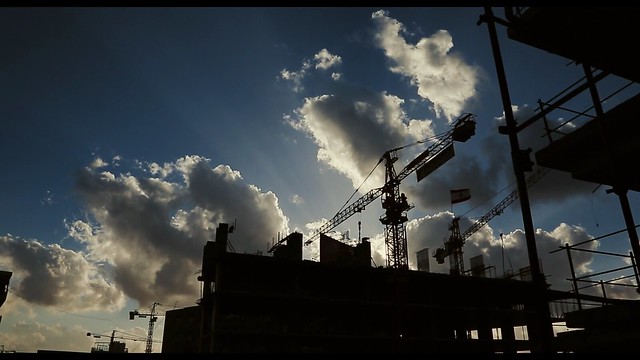
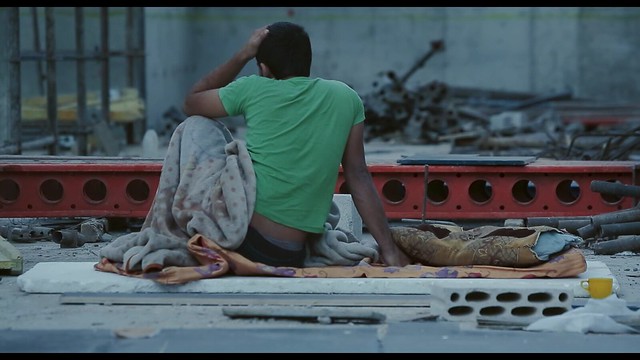
Taste of Cement (2017) - Kalthoum
Screen Shot 2018-06-07 at 7.36.53 PM
Screen Shot 2018-06-07 at 7.39.59 PM
Screen Shot 2018-06-07 at 8.01.46 PM
Screen Shot 2018-06-07 at 7.39.59 PM
Screen Shot 2018-06-07 at 7.47.34 PM
Screen Shot 2018-06-07 at 7.49.45 PM
Screen Shot 2018-06-07 at 7.43.15 PM
Screen Shot 2018-06-07 at 7.43.57 PM
It starts with a voice over. In it, a man remembers his construction worker father coming home from Lebanon. Holding his rough worker's hands, he as a boy could smell the concrete off of it. Dad also brought a poster of a white sandy beach and framed by a couple of swaying palm trees against the blue sky. the boy had never seen the ocean before.

Beirut has seen many wars. Because of that, the city is in perpetual construction boom. As the Syrian war turns its 7th year and the end nowhere in sight, Ziad Kalthoum's Taste of Cement rightfully juxtaposes the urban destruction of Aleppo with the neighboring country's relatively well to do city-by-the-sea. These are Syrian workers. As their fathers as migrant workers, worked to rebuild Beirut in the 80s, they are repeating their father's footsteps, but mostly as refugees. If the recent film The Insult was any indication - as unsubtle as that film was in portraying deep seeded prejudices and rift between the two countries, these workers are living under constant fear of prejudices and retaliation.

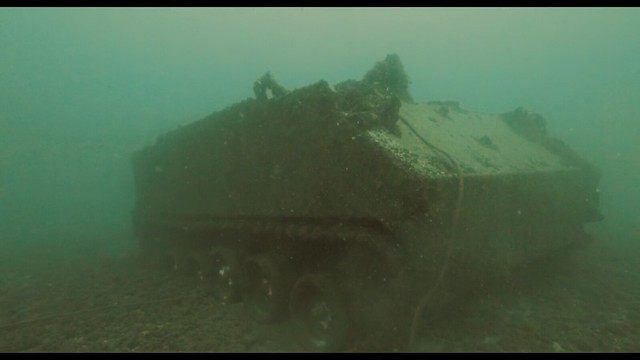
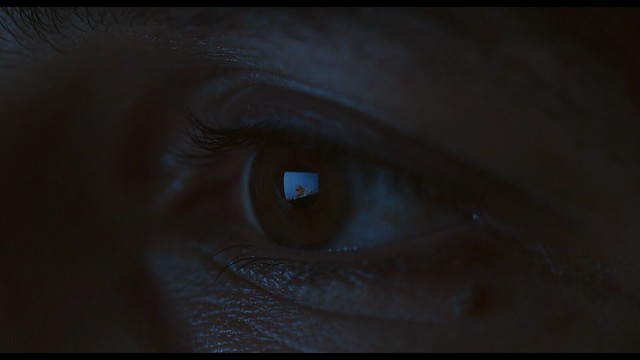
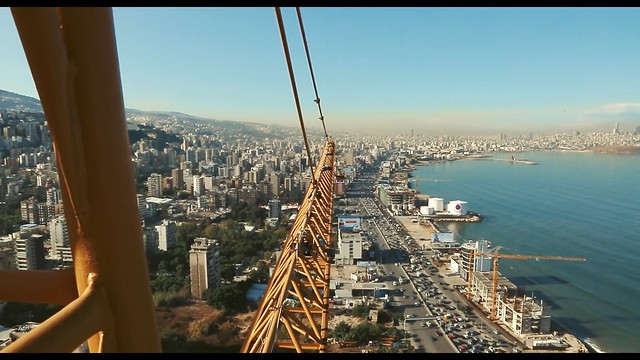
Kalthoum's lens serenely captures these workers in their work place - as they wake up from the concrete floor and emerge from the hole, taking a lift to a dizzying height, working in a highly dangerous environment. At night, everyone's glued to their phones, flipping through the photos of destruction of their homeland - of the mangled concrete and metal. TV blares terrible news from home, reflecting in their eyes. The unending lift ride, measured panning and camera placement all the way up in the crane that features the bird's eye view of the affluent city with many high skyscrapers on the lush slopes, hugging the beautiful coastline. The camera even dives in to the emerald water, reminding us the war past.

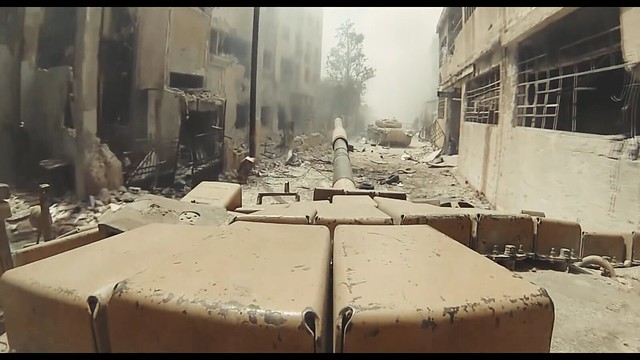
With close ups and silent moments, Kalthoum's visuals have lyricism and sensuality of Claire Denis' work. But once it gets to the matching POV footage of construction cranes slowly panning over the Beirut skyline and tank gunner pointing at its next target, and the real footage of rescue effort to dig out the civilians trapped in collapsed concrete buildings, you realize that Taste of Cement is much more than, say, Terry Malrick's pretty, contemplative picture show.

Concrete smell is the smell of travel and also the smell of death. It's also the smell of rebuilding and smell of destruction. Kalthoum achieves something miraculous here. Something tangible and important. Something that is arty enough for the public already jaded and numbed by the sheer stupidity of the world and don't care anymore, to care.

Thursday, January 11, 2018

The Insult Paints a Well Balanced Picture of a Complex Society

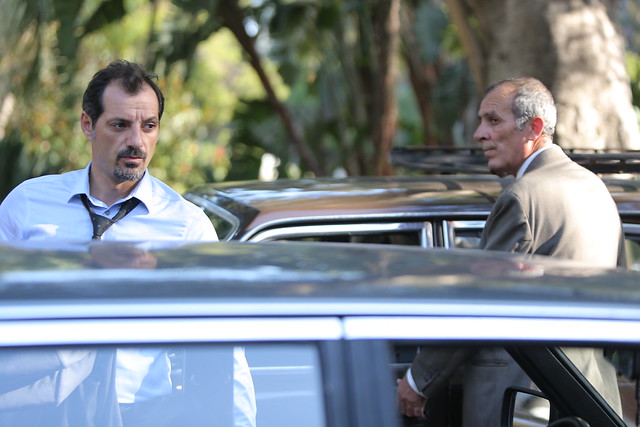
The Insult (1017) - Doueiri
InsultStill1
Situated just above Israel and bordering now war torn Syria, Lebanon's history is just as complicated and tumultuous as any other neighboring countries in the Middle East. With its diverse religious, cultural and political make up of Lebanese society came to a head in the long civil war (1975 - 90) and semi-permanent Palestinian refugee camps within Beirut and other cities have been creating lots of tensions between the majority Maronite Christians and growing Muslim population. Ziad Doueiri's new film Insult, takes the subject head on, in a story of a dispute between two men, one Christian and one Palestinian Muslim and projects it on a national level by way of a unfolding riveting courtroom drama.

Tony (Adel Karam) is a hard working car shop owner with a beautiful wife Shirine (Rita Hayek) who is expecting a baby, living in a rapidly changing, busy Beirut neighborhood. Their apartment and his shop are always inundated with hardline Lebanese right-wing Christian political propaganda - that Palestine Muslims are always inciting violence, draining valuable resources, that they are scourge of the country, etc., on TV and the radio. Yasser (Kamel El Basha) is a foreman of a construction project overseeing a high-rise building being built in the neighborhood. He is a Palestinian who's long been living in a refugee camp with a Lebanese wife.

Their lives intersect when wastewater from drainpipe of Tony's apartment balcony drenches Yasser below. Tony curtly rejects Yasser's polite offer (the construction firm he works for is big on community outreach) to fix the pipe and have it up to the city code. When Yasser's men fix the pipe without Tony's consent, Tony breaks the pipe with the hammer, resulting in Yasser calling him names.

Tony complains to the construction company and wants an apology from Yasser. But when Yasser shows up at his garage with his boss to apologize, Tony enrages Yasser by saying. "(Ariel) Sharon was right, you Palestinians need to be wiped out from the face of the earth!" Instead of apologizing, Yasser ends up punching Tony in the chest, sending him to the hospital with two broken ribs. They go to court, but the judge sides with Yasser and dismisses the case. Tony seeks out a high-profile, hotshot lawyer Wajdi (Camille Salameh) who has history with defending National Christian political figures in the past, to have his case be tried in high courts.

Their trial become a national sensation. In the polarized political climate, their case become a flashpoint for daily violence on the street. In the courtroom, their private lives are scrutinized and outside, their lives are being threatened with violence.

Even though The Insult is one of those politically charged film, it never loses the sight of characters. Tony and Yasser's stories stay personal and never fall into the stereotypes who get easily swayed by their surroundings. Unlike other films of this nature, they are not rewarded by their ideology or identity. They don't get supported by other entities other than themselves. Doueiri never wavers from reminding us that Tony and Yasser are ordinary working people living in a country with a very complex history where one can't separate their politics or identity from their ordinary lives.

Perhaps the best scene in the whole film is right after their meeting with high court judge, who suggests Tony to drop the assault charges to avoid the ensuing the media frenzy circus of a trial. At the court house parking lot, they go their separate ways. But Yasser's old car wouldn't start. Tony, already driving away, looks in on his rearview mirror, comes back to fix Yesser's car. Doueiri hits home with the fact that they are decent, working class people despite their prejudices and bigotry.

Being the smallest country in the region and ethnically diverse, Lebanon has been long mired in geo-political power games by powerful neighboring countries (along with the US), the film also puts a spotlight on lesser known facts like the PLO led massacre in Damour, a seaside town where many Christians were killed. It was a retaliation of a massacre of the Muslims in Beirut that happened just before. 'No one has a monopoly on suffering and pain' is the main take away in the film.

The Insult is a timely film in the world of extreme political polarization and where political correctness is viewed as a bad thing, and that every word that we utter still matters, that there are consequences to what we say.

The Insult opens Friday 1/12 in New York and 1/19 in Los Angeles.

Friday, March 11, 2016

We are all Parisians

Parisienne (2015) - Arbid
 photo 2e674a3c-f8b2-48cd-8606-b0d28521a0ee_zpsu7p5qzdn.jpg
There is no shortage of a-young-girl-coming-of-age films in French cinema. Danielle Arbid's Parisienne charts this common, seemingly familiar territory. But it's from a perspective of a foreigner, a Lebanese girl to be precise, in the 90s. Even though the film is set in the pre-9/11 world, it resonates strongly today, with France (and much of Europe in general) going through a social upheaval the scale not seen since 1968, because of massive influx of people from the Middle East region.

The strength of Parisienne comes from stellar performance by a newcomer, Manal Issa, playing Lina: a young, defiant girl with a dubious visa status attending university in Paris. Its semi-autobiographical, beautifully nuanced script (co-written by Julie Peyr of another semi-biographical, period film, Arnaud Desplechin's My Golden Days- also playing as part of this year's Rendez-vous with French Cinema) also helps making the film memorable.

The film starts with Lina on the eve of her life as a university student in Paris, fleeing sexual advances from her uncle (played by terrific stage and film actor Waleed Zuaiter) from Paris suburb. Once in Paris, penniless and homeless, Lina somehow manages to force herself into the cramped apartment of her classmates. She even scores a telemarketing job through one of her roommates. Just like any good foreign student, she is enrolled to study economics. But she soon has a change of heart after taking an art history and literature classes. The passionate professors Mm. Gagnebin and M. Lemernier (veteran actors Dominique Blanc and Alain Libolt), leave a big impression on our young protagonist in shaping her artistic tendencies. She also takes up an older lover Jean-Marc (Paul Hamy) who showers her with affection and gifts.

But things start falling apart when Lina inadvertently sabotages her roommate's job by being good at what she does while battling the unsympathetic immigration system. Tempers fly and the typical, jingoistic rhetoric- 'filthy immigrants are only here for handouts' is invoked. Lina ends up in a women's homeless shelter (she calls it a palace). Jean-Marc, being a married man, dumps her when things get too touchy. Then she hears her father in Lebanon is in his deathbed.

Lina then hooks up with a cafe waiter Julien (Damien Chapelle), whom she met when she first got to Paris. A low level drug dealer and a musician in his spare time, Julien introduces her to the other side of Paris - more gritty and working class, if you will. She also befriends with the royalists who frequently hang out with skinheads. Ironically, it's them who provide her with lodging. With the help of Mm. Gagnebin's lawyer friend, she tries fend off the impending deportation.

Lina is not a noble savage character as one typically gets portrayed in western films. She steals, and cheats to survive. Just like regular teenagers, she lies to make a cool impression on people, that she is an war orphan. One can easily dub Parisienne as 'An Education of Lina Kawal'. Concentrating on Lina's flight exclusively for two hour running time, the film is an intimate portrait of immigrant experience that is both very personal and universal. Arbid treats the 90s backdrop very casually (except for the appearance of Frank Black on stage - stock footage from the 90s I'm assuming, as Julien and Lina go to his concert) as if the setting and time are just numbers because we all know that history keeps repeating itself.

Lina, except for her stunning beauty, is fairly ordinary girl, adapting and blooming in complicated surroundings- be it politics, art, music, men and sex, taking all in. Issa portrays our complicated heroine with great intensity and thoughtfulness. Her presence is hard to ignore and you can't take your eyes off of her when she's on screen. All the supporting characters are stellar also. Vincent Lacoste (Eden, Diary of Chambermaid) plays a volatile socialist student, Rafael, who happens to be a son of the liberal lawyer who's helping Lina's case. He is a reminiscent of young Jean-Pierre Léaud- quick witted, wise and nonchalant. They become a couple. Elina Löwensohn (Nadja, Sombre) shows up as another foreigner in trouble with immigration at the court hearing and offers quietly heartbreaking backstory, again, illustrating what it means to be free and what's at stake in these cases.

The immigrant experience in France is a hot subject for a film as the country has been weathering some of the worst terrorist attacks in recent memory and consequently had a close call politically with the extreme right wing National Front almost taking over the country in the last election. Jingoism and bigotry are rising. Films like Persepolis, Mustang and Parisienne are great reminder of changing face of France, that the immigrant experience is just as French as having a coffee at an outdoor cafe or riding a bicycle in a beret chewing on a baguette. The film's original title, Afraid of Nothing (Peur de rien) is an apt one and perfectly suited for the personal story of Lina. But the Parisians, considering the theme of the film that everyone living in Paris can be and should be called that, I think Parisienne, however generic it sounds, is a better fit.

Parisienne plays part of this year's Rendez-vous With French Cinema series. For tickets and more info, please visit FSLC website.
Sunday, April 26, 2015

Beirut Confessional

Birds of September (2013) - Francis
 photo aa87d827-5cf9-4dfd-b9b7-0f2cfb946f4d_zpszcmvhjd3.jpg
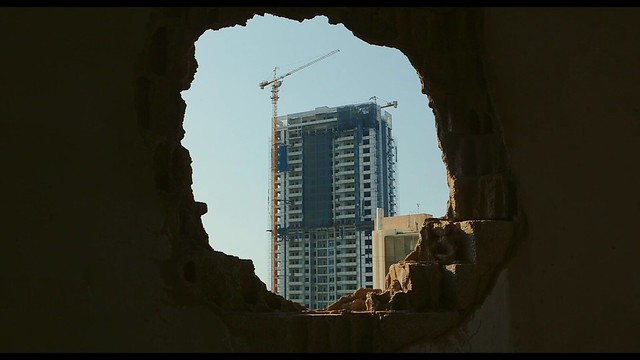
I can see Birds of September fitting nicely in the catalog of films Havard Sensory Ethnography Lab has put out. A van equipped with large glass panels for sides and back slowly drives around Beirut with interview subjects candidly talking to the unseen director, Sarah Francis. The subjects are usually in the back of the van, sitting on a chair while the background changes constantly as the van weaves around busy traffic, day through night. It has a similar effect of Manakamana or a Kiarostami film. But the interviewees stories are distinctly Lebanese and Beiruti. Downtown Beirut seems very cosmopolitan and secular even though ahan (call to prayer) is heard from time to time. It's also achingly beautiful in rain.

Francis records people from all works of life - unemployed man, nurse, yogi, middle aged business woman. The film has several different layers visually and aurally. Their stories are recorded separately and laid over the subjects as they quietly look around their surroundings. They are separated from their environment by glass walls, yet not. In intervals, a male narrator's philosophical musings (written by Francis) fill the gap. The city with such a violent history seem like just any other place - the subject's lamentations are about the same as our concerns and wishes. 'Loneliness in individualism' bit strikes a cord with me. One of the best films I've seen this year.