Showing posts with label Photography. Show all posts

Monday, April 3, 2023

Gazes, Mischief & Defiance

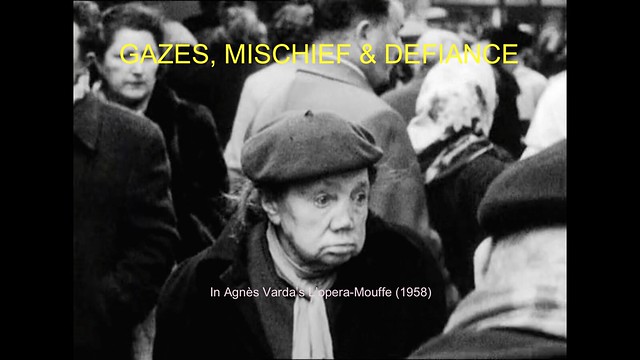
L'opera Mouffe (1958) - Varda Screen Shot 2023-04-03 at 12.09.10 AM L’opera Mouffe is a 16 minute short film Agnès Varda directed in 1958 after her feature debut Le Pointe Courte. Pregnant with her first child, Varda made the film in her immediate neighborhood on rue Mouffetard, in the Fifth Arrondissement of Paris. It is a mix of observational documentary and avant-garde style, filmic diary of a pregnant woman. It is done in her irreverent, self-reflexive, hybrid filmmaking that she was known for all of her career. The tagline of the film is carnet de notes filmées rue Mouffetard à Paris par une femme enciente en 1958. It has a catalog-like structure with the title cards - The Lovers, Feelings of Nature, Pregnancy, Dearly Departed, Joyous Festival, Drunks, Anxiety, Cravings and so on. With the narration/singing, the film depicts the mind of a pregnant woman as she observes both lively and harsh daily lives of the inhabitants of rue Mouffetard.

The film jumps around from one imagery to another. With loosely associated images and themes, L’opera Mouffe is a typical, Joyous and life affirming Varda film in a little package that showcases all of her usual themes and preoccupations in her later works - gazes, object/subject relationship, human bodies - especially female bodies, frank depiction of sex, aging and destitution. Screen Shot 2023-03-28 at 3.03.04 PM Varda starts the film with her own naked, pregnant body. Her naked torso, seated against the black backdrop which accentuates her very large pregnant belly. There are many scenes in the beginning of the film with young lovers’ mingling bodies in various close ups- the contours, the crevasses, dimples & goosebumps. It is not the question of whether she was comfortable with showing nudes, as much as seeing the world through her perspective - “the world is defined by how I look and not how I’m looked at.” (Ince, 613)
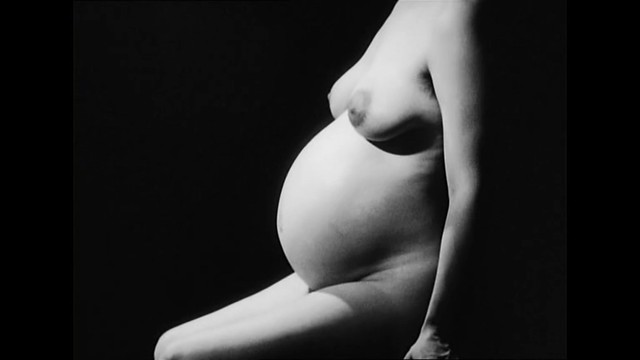
The haptic visuality, which the eyes function as organs of touch, whereas optic visuality sees things from enough distance to perceive them as distinct forms in deep space, haptic looking tends to move over the surface of its object rather than to plunge into illusionistic depth, not to distinguish form so much as to discern texture. (Ince, 603) Indeed, considering the next shot after Varda’s big pregnant belly are closeups of a giant pumpkin sliced up and its innards scraped out by an unseen farmer at the market. Through the deployment of a haptic gaze, Varda’s body - the filming and the filmed body - becomes here the feeling thing and subject-object Merleau-Ponty describes. It’s a self-portrait in haptic, rather than optical space. (Ince, 605)

Post-feminism constitutes a standpoint from which Western European female filmmakers disentangle their agency from unresolved issues in feminist praxis and theory: how to identify and develop feminine identity and expression within a society and a film system founded on male-dominant models of subjectivity. (Maule, 193) Throwing in her own naked, pregnant body first and foremost at the start of a film, Varda puts detractors questioning her as a feminist filmmaker to rest. And she did this in 1958. Screen Shot 2023-03-28 at 3.05.07 PM A simple narrative in L’opera Mouffe is a tale of young love. We see a young beautiful couple in the beginning: naked, embracing, smiling and making love in bed in their tiny habitat: A snapshot of a paradise in the biblical sense. The sequence is full of joy and happiness, directly contrasting the old and destitute habitants Varda films on rue Mouffetard.
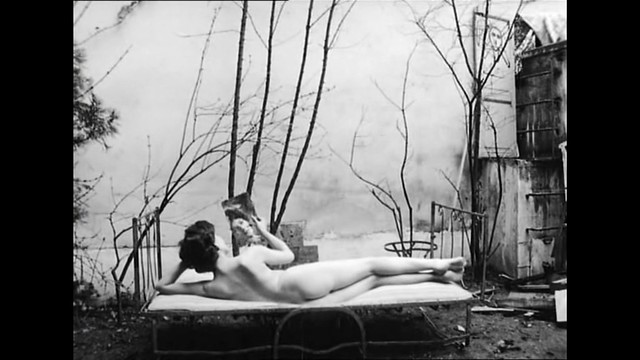
The image follows the young couple’s happy thrist. Beautifully composed in the backyard of Varda’s dwelling on rue Mouffetard, with bare trees in the background, the nude female actor lies in a makeshift bed, looking at her reflections and smiling.

In Lacanian sense, the moment in which the infant looks at his reflection in the mirror is when the child develops a sense of self. Before this, the child doesn’t think of himself as an individual at all, but simply exists as a unified subject, as one with his surroundings. Therefore, the development of a sense of identity leads to a distorted image of true self. This reminds me of many of the mirror scenes in Varda’s filmography, most notably Cleo from 5 to 7 and Beaches of Agnès. In Cleo, when the protagonist first sees herself in the mirror, after being told her fate by a fortune teller, it is to reassure herself the sense of self. That she is still beautiful and that gives her the feeling that she is more alive than others. It’s that youthful beauty that says all is well. As the film progresses, with fractured mirrors, Cleo learns to leave her distorted version of self in the mirror and become free from how the society expects to see her as. In Beaches, Varda sets up multiple mirrors on the beach, as she walks on by and sees reflections of herself in multitudes of angle, suggesting a kaleidoscopic view of her 70 year career and life. The young couple disappears in the middle of the film, then reappears at the end to embrace, not only by themselves this time, but surrounded by the inhabitants of rue Mouffetard, in the middle of crowded street, suggesting that they go out of their own little world to face the real world while still keeping their love and harmonious relationship within the community. Screen Shot 2023-03-28 at 3.08.12 PM There are many instances when Varda’s unsuspecting subjects on the street realizing they are being filmed and looking straight into her camera in L’opera Mouffe. This shot is not the first instance that happens in the film. They are both men and women. But more often than not, it’s the male subjects who wears intense displeasure on their faces.

It is interesting to think about Laura Mulvey’s notion of male gaze in cinema when viewing the film. In a world ordered by sexual imbalance, pleasure in looking has been split between active male and passive female. (Mulvey, 837) The images of woman as passive raw material for the active gaze of man takes the argument a step further into the structure of representation, adding a further layer demanded by the ideology of the patriarchal order as it is worked out in its favorite cinematic form - illusionistic narrative film. (Mulvey, 843)

Again, considering Mulvey’s book was first published in 1975, Varda seems to be a way ahead of the curb in terms of her feminist filmmaking practice, defying patriarchal order of the world early on. Screen Shot 2023-03-28 at 3.38.59 PM The ending sequence features a tracking shot of a visibly pregnant woman carrying a heavy load of groceries on the street. The title card reads “des envies” (cravings), followed by the shots of fishes in the outdoor fish stalls and various meat displays in butcher shop windows. The same woman stops by at the florist and starts voraciously devouring flowers. Perhaps Varda was commenting on weird cravings of a pregnant woman. But when we think of flower eating metaphors in art and literature, we think of lotus eaters in Homer’s Odyssey, an island tribe who are in a state of blissful forgetfulness. The term is often associated with people who indulges in pleasure and luxury rather than dealing with practical concerns. Many of Varda’s films, there are both sad and good moments, but all of her woman characters, there’s joy in being a woman and whether there’s a happy ending or tragedy with the choices they make for themselves. She quotes Simone de Beauvoir, “You are not born a woman, you become a woman.” (Kline, ed. 96) She explains woman’s prerogatives very nicely in an interview:

“If I enjoy pregnancy as a sexual event, it’s my life, my body! Many anti-feminist women don’t. If you choose to have children, pregnancy is a natural event, you should enjoy it. I’m not recommending the way the Church tells me to enjoy it, as a duty, or strengthen the state or the family. It’s never talked about, but most women actually enjoy sexy more when they’re pregnant, for reasons we don’t really understand. I supposed that has to do with many things. But should I deny it? World that make me a better feminist? A woman should let herself feel good being fat and full of baby, that’s her privilege. A model figure isn’t everything, and if that’s what you want, you can go back to it later.” (Kline, ed. 96)


BIBLIOGRAPHY

Ince, Kate. “Feminist Phenomenology and the Film World of Agnès Varda.” Hypatia 28, no. 3 (2013): 602–17.

Kline, T. Jefferson, ed. “Agnès Varda: Interviews.” University Press of Mississippi, 2014: 92-101.

Maule, Rosanna. “Beyond Auteurism : New Directions in Authorial Film Practices in France Italy and Spain Since the 1980s.” Bristol UK: 2008 :Intellect: 1-296.

Mulvey, Laura. “Visual Pleasure and Narrative Cinema. Film Theory and Criticism :Introductory Readings.” Eds. Leo Braudy and Marshall Cohen. New York: Oxford UP,1999: 833-44.

Wednesday, May 24, 2017

Visual Journal of Raymond Depardon

Journal de France (2016) - Depardon
depardon
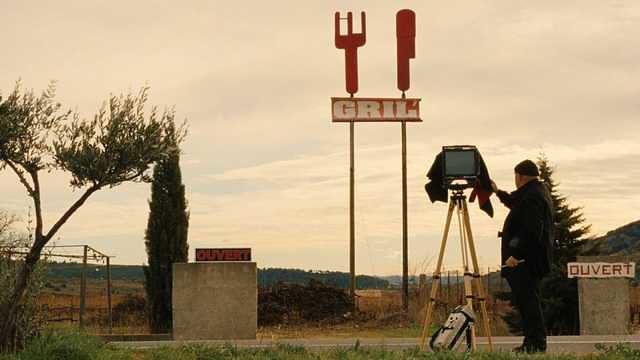
An intimate portrayal of a journalist, photographer, filmmaker Raymond Depardon as he embarks on a tour of his country with his large format still camera. Unseen narrator is his long time collaborator/wife/Sound recordist Claudine Nougaret. It's both journey through time and intimate portrayal of Depardon and his unending curiosity around the world and at home. Depardon's assembled, mostly handheld reportage takes us to various political hotspots around the world since the 60s - Venesuela, Chilé, Czechoslovakia, Congo, Djibouti, South Africa and a lot more. It also illustrates the artist's obsession with the desert with all it represents. We get to see how Depardon and Nougaret hooked up through various stock footage. It's a great doc that avoids being a sentimental nostalgia piece. Great Saturday morning movie it turns out to be.

Saturday, January 2, 2016

Uncomfortably Intimate, Bafflingly Beautiful

Field Niggas (2015) - Allah
 photo 73a42e1c-0456-4b1d-8208-6c75f2312f28_zpses4tek01.png
 photo 58b47754-e644-4643-9248-56972532beb8_zpszzfclixo.png
 photo 9430b6f1-b046-4a4e-b17d-5543adcd7dc8_zpszhqefsdo.png
 photo dbe2f1e2-ac73-4f12-b545-2c9e313c4184_zps6mnnrjv8.png
 photo 25516a4b-9cc6-49fc-a8ff-07eebc437384_zpsesv3gbtn.png
 photo 2a360c90-1a8f-4978-b8b0-21a27c4f6013_zps9n1o6hdi.png
 photo 5b555469-1ce3-4098-97de-5dbdfde92495_zps1hjwueo4.png
 photo 26ad3a0c-3ae8-49ed-82b9-85b6ddd6abd3_zpscllkgyag.png
 photo 2ce713bb-665c-463a-a3a4-46e6941ab1a1_zps6kzy7e80.png
 photo 6d49f8e4-e48f-4ce0-a476-e3f6d5a19f82_zps6266bh2o.png
 photo 43fd997f-5b16-448d-b06a-89019b069daf_zpsgi1mmsif.png
 photo 5f6b0aa6-c97d-43be-a83f-6513362174a9_zps3mwjldf2.png
 photo 8906a125-461c-40a1-80a0-649b8d88b5f0_zpsuicmtwpm.png
Kalik Allah has been photographing people in East Harlem (Lex & 125st) for years with his analog 35mm camera. Field Niggas is an extension of his practice with a small DSLR (shot in half the normal speed). The power of his arresting images is in his subject looking back at you straight in the eye. The experience of their lingering glance is bafflingly beautiful and uncomfortably intimate. I haven't felt like that probably since Robert Bergman photo exhibit in 2009. Accompanying wild tracks of its many subjects conversing with Allah give necessary context to the images presented. Obviously, Allah being a brother from the neighborhood gives him advantage to take these intimate photos at night in East Harlem. And the young photographer is not shy about his involvement in the process. He is seen and heard throughout the film.

Shot in the shadow of Robert Gardener incident during the Summer of 2014, the tension on the streets is reflected in the film as well. Police presence is everywhere and Allah includes them in his universe too. These young officers might be voiceless and distant in the film, but that doesn't stop Allah from getting in their faces and share his photo albums with them.

With the evocative title and constant presence of old chain gang songs, Allah draws parallels to the present inner-city life - poverty, drugs (it seems the drug of the choice at the moment is K2, the synthetic cannabis) & single motherhood. Field Niggas is a great snapshot of the nitty gritty present of the street people. But Allah seems incapable of staying away from beauty- time and time again he revisits pretty faces lit only by the dim street lights.

Please visit Khalik's Tumblr

Sunday, September 13, 2015

Greenpoint Outing 9/13/15

Nicole and I went out to Greenpoint today to checkout Brooklyn Renegade Craft Fair. Most of those exquisite trinkets were too much to afford as expected but we had a great time walking around. Here are some pictures:
 photo 05918f2a-b6a5-477a-8e0d-5dfad3b03cb1_zps8ufrkawm.jpg
The setting sun hitting just the top of the Ed Hopper row houses on Kent Ave.
 photo bc130a5e-b51c-45e8-9e61-fbb40ecc70bb_zpsadxbzvqy.jpg
Nicole at The Bounty. They have a lovely backyard, well more like a greenhouse. We took a shelter as the rain drops fell. The sky was getting dark then cleared again.
 photo a8773500-b904-4565-95cb-c5f6fc5a81cd_zpslnr37e1k.jpg
The ceiling of the greenhouse.
 photo 27c490cc-668e-4f1a-aeca-f2a5fd5488d3_zpsnhfzyg3z.jpg
 photo 203ec110-698c-4e7a-9152-da6b399a0012_zpsapt1popd.jpg
Inside the Bounty Bar.
 photo cfc40ba6-fbb9-469a-9d42-d716a949ba61_zpsiffx9u8z.jpg
A window display of a house full of toys. This person must love showing off his toy collections.
 photo 4bc8362c-9a8d-4611-b2dc-b987ee46aa64_zpst01fpbrs.jpg
Empty lot near the East River overlooking across Manhattan at sundown.
 photo ad9c18c5-a7bb-4ffd-bb23-cd7099536ba5_zpsudbfvj4q.jpg
Ducks taking a bath in rain puddle.
 photo b6595ee5-bb1a-4aef-a83d-84fcf0c6b561_zpseiy79zha.jpg
Some funny Ad campaign.
 photo 07de30c3-913e-4132-a94a-870190008a19_zps2vpdh57h.jpg
On the Waterfront looking across Empire State Building at dusk.
 photo ae0af4c4-676d-4113-9441-04d16b23dcbd_zpssjipyql7.jpg
Some salacious poster for a show.

Thursday, March 27, 2014

Mystery Well Worth Investigating

Finding Vivian Maier (2013) - Maloof, Siskel
 photo Vivian115-thumb_zps6f5a6f0c.jpg
I became aware of Vivian Maier's beautiful photographs through my photographer friend about a year ago when he showed me a photo book he just purchased called Vivian Maier: Street Photographer.

Those Rolleiflex medium format shot black and white photographs of people immediately grabbed my attention. He told me a very improbable yet amusing story about how Maier's work was discovered. In 2007, a young man named John Maloof, while doing research on his Chicago neighborhood, happened to come across a box full of 35mm still photo negatives at an auction house. He then discovered that the box contained amazing works of art. They belonged to a reclusive woman who worked as a nanny and housekeeper all her life. Ever since then, Maloof has been doing everything in his power to get her work out into the world.

Curiosity really got to Maloof. Clearly not satisfied with getting out the book and the website dedicated to Maier's work, with a video camera, he, along with co-director Charlie Siskel (nephew of the late critic Gene Siskel), sets out to find just who this woman really was, interviewing an impressive amount of people who, one way or another, knew her. There is so much she left behind -- not only of thousands of undeveloped b&w and color film rolls, but also stacks of newspaper clippings she collected, receipts, letters, clothes -- that had been in storage, and would most likely have been thrown away if Maloof didn't intervene.

So who was she? Finding Vivian Maier works like a good detective story: a lanky woman with a French accent, who took thousands and thousands of photographs in her spare time, who appeared in many of her photographs herself, but never showed her pictures to anyone. Did she want her talent to be discovered or didn't she? The film traces her life as a nanny/caretaker in Chicago and the New York area by interviewing many of the families she worked for. It seems that Maier had a dark side as well, as some of the children (now adults), whom she took care of, testify about her condescension toward 'normal' people and their lives.

Maloof even travels to Maier's ancestral homeland in French Alps, a small town where her mother is from. There he finds a film lab where Maier corresponded with its technicians. Maier knew the importance of developing and editing her work. She wanted her work to be shown at some point.

Although this documentary doesn't go deep into her late years, it was some of the children, whom she took care of as a nanny, who came to her rescue to get her an apartment, and took care of her until the end of her life.

Finding Vivian Maier is a fascinating documentary about a person's life. And I give Maloof a huge credit for his dedication. Many interviewees snigger at his unbelievably good luck of stumbling upon Maier's work. One of the interviewees bluntly tells him in the beginning of the movie, "I just wish I discovered them (photographs) first, not you." The filmmaker demonstrates that the film's not about him, but all about his subject, by exiting the frame and letting the story unfold by itself early on. 

It is quite commendable to devote many years of your life cataloging and sorting through not only someone's life's work but also one's life story. It is Maloof's unwavering devotion to let Maier's work be known (with a great curatorial eye) to the world and the sincerity in his investigation into finding who she really was that I find extremely noble and moving.


Finding Vivian Maier opens in New York and Los Angeles on Friday, March 28, and in other cities in April. Please visit IFC website for more information.

To see more of Maier's photos and information, please visit www.vivianmaier.com

Saturday, June 1, 2013

Lights! Camera! and Hold!

Gregory Crewdson: Brief Encounters (2012) - Shapiro
 photo 4d36d313-671e-44fc-b019-a261efbc7b22_zpse4132daa.jpg
 photo 07a5a7d7-728f-435f-bf19-c993ea9bd397_zpsda5ff0d0.jpg
 photo 0c2d85d1-2057-4f1f-84b0-8737cc3855ad_zps2cd54dc0.jpg
 photo d76e0e20-c3f7-47af-bec0-e00ddf5cc251_zps04d7d45c.jpg
Image
I like Crewdson's large format, cinematic photographs. I was excited about this documentary coming out but missed the chance to see it in theaters this spring. The native Brooklyn photographer is known for capturing scenarios of lost (white) American dream in the suburban/small town setting that New England writers are so fond of (apparently, Russell Banks and Rick Moody are big fan of his work and are interviewed in the film). As Crewdson talks about Cindy Sherman and David Lynch as inspirations, you can see where he's sensibilities are coming from. Unfortunately, Shapiro's doc is all about the process- how he shoots his massive scale photos working with a DP, production designer, set decorators and editors. It is indeed interesting stuff that he regards his photographic process as a film shoot with same amount of people and equipment as a moderate indie movie set. Instead of 'lights, camera and action!', it's 'lights, camera and hold!'

The doc never delves into how a well to do Brooklynite became photographing suburban decay. Crewdson comes across as a nice enough guy and his meticulousness (shouting from a cherry picker, "move your left hand about 2 inches up and to the right!") is pretty cool. But what motivates him to gravitate toward his subjects? Also, his post-touch up heavy process made me wonder about being an artist in the tech heavy age. Call me old fashioned, but I feel ambivalent about his compositing final product from many different takes, physically removing certain things from the frame and whatnot. I guess what matters at the end is selling your photos of poor folks for upward of one hundred thousand dollars to rich folks.

Friday, August 3, 2012

Signs

sign
There is a McDonald's right across from my job. As I was passing by to get a coffee, I noticed the sign. It was done by a homeless guy sitting right outside McDonald's. I couldn't help myself but talking to the guy. I asked him if this was his opinion. He said, "No man, you can ask any homeless person, black or white, they will tell you the same thing, Asians are the least compassionate people in the world. Do you have a dollar?" I gave him some change. We got into a deep discussion. Richard, a nice, young black guy. Not crazy at all. He also said women are less compassionate than men. I mentioned it might be because homeless men are usually fucking scary. As if to prove his point, and maybe encouraged by me taking pictures of the sign, an Asian woman shop keeper next door came out and took a picture of the sign with her iphone while talking loudly on the phone, "I'm going to call the police, this is really unacceptable..."

Only in New York. I love it.

Thursday, February 23, 2012

Heaven or Las Vegas

Some pictures from our Vegas trip:

Freemont
Photobucket
Vegas Strip
Photobucket
Photobucket
Photobucket
Shark Reef at Manderlay Bay
Photobucket
Photobucket
Red Rock Canyon
Photobucket
Photobucket
Photobucket