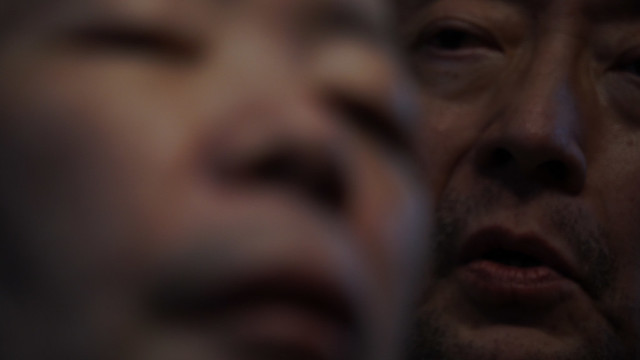
Leviathan
, a stunning piece of audio-visual whatsit shot on tiny HD cameras on a fishing vessel, made a splash last year at various film festivals, including Locarno, TIFF, NYFF and this year's Forum section of Berlinale. The film's receiving a theatrical release in New York starting on Friday, March 1.
I got a chance to talk briefly with its directors Lucien Castaing-Taylor and Véréna Paravel at the office of U.S. distributor The Cinema Guild. Fiercely intelligent and academic, yet very passionate about their filmmaking, Castaing-Taylor and Paravel responded lengthily to everything I threw at them, even though our interview took place in the latter part of their press day and Paravel was still reeling from jet-lag, having returned from the Berlinale just the day before. I thank them heartily for their patience and candor.
You both are anthropologists by profession?
Véréna Paravel (VP): We used to be.
Lucien Castaing-Taylor (LCT): We are recovering anthropologists.
VP: We still are. But we're just trying to forget this dark side of us. (laughs)
For those of us who don't know what the Sensory Ethnography Lab is, can you explain?
LCT: It's a little lab, as in an experimental laboratory, but not really scientific. We are not conducting experiments with controlled variables. It's experimental since we don't know what we are doing. There are a bunch of us working there. We are trying to do things with audio visual media -- with photography, sound, film and video, to do things that can't ordinarily be done or aren't ordinarily done either within anthropology or within film, especially documentary or within art.
We are definitely, like anthropologists, invested in the real world and the vagaries and different varieties of lived experiences and cultures around the world. But we are not interested in reducing that magnitude of that lived-in experience to sound bites or to discuss formulations or linguistic propositions that would summarize a culture or human existence in ways that are reducible to meanings that can be transcribed in language or written words.
We are interested in working with documentary in ways that pulls away from its affinity with broadcast journalism, with the lecture format and with talking heads to discuss the world rather than experiencing it. In that regards, I think our works, even though largely non-narrative or working against the conventional narrative structures, have a lot more affinity with cinema as a whole rather than just a straight up documentary.
We are also interested in, even though most of us are working with moving images, like film and video so far, unless of course working with sound, we are doing things that don't separate different art forms, different genres but seeking a way to bring all in, so everything is rubbing shoulders, so there is more friction and interstices between different art forms and different traditions and representations as well and to see where they can take us.
How many people are involved in this laboratory usually at one time?
LCT: It changes the whole time. Like when we teach, usually classes are kept at ten or twelve people and every year there is a new twelve. Then there are visiting post doctorates and different artists passing through. I'd say about a dozen people at any given time.
Are there a lot of people making projects similar to what you guys are doing?
LCT: Yeah. But we don't want it to be huge. We are not a factory. (laughs)
I do feel LEVIATHAN is much more than just an observational documentary. I mean it's so cinematic. I've seen both SWEETGRASS and FOREIGN PARTS and I kept thinking that you must've had some sort of training as a filmmaker or photographer. I can't accept the idea that you guys just shot a bunch of footage and made your film out in the editing process.
VP: Well, for me making Foreign Parts was basically the first time I touched the camera.
That's crazy talk.
LCT: (To Paravel) Well, Foreign Parts came out of an amazing earlier work that you did on the No.7 subway Line (7 Queens).
VP: Yeah, I just borrowed a camera and made this short, very strange, non fiction film and I discovered the junkyard right there which became the subject for Foreign Parts. The only training I got was actually from the Sensory Ethnography Lab, where I spent a year watching films and reading poetry and not-too-academically written ethnography books. But basically no film or photo school for sure.
You just blew my mind!
LCT: We did have a yearning, even though we were trained as anthropologists, we both have PhDs in Anthropology and social science. (To Paravel) For a long time you had this yearning to break out of this academia. You were unsatisfied with academic work and wanted to work with images and sound.
VP: Yeah but I didn't know--
LCT: And moving from Paris to New York, you watched a lot of films and lots of documentaries and you told me (Frederick) Wiseman was a huge influence on you.
VP: But that's not really true, because I didn't start watching films too seriously until I really decided that I couldn't go any further with the written words. Something was deeply missing in my capacity of expressing myself, which I am still struggling with, all the time. I didn't figure out right away, but I knew deep down that there was something more in expressing myself through images. It was a huge bet within myself to see if I could go through with it. I had many ideas that could be expressed through film but I was really shy and scared when the camera was literally thrown into my hands. But enough about me...
LCT: I had a little more training. We had a similar but also very different childhood. In France and in England. Yours was completely peripatetic, always moving around and mine was not. I grew up in Liverpool but we didn't have television at home. My parents never went to the movies and I was never interested in visual medium. I'm still a very non-visual person in many ways. I'm hardly a cinephile. I hardly have seen any movies. I don't like movies unless it's incredibly good. I'm easily bored by a film. Now I'm middle aged, I fall asleep invariably while viewing a regular film, including 56 Up two days ago. (laughs)
But I ended up studying anthropology undergrad in the UK and being unsatisfied with it already even though I ended up doing PhD in Berkeley, CA. But at least I escaped the UK and anthropology and became a self taught, bad still photographer and ended up going to this program in South Central LA in visual anthropology and that was my first exposure to the field and that was the first time I had to deal with moving images instead of still images.
It was really hard for me because I was always fetishizing compositions and the stillness, the cutoff-ness of the frames and so on. And the moving image with sound has obviously having an affinity with the flux of life and existence within the duration of time frame. So it was hard for me to make that transition. But after I've gone to this program in Los Angeles, after I started working with moving images and sounds, I, like Verena, found it much more demanding but much more fulfilling and much more potentially faithful to myself and to whatever little minuscule thing either of us could contribute to the world or to ourselves than anything I could do with the written words.
VP: The way we capture things is with our bodies. We don't necessarily look through the viewfinders but we are there, trying to experience the friction with the real world. I think that's why people tell me that our films are different. It's not from a cinephile's point of view.
I was at the New York Film Festival and attended your Q & As after the screening. It was funny to see a French filmmaker, Philippe Grandrieux being there and defending you from a barrage of silly questions. Subconsciously, I thought about how similar the experience was seeing LEVIATHAN with Grandrieux's work. What's the connection there?
LCT: We have quite a number of mutual friends. We've only met him two years ago in France. We both adore his films. We were blown away by his work because they are so visceral and haptic and deranged and disturbing and courageous and risky ... and because of all the common things we pursue artistically, we wanted to meet him. So we did and that's how we became friends.
So in Paris, we asked him if he could come to Harvard and teach, to take a break from the film world. And eventually he came to Harvard and has now been teaching for a year and is also very interested in coming back and be a part of the film studies program. It's a good break for him because for him, making film is so physically demanding, it consumes him body and soul. As it happens that he is just as invested in teaching even though he has never taught before, but he gives his all, exhausts himself teaching. It's been great for students and for him. He really gives all to life. There is nothing he does that is not 110 percent. That's what he's doing this year and it's been working out really well.
VP: It happened that he was in Montreal attending his retrospective. He had the Leviathan DVD but he refused to see it unless it's on the big screen on DCP, so he agreed to come down with us to New York. So we drove down together in our car: him and his wife and us having all these conversations. We got him in to the press screening and that's why he was there.
To go back to his form of cinema, the haptic cinema, as people call it, his cinema does something to you deeply, even the way you breathe. It affects you physically and emotionally in a very deep way and cinema should be like that, rather than you thinking about the next shot is going to be this and that.
I don't want to ask you about the technical questions. I'm pretty sure you get asked a lot about how LEVIATHAN was shot. The use of GoPro cameras in this movie is something we've never seen before though. So let me ask you about how you perceive this ever evolving video technology and if it is beneficial for your artistic practice.
VP: I have to tell you first that we are a complete technophobe and very spastic.
LCT: It's true, she is not being humble.
VP: When they asked me about these technical questions about my last project I couldn't help but being repulsed by it. (laughs)
But I can't imagine that kind of spontaneity and being that physical in LEVIATHAN with clunky big movie cameras. What was SWEETGRASS shot on?
LCT: It was shot on video but it was bigger, shoulder mounted camera. One thing I'll say about the miniaturization and automatization of the cameras can sometimes be really enabling. But for me it's more of a difference in degree than kind. And also paradoxically there is an inversion within, which is now with HD cameras whether they are big or small, they have clarity of resolution that to me is very non-real. You can have great depth of field but there is still this flatness that comes with HD. And these GoPro cameras have much more cinematic quality, the look is more filmic than video-y: the noise, the abstraction and the figurality of them resemble the film grain, the degree of abstract realism of the film camera. We could've shot everything with the film camera in a waterproof housing but the size of GoPro definitely enabled us.
As much as we wanted to come up with the film from the human perspective: the anthropologized representation of this encounter at sea with all the different players and agents, humans and non-humans, animals and non-animal, there was a danger in supposing that these shots are purely mechanistic. A kind of technological perspective that there is no filmmaking or directorial agency whatsoever, that you can just place these cameras and let them do the work. There are really four shots in the whole film that were not held by nor tethered to our bodies. All other shots were either held by us or attached to the fishermen's bodies. The shots of the camera going over and underwater were done, GoPro attached on the sticks held by us.
VP: It is the extension of ourselves. It's physically attached to sentient beings--
LCT: It's exactly the same discourse though when the 16mm and super 8 came in. It always goes back to what's great for democracy and the greater informality and domesticity but it greeted every new technological advances whether it's photochemical or video the same way. But it's true that the latest cameras are so small that you don't have to hold it at head high anymore and it's very enabling.
With the amount of attention LEVIATHAN is getting, being filmmakers is working out for you. Is it something you will be continuing in the future?
VP: Hopefully, yes, if we can survive.
Leviathan opens 3/1 at
IFC Center in New York and rolls out to other cities later. Please go to
The Cinema Guild website for more information.
My Leviathan Review
 Setting aside the politics of healthcare and its inadequate system, let's consider the frailties of human bodies. And this is what Julien Castraing-Taylor and Verena Paravel are interested in to document, in graphic detail- the blood, guts and no glory. Gaining unprecedented access to 5 hospitals in Paris, we are presented to operating tables, endoscopy, colonoscopy, Ophthalmology procedures, morgues. Tiny cameras in tubes goes in and out of the bodies, exposed human brains, cutting flesh, cesarean sections, exposed, bleeding penis... while doctors and surgeons talk about their daily lives as if the patients they are treating aren't even there. And you ask yourself, why do I need to see this? This is a legitimate question to ask. But this is fascinating stuff.