Sunday, January 16, 2011

Friday, January 14, 2011

East of Eden: Kim Tae-gyun Interview

Photobucket
In 2002, East Timor (officially Timor Leste), a tiny island nation 400 miles north of Australia, became the first independent nation of the 21st century. A former Portuguese colony and invaded and annexed in 1975 by Indonesia with the help of US, this nation's history is marred by violence and poverty.

Director Kim Tae-gyun (Volcano High, The Crossing) uses this volatile backdrop for his latest film A Barefoot Dream, tells a story of a former Korean soccer star and failed businessman who travels to East Timor, like many other opportunistic foreigners, in the hopes of exploiting the local economy. Instead, he ends up coaching a soccer team of poverty stricken East Timorese kids, ultimately bringing them to a world tournament soccer victory. The film makes its North American premiere at the Tribeca Cinemas in Manhattan as part of bi-monthly Korean Film Nights series, made possible by Korean Cultural Service and the Subway Cinema. I had an opportunity to sit down and talk with director Kim prior to the screening:

How did you come across this incredible story?


There was a Korean TV documentary about East Timor and its independence. They featured coach Kim Shin-hwan and the East Timorese kids and how they won the Hiroshima International Youth Soccer Tournament very briefly. In it, Kim says, "I wish I could feed these kids some meat from time to time." That appealed to me a great deal.

Did many Koreans know about the existence of East Timor prior to A Barefoot Dream? In the States, except for some reports by independent journalists, the situation in East Timor didn't generate a lot of attention in mainstream media.

Yes and no, there were debates on sending peacekeeping troops in the parliament without much of fanfare (which we eventually ended up doing) when Indonesian troops were violently oppressing the East Timorese. I think Koreans are more aware of international issues once it became a viable economic power.

Was coach Kim Shin-hwan (as Won-kwang in the film, played by Park Hee-soon) involved in making of the film?


Oh, absolutely, from beginning to end. If it weren't for him, we wouldn't have the film. Just like you see in the film, Kim got to know the locals pretty well, first with his broken English (or Konglish as we call it) then by picking up their dialect. He was not only our consultant, but a guide, interpreter and ambassador. It was his friendship with Xanana Gusmão(the former President and present Prime Minister of East Timor) that made possible for him to appear as himself in the film!

What were some of the challenges you faced shooting in East Timor?

They literally had nothing there. After years of violent conflicts, there was no infrastructure set up. We had problems as soon as we landed. Bureaucracy over there is tantamount. Our gear was stuck at the airport for a long time. There have been no film productions in East Timor other than one Australian documentary crew before us. Dili is a small town of about 15000 people. And we needed about 300 extras for many of the scenes. We put out an ad for cast and extras but no one came. We had to actively seek out people on the street. But they had no concept of film business. They just came and went as they pleased. Understandably they were busy eking out a living. But for us every step was a challenge since all the things we took for granted in film productions were not there.

You have some amazing kids in this film. How was the casting process?

We cast mostly from Coach Kim's pool. He had about 30 members in his team. We picked kids whom we felt right for the part. They were around 9-11 years old.

Was it a difficult to direct them?


When the script was finalized, we gave them copies and asked them to read it prior to shooting. But kids just being kids, not some professional child actors, non of them read the script all the way through (laughs). So I had to sit them down beginning each day of the shooting and read it aloud together, one page at a time.

What became of the original team members?


As you know, it was 2004 when Kim led the East Timor team to become champions. The original members of that team are now in their late teens and many of them make appearances in the film (as grown up soccer players). They all went different ways. Some of them are still playing soccer.

You think some of the kids from the film have a future in professional soccer, for instance, Ramos? He is phenomenal.


Yes. I think Ramos could definitely be a soccer star. The other two (Motavio and Tuo), I'm not sure. I think they like to play but have other interests.

Your previous film, The Crossing (2008) (about the flight of the North Korean refugees) dealt with an important subject. Are you generally attracted to social justice issues in making films?


I think it's got to do with me getting old. I don't think film should be made just for entertainment purposes. I think there should be a good balance between entertainment and substance. At least that's what I try to do anyway.

There is talk that A Barefoot Dream is being considered for nomination for the Best Foreign Film Oscar. This film would certainly deserve such an honor.

For Trailer, Please visit Subway Cinema for Free Korean Movie Night

Monday, January 10, 2011

Kauai Morning

Recorded from the bedroom window 5:30am 12/30/10
Photobucket
6 min 30 sec

Wednesday, January 5, 2011

Before Sunset for Grown Ups?

Certified Copy (2010) - Kiarostami
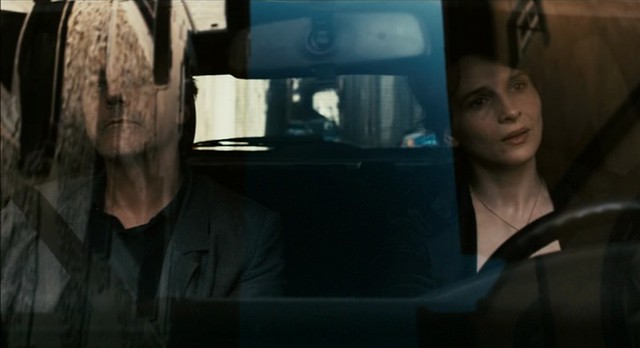
certified-copy-from-car-2
Is it safe to say Certified Copy is Before Sunset made by Abbas Kiarostami (Taste of Cherry, Wind Will Carry Us, Close-Up) starring middle aged people? Well, not really. It starts out with an Englishman James (William Shimell, resembling David Strathairn) giving a talk on his new book about the legitimacy of copies compared originals in art in picturesque Tuscani. As an infatuated antique dealer (Juliette Binoche, reviving her frazzled single mom in Hou Hsiao-Hsien's The Flight of the Red Balloon) picks James up and drives him around town as a guide, the film becomes something else: deconstruction of a marriage. Even though it's the first film set outside Iran, there are Kiarostami touches everywhere- long driving shots, actors talking while looking at you straight in the eyes, blurring the lines of what's real and what's not. As the couple exchange tit-a-tat, we witness the copy of the real married couple breaking apart.

I realized while watching it, that Kiarostami was at it with his magic again, completely blowing away my expections of what the movie was going to be with his elegance in simplicity.

Tuesday, January 4, 2011

Piece of Heaven

Anini Beach, Kauai Island, Hawaii 7:00am 12/31/10
Photobucket
9 min 30 sec

Sunday, December 19, 2010

No Gummo

Winter's Bone (2010) - Granik
Photobucket
Wow, not one false note: from its acting, script to HD cinematography. It's not the authenticity of what the people of the Ozarks are like that I loved, since I have only a blurry notion and won't pretend here that I know and understand, yet these poverty stricken, meth ravaged, unfathomably tough characters ring so true to me.

Jennifer Lawrence is Ree, a 17 year old girl who needs to take care of two younger siblings and sick mother in the absence of her unseen meths 'cooker' father. It turns out daddy's out of jail and a bail bondsman and other people are after him. If he doesn't make the court date, they will take the house. It is widely suspected that local bigwig family might have killed her dad for some old grudges. Unflinching against all the poverty and violence around her, resilient and resourceful Ree is a revelation. John Hawks shines (second best performance in the film) as Teardrop, Ree's scary uncle, and aging but well fitting Sheryl Lee also makes an appearance.

Debra Granik's depiction of the Ozarks is never patronizing nor sentimental. Winter's Bone is filled with the lives of the locals in great detail and presented with great care, nothing seems out of place. Definitely one of the year's better films for me if not the best.

Tuesday, December 14, 2010

Bird Flu

Black Swan (2010) - Aronofsky
Photobucket
It's one of those 'it's all in her head' films. Relax. I haven't blown anything. If you've seen the trailer, you know what's coming. What's commendable here is that Aronofsky reached the comfortable point as a skilled filmmaker that his audience doesn't feel cheated watching his films. Since The Wrestler, he's smart enough to contextualize his actors to fit his projects. All the actors shine (Barbara Hersh as a protective mother, Vincent Cassel as a sleazy ballet instructor, Mila Kunis as seductive rival). Here, once again, Natalie Portman plays a young woman on the verge of going to pieces as she always does. But she doesn't come across as a cry baby. Like Polanski using Mia Farrow's waifish quality fully in Rosemary's Baby, Aronofsky takes advantage of Portman's girlish fragility to 11. Black Swan is way over the top (not that his films were ever subtle) in saint/whore dichotomy with bombastic Swan Lake score. But it fits with visceral visuals creating internal chaos in the character.

Matthew Libatique's dizzing, grainy 16mm/HD camerawork matches perfectly with woman losing her shit theme. Hugely entertaining, this is by far Aronofsky's best film.

Friday, December 10, 2010

Spoilt Milk

La Teta Asustada/The Milk of Sorrow (2009) - Llosa
Photobucket
Photobucket
Photobucket
Photobucket
Sullen Fausta (luminous Magaly Solier) has the 'milk of sorrow' illness: offsprings of the rape victims during the civil war are said to be borne without souls. So afraid of being violated, she had shoved up a potato in her vagina. After her mother dies, she needs to come up with the money for the funeral (she lives in a shanty town on the hillside of Lima) and to take the body to her old village. She starts working as a maid for a rich pianist who wants her to sing with the promise of pearls.

It's really hard not to compare this to Claudia Llosa's previous effort, Madeinusa. Even though it's far better than most of the films I've seen this year, The Milk of Sorrow was underwhelming. Although it's beautifully photographed, it's not literal enough in that South American literary magical realism way. It boils down to a young girl getting over her fear of the world and finding wisdom in gardening- which isn't too interesting of a subject. For some reason, the 14 yr old heroine in Madeinusa seemed a lot more mature and interesting than Fausta in Sorrow. But don't get me wrong, Solier, with her trembling girlish voice and time-transcending face, is something of an enigma still. This will definitely end up on my top ten list of the year.

Llosa's Madeinusa review

Monday, December 6, 2010

Hong Kong, My Love

Chinese Box (1997) - Wang
Photobucket
Photobucket
Photobucket
Photobucket
Wayne Wang's love letter to Hong Kong coincides with the 1997 handover of HK to China from the British rule. Jeremy Irons is John, a Brit journalist who never figured out the place where everyone speaks nothing but money. Gong Li is Vivian, a successful business woman who can't get out of the shadows of her past and Maggie Cheung is Jean, a young woman with a scarred face who can't get over her first love. Thanks to Jean-Claude Carrière's nuanced, mature script, the three are not merely stand-ins for the dying Empire/end of the era, old generation bound by tradition and bitter new generation. He captures the year of uncertainty in a specific place/specific political climate like a time capsule. Shot mostly hand-held by Vilko Filac, regular of Emir Kustrica's, HK has never been this intimate or beautiful. Ruben Blades steals the show as a serenading roommate of John. Jared Harris as a straight-faced, forgetful former high school sweetheart of Jean is also memorable. I like this a lot.

Too Goddamn Beautiful

La Piscine/Swimming Pool (1969) - Deray
Photobucket
Photobucket
Photobucket
It's sunny French Riviera. Jean-Paul (Alain Delon) and Marie (Romy Schneider) are staying in a beautiful summer villa with a fancy swimming pool. They are stunning looking couple. In fact, everything in this movie is fucking beautiful. They have sex, fool around, everything is hunky dory until their friend Harry shows up with his 18 year old daughter, Penelope (Jane Birkin). Tension rises. The couple's fragile relationship is being tested. It's Harry's off hand remarks over dinner or snack near the pool that carries venom for both Jean-Paul and Marie. You see, Marie was Harry's mistress once.

Romy Schneider is radiant in this, much more compelling than lanky, flat chested Jane Birkin's non character whom she is supposed to be jealous of.

There are no real dangerous games or seductions playing out in Swimming Pool. Even though it resembles Delon's better known Plein soleil a little, with his darker side coming out, it's not really a simple morality play. The film is a little too simple on the character's psychology and its pacing is slow but the leads are so damn pretty.

Sour Grapes

Les Rasins de Mort/Grapes of Death (1978) - Rollin
Photobucket
Photobucket
Photobucket
Photobucket
Soft focus, inept sound, snail's pace, horrendous continuity, bad make up...I should've hated this. But for some reason, I didn't. Jean Rollin might not be the cinema's most celebrated poet of death, but there is something very unsettling about his films. In Grapes of Death, female characters are only there to be naked, beheaded or impaled and only the beer guzzling, uni-browed peasants survive the vineyard pesticide induced zombie attacks (well, not really). I wouldn't call that exactly a social commentary. Still something very macabre about the whole thing. I'd like to see more of his stuff, maybe better ones than this though.

Monday, November 29, 2010

Poor Man's Hitchcock

Hi, Mom! (1970) - De Palma
Photobucket
Brian De Palma's take on fame and upper class in the backdrop of sleazy New York in the 70s is hilarious romp. Young De Niro plays Jon, an aspiring pornographer pitching his idea for peeping with a long lens on the inhabitants of a highrise across the street. He then takes advantage of a ditsy lonely girl after spying on her for a while. Then there is a experimental theater group doing an interactive piece called 'Be Black Baby' where well intentioned rich white patrons go through some horrendous ordeal- putting on black faces and getting physically assaulted, only to rave it as life-changing experience.

Maniacally spastic and energetic in its playfulness, this might be my favorite De Palma.

All Dogs Go To Heaven

Plague Dogs (1982) - Rosen
Photobucket
Photobucket
Photobucket
Photobucket
Photobucket
Photobucket
A black retriever named Rowf and a fox terrier, Snitter escape from a top secret laboratory in a mountainous English town by the lake. After many water endurance test where many fellow lab dogs drown, Rowf has issues with water. Snitter has been subjected to brain surgery and has a hole in his skull and also has a lousy luck with humans (his masters die). To avoid starvation, they stalk sheep with the help of a snarky fox named Todd. The body count rises. The towns people are after them, the labcoats are after them. Soon the Defense Ministry is called in with paratroopers to smoke the dogs out and destroy them for fear of them carrying bubonic plague.

No less devastating than Rosen's Watership Down, Plague Dogs is nevertheless beautifully drawn animation with a strong anti-animal lab testing message. The ending will break your heart.

The Lamest. Motorcycle Gang. Ever.

Psychomania (1973) - Sharp
Photobucket
Photobucket
Photobucket
Photobucket
The devil (frog god) worshiping motorcycle gang, 'The Living Dead' roams the English countryside, wrecking bloodless, Monty Python skit resembling havoc- cruising through supermarket and terrorizing old ladies by ripping off sideview mirrors and breaking windshieldsof their cars. Their leader, a suave young man believes, with the approval from his ghost channeling medium mother, that they will come back as invincible after they kill themselves. All the members follow his suit in very comical ways and leaving dry corpses everywhere (they just fall down), but our heroine Abby is still undecided because she loves life!

Not hokey enough to be a cult classic and bike stunts are pretty lame. There is a disclaimer about the film's original negative being lost that they had to transfer from 'the best available sources'. Picture quality wasn't too bad though. And the film is chuckleworthy.

Monday, November 22, 2010

Tony Chestnut (see the movie to get the joke!)

Mumsy, Nanny, Sonny and Girly (1970) - Francis
PhotobucketPhotobucket
Photobucket
Photobucket
The children, Sonny and Girly dressed in English school uniforms find homeless people in the park and bring them home, to Mumsy and Nanny, to make them family playmates. When their playmates break the rules, they send them to the angels. This nursery rhyme filled, giggly family slowly disintegrates when they bring home a new feisty friend.

Part Teorema and part Wicker Man, Mumsy and Co, features some of the most delicious dialog and bewitching Vanessa Howard as Girly who can sing Siamese National Anthem. Another great Brit class satire borne out of the clash of the traditional family values of the war generation and 60s free love/anti anything generation. Great fun.

Wednesday, November 17, 2010

Ideal vs. Normal Relationship

Alle Anderen/Everyone Else (2009) - Ade
Photobucket
A young, not unattractive professional German couple, Chris (Lars Eidinger)- an architect, Gitti (Birgit Minichmayr), a music promoter, is vacationing in Sunny, picturesque (but testy) Sardinia. Chris is somewhat timid and full of self doubt, Gitti more assertive but needy. Ups and downs and tensions between them are pretty obvious, so as their physical intimacy. It becomes apparent that their relationship is not quite typical/ideal when they run into Chris's successful macho colleague and his nice pregnant wife. Things go a little volatile, as their unconventional (in other words, real) relationship gets tested. Simple in its aesthetics (heavily dependent upon two leads' actings) and brutally honest in its depiction, this 'relationship drama' rings very true to me. Very refreshing.

Sunday, November 14, 2010

Hope Down South

South of the Border (2009) - Stone
Photobucket
Oliver Stone tours Venezuela, Bolivia, Argentina, Paraguay, Brazil, Ecuador and Cuba, hobnobbing with 'evil' dictators- playing soccer with Morales in Bolivia, cracking a sexist joke at Kirchner in Argentina, etc. This is by far the best Stone film I've seen. He narrates the film but the narration and his presence are very unobtrusive. The film lays out these countries' tumultuous histories. South America, after years of American imperialism and devastating measures from IMF, is finally getting back on its feet and there seems to be genuine solidarity. Curiously Nicaragua is missing from Stone's itinerary.

Since the US is not a superpower anymore and still tangled in the Middle East, is there a hope for Africa?

Thursday, November 11, 2010

20 Minutes of Bliss: Claire Denis Interview

Photobucket
Whether it's about a disco dancing French legionnaire, underworld organ trafficking or vampires, Claire Denis's enigmatic films have been enrapturing cinephiles around the world since her debut feature Chocolat (1988). With her thrilling new film White Material opening statewide on November 19th, and the retrospective- No Fear: The Films of Claire Denis at IFC starting this week, I sat down with Denis for a brief interview. She was very personable and gracious, offering long and thoughtful responses.

It's been 22 years since Chocolat and more than 10 years since Beau Travail, what prompted you to shoot a film in Africa again?


A while ago, Isabelle (Huppert) mentioned if I would be interested in adapting Doris Lessing's book The Grass is Singing. The book is set in South Africa right after the WWII. It's about Lessing's British ex-pat parents trying their hands in farming which they were terrible at. But even though it's a great book, there were two reasons why I didn't want to do it. First, the book already had a big influence on me making Chocolat. Secondly, I didn't want to do a period film. I don't like the typical nostalgic notion of colonial era- beautiful landscapes, exotic animals, heat, et cetera. I also didn't think it would be fair to show a colonial South Africa after all they've been through- 50 years of apartheid and election of the president Mandela and all. I wanted to make a film about 'now'.

White Material seems like a whole another world though. It feels timeless, not attached to any time period.


But it's not the 30s anymore. Surely you noticed the Chinese motorbike! (laughs). Those motorbikes are everywhere in Cameroon. Then there are those old beat up trucks, but it's mainly because they are poor. I would say the film is set somewhere in the last 10 years or so.

Has it changed a lot since Chocolat, shooting in Cameroon?


Yes. I think it's modern in a way other parts of Africa are modernized. But in rural farming areas, in French countryside even, everyday life is not so easy. It's not because the modernity is coming slowly, but because of the economical hardships. When I was making Chocolat, we were pretty much blind to the economic crises in Africa. Now we all live in the global recession, we see the blow is twice as hard there.

The famed French author Marie Ndiaye co-wrote the script with you. Can you tell me the process?

I've been admiring her work since her very first book (*Quant au Riche Avenir, written when she was only 17). We've been corresponding for a while because we both were intrigued by each other's work. When Isabelle told me about the project, naturally I contacted Marie. We took a trip to a coffee plantation in Ghana together to see what it's like. Since she had never written a film script before, she didn't have any bad inhibition that comes with the pitfalls of bad scriptwriting. She was very open. It was great.

The White Material seems much more narrative driven than your previous films. Do you feel that way?

Yes. After The Intruder (2004), I was driven by the idea of doing something not too mysterious but more concrete. Both this film and 35 Shots of Rum are very straightforward. The idea of heart transplant in The Intruder was both naïve and abstract in a way. Just like the old man in the film, it made me think of my own mortality. Then during editing that film, my producer (Humbert Balsan) died. I actually thought that it would be my last film and I would die myself. I wasn't afraid, but I felt that I'd never be able to make a film like that twice. It was a real turning point for me.

Wow, I didn't know about that.


But I'm sure it's not uncommon that other filmmakers feel like that too sometimes, that the film they are making right now would be their last. It was Isabelle and others who encouraged me to make films again. I did dedicate 35 Shots of Rum to Humbert.

One thing that struck me in the White Material was the son character, Manuel (played memorably by Nicolas Duvauchelle). He is a country-less product of the white colonialists who are losing power. He's described as 'half baked'. Tell me if I'm reading it too deep, but is there a parallel between Manuel and recent violent upheaval in French society?


Oh no. For me and Marie, it was much more concrete and simple. As a mother you don't want your son to be 'soft'. I was like that when I was that age. I would've rather laid on the couch and sleep all day. I think it's more conventional 'mother wanting her son to be a man'.

White Material Review
Chocolat Review

Interview at twitch

The Retrospective- No Fear: Films of Claire Denis at IFC Center runs November 10th - 18th

White Material opens limited in the U.S. this Friday, the 19th, with more cities to follow

Wednesday, November 10, 2010

Post-College Blues

Tiny Furniture (2010) - Dunham
Photobucket
Winner of this year's SXSW Jury Award, at a glance, Tiny Furniture could fit neatly into the typical post-college subgenre that has been a staple in American indies for the last two decades, except it doesn't. Thanks to director/actor Lena Dunham.

Aura(Lena Dunham), a recent graduate from some liberal art college in Midwest with her useless film theory degree and a dying hamster comes back home, to the Manhattan loft, inhabited by her successful photo artist mother Siri (Laurie Simmons, Dunham's real mom) and her high school prodigy, prettier sister Nadine (Grace Dunham, her real sister). Only thing she has to show for her college education is a youtube clip of herself in an unflattering performance art (she already has 375 hits on it!). She is completely stumped at life after college with no job prospects, no ambition and no boyfriend. Only thing that is left for Aura to do is to overstay her welcome in the house and get into trouble.

Even though it has all the slacker genre trappings- affluent white family, sibling rivalry, obligated party scenes, snappy one-liners, Tiny Furniture rises above all the pre-conceived notion of being just another white privileged college kid movie. It's Dunham's guileless characterization of Aura that comes off as real, funny and endearing.

Tightly executed on Canon 7D in controlled static shots by a talented cinematographer Jody Lipes (Afterschool, Wild Combination and director of NY Export: Opus Jazz), the movie fortunately lacks any hand-held camera movement or meandering shots usually associated with indie HD filmmaking.

With Dunham's acute observation and embodiment of romantic humiliation and post-college confusion, Tiny Furniture is an intriguing mixture of autobiographical filmmaking and performance art. I'm looking forward to see what she will come up with next.

Review at twitch

Friday, October 29, 2010

Kashmir

Harud/Autumn (2010) - Bashir
Photobucket
Kashmir, a hotbed of India-Pakistan territory dispute is the subject of Harud (Autumn). A young man, Rafiq (Shahnawaz Bhat), is seen trying to cross the border over to Pakistan only to be captured and returned to his home, to his parents. The village is under watchful eyes of heavily armed occupying Indian Soldiers. Rafiq's brother is one of the thousands of young men who have gone missing since the military insurgence. His mother is still hopeful that her older son will turn up some day and attends rallies by APDP (Association of Parents of Disappeared Persons). His father, a traffic cop, having seen a lot of violence, is deteriorating fast due to post-traumatic stress disorder. Rafiq sleepwalks through the day with his friends who are dreaming about escaping from Kashmir. The jobs are scarce for young people and the news of cell phones arriving in town is quite possibly the most exciting thing they ever heard in quite some time.

Harud, directed by a Kashmir born actor turned director Aamir Bashir, is a quiet, understated drama that acutely presents what living under siege is like. Absence of soundtrack and sparse dialog adds to the gloomy, suffocating tone of the film. It's Shahnawaz Bhat's expressionless face that speaks volumes. There is no life left in that blank stare. We see a glimpse of emotion stirring up in Rafiq when he finds his brother's still camera. He has to bear witness to what's happening in Kashmir through the lens. Bashir meticulously builds up to the film's climax which coincides with Eid (a three-day festival marking the end of Ramadan) where a lamb needs to be sacrificed.

Subtlety is both the film's strengths and weaknesses: Harud never lets up its depressive mood and Bashir keeps it from falling into sappy stereotypical situations. With its unavoidable but artfully done ending, the film is a bit underwhelming. Given the heady subject matter, a little harder, grittier filmmaking would've been more suitable to make a bigger impact.

Harud plays on November 1st (7:30PM) at SVA Theater as a part of 2010 SAIFF.

Review at twitch

Wednesday, October 27, 2010

3D Time Capsule

Cave of Fogotten Dreams (2010) - Herzog
Photobucket
This History Channel funded Werner Herzog's foray into 3D filmmaking is a pretty straightforward documentary. Only it's in 3D. It is a rightful companion piece to Encounters at the End of the World where he explored otherworldly beauty of the world beneath the icy Antarctic Ocean. This time, it's the Chauvet cave of Southern France, home of the 32,000 year old cave drawings. Pristinely preserved by landslide covering up the entrance, the exquisite charcoal drawings of lively animals- lions, wooly rhinos, horses and bison had been untouched by natural elements and humans alike until the 1990s.

Just how he convinced French Cultural Ministry to give him the access for filming inside the fragile caves is a total mystery to me- another great addition to Herzog myth I'm sure. Armed with a custom made small 3D camera and with the crew of 3, he shows us under the dim, battery operated cold panel lights (because any other light will damage the delicate environment), the interior of the cave. The crystals glisten, unreal stalagmites and long extinct animal bones adorn the surroundings. But it's the drawings on uneven contour of the walls that are truly breathtaking. If it were shot traditionally, Cave of the Forgotten Dreams would still be an interesting documentary. At first, this 3D project has an air of excess but after a while, it becomes a fitting, not too obtrusive addition. With the help of Ernst Reijseger's gorgeous string arranged and choral score, Herzog lets you in the once in a lifetime experience in a truly unique way.

Whether it was because of its confounding environment or limited resources for Herzog to go all out with his usual operatic visuals- he and his crew were only allowed on 2 feet wide tracks laid upon the surface and 4 hours a day maximum shooting time in the caves, the film is much more introspective. Perhaps it's being in the presence of the transcending, awe-inspiring 30.000 year old charcoal drawings made a cerebral filmmaker like Herzog to turn spiritual? Or seeing god's face in Quaker Oats container in My Son My Son, What Have Ye Done count as earlier indication?

This little experiment (said to be the first and the last 3D film by him) confirms that Herzog does whatever he feels like, never following trend, but with astounding consistency. It fits within his body of work very smoothly. There are many Herzogian moments throughout the film to make diehard fans giggle- (un)intentionally hilarious interviews with kooky scientists and at one point, he says "mutant radioactive albino crocodiles" in his inimitable accent and it's intriguing enough to satisfy general movie going public.

Review at twitch


Related Links:

Wonderland

Reptile Cam + Crack Pipe + Soul Dancing + Wet Underpants = Bad Lieutenant
Herzog's Americana Continues...