Sunday, August 23, 2020

Bullshit

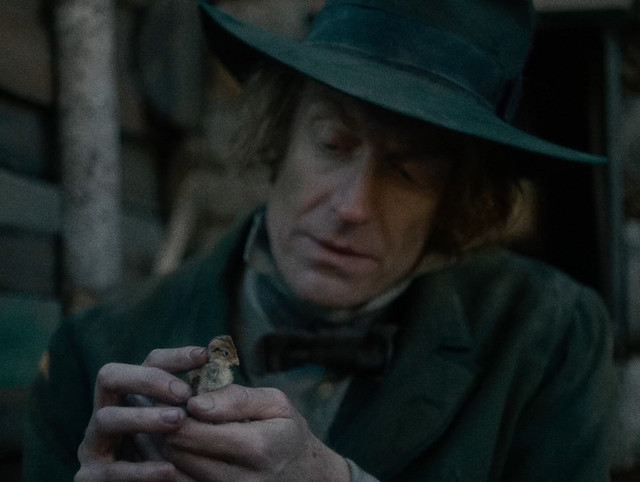
Nuestro Tiempo (2018) - Reygardas
nuestro_tiempo+still+1
My initial thoughts were right about Carlos Reygadas it turns out. I don't like to disregard a movie as pretentious. It implies that I didn't understand the film and am attempting to disparage it. But even from the beginning, starting with Japon, his first film, with all the critics going gaga over it, I didn't buy it. I didn't buy his supposed talent, his vision and questioned his intentions behind his stunts. Behind every single one of his movie except maybe Silent Light. Why do we need to see graphic sex scenes performed by non-actors? Why do we need to see animal abuse? Why do we need any of these? With each of his film, the experience felt like nothing more than exploitation. Visceral provocation has its place in films. But with nothing more than making its not so subtle points, I thought these scenes were beyond excessive and uncalled for. Just because of the strength of Silent Light, his serene contemplation of faith by way of Dreyer which I liked very much, I've decided to give him another try.

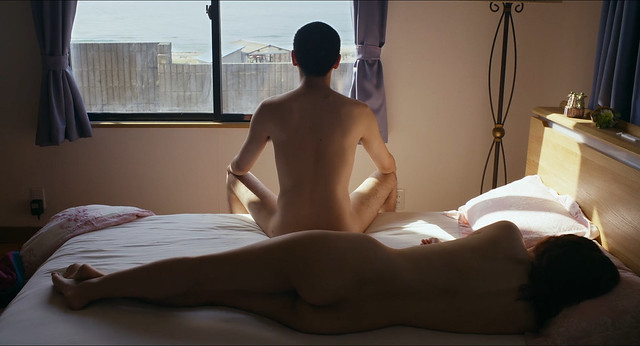
It's a 3 hour domestric drama starring Reygadas himself, his actress wife and his children in his ranch in rural Mexico. The beginning thirty minutes, involving children and teenagers playing in mudflats shot in anamorphic lens flare glories, are stunningly beautiful, if not creepy - like gliding over their nubile bodies which made me very uncomfortable, doesn't factor into the rest of the film at all. Our Time is definitely not about their offsprings. It concerns an open marriage of Jose (Reygadas), a renowned poet and rancher of bulls and his beautiful wife Esther (Natalia López) and a gringo horse breaker named Phil (Phil Burgers). Jose suspects that Esther is having an affair with Phil who is moving from job to job wherever he's service is needed.

It is not quite clear if Jose arranged his unfulfilled wife's affair with Phil from the beginning. But numerous narrations suggest he has something to do with the arrangement. But it doesn't make him compulsively checking Esther's phone for chats and passive aggressively confronting Esther about her lying. Our Time could've gone to the route of one of those cliché blinding jealousy movies or about an obsession. What Reygadas is doing here or not doing here is far worse - Time after time we hear Jose and Esther's narration (both their thoughts and reciting their letters to each other) over beautiful images - most notably over the extended shot of Mexico City at night from a plane as it descends through the fog, but what they are totally unreliable since their thoughts and their actions are completely different.

There is no causality for any of Esther's actions. Is she a nympho? Why is Jose encouraging her to have sex with other men? If he is for open marriage for satisfying Esther and not jealous, why is he still peeping while Esther is having very graphic sex with other men?

None of these makes much sense. It's not vascillation for some kind of resolution at the end emotionally or physically, it's going on like that forever. But is it about communication breakdown between a husband and wife? They talk but they can't articulate themselves? They tussle, throw chairs and still nothing gets resolved.

I read some interviews with Reygadas where he defends the reason for using his family. It's bullshit. Out of convenience, really? Our Time is perhaps the most egregiously self-indulging movie I've ever seen. It's Scenes from a Marriage only on the most superficial level. Even though I give benefit of the doubt in their trying that they are sincere in representing their relationship, I find them and their petit bourgeois life in the rural Mexico so uninteresting and boring.

He also said that it's not about masculinity that only American audiences would think that. It features bull ranch, bulls making horrendous sounds day and night, a bull gores a mule to death and a bull fight ends in the death of a bull at the end of the film. How does one interpret that any other way? This is movie is bullshit. Reygadas is bullshit.

Wednesday, August 5, 2020

Blood on the Dance Floor

All That Jazz (1979) - Fosse
Screen Shot 2020-08-05 at 5.19.54 AM
Screen Shot 2020-08-05 at 5.25.03 AM
Screen Shot 2020-08-05 at 5.26.20 AM
Screen Shot 2020-08-05 at 5.28.54 AM
Screen Shot 2020-08-05 at 5.29.31 AM
Screen Shot 2020-08-05 at 5.34.24 AM
Screen Shot 2020-08-05 at 5.43.06 AM
Screen Shot 2020-08-05 at 5.43.57 AM
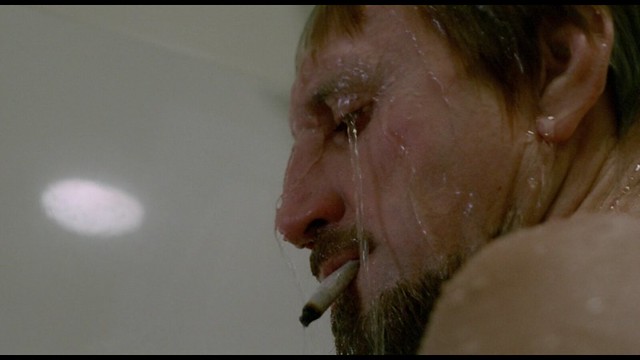
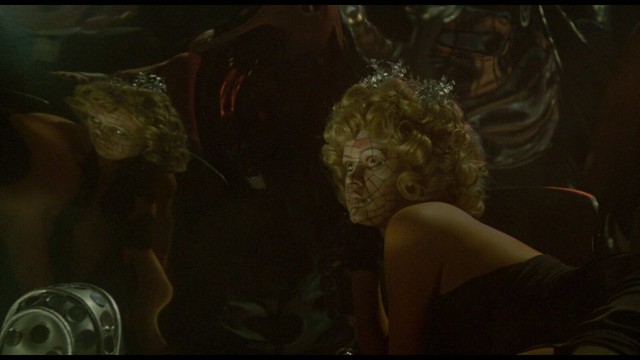
There isn't much of a story in Bob Fosse's All That Jazz. It shows Joe Gideon (Roy Scheider), a chain smoking, heavy drinking, drug addled, womanizing, hard working Broadway choreographer and movie director getting ready for a new project and pushing himself too far and dying in the hospital. Fosse, who directed, choreographed and co-wrote, this is as self-reflexive as it gets, closely resembling Fellini's 8 1/2. From the beginning mass audition scene to the ending Ben Vereen number, the film is spectacular display of dancing talents. It also oozes that unmistakable 70s New York vibe. Scheider is phenomenal, so is Anne Reinking who plays Gideon's understanding ex-wife, Erzsebet Foldi who plays his daughter, Leland Palmer, his dancer mistress and Deborah Geffner, his one night stand. Sweaty, garish, energetic and brilliant, All That Jazz is all show and extremely proud of itself. Good times.

Monday, August 3, 2020

5 Best Japanese Films of the Decade

This list reflects my tastes and preferences only. Please keep that in mind. Not in any order. Please suggest some good Japanese films from the last decade.

Japanese Girls Never Die (2016) - Matsui
20161203160159
With its intentionally jumbled chronology, Japanese Girls Never Die goes on to tell the story of Haruko (Aoi Yu), an aimless 27 year old who works at an office and still lives at home. Then there is an accidental graffiti artists and an anarchic High School girl gang on a crime spree, beating up unsuspecting men subplots. In series of flash forward, we learn Haruko hooking up with a grocery store clerk/childhood playmate, Soga (Ishizaki Huey). She has to deal with daily sexism at work place - hearing male superiors shit talking 35-year old, unmarried female co-worker and constantly being asked whether she has a boyfriend, then told she won't have problems getting married because how she looks. They even say to her point blank that they'd rather hire a 18 yr old girl with no experience rather than a male applicant with experience because they have to dole out more money for a male workers.

Then she goes missing. Yukio and Manabu, two 20 yr olds working dead end jobs and Aina (Takahata Mitsuki), a slightly pumped up version of cutesy Japanese girl decked with a blinged out cell phone and a gaggle of flush toys on her car dashboard, start stenciling Haruko's face from the police missing sign all over the neighborhood walls. The image goes viral and gets tied into the violent crimes perpetrated by the girl gang. In her absence, Haruko becomes a unwitting heroine of a movement.

Japanese Girls Never Die is a strong indictment of the society where girls are subjugated and sexualized at an early age. It's a structurally daring, thought provoking work. Aoi Yu, the baby faced star of millennial classics like All About Lily Chou-Chou and Hana and Alice does a great job, carrying the burden of being twenty something female in society where self-worth is hard to come by. It's crazy to think that Aoi is old and therefore can easily be discarded. What kind of world is this? Even though it's more than a decade apart from each other, it would make a great double feature with Kurosawa Kiyoshi's Bright Future.

0.5mm (2014) - Ando
4765399_film-review-05-mm_e43310df_m
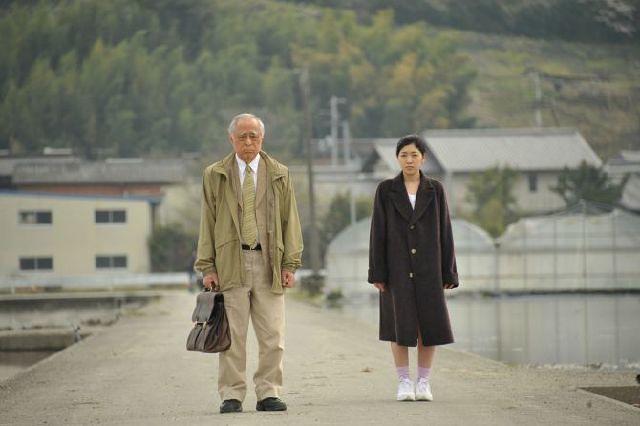
Clocking just over 3 hours, 0.5 mm tells a sprawling journey of a young caretaker of elderly people (director Ando Momoko's little sister, Sakura) as she travels through Japan. It's a comical, tender and deadly honest look at aging Japan and its seemingly unbridgeable generation gap.

Sawa (Ando Sakura), is a comely caretaker of an bedridden old man- she changes his diapers, cleans his fluid tubes and feeds him every day. The man obviously hasn't long to live. Sawa expertly handles it all. One day, the man's daughter asks him if she's willing to sleep with the dying man- that it is his dying wish, and assuring her that he is quite flaccid. Breaking the agency protocols for a large sum of money and compassion, Sawa agrees to go through with it. But it only ends in a disaster that costs the old man's life. Something breaks in Sawa and she takes off on the road.

Without any money, she witnesses an eccentric elderly man (Inoue Tatsuo) who's compulsively going around town stealing bicycles and puncturing tires. She blackmails him into pressing herself into his life as his live-in caretaker. There are many funny moments in this prolonged segment as Sawa flirts and disinfects his desires, fights off a sleazy scammer of elderly people, until he decides to go to the fancy retirement home, leaving Sawa his long, worn-out winter coat and his beloved old vintage sport car which has been sitting in his garage.

Sawa moves on to another elderly man, a former professor (Tsugawa Masahiro), who pretends to go to teach every morning, but instead hangs out in the mall all day and spends his time looking at dirty magazines instead. No challenge is small for Sawa, as she pushes herself into the professor's life, guising herself as a former student and admirer of the professor, she forms an uneasy alliance with his older housekeeper and caretaker of his bedridden wife. Sawa insists upon taking care of the wife, who must have been a cultured woman, as she sings arias in the middle of the night. The professor was a navy captain in the war. He reflects contemporary Japan's directionlessness. With the collective will of the people, they could've moved a mountain 0.5mm if they wanted, back then. Just like his wife, he too, slowly loses his mind to aging.

Sawa travels to a small fishing village where she meets a slovenly mute boy whom she's known before and follows him to a shack where his brutish scavenger father lives. The boy turns out to be a girl underneath all the baggy clothing and Sawa and her father has several physical altercations.

With these encounters, Ando takes a current snapshot of Japan, where elderly population problem needs to be dealt with. That they need to be respected and seen with compassion. She also vilifies the post war generation who lacks compassion. They are passing responsibilities of taking care of elderly on to the directionless younger generation. In the center of 0.5mm is brave, ferocious, magnificent Sakura Ando. Not afraid of the physicality and wackiness of her character but also conveys deep compassion and understanding Sawa has for her elderly counterparts. With 30 percent of Japan's population over the age of 65, it's no surprise that Japanese cinema is the first to tackle growing elderly population problems. Biting, uncompromising and deeply poignant, 0.5mm is an impactful film mostly because its untethered, sprawling narrative. There are certain new breed of Japanese indie-filmmakers who totally ignore the typical 3-act narrative structure- Sono Sion, Aoyama Shinji come to mind. I see Ando is also the cut of the same cloth. There is a sense of freedom, freshness to their storytelling.

Asako I & II
(2018) - Hamaguchi
Screen Shot 2019-05-29 at 6.47.08 AM copy
Asako (Karata Erika), a passive young girl eyes a tall, good-looking boy, Baku (Higashide Masahiro) at a gallery. With the sound and smell of firecrackers set by rowdy school boys still ringering in the air, they kiss and hook up, just like that. They become a young couple very much in love. Asako's dependency on Baku is total. But always aloof, he disappears for days on end without explanation. Her friends warn her that he will break her heart one day. And one day, Baku goes out for errand and never comes back. At this point, I am expecting some existential, poetic drama along the lines of Maborosi or Before We Vanish. But I'm wrong.

It's been five years. Asako relocated from Osaka to Tokyo, has an stage actress roomate and works at a coffee shop. While delivering coffee at a coporate conference at the building across, she is shocked by a presence of Baku. But it's not him. His name is Ryohei (Higashide again in a double role) who works for a sake sales company. In turn, Ryohei is extremely intrigued by Asako who seem to have an extreme aversion to his presence. It's her shy but clear, direct stares that draws him in. After multiple attempts with the help of his Chekov quoting, English speaking colleague as a wingman, they hook up. It takes a long time for Asako to finally get over her first love and fall in love again to another man, a very different man who is down to earth and real.

Then Baku shows up in Asako's life again. Now a famous model, he turns Asako's life upside down.

Based on Shibasaki Tomoka's novel Netemo sametemo - Waking and Dreaming, the film tackles on letting go of the first love from a woman's point of view in a very unique way. Hamaguchi has a great sensitivity dealing with delicate subject and make his actors shine. Young Karata embodies depth and mystery of a young woman coming out of her shell without compromising her core self, while Higashide shines in dual roles with great empathy and maturity. All the supporting roles are also great and well drawn out. It is refreshing to see a Japanese film that is modern and direct and not trying to be overtly Ozu-y or arthouse poetic or genre-y, yet very Japanese. I very much appreciate Hamaguchi Rusuke's work.

It Feels So Good
(2019) - Arai
It feels so good 1
'What would you do in the face of impending doom?' is the question posed on Kenji (Emoto Tasuku, Your Bird Can Sing) and Naoko (Takiuchi Kumi, Greatful Dead) in It Feels So Good. Writer/director Arai Haruhiko's new film, based on a novel of the same name by two time Naoki Literary Prize winning novelist Shiraishi Kazufumi, written right after Fukushima nuclear meltdown, sees a couple in the precipice of another major natural disaster in Japan.

It starts out with Kenji, unemployed thirty something divorcee seen on a riverbank, fishing half-heartedly, then getting a phone call from his unseen dad informing him that his cousin, Naoko, is getting married. Would he be able to come down from Tokyo and attend?

Naoko is getting married to an older career military man, who is in charge of disaster relief missions, in five days. He is involved in some National Security briefings right now. It turns out Kenji and Naoko share a past: they both were young and very much in love. Naoko even kept graphic photo album full of their sex acts taken by themselves. They tried every position, and everywhere. They used to explore every inch of each other's body. The memories of their affair come flooding back and they can't keep their hands off each other. They will continue to have sex until the day Naoko's fiance returns.

Arai makes sure that we see Kenji and Naoko and them only. We are invited into the couple's intimate bubble. No one else is seen and only heard occasionally on the phone. They go out to restaurants and street festivals, but the camera is only concentrated on them. But mostly, we see them having sex in his old mother's house, her parents house and her big empty new home which she will move in with her husband after the wedding.

Emoto and Takiuchi give commited, brave performances as lovers against socital norms and impending natural disasters. They have great chemistry together.

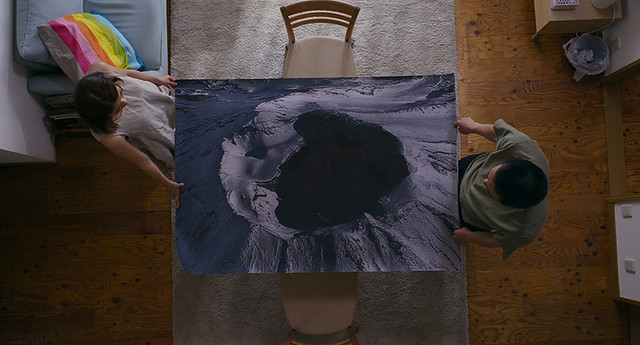
It is slowly revealed why they are not together. Kenji got someone pregnant and had to marry. Naoko only wants to marry the military man because she wants to have a baby. Obviously they have made some bad choices in their lives, they realize. Incest among cousins is looked down upon in Japanese society. But Japan is also a few countries which allow the first cosins to marry. There is a talk of inevitable eruption of Mt. Fuji, the sacred mountain of Japan. They reminisce about how they made love in front of the large picture of the caldera of Mt. Fuji, swearing their love into the volcano, as if sacrificing themselves to the mountain gods. They even took a picture to commemorate that night. Would they go their separate ways when Naoko's fiance returns?

It Feels So Good's theme is letting all your inhibitions go and live your life the way you want to, because it will all end anyway. Living in a country where natural disaster is way too common and people lead perpetually suspended in temporary existence, Ken and Naoko realize, it's now or never. From their point of view, their behavior might come across as nihilistic, but they are portrayed with much warmth and humanity by Emoto and Takiuchi. If we are to die tomorrow, who are we to judge how others led their lives? Intimate, natural and helplessly romantic, It Feels So Good is one of the best contemporary Japanese film I've seen.

A Story of Yonosuke
(2013) - Okita
StoryOfYonosuke_2013
From reading a brief synopsis online of A Story of Yonosuke, and with its 2 1/2 hour plus runtime, and the fact it is a period piece (taking place in 1987), I was fully expecting a Being There or Forest Gump type parable steeped in a socio-political survey on Japan's economic boom and its downturn in recent years. In a way the film is a parable, but in the subtlest terms.

It's a winsome tale about an affable young man named Yonosuke (a funny sounding name, I was told), who is not mentally handicapped nor an ethereal butler who may or may not exist. Rather, he is a regular guy who still manages to touch many lives with his gentle, optimistic nature.

Even though the film's periodic details are astutely recreated and observed, it is not the nostalgia piece where someone would say, "Yes, I remember the Yomiuri Giants winning the world series that year". As you delve into Yonosuke's life, it makes you forget the film's artificial backdrop soon enough.

Yonosuke, a college freshman from Nagasaki, is played by Kora Kengo (Norwegian Wood, Woodsman and the Rain). His sharp features and intensity are diffused by his big fuzzy hair and goofy smile. He is an ordinary, good natured kid whom everyone wishes would be their best friend. Yonosuke first befriends Kuramochi (Ikematsu Sosuke) and Yui (Asakura Aki) (they later become a couple), when they stumble into the school's samba club in an orientation week. They become an inseparable trio. After getting infatuated with an older, alluring 'party girl' Chiharu (Ito Ayumi), Yonosuke unloads his feelings about her on the reluctant ears of Kato (Ayano Go), a reserved man Yonosuke mistakes for someone he knows. They also become best friends. Then he meets Shoko (Yoshitaka Yuriko), a rich industrialist's daughter, who is always chaperoned by a driver and waited by a maid. Their class differences provide many comedic moments in the film. A wide-eyed naif, Shoko falls for good natured Yonosuke right away. She even follows him to Nagasaki for the summer break at a moment's notice, bewildering him and his rightfully suspicious parents. Their courtship is perhaps the most beguiling part of the film: awkward, funny, tender and uplifting- as should any first love be remembered by.

"When I die, would anyone cry?" wonders Yonosuke at his grandma's funeral. It's a question all of us ask ourselves at some point in our lives. "No, everyone will laugh when they think of you." Shoko tells him. And this they do. Throughout the film, director Okita Shuichi unhurriedly inserts people from Yonosuke's life reminiscing about their time with him after some 16 years, without sacrificing the film's gentle narrative flow and without corny sentimentality. Their chance encounters with Yonosuke enriched their lives immeasurably and they feel privileged to have known him.

I take the film as a reminder that beauty and kindness is in all of us, in this time of economic hardship/post-Fukushima Japan. It's a warm hearted, hopeful film subtly realized by Okita and its spirit is beautifully embodied by Kora.

Sunday, July 26, 2020

This is a Woman's World

A Portuguesa (2018) - Gomes
Screen Shot 2020-07-24 at 10.27.13 AM
Screen Shot 2020-07-24 at 10.41.47 AM
Screen Shot 2020-07-24 at 10.48.07 AM
Screen Shot 2020-07-24 at 11.27.28 AM
Screen Shot 2020-07-24 at 10.58.30 AM
Screen Shot 2020-07-24 at 11.23.29 AM
Screen Shot 2020-07-24 at 10.36.47 AM
Screen Shot 2020-07-25 at 11.37.19 AM
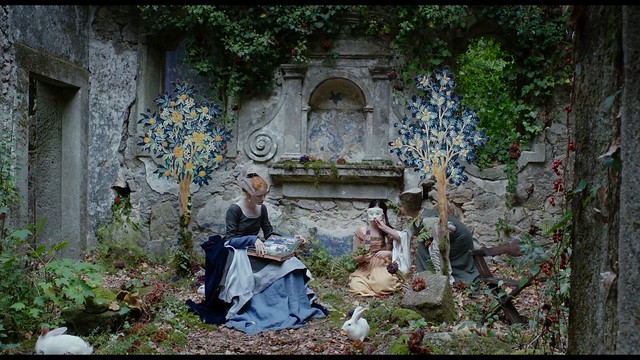
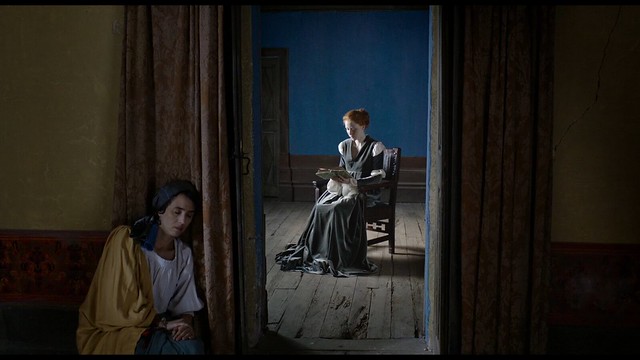
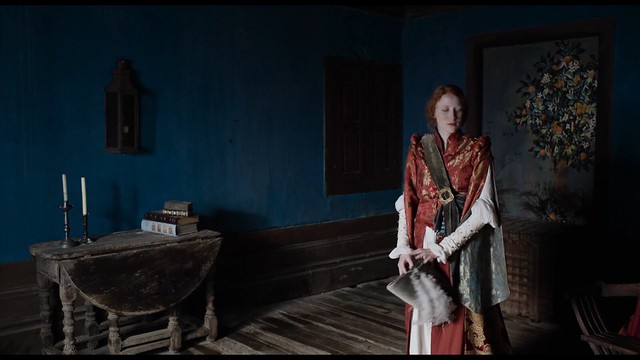
Rita Azevedo Gomes's The Portuguese Woman is a quietly radical feminist film in the highest order. The director's formalist approach here produces a stunningly beautiful images of an unnamed, young Portuguese woman (Clara Riedenstein), a Botticelli-an beauty with fiery hair, as she persevere more than a decade for her husband, Lord Von Ketten (Marcello Urgeghe), also known as the Lord of Chains (wink wink), to come home from endless war against a bishop of Trent. Mainly situating the camera on Riedenstein with shallow depth of field and playfully manipulating foreground and background, Gomes creates the Portuguese woman's own world in extreme details and full of life that is devoid of the usual drab domesticity of women in waiting depicted in films.

Soon after arriving in a ramshackled castle on the top of the hill, Von Ketten says farewell to his young wife, to go off to war in Italy. As a young, newly wedded woman in a rugged foreign land, the unnamed Portuguese woman seems to be resigned to the fate that is dealt for her. But instead stewing in misery, she sets out to make the new environment home, away from her life near the sea back in Portugal. The contrast can not be clearer - she is a realist, saying excessive love is a dream, not reasoning. While men endlessly toil in valorization of war and honor, she flirts with life's ups and and downs as if everything has equal value, even life and death. It is told like a moral tale in singing, by Fassbinder regular Ingrid Caven, who appears throughout the film, twirls around in modern dresses, singing in different languages.

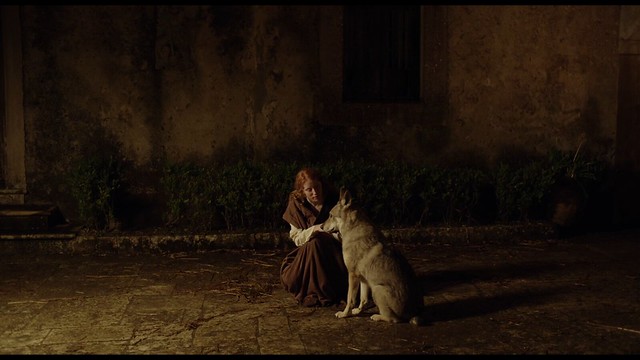
While Von Ketten is wasting away from his wounds in countless battles, the woman delves in many hobbies, bears and brings up two children, flirts with her visiting handsome cousin who studies in Bologna, raises an wolf cub. She might seem lonely and tired of waiting for the man she loves, but she leads a full life.

There are certain filmmakers who uses the static, meticulously framed, tableau style approach. Here, Gomes uses to create frame-within-a-frame, a hidden world. Each shot with its carefully arranged colors and props, resemble renaissance paintings. Radical in its approach, subtle in its messages, sublime in its presentation, A Portuguesa is a stunning film about a woman's world full of life.

Monday, July 20, 2020

A Generation Under Siege

Sacrifice (2020) - Tsuboi
Sacrifice
The Great Eastern Japan Earthquake of 11th of March 2011, which took the lives of 15,000, seared deeply into collective Japanese psyche. There have been films dealing with the aftermath of the disaster and manifested into popular culture in myriad of ways since then. But after less than a decade since the incident that affected millions of lives, its full psychological impact is still to be seen. Tsuboi Taku, who as a film student, worked on set of Kurosawa Kiyoshi's Journey to the Shore, as a second AD, makes a strong debut feature with Sacrifice, an understated, atmospheric thriller/murder mystery concerning the aftermath of such monumental tragedy and its effects on young people. Here he shows a great deal of potential as a writer/director.

The devastating earthquake and ensuing Tsunami happened 7 years ago when Midori (Gomi Michiko) was in middle school. She was known as Ap, her Sanskrit name back then. She belonged to a cult called Sacred Tide where its members believed a great tidal wave would purify the earth once again. She was a special child because of her ability to predict the future, as she did about the Great Eastern Japan Earthquake. But she escaped from the cult, in the hopes to have a normal life.

Now Midori is a college student and there's serial cat killer on the loose near the campus. The killer also claimed the life of Sora, her friend from her cult days. Toko (Handa Miki), an inquisitive fellow student, is determined to track down the killer and she suspects a quiet outcast named Okita (Aoki Yuzu) after she finds photos of gruesome cat killings in his possession. Toko is dating a good-natured senior Masaya (Fujita Kosuke), who is busy job hunting.

The cult is disbanded now but it morphed into a black-ops style private military firm, actively recruiting students on campus and scaring the general populace with their camo outfit and close to the skin haircuts. They want Midori back for her clairvoyant ability.

After Okita rescues Midori from threats made by a military man, they team up to find the killer. Okita suspects the cat killings are related to the date of the disaster, 3/11, that the killings won't stop until there are 311 victims that it is somewhat ritualistic in nature.

Reflecting the mood of the nation ailing from economic downturn and natural disasters, Sacrifice touches upon the collective anxiety of the young generation: students are faced with grim prospects of depressed job market after they graduate. They openly joke about their lack of interpersonal skills at job interviews. Some find the private military firm an attractive alternative even though the news of captured Japanese solders overseas constantly blaring on TV.

The film's visual style - large public places, an abandoned factory, the use of wide shots and effective framing, all for the benefit of generating eerie and atmospheric tone, are reminiscent of seasoned contemporaries - Kurosawa Kiyoshi, Tsukamoto Shinya and Ishii Gakuryu, just name a few. Sometimes the run-on exposition heavy dialog feels a little too much for the young cast to handle and wish he could've relied on his visuals to do the talking. But overall, Sacrifice is a brooding examination of a generation under siege by the catastrophe which they still struggle to understand its full impact.

Sacrifice exclusively streams as part of Japan Cuts 2020, July 17 - July 30. Please visit Japan Society website for tickets.

Saturday, July 18, 2020

Humanity in Lower Depths

Life: Untitled (2019) - Yamada
Life untitled
One can't go without mentioning Mizoguchi's superb melodrama, Street of Shame (1959), when we talk about films about sex workers. Like Street of Shame, where there were 5 different individuals with their own stories to tell, Yamada Kana's Life: Untitled manages to tell a group of people, men and women, engaged in a ramshackled escort business. Adapting her own play in her debut film, Yamada weaves stories of empowerment, identity, misogyny, gender roles and how bottled up sadness and anger materialize in the form of sociopathic behavior and violence. She also shows wealth of humanity in each character and brings out compassion and understanding. Not unlike Mizoguchi's film, Life: Untitled is a deeply moving film and sympathetic look at the world's oldest profession in modern Japan.

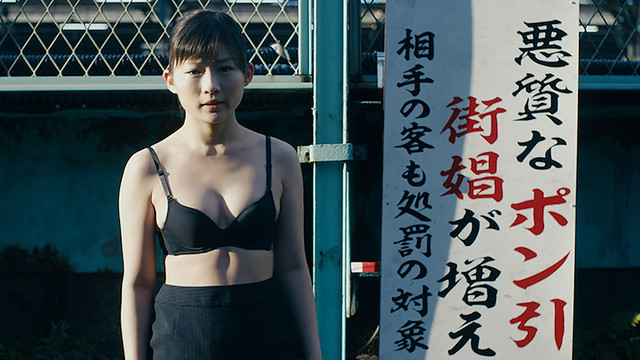
The film starts with Kano (Ito Sairi)'s voice over: she is a girl tired of leading ordinary life and down on her luck. She wants to give her life meaning, somehow. Then she ends up interviewing for a job at an escort service run by ruthless Yamashita. Kano has absolutely no qualifications for the job, as far as her resume is concerned. But she is up for anything, ready to challenge herself. But on her first assignment, Kano is grossed out by a horny client, fights him off in the hotel room and runs out to the street with only her bra on. After that, she is assigned to an office duty. She then becomes the fly on the wall for us.
The office, where girls hang out while waiting to be called and interact with each other, becomes a main stage for Life: Untitled. There is Mahiru (Tsukematsu Yuri), an always smiling, sweet girl and clients' favorite, Atsuko (Satsukawa Aimi), who always whines and complains, Kyoko (Morita Kokoro) who is helplessly in love with brutish Ryota, the company driver, Shiho (Nozaki Tomoko), an older woman who keeps to herself and Chika (Yukihira Aika), a loner who scribbles in her diaries in the corner everyday. They all have part of their stories played out.

Girls gaggle and play around in the office but also tempers fly for the smallest things. As with any profession, there are good sides and bad sides. With their profession, it's how well they keep its depressing bad side hidden to function. There are emotional blow-ups and threat of violence. Things boil up to the surface.

There are many poignant moments but the most touching episodes are one with Kyoko and Ryota, no matter how much he abuses her, Kyoko sees through Ryota's tough guy façade and sees him for what he is, a scared little boy who needs to be taken care of. It shows Kyoko isn't some mindless prostitute with masochistic tendency but sees in him the exact same qualities as herself, that they are made for each other. It's real pleasure to see their transforming relationship through out. Another is smiling Mahiro. Her sweet girl façade hides the sadness inside her and brings out pyromaniac in her. She wants to burn the whole Tokyo to the ground. She wants to burn it all down. Catharses small and big for these characters are movingly captured near the end, like a collective therapy session, reminding you of the ending sequence in Kieslowski's Blue, where camera hovers on each characters' lives.

Ito Sairi with her small figure with an improbably husky voice is a force to reckon with. Her physicality and presence anchors the film from hurtling away with multiple storylines. As well as being our eyes and ears, she stands firm as the moral core of the film, quietly managing everyone around her and brings out their stories.

Life: Untitled, with superb acting and energetic direction, reflects on the bittersweet lives of these affable characters on the bottom rung of the society. Highly recommended.

Japan Cuts 2020 is streaming this year! For virtual viewing, please visit Japan Society.

Friday, July 17, 2020

Sex, Love and The End of the World

It Feels So Good (2019) - Arai
It feels so good 1
It feels so good 2
It feels so good
It feels so good 4
'What would you do in the face of impending doom?' is the question posed on Kenji (Emoto Tasuku, Your Bird Can Sing) and Naoko (Takiuchi Kumi, Greatful Dead) in It Feels So Good. Writer/director Arai Haruhiko's new film, based on a novel of the same name by two time Naoki Literary Prize winning novelist Shiraishi Kazufumi, written right after Fukushima nuclear meltdown, sees a couple in the precipice of another major natural disaster in Japan.

It starts out with Kenji, unemployed thirty something divorcee seen on a riverbank, fishing half-heartedly, then getting a phone call from his unseen dad informing him that his cousin, Naoko, is getting married. Would he be able to come down from Tokyo and attend?

Naoko is getting married to an older career military man, who is in charge of disaster relief missions, in five days. He is involved in some National Security briefings right now. It turns out Kenji and Naoko share a past: they both were young and very much in love. Naoko even kept graphic photo album full of their sex acts taken by themselves. They tried every position, and everywhere. They used to explore every inch of each other's body. The memories of their affair come flooding back and they can't keep their hands off each other. They will continue to have sex until the day Naoko's fiance returns.

Arai makes sure that we see Kenji and Naoko and them only. We are invited into the couple's intimate bubble. No one else is seen and only heard occasionally on the phone. They go out to restaurants and street festivals, but the camera is only concentrated on them. But mostly, we see them having sex in his old mother's house, her parents house and her big empty new home which she will move in with her husband after the wedding.

Emoto and Takiuchi give commited, brave performances as lovers against socital norms and impending natural disasters. They have great chemistry together.

It is slowly revealed why they are not together. Kenji got someone pregnant and had to marry. Naoko only wants to marry the military man because she wants to have a baby. Obviously they have made some bad choices in their lives, they realize. Incest among cousins is looked down upon in Japanese society. But Japan is also a few countries which allow the first cosins to marry. There is a talk of inevitable eruption of Mt. Fuji, the sacred mountain of Japan. They reminisce about how they made love in front of the large picture of the caldera of Mt. Fuji, swearing their love into the volcano, as if sacrificing themselves to the mountain gods. They even took a picture to commemorate that night. Would they go their separate ways when Naoko's fiance returns?

It Feels So Good's theme is letting all your inhibitions go and live your life the way you want to, because it will all end anyway. Living in a country where natural disaster is way too common and people lead perpetually suspended in temporary existence, Ken and Naoko realize, it's now or never. From their point of view, their behavior might come across as nihilistic, but they are portrayed with much warmth and humanity by Emoto and Takiuchi. If we are to die tomorrow, who are we to judge how others led their lives? Intimate, natural and helplessly romantic, It Feels So Good is one of the best contemporary Japanese films I've seen.

It Feels So Good, exclusively streams as part of Japan Cuts 2020, 7/17 - 7/30. Please visit Japan Society website for tickets.

Monday, July 13, 2020

A Gentle Friendship in the West

First Cow (2019) - Reichardt
First Cow 1
First Cow 2
First Cow 3
First Cow 4
First Cow 5
First Cow 6
First Cow, Kelly Reichardt's new film, based on a novel, Half Life by her long time writing partner Jon Raymond (who also adapts here with Reichardt), is thing of a beauty from start to finish. It starts with an William Blake quote - "The Bird a nest, the spider a web, man friendship." Friendship here concerns between Cookie Figowitz (John Magaro), a beaver trapping party cook in an Oregon trail and King-hu (Orion Lee), a prospector on the run. When they first meet, King-hu is naked and starving, hounded by Russians who think he crossed them on a deal. Mild mannered Cookie isn't quite welcomed in his own party, as they aggressively bully and threaten him with violence. Cookie helps the Chinaman food and shelter over night. The next time they meet, they are in Fort Tillicum, a small outpost in the woods. They start sharing King-hu's shack in the woods, dreaming of going south and opening up businesses there. There is a cow that is brought up from San Francisco in the order of Chief Factor (Toby Jones), a proper English gentleman who drinks needs milk in his tea. The cow is said to be the first one in this part of the woods. The cow had its mate and a calf, but they didn't make the long journey, they say. Any type of bread is hard to come by those days, and Cookie mentions making some milk bisquits, if he only had milk, to King-hu in passing. King-hu, more entrepreneurial of the two, suggests they milk the Chief's cow at night to make bake goods and sell it. Who's gonna know?

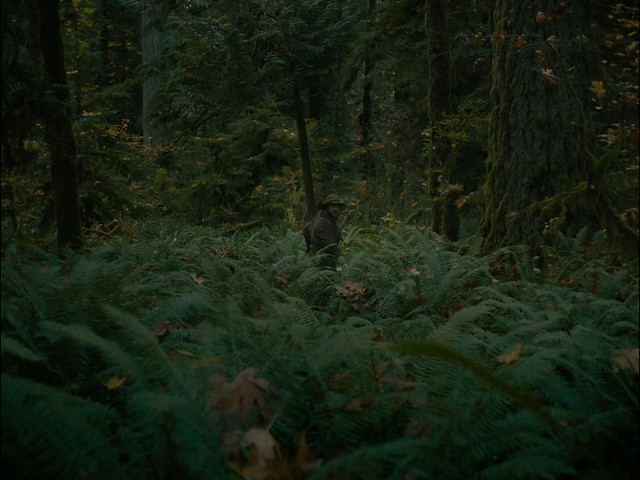
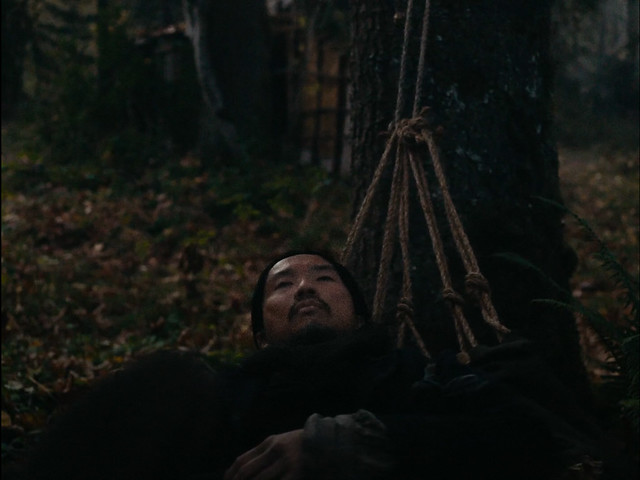
With this simple premise, an unusual Western in the Reichardt way, unfolds. Reichardt's deliverately gentle tone and two gentle protagonists are polar opposite of the Wild West told in film we are used to. And just like her Meek's Cutoff, Reichardt redefines it with First Cow. This early days of America (at least in the prospecting west) back then, was ethnically very diverse and in too much of a survivalist mode to be overtly racist yet. It's good to see the presence of Lily Gladstone (Certain Women) and Gary Farmer in an interesting and perfectly fitting cast. I mean, where else would you see a western about a couple of gentle souls with their small dreams other than in a Kelly Reichardt film? As usual, shot in 16mm, 4:3 academy ratio by Christopher Blauvelt, the mossy forest of Pacific Northwest has never been more beautiful. And with gentle, fitting music by William Tyler, First Cow is one of those rare, perfect movies in every single way. It's something you want to cherish for years to come. Now I want some oily cake with honey.

Saturday, July 11, 2020

Guilt Trip

Guest of Honour (2019) - Egoyan
Guest of Honour
Harkening back to his former glory days, writer/director Atom Egoyan (Exotica, Sweet Hereafter) makes a comeback of sorts with Guest of Honour with a stellar lead performance by a veteran British character actor David Thewlis. The film slowly and seductively unfolds a story of guilt, childhood trauma and vengeance in that unmistakable Egoyan style.

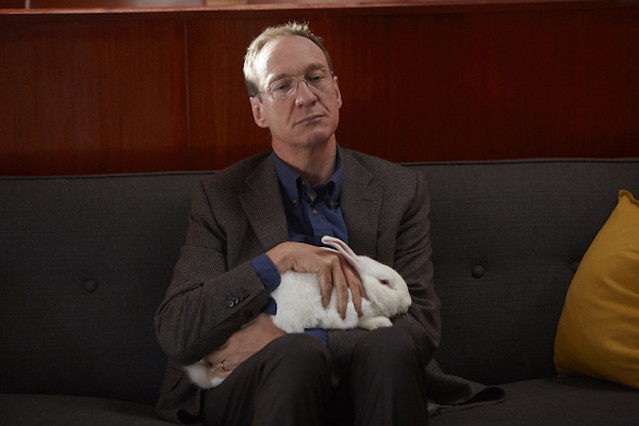
It starts with beautiful Veronica (Laysla de Oliveira) meeting a local priest (Luke Wilson) to arrange for her dad's funeral. She is there to lend him some insights to what kind of man her father was for composing a eulogy at the service. She doesn't have much to say about her dad, Jim (David Thewlis), except he took good care of her pet bunny, Benjamin, whenever she was away. The last time she was away was quite a while, because she was in prison for something she didn't quite commit.

With the film alternating between present and flashbacks, we meet Jim, a nebbish health inspector, widower and former restaurateur, as he visits various eateries, zealously enforcing by-the-book health regulations. His matter of fact, cold approach lends at times lively and almost comical situations, countering the film's more grievous subjects. At home, he leads a lonely life, with an enormous 15 year-old white rabbit whose entire life span determines the approximate time elapse for the film.

Technology has always been played part in Egoyan films. Now it is the use of cellphone in the age of sexting and online harassment and videotapes. Veronica gets into trouble for not handling unwanted attention well while traveling as high school band leader, chaperoning horny teenagers from concert halls and venues to hotel rooms and back and forth. A prank on a creepy and aggressive bus driver who has crush on her triggers Veronica's deep seeded guilt conscience about her boyfriend's suicide when she was a teen.
And it all stems from her childhood when she witnessed Jim holding hands of her music teacher while sitting next to her dying mom at her music recital.

If you think above plot description is way too convoluted, it is. The plot of Guest of Honour is way too overwrought to be profound or even plausible and encumbers its big reveal at the end. Many of its intriguing parts – the bus driver, the horny student, a rabbit's foot keychain, rat droppings and even Jim's profession are all ill served and sacrificed for its intricate plotline.

But there are also some brilliant moments in the film: as it is customary in Egoyan films, there is an all out, uncomfortable public confessional with big emotional display. In Guest of Honour, it takes place in Armenian restaurant, managed by Anna, played by frequent Egoyan collaborator and wife, Arsinée Khanjian. Inebriated Jim is supposed to give speech as a guest of honour and Jim spills out his intentions for killing the bus driver whom he sees as responsible for ruining his daughter's life. The scene highlight's Thewlis as a gifted, dexterous actor and places him alongside the Egoyan pantheon of memorable fellow British actors, namely Ian Holm in Sweet Hereafter and Bob Hoskins in Felicia's Journey, both indulged in brilliant confession scenes of their own. Scenes with Jim visiting Veronica in the jail are also wonderful. Their encounters are sometimes accusatory and resentful, but there are also great and tender father-daughter moments and mutual understanding and shared grief.

Guest of Honour might not be the best thing Egoyan has made. But with David Thewlis's affecting and measured performance, it comes close to his heydays of filmmaking in the 90s.

Guest of Honour opens virtually through Kino Lorber's virtual platform, Kino Marquee on 7/10.

Tuesday, July 7, 2020

Cthulian Horror in the Age of Ecological Devastation

The Beach House (2020) - Brown
The Beach House
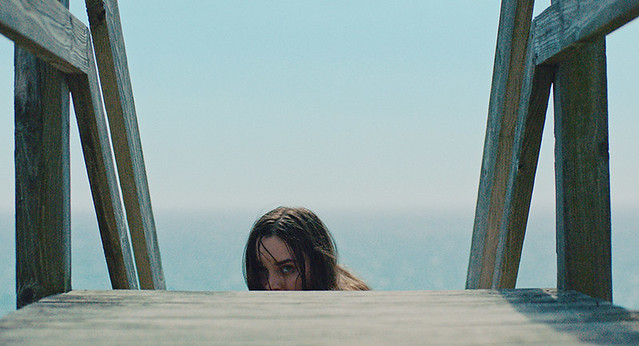
Jeffrey A. Brown's low budget debut feature, The Beach House, is a fast moving, effective Lovecraftian horror. It's heavy on mood and light on exposition, which is the best kind of horror in my opinion. An ominous deep-sea underwater sequence with active hypothermal vents releasing plumes of black smoke and heat, even before the title, sets the tone nicely, signaling what's in store for us.

A young attractive couple, Emily (Liana Liberato) and Randall (Noah Le Gros), hoping to reconnect, arrives at a remote beach house that belongs to Randall's family. Emily is unsure about Randall's plan of just crashing at the house unannounced. But he insists that they will be alone and undisturbed. Soon they find out that there is an older couple, family friends, Mitch (Jake Weber) and Jane (Maryann Nagle), already staying there. But they are kind enough to accompany the two young lovebirds' sharing the house, only if they are OK with it.

It is revealed that Jane is seriously ill and it is kind of a last hurrah for her and Mitch being there at the beach house. While chatting over dinner, Emily is revealed that she is a beauty with the brain, as she is finishing her degree in Organic Chemistry and planning to continue her study in Astrobiology in Grad school, unlike Randall, who has but all dropped out of college. She corrects Mitch on astrobiology that it is less to do with outer space but more about how organisms can survive in extreme environment, on earth. That there's still so much we don't know about the mother earth. But even after all that primordial soup discussion, Emily refuses to slurp down oysters. It's an acquired taste, others quip. That night, they find organic, gooey phosphorus substances have overtaken trees in the surrounding area, glowing blue, both beautiful and otherworldly yet creepy. Is it edibles they have taken together acting up or is it something else?

The next morning, Emily discovers Jane being in a bad shape and Mitch missing. Randall's stomach is acting up too, probably from oysters. Mitch shows up next to Emily on the beach says some creepy stuff and walks into the sea. Emily goes after him only to step on slithery, moving organic creatures strewn about the shoreline. They seem like pods of some kind with tentacles stretching out. Emily freaks out as one of them infects the bottom of her foot. Jane, in the process of turning into something else, is now a crawling mess, and attacks Randall. Those things are in the water system too. Then, a mysterious fog engulfs the area, rendering everyone into a zombie like, crawling creatures in transition. Emily desperately needs to find a vehicle to drive away.

The Beach House keeps moving things along, giving the audience no time for dwelling on why or how and it is better for it. It builds on our preconceptions about the Cthulian myth and other creature horrors we grew up with and leaves it to us to make connections. With countless eco-disasters on the news in our daily lives- global warming, arctic melting, offshore drilling, hurricanes, massive forest fires, unfortunately, it is not hard to accept what's happening in The Beach House is entirely possible.
Liana Liberato, with her raised eyebrows and great athleticism, has a great potential to be a next great scream queen. It's also good to see always great Jake Weber (Snyder's Dawn of the Dead) being in the film.

With 'we come from the sea, we go back to the sea' theme, The Beach House is a top rate gross creature-feature and welcome addition to Lovecraft inspired horror we hold dear.

The Beach House Comes out in the US, Canada, UK & Ireland on AMC's horror streaming platform Shudder on 7/9.

Saturday, July 4, 2020

Macho Dance

And Then We Danced (2019) - Akin
And then we danced
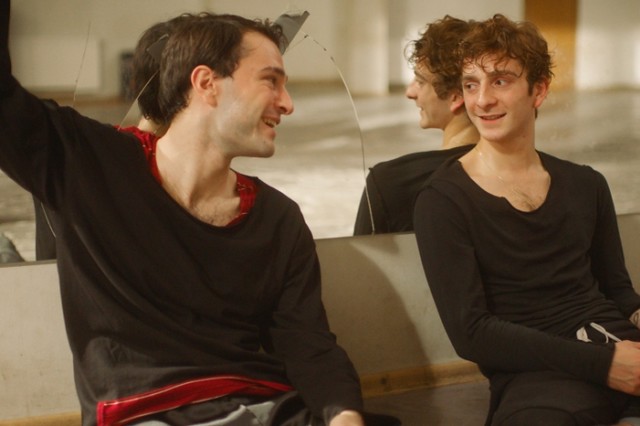
Tradition and love collide in a superb new film, And Then We Danced. Merab (Levan Gelbakhiani) is a dedicated dancer in National Georgian Ensemble, a prestigious and traditional Georgian dance academy under Aleko, a stern disciplinarian. Merab's estranged father was also a dancer who didn't see the future in the traditional dancing and now a mechanic. His delinquent brother David is also in the academy, but his foot is always half-way out the door. A new dancer Irakli (Bachi Valishvili), catches Merab's attention - his skills and masculinity, are well suited for rigidity of Georgian traditional dance, which Merab lacks (according to Aleko). Along with Merab's long time dance partner and childhood friend Mary (Ana Javakishvili), friendships blossom among them.

There is going to be an audition for a male dancer spot in the national dance team, vacated by a dancer who is accused of homosexuality and committed to a clinic. Naturally, Merab and Irakli are strong contenders for this audition. They practice hard while juggling jobs and family life. But their attractions to each other is growing. At the Mary's birthday party, Merab and Irakli make out. The forbidden affair takes hold of Merab, as it's his first love. Irakli disappears and David gets kicked out of the group. In despair, Merab injures his ankle during a practice run. At David's shotgun wedding, Irakli reappears, citing his absence to attending his dying father back home and a girlfriend he will probably need to marry for his father's wishes. And he will probably not come back to the academy. Now Merab is determined to express himself at the audition.

Anchored by Gelakhiani's stellar performance, And Then We Danced is a life affirming coming-of-age film and also a resistance film in the face of rigid and traditional society. Akin's portrayal of young loves and self-expressions are captured with pulse pounding energy and grace.

Thursday, July 2, 2020

Familial Truth

The Truth/La Vérité (2019) - Kore-eda
The Truth
Born out of forever adventurous French actress Juliette Binoche's years of insistence to work with Kore-eda Hirokazu, The Truth marks the famed Japanese writer/director's first film shot outside Japan and in non-Japanese language with international cast. And still, it is, in many ways, a very much Kore-eda film: about family dynamics with thorns and all, yet unmistakably gentle and humanistic. The only departure from his filmography I detect (other than not being Japanese) is that the characters aren't ordinary middle to lower class people that he usually portrays in his films. But I guess the prospect of working with a legendary French film star, Catherine Deneuve, made Kore-eda taking on a different direction. If the appeal of Kore-eda's films is in their universality, especially concerning adults in his films such as Still Walking and After the Storm - the innate goodness in people, admitting their shortcomings, small redemptions and letting the past go, The Truth shows that no matter the class distinctions, the concept of a 'family' still rings true to all of us.

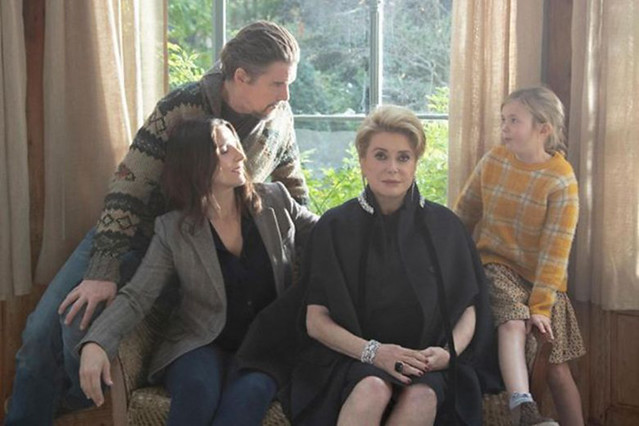
The story concerns Fabienne Dangeville (Deneuve), a legendary French film star and her screenwriter daughter Lumir (Juliette Binoche). Fabienne's memoir titled The Truth is coming out and to celebrate the occasion, Lumir and her American, second-rate TV actor husband Hank (Ethan Hawke) and their bi-lingual preteen daughter Charlotte (Clémentine Grenier) pay her a visit in a secluded grand mansion where Lumir grew up.

Upon reading the memoir, Lumir finds there are glaring omissions and falsehood from her childhood. For instance, Fabienne never picked up Lumir from school, like ever, unlike she says that she always picked her up even during her busy schedule. Fabienne's defense is , "Actors never tell the naked truth" in public. Everyone's memories are subjective anyway, she quips.

To make the matters worse, Luc (Alain Libolt), a long time devout assistant to Fabienne, calls it quits over not mentioning one word about him in the memoir. Now all the personal assistant duties fall on Lumir - receiving messages, accompanying Fabienne to movie sets, etc., whether she likes it or not- after all, she is her mother.

The catalyst for Fabienne happens when she takes an acting job, a supporting role in a low budget Sci-fi movie, aptly titled Memories of My Mother, by an unknown young director. Her co-star, a rising actress Manon (Manon Clavel), reminds her of her acting rival and close friend Sarah back in the day. It was kind-hearted Sarah who became a mother figure for young Lumir in Fabienne's absences.

Memories of My Mother, this movie-within-a-movie, is about a woman who is terminally ill, so she takes off to space in order to stop the advancing disease. She only comes down to earth every seven years to see her daughter, Amy, grow. She, herself forever young, gets to witness her daughter grow old. Fabienne is playing the old Amy part.

First, Fabienne tries to outdo her perceived rival in acting, scoffing and jabbing with pointy remarks at everyone around her, using her diva status indiscriminately. Then she realizes that Manon, like Sarah, is a genuinely warm-hearted soul and also a talented actress with great potential. This makes her to reassess her relationship with her daughter and people around her.

Is Fabienne character a thinly disguised reflection of Catherine Deneuve? Is The Truth a sly take on real life and movie industry and stardom in the likes of Postcard from the Edge? It is pretty clear that Kore-eda's interest is elsewhere. Given the opportunity to utilize a screen legend, he makes it larger than life, but at the core, The Truth is a superb family drama full of heart.

Fabienne says to Lumir in her defense things like, "I'd prefer to be a bad mother, bad friend but a great actress." It is true that we say the meanest, most hurtful things to those closest to us. Like it or not, we've all experienced it in our family. It's not because we mean it, but rather, because we can (and often shouldn't), precisely because we are family. For Kore-eda, who often examines the concept of family, understands this and creates beautiful, three-dimensional characters and great dynamics here. Deneuve is flawlessly in the role of aging diva. Binoche, a struggling daughter always in the shadow of her mother is also great. Ethan Hawke assumes his goofiness and brings in much needed (self-deprecating) humor and warmth.

With no huge emotional explosions and tearful scene-stealers, The Truth might come across as too subtle. But that's how Kore-eda always has been operating. Even though there is nothing Japanese about the film, he proves that there is universality in family dynamics anywhere. Quietly affecting with superb performances, The Truth is a welcome variation from always reliable Kore-eda.

The Truth opens July 3. Please visit IFC Films for more info.

Dustin Chang is a freelance writer. His musings and opinions on everything cinema and beyond can be found at www.dustinchang.com

Thursday, June 25, 2020

Outsourcing Feelings

Family Romance, LLC (2019) - Herzog
Screen Shot 2020-06-24 at 7.08.42 AM
Screen Shot 2020-06-24 at 6.45.55 AM
Screen Shot 2020-06-24 at 7.25.45 AM
Screen Shot 2020-06-24 at 6.25.07 AM
Family Romance is a company that provides rental services for human relationships. And it's a fitting concept for Werner Herzog who has always been a filmmaker, documenting vagaries of human life since the 60s, in both narrative and non-narrative forms. Even though his recent 'documentaries' might not be grandiose enough when compared to such classics as Aguirre, The Wrath of God or Fitzcarraldo, I think he is an unsung chronicler of human existence, not only to an extent of extreme and obsessive tendencies of us humans, but rapidly changing technology and its philosophical implications with his string of recent films.

Herzog's stance as a filmmaker always has been that films are all an illusion, therefore, there are no distinctions between a narrative or a documentary. Family Romance, LLC certainly plays out like a documentary, with some of the real life subjects playing themselves. But we all know that it is scripted, with unmistakably Herzogian touches in dialog in it. The master filmmaker is again, searching for that ecstatic truth.

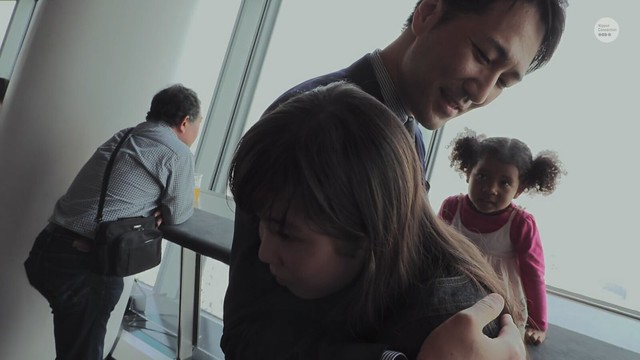
We are introduced to Ishii Yuichi, the head of Family Romance, having a rendez-vous with his client's daughter, Mahiro. He is hired to play her long absent daddy because she is bullied in school for not having a father. We see her sheepishly passing by many times, among crowds enjoying cherry blossom festival in a public park. They finally meet and talk. Mahiro, a shy 12 year old girl, slowly opens up over time, accepting Yuichi as her dad.

It's probably Herzog's insistence that Yuichi stops by at Robot Hotel, to ask its owner about incorporating the technology to his business. The filmmaker is obviously making a tenuous connection here with impersonality and dehumanization of face to face service industry and preposterousness of its theatricality and performance. They have creepy male and female robot attendants at the counter, as well as robotic fishes in the fish tank. Family Romance also services 'web influencers' as hired actors posing as paparazzi, following the client on the street, taking pictures in busy streets.

As the 'lie and deception' on Mahiro continues, Yuichi is having an existential crisis. He expresses his fear of getting caught by 'playing many roles' in a fox shrine adorned with fox statues all wearing cute red scarves. Fox is known in Japanese folklore as shape shifters and Japanese people prey often to them when they want change in their lives.

There are Herzogian touches and humors everywhere: in the middle of a session, an old blind oracle gets a loud phone call and of course, Herzog doesn't call it cut or pans away from her but stays with her until she turns off the phone. Yuichi asks the robot hotel manager, "Will robots have dreams?"

Family Romance, LLC is shaped as Yuichi confronting his role as a lie. You feel for Mahiro as she comes to love Yuichi as her father. Where does this relationship take them in the future? Herzog lets us know that it's that sinuous relationship we have with each other as human being that can't be faked with any artificial means.

Wednesday, June 17, 2020

Majesty shmajesty.

A Hidden Life (2019) - Malick
Screen Shot 2020-06-15 at 4.01.54 PM
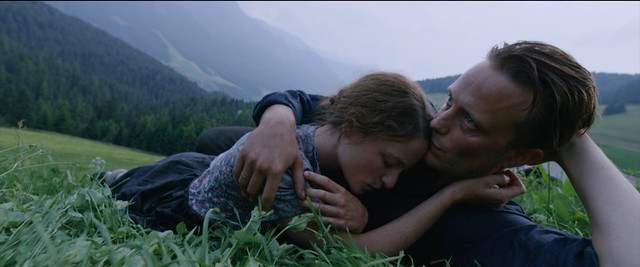
His abstract visual poetry of two previous films that left many of his pre-Tree of Life fans in the cold, Terence Malick is sort of back in a straight narrative world with A Hidden Life. Based on a true story of a farmer named Frantz, a conscientious objector in Nazi Austria during WWII. It is a slim and simple film stretched out for almost 3 hour running time. "Injustice is better being suffered than do", says one of the characters in the film. Frantz believed what is right and couldn't bring up to himself to pledge his loyalty to Hitler. He and his family were ostracized by their community and religious leaders for not conforming. And worse, called traitors. The theme rings resonant now with all the horrors that are happening everywhere in the world. Franz Jägerstätter was deified by Pope Benedict XVI (yes that pope who called it quit) into sainthood. His portrait of nature and that of a higher power is admirable. And it's beautiful in its Malickian way as usual. The Austrian Alps is breathtaking in his wide-angle cinematography (by German cinematographer Jörg Widmer). A Hidden Life should be seen on the big screen to experience its majesty.

I admire Malick's world view and his philosophy in general and his use of it in his beautifully photographed, elegant films. But we know that the world we live in now is not that simple. Evils of the world is not that cleanly and conveniently defined. It is not anyone's fault but ours that we live in a complicated society where morality is as murky as milk in tea. Malick's world view, that of the boomers, is nostalgia ridden, black and white world of yesteryears. And clocking at 172 minutes, it's way too long even with all the pretty pictures.

Friday, June 12, 2020

Best Friends

Fourteen (2019) - Sallitt
Screen Shot 2020-06-12 at 11.23.26 AM
Former film critic Dan Sallitt's latest, Fourteen, is an absorbing observation of a lifelong friendship of two women as they struggle through relationships, careers and life. This finely tuned, exceptionally written and superbly acted work is a thing of a beauty. It concerns Mara (Tallie Medel) and Jo (Norma Kuhling), who have been friends since middle school. They are both in late 20 early 30ish, treading edges of their middle class existence in New York precariously. Mara is a school aid, working on her Masters in education to get a permanent teaching position and Jo is a social worker. As a New Yorker who struggled in my twenties and thirties, their lives are immediately relatable. Mara is a responsible one, Jo is a hot mess. This also, depending on where you fall in the spectrum, completely relatable and have known a friend like Mara or Jo. Naturally, it's Mara who's there whenever Jo is in trouble and needs support. Jo, who has questionable work ethics, possible addiction problems, fucks up a lot at the job and always in need of another. They both are not lucky in romance. Blonde and pretty, Jo attracts a lot of men in her life, but they one way or another realize that she is trouble and end up leaving. Mara is dating on and off bookish programmer Adam (C. Mason Wells) but see other men as well. All their conversations are all natural and go from one subject to another like real life conversation among close friends.

But as Mara slowly settles in her life, Jo's losing a grip on it. It's gotten bad that even the staffing agency wouldn't return her call. She threatens one of her boyfriends with a knife and the incident pushes him to call Mara in the middle of the night. Jo also ends up hospitalized and Mara has to visit her in her parents house on Long Island as she recuperates.

Time passes us by. Life comes at you fast. However we try to care for each other, adulting means less time for your friends. Sallitt is fully aware of this. We can't be there for our best friends 24/7. Is fourteen/hitting puberty the end of all the fun in life? Are we just carrying out a death sentence after that? Mara gets pregnant and gives birth to a baby girl named Lorelei. Jo promises to come and meet her. We don't get to see their encounter, like many events in their lives in the film, until at Jo's funeral. With astonishingly economical edits, Sallitt let us witness the passage of time without missing a beat. With his extremely slim and straightforward filmmaking, Sallitt accomplishes something that is both deeply poignant and beautiful. One of the year's best films so far.

Let’s Get Physical

Aviva (2020) - Yakin

aviva-02 It seems dance movies are in vogue again as of late, with Gaspar Noé's Climax, Luca Guadagnino's Suspiria, Levan Akin's And Then We Danced and Luka Dhont's Girl, among others. Writer/director Boaz Yakin (Fresh, Remember the Titans)'s new film Aviva is a stunning new vision about gender fluidity, in close collaboration with dancer/choreographer Bobbi Jene Smith.

The film starts with Eden, or a part of Eden, played by Smith, in bed and naked, directly looking at the camera, telling us she is indeed playing a part in a movie we are watching. She states the movie is written by a man, and for all intended purposes, she is playing a man named Eden (also played by Tyler Philips). She says it's about her best friend, Aviva. Aviva also is played by a woman (Zina Zinchenko) and a man (Or Schraiber). Confused yet? Yakin plays around with our society's perception of the typical man/woman dichotomy and polysexuality within us all, in an exuberant, sensual, free form filmmaking with the help of the all-professional dancer cast.


Eden (Philips) is a New Yorker recovering from a devastating breakup. He is introduced to Aviva (Zinchenko), an ambitious Parisienne by a mutual friend in Europe. They start their email correspondences and hit it off and they both feel that they are a great match. Aviva takes a leap of faith and decides to come to New York and meet Eden. He is happy about the news of finally meeting Aviva in person, but his expectations are so high, he is somehow afraid of disappointing her or himself.

Whether it was social conditioning, or his preconceived notion, Eden seems to be regarding women not being equal to men. Through the flashbacks of their childhood, we get to see Eden's deep seeded distrust and antagonism toward his feminine side. Can his best friend be a girl? Are all women sexual objects like in porn he incessantly watches?

After they get together, and Aviva decides to permanently move to the US, Eden has a hard time truly connecting with her. He avoids eye contacts while having sex with her, and he'd rather hang out with his buddies at the bar by himself than inviting her in to the fold.

At the same time, with the male part of Aviva (Schraiber), Eden has great time sexually, even though he feels ambivalent about not being on top. In order for Aviva to stay in the US, they have to get married and after a considerable persuasion from his feminine side (Smith), Eden reluctantly marries her. Aviva pursues her ambitions in being a film director and starts exercising her creativity.

If the above description of Aviva's plot is a little melodramatic, that's because it is. The film's strength lies in its daring physicality and energy. To be honest, even though there are plenty of beautifully choreographed dance scenes in the backdrop of New York and Paris streets, in bars and empty warehouse spaces, I still wanted less talking but more dancing. It could've been a little more abstract just seeing graceful human bodies moving in close-up and let them convey the all the meaning.

Using 2 compact, highly mobile Canon C300 high-resolution cameras, Yakin succeeds in capturing those moves in fluid motion. Sensationally choreographed, Smith and co.’s dance interpretations of the push and pull of gender politics, heartache and loneliness, triumphs and soul searching that reside within all of us are all exhilarating to watch and at times, extremely moving.

The traditional notion of gender roles is still a hard concept to let go for many, because of centuries of social conditioning. The dominance of male gaze in mainstream media is well-documented facts. Male nudity, depiction of nude bodies and gay sex are still very much taboo. But as Aviva says with a hopeful smile, at the end of the film that things are changing. Yakin seems to want to challenge these evidently uncomfortable notions with Aviva.

The film's free flowing style doesn't always work - like the scene where little white kids break out rapping in the streets and subways, or male Eden thinking out loud if he wants to spontaneously start singing even though he hates musical are too precious and too self-conscious to work. But its bold, energetic and progressive representation of gender and body politics is sure to be a modern classic in the making.

Aviva opens a virtual theatrical release on June 12. Please visit Outsider Pictures for more info.

Sunday, June 7, 2020

Plenty

In My Room (2018) - Köhler
Screen Shot 2020-06-07 at 6.23.14 AM
Screen Shot 2020-06-07 at 7.59.07 AM
Screen Shot 2020-06-07 at 7.10.01 AM
Screen Shot 2020-06-07 at 7.45.04 AM
Screen Shot 2020-06-07 at 7.45.33 AM
Screen Shot 2020-06-07 at 7.43.44 AM
Screen Shot 2020-06-07 at 7.56.54 AM
Screen Shot 2020-06-07 at 7.46.00 AM
The apocalypse or extinction of human race comes in suddenly and without a bang in Ulrich Köhler's In My Room. The Sci-fi tinged dystopian near future has been the genre of choice for many prominent filmmakers working today. And Köhler, one of the Berlin School directors, is no exception. And he delved in to it previously, in Bungalow (2002). Rest assured, In My Room is not a wistful comedy or action thriller of Hollywood's view of the future. It's realistic version of what if and the reflection of the current consumerist society we live in.

Armin (Hans Löw) is a slovenly TV cameraman in his 30s who is prone to fuck ups. Living in a tiny, unkempt apartment alone and not getting any younger, he is wasting away his life by chasing young girls and getting fucked up. He visits his dying grandma at his father's house. His devorcee father is dating someone new. Other than that, life is uneventful. Then grandma passes away. His father doesn't want to be consoled. So Armin leaves and get wasted looking at party boats floating by in his car, under the elevated highway.

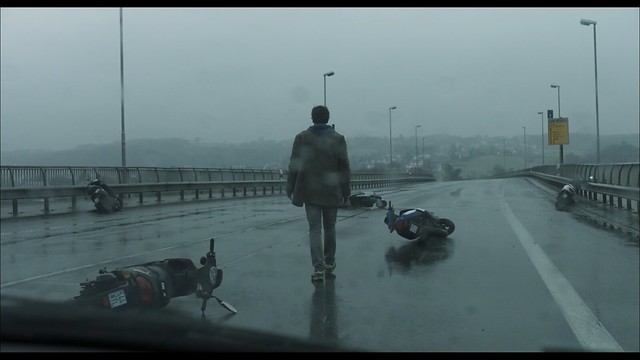
The next morning, he realizes that everyone has vanished. There are empty cars and motor bike strewn about on the road, no attendants at the gas station. The phone has no signal. After building a makeshift pyre for his grandmother in her bedroom, Armin takes off, leaving his father's house on fire. During a joyride in a cop car through the empty streets of small town near Switzerland where he grew up, he finds trapped horses in the tunnel and frees them.

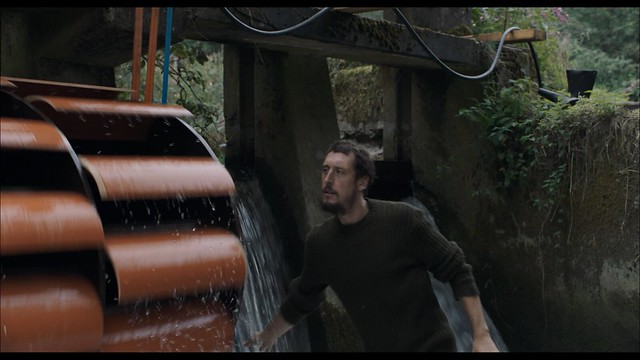
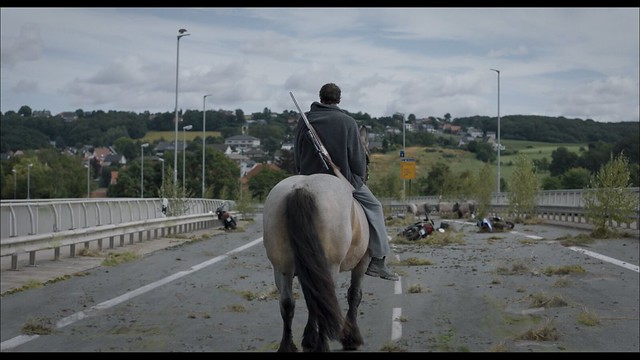
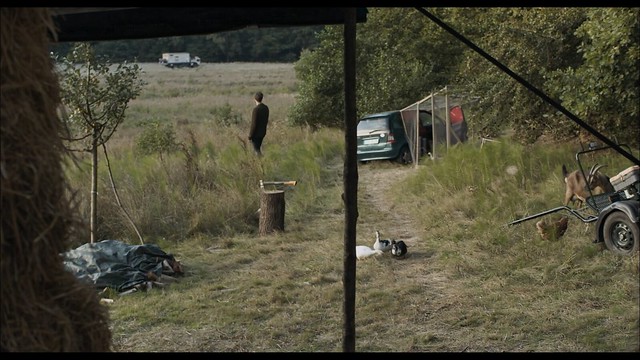
Next time we see Armin, shirtless and fit, is working on some type of hand rigged watermill using the stream. It turns out the rig powers his make-shift home where he irrigates land and grows animals. He goes supply runs on a horseback with a hunting rifle that used to belong to his neighbor, to empty shops and grocery stores. He seems efficiently settled down living by himself, as the possibly only man on earth. One night, a dog snatches his goat calf and he goes after it and falls off his horse after dog attacks him. It turns out the dog belongs to Kirsi (Elena Radonicich), an Italian speaking woman who's been living in a small RV. They haven't seen anyone other than themselves. They could be the only people on earth. They become close. There are still plenty of remnants of the human civilization, like canned food and DVDs and Techno music which they enjoy. But while Armin is pretty much settled in to the environment and accepts the new world, Kirsi remains curious and searching. He wants a child, she doesn't. She wants to see the world and doesn't want to stay with him.

In My Room realistically imagines the apocalypse where you might be the last man on earth and infinite choices we might encounter living in the comfort of the advanced capitalism or remnants of it. You can choose Armin's way, a city boy who seems to be enjoying being a self-made man and content being domestic or Kirsi, who is from a small town, trying to experience the world. The tragedy here is, the comfortable society we led so far gives you way many options, so even if you are the only man and only woman on earth, there is no guarantee that you will end up with each other. Sex and intimacy? Yeah sure. But the couple is seen in a DVD store browsing not only Ben Affleck movies (Kirsi's favorite) but the store's massive porn collection. Köhler seems to tell us that we have so many things to entertain ourselves with, companionship and loneliness take a backseat even at the world's end.