Showing posts with label Poland. Show all posts

Monday, August 17, 2026

Unfinished

Franz (2025) - Holland FRANZ 3 Seasoned Polish director Agnieszka Holland's biopic of perhaps the most celebrated Czech writer Franz Kafka shares much unconventionality in filmmaking as Peter Watkins' Edvard Munch biopic - with jumbled timeline - Vonnegut style, breaking the 4th wall with protagonists glancing at the camera, etc. Like Watkins's Munch, Holland relies on these dizzying formalist filmmaking - unruly zoom-ins, shallow focuses, to accentuate the craziness of early 20th century hurtling towards world wars and nazi Germany.

In Franz, Kafka (Idan Weiss), is a man of words, writing strange short stories in the household of gregarious industrialist patriarch, Hermann (Peter Kurth). Growing up with 3 sisters and an obedient mother and later, suffering from consumption (which he died of at the age of 40), in many film versions, Kafka is treated as an effeminate and sickly man, a complete outsider who couldn't deal with outside society. Not in Holland's version - here, he is depicted as a well-rounded, vigorous young man who enjoys the company of women, physical exercises and being sociable when he wants to. He even enlisted in WWI in support of the Austro-Hungarian empire.

It's his words on many letter exchanges with women that gets him in trouble. First with Felice Bauer (Carol Schuler), whom he was hastily engaged with, then her best friend Grete (Gesa Schermuly) and later, his best friend and publisher Max Brod (Sebastian Schwarz)'s wife Milena (Jenovéfa Boková). In many ways, Kafka is depicted as an everyman who happens to be a great writer with a very dark imagination. As a tour guide to Kafka museum in present day explains, Kafka wrote only a handful of short stories and novels but himself is a subject of millions of writings.

But I think Holland's cinematic approach to Kafka's genius was taken for granted too much. The only time we see one of his writings coming to life is Penal Colony in the beginning. It is appropriately shocking and gruesome - an accused is bound on a board face down. And countless beds of needles press down on his bare back to write his crimes on his skin for hours. As Kafka reads giddily in front of live audiences, the half of the crowd, sickened by the story, walk off. I just wished she used more of his writing imagined on screen, throughout the film.

With a kaleidoscopic depiction of the life of the famous literary figure, what Holland is trying to get at with Franz, is that it is impossible to present someone truthfully. It is true that Holland's Kafka is not a caricature of the famous writer but more of a person, but in doing so misses the mystique about the man who was one of the most influential writers of all time.

Wednesday, November 16, 2022

Beast of Burden

Eo (2022) - Skolimowski EO You can't not talk about a donkey in cinema without Robert Bresson's Au hasard Balthazar. Bresson's Christian allegory, where the beaten and abused donkey dies on a hill for sins of all humanity. It has always been regarded as an austere, unflinching masterpiece, if too biblical for this day and age. Fast-forward 56 years to the present: our highly globalized capitalistic world is on the brink of ecological, societal collapse. And we have Eo, a sobering, cinematic masterpiece by Polish veteran filmmaker Jerzy Skolimowski. The mass migrations of people, brought on by wars, by political/economical instability in the global economy, by famine and other natural disasters, have become our daily news, which we consume for better part of the last few decades. And there had been some outstanding films made about the current refugee, immigration crises - Fire at Sea, Human Flow, Limbo and Flee, just to name a few. Anywhere in the world, from formerly homogenous nations as South Korea to Ireland, the globalist economy is pushing massive human surge everywhere and it is changing the very fabric of their society. It confronts you on a personal level too - they drive you to your destinations, cook the food you eat, deliver your goods, take care of your children - in short, they are the backbone of our society.

So how do you portray the suffering of immigrants and refugees, caught up in circumstances that they have little to no control over, with an empathetic eye? How do you give the voice to the voiceless without being too didactic? How do you show the carnivalesque atmosphere of current political situations in the Far-Right, anti-immigrant, nationalistic governments in Europe and the US?

The film starts in the circus (!) tent. Eo, our titular protagonist, is a donkey, trained and cared by Kasandra (Sandra Drzymalska). It is clear that he had been abused and beaten when not taking directions by other carnies. There are animal rights activists in Warsaw violently protesting outside the circus fair ground. They succeed in seizing the rights to the circus animals. Eo gets separated from Kasandra, the only human who had shown kindness. He is transferred to a horse sanctuary in the countryside. As a working animal, unlike horses that are being treated there, Eo is being used to carry stuff around in the stable. Eo witnesses some dreadful conditions and treatments horses receive. After refusing to work, Eo is transferred once more to a small farm. As he is being taken from one place to another, our beast of burden witnesses human folly and cruelty to both him or to other animals. He travels sometimes alone, sometimes in cattle cars and treated nicely only when he is deemed useful.

Eo escapes to the forests, thinking of Kasandra, gets captured again, freed once more.... It's a road movie of the highest order.

The film, mostly shot from the donkey's point of view, with jarring close-ups, has a visceral, raw quality only seen in haptic cinema of Sensory Ethnography Lab (SEL) - Leviathan, Sweetgrass, The Iron Ministry or Philippe Grandrieux's more pastoral, picturesque film - Un Lac. The film visually, sensorially replicates what Eo is experiencing - disorienting sensation being in the cattle car, out of place in a football stadium, going over the bridge overlooking grand man-made structures, et cetera. Michal Dymek's cinematography is exquisite: it conveys both intimate and grand spaces of our world and accentuates its beauty and ugliness. Without much dialog, Eo plays out like a documentary at times and has its own visual rhythmic flow of a road movie.

As if the fablist, allegorical nature isn't obvious enough in the beginning of the film, it becomes loud and clear with Isabelle Huppert showing up near the end as an unnamed, dispassionate countess living in a lavish palace in Italy, obviously a stand-in for decadence of Western Europe, speaking French and Italian and flirting with her disaffected, too good looking step-son Vito (Lorenzo Zurzolo) who rescued Eo from an accident and brought him home.

Unlike some cute Disney family movie starring a talking donkey, Eo is not a fairy tale. It can also be seen as sobering examination of the meat industry. But more importantly, it is an allegory for how people from different parts of the world, not by their own volition, get uprooted and go through unimaginable hardships and alienation only to be at the mercy of a handful of strangers who ultimately don't have any stake in their lives. Eo's abrupt ending heightens the disconnect, makes the audience uncomfortable and reflect on the globalist economy and its effects on Global South, which is precisely the point Skolimowski is making.

Eo is Poland's official selection entry for Oscar next year. It opens on 11/18 at Film Forum and Film at Lincoln Center in NYC.

Sunday, October 7, 2018

Fatalistic Love Story

Cold War (2018) - Pawlikowski
Cannes-5
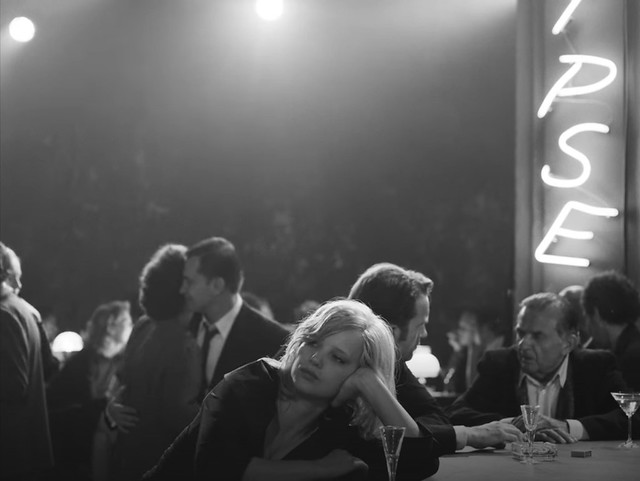
Cold War is a tragic, fatalistic love story set in Poland after the second world war. The year is 1949. Wiktor (Tomasz Kot) and Irena (Agata Kulesza), two musical enthusiasts are seen traveling and collecting samples of Polish folk music in rural areas. They are two pivotal force behind a newly established Polish State run music school. While auditioning many young, talented pupils, a sultry, troubled girl Zula (Joanna Kulig) catches Wiktor's eyes. It's a school where they train students to be entertainers on stage - involves not only singing but choreographed dancing in traditional garbs. Zula, talented and has a beautiful voice, becomes a star soon enough. And Wiktor and Zula soon become lovers. Now the year is 1952.

Soon the school and its trope becomes a success, the communist regime takes an interest and pressure them to integrate pro-Stalin propaganda songs. Irena objects at first but relents at the Kaczmarek (Borys Szyc), the founder of the school's insistence. But it gives school and Zula an opportunity to travel and perform elsewhere in Europe. While they are performing in Paris, Wiktor suggests Zula that they defect to the west. But Zula fails to show up at the rendez-vous point and they are separated.

Many years passes. Wiktor is now living in Paris, composing and playing piano in a jazz ensemble living in a tiny apartment, like a true bohemian in French movies. After seeing Zula perform with her traveling Polish group on stage in Zagreb, and after forcefully removed and put on a train out of Yugoslavia, they are reunited in Paris. But the whole Paris scene doesn't satisfy Zula. It's too stuck up and Wiktor seems to have lost his mojo in a foreign land - "In Poland, you were a man!" Zula chastises him. After couple of jealousy fueled fights - involving a poet Juliette (Jeanne Balibar) and movie director Michel (French director Cedric Kahn) in Wiktor's circle of artist friends, Zula goes back to Poland. Wiktor, crestfallen, decides to go back to Poland for Zula, risking being jailed as a unpatriotic traitor.

Shot again in full frame monochrome by Lukascz Zal, Cold War is every bit as beautiful as Ida. His use of head space is there and it's lovely. Kulig has a clear and beautiful singing voice in every style, providing some of the loveliest vocal tracks for the films great jazzy soundtrack.

Pawlikowski deftly directs, like his previous film, Ida this 90 minute film in a breeze. But whereas this quick, no moment to spare, no time to contemplate pace worked for a young woman coming of age story, for something like Cold War and the subject like tragic love, I wish the director spent a little more time with Wiktor and especially more with Zula, since Kulig, resembling Slavic Léa Seydoux, is very lovely to look at and listen to. Constant fade to black after pivotal moments in their lives doesn't feel like just times passing or mere transition but more like we've missed out on a lot of details. I understand Pawlikowski's driving idea of 'love has no ideology or borders', but the absence of the couple's political allegiance/aversion as 'artists' bothered me (same way as Ida wearing religion on her sleeve in Ida), especially no background for either of them were ever fully explored. The ending is beautiful but I feel like the rest of the film didn't quite earn it.

Friday, March 16, 2018

Direct Cinema

Nawet nie wiesz, jak bardzo cie kocham/You Have No Idea How Much I Love You (2016) - Lozinski
Screen Shot 2018-03-16 at 6.34.49 AM
I've seen some excellent documentaries coming out of Poland recently. You Have No Idea How Much I Love You is one of them. The set up is simple: it's a recording of family therapy sessions - mother (Ewa Szymczyk), daughter (Hanna Maciag) and the therapist (Bogdan de Barbaro). With close ups of these three people, sometimes the camera panning, sometimes over the shoulder, are as direct cinema as you can get. It's not their bad complexions we notice, but their eyes, catching the lights as they speak that lend the film's hypnotic power. Lozinski focuses on these three and nothing else and we are held captive audience, holding on to every word spoken.

Even though they grew apart, these two women got together in the hopes of solving their differences - abandonment issue, loneliness both stemming from Ewa's divorce when Hanna was still young. Blames, waterworks, breakthrough. It's truly captivating stuff.

Monday, February 27, 2017

Fishy

The Lure (2015) - Smoczynska
 photo 640_zpsgq4ln7pd.jpg
Half baked ideas and intentionally campy approach, The Lure is an epitome of an amateur hour at international film festival circuit. The title is an apt one. You are supposed to be lured in by a pair of young topless girls and candy colored palette and catchy 80s music numbers only to find there is nothing else in it. There isn't an ounce of creativity or originality.

Monday, February 22, 2016

Start Making Sense

Cosmos (2015) - Zulawski
 photo 0fa0df2e-e48c-425b-8ea3-c35af89eb2c3_zpsa0v3n4wt.jpg
Andrzej Zulawski lost his battle with cancer last week, adding his name to mounting number of cultural icons who passed away this year. His death came as a shock especially to New York cinephiles, who's been waiting patiently for the chance of seeing Cosmos, his new film in 15 years, ever since it made a world premiere at Locarno Film Fest last year.

When the good folks at Film Society of Lincoln Center announced the roster for this year's Film Comment Selects series, I was overjoyed that Zulawski's new film was included. Incidentally, they also added A Spotlight on Zulawski, a mini-retro consists of his digitally restored Polish films, including the seldom seen Sci-fi epic, On The Silver Globe.

The good news is that Kino Lorber has acquired the film and will be distributing it this summer in North America. The Bad news is, Cosmos is not quite the (last) film you expected from Zulawski; the master of emotional paroxysms. Rather, it's filled to the brim with non-stop psychobabbles and many intrigues that don't deliver on an emotional level. Its non-sensical wordplay is reminiscent of his My Nights are More Beautiful than Your Days, sans all the sex scenes. And it plays out like a chamber comedies of later period Alain Resnais.

Failed law school student Witold (Jonathan Genet) and his aggressively anti-intellectual friend Fuchs (Johan Libéreau) are on vacation on a picturesque rural town by the sea. They end up in a quaint bed and breakfast run by an eccentric couple, Léon (manic Jean-François Balmer) & Mme. Woytis (Resnais regular/wife Sabine Azéma) and joined by their newly married daughter Lena (stunning Victória Guerra) and housemaid with a grotesquely deformed harelip, Catherette (Clémentine Pons).

Witold is highly intrigued and aroused by flirtatious Lena and innocent Catherette in different ways. Lena is married to a handsome, but moody architect Lucien (Andy Gillet) and they seem to be very much in love. But there seems to be signs everywhere that suggest Lena is somehow coming on to Witold. Is it all in his mind or does everything in life have some sort of meaning and that everything is connected and that there is some kind of order in this seemingly chaotic world?

After finding a dead sparrow hanging from a wire on a blue string, Witold is obsessed by the imagery. Who put it there? What does it mean? In his mind, the only way to find out is to counter signal it with a larger animal.

Cosmos operates in its own baffling, internal logic. From what I hear, the film is quite faithful to its source material - a beloved cult novel by Polish author Witold Grombrowicz.

Léon, whose verbal acrobatics provide much humor in the film, seems at first a foolish old man, but turns out to be Prospero-like character, providing film's many philosophical musings. Mme. Woytis has a tendency to freeze in mid-sentence while excited. Veteran actors, Balmer and Azema seem to be having a lot of fun with their over-the-top characters.

Raven haired Guerra's bewildering beauty promises yet another tempestuous Zulawskian heroine but alas, she remains an object of desire and mystery from afar. Clémentine Pons adds another layer in this complex film playing dual roles, as I try to decipher and digest this intricate, Mulholland Dr. level puzzle piece. I'm not even gonna attempt to unravel what Tolo the country priest (Ricardo Pereira) and the swarm of bees in his pants is about.

Cosmos may lack Zulawski's manic energy and sexual/psychological frankness of his earlier films. But it's any less enigmatic. The fact that he chose Grombrowicz's supposedly unfilmable novel to be his next project after 15 years of absence shows his maverick spirit as an uncompromising artist up until the last moment of his life. RIP Zulawski.

Zulawski won the Best Director award at Locarno for Cosmos. Kino Lorber is the film's North American distributor. It will be in theaters in summer 2016. Please visit FSLC website for showtimes and more info.

Szamanka Review

The public Woman Review

Most Important Thing: Love Review

My Nights are More Beautiful than Your Days Review

L'amour braque Review

Possession Review

Friday, February 12, 2016

Shamanism

Szamanka (1996) - Zulawski
 photo a7a3631f-7163-41f6-b52d-21b549753b22_zpsa63nraxa.png
 photo ccedafc2-7c20-49c8-b1ec-ca3220ffaf82_zps6sb1wbv1.png
 photo 53257535-ed30-4b1d-9d9a-dda7d85f0986_zpsub4z6qee.png
 photo fe0ef486-fb8b-4afc-8286-6fc32e36cc26_zpsabgt97xp.png
 photo 8f24a1d4-7242-40aa-a1f5-45b85efe754b_zpswgym0ec6.png

A feral engineering student, only known as Wloszka- the Italian (Iwona Petry), for her pizza making skills begins an intense physical relationship with Michal (Boguslaw Linda), an anthropology professor. Her uninhibited behavior and mannerism are somewhere between animalistic and schizophrenic, as she jerks back and forth on the street/in bed or slobbering on catfood on the floor or smearing red meat on her face. Michal somewhat connects Wloszka's manic energy to his new discovery, an ancient body of a yogi/shaman he dug up. The extensive tattoos on the back of his body from his tailbones to the head and missing of the back of his skull suggest that his brain is blown out by some physical ecstasy he experienced. Because of Wloszka's intense physical grip on him, Michal slowly descends into madness and loses his career and rich wife.

As usually the case with other Zulawski's obsessive love stories, the carnal desire and its profundity wins over the intellect. Iwona Petry's raw, unpolished performance brings another dimension to already towering Zulawski heroine mould. His jab at catholicism and visual metaphors (Wloszka works at a construction site with big machinary and meat factory and so on) are sometimes too unsubtle, but at the same time gives us some of the most striking images. Simple and honest, it might be the most thematically uncluttered Zulawski film I've seen so far.

Thursday, May 1, 2014

Hey Little Sister What Have You Done?

Ida (2013) - Pawlikowski
 photo dbca74a5-a955-4865-a3e8-684dc250a121_zpsa020d5f7.jpg
 photo 7a1af10c-b8ca-4c1e-8017-b59e7e05ab2e_zpsaabe10f9.jpg
 photo d4a99e4d-feee-4012-959f-4f4398a94944_zps13cca2dd.jpg
 photo aa16856a-925c-477f-91d1-5349fce55b1b_zps439afc1c.jpg
Sister Anna (Agata Trzebuchowska) is an war orphan who is about to take a vow. The Mother Superior tells her that her only known relative, aunt Wanda (Agata Kulesza) finally contacted her and Anna is to leave the convent and stay with Wanda before committing herself to God.

Chain smoking and boozy, aunt Wanda is kind of a mess- a guilt ridden Jewess war survivor, she became a judge hell bent on revenge. She tells Anna that her name actual name is Ida Lebenstein, a daughter of a Jewish couple who perished in the war.

Together they take a trip to find out what happened to Ida's parents. They confront a Polish farmer who might or might not have killed Ida's family during the Nazi occupation of Poland. During the trip, Ida also attracts attentions from a young jazz saxophone player who is playing at the hotel they are staying in.

Picturesque full frame photography and great use of negative space, Ida is a breathtakingly gorgeous film (shot by Lukascz Zal). Every frame is a work of art. Doesn't hurt that luminous first-timer Trzebuchowska is in almost every frame. Also there are no wasted moments - clocking at mere 80 minutes, the film is a remarkably lean experience.

The family tragedy befallen under Nazi occupation isn't the main draw here. While Wanda seems to carry around the weight of the war past, Ida literally buries the hatchet. The film is rather a loving character study of a young woman who represents a clean break from the past. Clear eyed, reserved Ida is at once naive enough not to realize her dimples have enormous effects on the opposite sex and wise beyond her years to know what she wants.

Further tragedy strikes and Ida comes back to Łódź. Alone in the apartment left for her, she thinks about exploring the world that she never lived. With beautiful black and white imagery accompanied by John Coltrane tunes, Pawlikowski's Poland in 60s is as irresistible to us as is to our little Sister. This little vacillation or the test that she sets herself in, provides one of the loveliest movie sequence in history, accentuated by Trzebuchowska's unassuming beauty.

Ida is one of those quiet, artfully crafted little masterpieces that goes unnoticed in dead of Spring movie season. I haven't seen anything this year that is more lovelier than this. Don't miss seeing this film in theaters.

Ida opens May 2 in New York and LA. National roll out will follow. For more information please visit Music Box Films website

Monday, February 24, 2014

Mind and Body Problem

The Illumination (1973) - Zanussi
 photo 4c079e68-bc81-4696-a51a-38f4f4e5d046_zps307c3e50.png
 photo 0dc93b3e-70f8-479d-89e5-f5c29a188809_zps5a6024ef.png
 photo 737732a6-237a-414b-8614-18d53b728b4d_zps5507b951.png
The Mind-body problem -- this well worn, philosophical quandary is Krzyszstof Zanussi's theme in The Illumination. Using archival science lab footage, Zanucci examines the life of a bookish fella Franciszek (Stanislaw Latallo) as he enters college deciding on studying Physics, because it's studying something concrete. But he finds out that life is nothing but. During mountain hiking trip, he encounters death first-hand in an accident. During the same trip, he falls in love too with a cute fellow student. The girl he falls in love with gets pregnant and Frank needs to drop out of college to support his new family. He gets into existential crisis, seldom coming home to domestic life. He has a change of mind about what he wants to study if he ever got back to academia- biology. He even visits a monastery to seek some answers.

The Illumination is, as the narration says in the beginning, quite different from temporary ecstasy or trance. It's the true understanding of life. With that, the film is more cerebral than Dušan Makavejev films. It is pretty similar with Alain Resnais's Mon oncle Amerique in its presentation and theme. I'm glad I got to see it.

I found the film in its entirety on youtube:
Click Here

Sunday, October 23, 2011

Mad Love

L'Amour Braque (1985) - Zulawski
Photobucket
Photobucket
Photobucket
Inspired by Dostoevsky's The Idiot, the films tells the story of Léon (Francis Huster), an idiot just released from a mental hospital in Hungary. He befriends with the wild gang of bank robbers, headed by Micky (Tchéky Karyo) on the train to Paris. After getting back Micky's girl Mary (luminous young Sophie Marceau) from the other rival factions, they proceed to hunt down the powerful Venin brothers who wronged Mary's mother. Léon hopelessly falls for Mary and she does a see-sawing act between two men, driving everyone involved crazy.

L'Amour Braque is just an amazing movie experience. Zulawski's manic energy has no comparison. The film is hard to follow since its dialog is totally nonsensical. But one grandiose, emotionally and physically bare, violent scenes after another, you get into the groove of things. You get to feel the film first, as you try to digest what it all means. Chaos is methodology and it's an amazing feat. His examination of Love and animal instinct is embodied by Sophie Marceau. She eats up the screen. Karyo and Huster do their best, but the film definitely belongs to Marceau. You can't take your eyes off of her when she's on screen.

Thursday, October 21, 2010

Mother Superior Jumped the Gun

Matka Joanna od Aniołów/Mother Joan of the Angels (1961) - Kawalerowicz
Photobucket
It's the 17th Century Poland. A young handsome priest was burned at a stake for having affair with Mother Joan at the remote convent. That the nuns there are possessed and priests there weren't able to exorcise demons out of the nuns. This is the backstory told to the new priest Joseph.

It's an eerie movie. Jerzy Kawalerowicz has very distinctive visual style with handheld camera movements, first person POVs to convey physical separation of the possessed. No tricks or special effects, no real overacting, but just unsettling in that Eastern European way. There are a lot of lovely scenes: a nun in love with dashing officer singing, tense self-flagellatings of Father Joseph and Mother Joan in a same room divided by drying habits and Father Joseph's encounter with his doppelganger rabbi- one suggesting the other that carnal desire is not from devils but humans, that there are only angels and humans.

Not a big standout Mother Joan of the Angels is, but its understated, visually interesting love story will linger in my head for a while.