Showing posts with label Cold War. Show all posts

Friday, November 22, 2024

This is No Communist Speaking, This is an Angry Black Man Speaking

Soundtrack to a Coup d'Etat (2024) - Grimonprez Screen Shot 2024-11-22 at 11.11.16 AM Screen Shot 2024-11-22 at 11.17.56 AM Screen Shot 2024-11-22 at 11.15.31 AM Screen Shot 2024-11-22 at 11.19.15 AMScreen Shot 2024-11-22 at 11.16.27 AM Screen Shot 2024-11-22 at 11.14.29 AM Screen Shot 2024-11-22 at 11.28.23 AM Screen Shot 2024-11-22 at 11.13.08 AM Screen Shot 2024-11-22 at 11.13.58 AM Screen Shot 2024-11-22 at 11.18.24 AM Screen Shot 2024-11-22 at 11.20.24 AM Screen Shot 2024-11-22 at 11.20.32 AM Once upon a time, there was a hope and solidarity enough to counter the First World (The US and Europe): when the UN assembly was more democratic, in part, because of a bloc of newly independent African and Asian countries had votes and power to oppose the First World hegemony- This is when Castro, Nehru, Khrushchev, Malcolm X, Shukarno, Nasser, Tito hung out together in New York. The year was 1960 and The Belgian Congo was seeking independence. Belgian filmmaker Johan Grimonprez creates a comprehensive intersectional picture of post-colonial, Cold War world with American Civil Rights Movement, Black Nationalism and jazz in 2-hour-30-minute runtime. It's quite a lot for a historical documentary. But believe you me, it's worth it.

Jazz, that unique American music genre, was in its hay days in the 1960 with bebop (with Dizzy Gillespie widely credited as origin of this style) dominating the scene with the greats like - Max Roach, Miles Davis, Thelonius Monk, John Coltrane, Duke Ellington, Gillespie, Art Blakey, Melba Liston and singers such as Nina Simone, Abbey Lincoln... There are just too many to name all here. So how does Grimonprez pick and choose for this film? His decision is a wise one - include them all. First and foremost, with title cards closely resembling Blue Note album covers, jazz takes center stage with many musicians stating their political views in their interviews and music. Patrice Lumumba of the Congo and Kwame Nkrumah of newly independent Ghana and their desire to create the United States of Africa resonated deeply with Malcolm X, Black Nationalists and many musicians in the States.

It was an exciting time but also a dangerous time, especially for Lumumba, who had many admirers including Khrushchev and Castro. For Belgians who reluctantly gave the Congo their independence, the riches of the minerals in the Southern region of Katanga was too much to give up. Here Grimonprez connects the dots with the history of exploits of the region that continues to this day - from uranium to make atomic bombs that fell on Hiroshima and Nagasaki, to cobalt and nickel to make batteries for Tesla and iphones with gross human rights violations. With so much corporate interests at stake, the Belgians, British, the CIA and even the UN - at the time Secretary General Dag Hammarskjöld favoring and arming different factions to eliminate Lumumba. There's a funny bit about the US State dept. sending Louis Armstrong as a cultural ambassador to Africa and the Congo to snoop around what's going on there. Armstrong apparently later found out the CIA's real motivation and threatened to give up his US citizenship and move to Ghana.

The film builds up to the assassination of Lumumba. There is plenty of historical footage of Lumumba and his close associates including his speechwriter/political activist Andrée Blouin, Khruchshev, and enemies, mercenaries, diplomats, government officials all accompanied by jazz greats.

There are some modern documentary pitfalls in the film - obvious visual metaphors like an elephant being clumsily transported by the whites and Chubby smiling Khruchshev banging on the table over and over again, whitewashing his brutal oppression and invasion of Hungary, but Soundtrack to a Coup d'Etat is a comprehensive look at the turning point in history - a glimmer of hope for the third world what it aspired and what it could have been - and how it was quickly snubbed out by the colonialist, imperialist, capitalist power that threw African continent into a turmoil with its tragic consequences still playing out all over the continent. During the Cold War, the US and Europe were seeing the world in dichotomy, quick to accuse voicing injustice as a communist activity. And how it became the prevalent mantra of the public even now. Boppers knew. Malcolm X knew. People protesting the European’s and CIA's roles in Lumumba's death in Harlem knew. Soundtrack to a Coup d'Etat is a tremendous film and certainly one of the best of 2024.

Sunday, October 7, 2018

Fatalistic Love Story

Cold War (2018) - Pawlikowski
Cannes-5
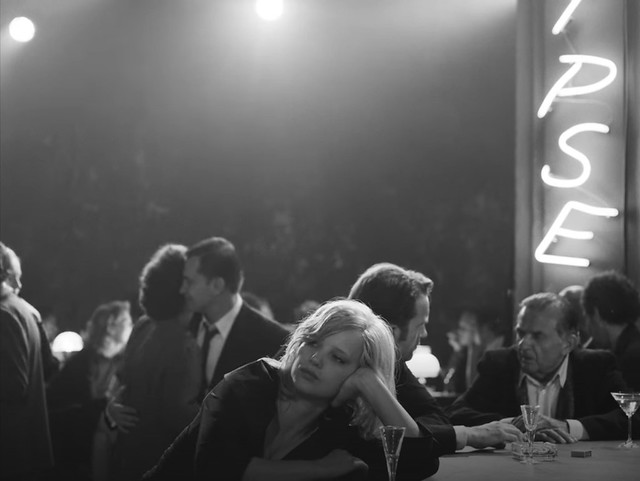
Cold War is a tragic, fatalistic love story set in Poland after the second world war. The year is 1949. Wiktor (Tomasz Kot) and Irena (Agata Kulesza), two musical enthusiasts are seen traveling and collecting samples of Polish folk music in rural areas. They are two pivotal force behind a newly established Polish State run music school. While auditioning many young, talented pupils, a sultry, troubled girl Zula (Joanna Kulig) catches Wiktor's eyes. It's a school where they train students to be entertainers on stage - involves not only singing but choreographed dancing in traditional garbs. Zula, talented and has a beautiful voice, becomes a star soon enough. And Wiktor and Zula soon become lovers. Now the year is 1952.

Soon the school and its trope becomes a success, the communist regime takes an interest and pressure them to integrate pro-Stalin propaganda songs. Irena objects at first but relents at the Kaczmarek (Borys Szyc), the founder of the school's insistence. But it gives school and Zula an opportunity to travel and perform elsewhere in Europe. While they are performing in Paris, Wiktor suggests Zula that they defect to the west. But Zula fails to show up at the rendez-vous point and they are separated.

Many years passes. Wiktor is now living in Paris, composing and playing piano in a jazz ensemble living in a tiny apartment, like a true bohemian in French movies. After seeing Zula perform with her traveling Polish group on stage in Zagreb, and after forcefully removed and put on a train out of Yugoslavia, they are reunited in Paris. But the whole Paris scene doesn't satisfy Zula. It's too stuck up and Wiktor seems to have lost his mojo in a foreign land - "In Poland, you were a man!" Zula chastises him. After couple of jealousy fueled fights - involving a poet Juliette (Jeanne Balibar) and movie director Michel (French director Cedric Kahn) in Wiktor's circle of artist friends, Zula goes back to Poland. Wiktor, crestfallen, decides to go back to Poland for Zula, risking being jailed as a unpatriotic traitor.

Shot again in full frame monochrome by Lukascz Zal, Cold War is every bit as beautiful as Ida. His use of head space is there and it's lovely. Kulig has a clear and beautiful singing voice in every style, providing some of the loveliest vocal tracks for the films great jazzy soundtrack.

Pawlikowski deftly directs, like his previous film, Ida this 90 minute film in a breeze. But whereas this quick, no moment to spare, no time to contemplate pace worked for a young woman coming of age story, for something like Cold War and the subject like tragic love, I wish the director spent a little more time with Wiktor and especially more with Zula, since Kulig, resembling Slavic Léa Seydoux, is very lovely to look at and listen to. Constant fade to black after pivotal moments in their lives doesn't feel like just times passing or mere transition but more like we've missed out on a lot of details. I understand Pawlikowski's driving idea of 'love has no ideology or borders', but the absence of the couple's political allegiance/aversion as 'artists' bothered me (same way as Ida wearing religion on her sleeve in Ida), especially no background for either of them were ever fully explored. The ending is beautiful but I feel like the rest of the film didn't quite earn it.

Thursday, August 23, 2012

Germany's Reincarnation

Germany Year 90 Nine Zero (1991) - Godard
germany year 90
germany year 90 1
germany year 90 2
germany year 90 3
germany year 90 4
germany year 90 5
germany year 90 6
The film is Godard's contemplation of Germany after the fall of the Berlin Wall. The aged Lemmy Caution (Eddie Constantine) from Alphaville, slated as the last spy, marooned in East Germany, wanders across grey landscapes asking in French, "Which way is the west?" to equally confused bystanders. There are no similarities between the two films. Godard merely re-appropriates Caution as the archetype of cold war (in itself a parody) whose stone carved face stood on a solid ground and even more solid philosophy. Some thirty years later, he is nothing more than a relic and out of his element.

Godard is as critical of the failure of communism in the East as the Germany's Fascist past and rampant capitalism of the West. With jarring grey old film clips playing constantly sped up or slowed down and the classical music soundtrack by the greats- Liszt, Mozart, Bach, 90 Nine Zero is also contemplates the decline of culture and art. It works better in the last third when Caution finally reaches the West. He notices an East German girl he saw before, working as a maid in a fancy hotel he is staying in. He asks, "So you wanted to be free, huh?" and she answers, "Work makes you free (Arbeit macht frei)," which was the trademark of the concentration camp slogan. It is fitting even in the opulent west. With the soundtrack by Mozart, Liszt and Bach, 90 Nine Zero is yet another beautiful, biting one by Godard.