Showing posts with label Politics. Show all posts

Sunday, December 20, 2020

Time is a Flat Circle: Temporal Dissonance and Trauma in Christian Petzold’s Transit

Time is a Flat Circle: Temporal Dissonance and Trauma in Christian Petzold’s Dystopian Tale: Transit

Time is a Flat Circle         I’m thinking about Nietzsche’s concept of eternal return when I think about Christian Petzold’s film Transit. Eternal return/eternal recurrence is a concept that the universe and all existence and energy have been recurring and will continue to recur, in a self-similar form an infinite number of times across infinite time and space. “Time is a flat circle,” is a phrase uttered by Rust Cohle, a character who has a very pessimistic view on human existence in an HBO show True Detective, when he is reminiscing about an old, unsolved case, “Someone once told me time is a flat circle. Everything we’ve ever done, or will do, we are gonna do all over again.” He is suggesting that we are destined to relive the same experience over and over, past and present melding into one another. And this is the case with Transit which takes place in a hypothetical world where fascist Germany is occupying France once again and its characters, traumatized by the unfolding events, enter into a sort of fugue state where there is no escape.

        All characters in Petzold’s films are in a state of uncertainty: they are forced to embark on a journey by the outside forces, rather than by their own volition like in Wim Wenders films or the works of Novalis or Hölderin of German Romanticism. In effect, the title Transit, can be used in all his films, interchangeably, making it a perfect title that emblemizes his work. With Transit, I’d like to examine how temporal, spatial dissonance causes the lasting trauma in people’s psyche and how Petzold and the Berlin School filmmakers use genre conventions to reflect on the post-wall neoliberal Germany as well as its nazi past.

Transit         Transit is a novel written by Anna Seghers based on her own experience in France under the nazi occupation in 1942. Petzold transposes its setting to contemporary Europe; a modern day Marseille. The film’s setting can be interpreted as either an alternate reality or a very near future where Germany has become a fascist state yet again. But Petzold goes about presenting this slyly, often blurring the boundaries between past and present - there are no discernable historical/cultural markers in the film- no swastikas, propaganda posters or incendiary slogans on banners in public squares. But the motor-vehicles and police in riot gear suggest that the film takes place in the present day. Pinpointing the film’s timeframe is a tricky business. Judging by the conversation held by characters about a movie about zombies- that even the dead not having much imagination by going to a shopping mall, it alludes to taking place post-1978 or even 2004 (the release year of George Romero’s classic Dawn of the Dead and Zach Snyder’s remake respectively). Curiously, there is no sighting of mobile phones anywhere, adding more confusion to the film’s timeline. There are also no lamentations by any of the characters on how history repeats itself. It’s as if Germany’s dark war past has been deliberately erased from history or invoking its history is a taboo subject. Yet for us audiences, hearing the sound of jackboots marching, a talk of ‘cleansing of the Jews’ and seeing police rounding up people in the streets are familiar sight and sound from countless World War II films set in the cities under nazi Germany. Seeing and hearing this in the present setting is jarring and disorienting. There is a definite temporal dissonance. It’s an interesting choice for Petzold to directly invoke Germany’s nazi past to reflect on the current state of Germany and Europe.

        Transit was released in 2018 under the shadow of the foiled assassination plot on the German Chancellor Angela Merkel in 2016 and after the extreme right-wing nationalist party AfD (Alternative für Deutschland) gained 12.6 percent of the seats in the German Parliament in 2017 (later it became the largest opposition party). Germany’s white nationalist movement has seen a steady growth since the fall of the Berlin Wall in 1989. With the influx of over 1.2 million immigrants (not counting 3 million Turkish descent German citizens who have been living there since the 60s), the racial violence against ‘outsiders’- meaning, against people of the Middle-Eastern and African origin as well as German Jews, has been increasing over the recent years. According to the Interior Ministry data, xenophobic acts of violence saw 19.7 percent jump in 2017 from the previous year.

        Christian Petzold, as a leading figure in the Berlin School which is Germany’s most significant film movement since the New German cinema of the 60s and 70s and a prominent voice in a recent surge of German cinema in the global stage, has been making films that reflect the cultural & political landscape and collective German psyche in the post-wall, neo-liberal era Germany. The Berlin School is a term given to a group of loosely connected filmmakers who attended German Film and Television Academy (DFFB) in the late 80s and early 90s, namely Thomas Arslan, Christian Petzold and Angela Schanelec - known as ‘The First Wave’. Ulrich Köhler, Valeska Grisebach, Christoph Hochhäusler, Maren Ade and many more were considered and later added to the growing list of like-minded filmmakers. The main themes these filmmakers share in their work are: loss of identity, guilt, aimlessness and dislocation under neo-liberal Germany. One of the main themes they often deal with is, as Marco Abel puts it, ‘sehnsucht’ (longing): a longing for Germany that has never materialized under neoliberal capitalism. The Berlin School, in effect, is about ‘reseeing’ Germany.

        Utilizing genre conventions and twisting them to reflect on the current state of the post-wall Germany is a tendency of many filmmakers of the Berlin School: Heist films/thrillers/noir are bread and butter for many - The City Below, The Lies of the Victors (Christoph Hochhäusler), In the Shadows (Thomas Arslan), The Robber (Benjamin Heisenberg), The Dreileben Trilogy (Höchhausler, Dominic Graf and Petzold). They also dabbled in Western - Gold (Arslan), horror - Yella (Petzold), Sci-fi - In My Room (Ulrich Köhler) and fantasy - Undine (Petzold), just to name a few. Although many critics emphasized the Berlin School’s presentist and realist approach – the contemporary world observed in almost obsessive detail, Petzold has been deeply concerned with history in various ways throughout his filmography. Especially with his last four output - Barbara (2012) a period film that takes place in East Germany in the 80s, Phoenix (2014), set in the aftermath of WWII, Transit (2018), set in the near future/alternate present where Europe is in the grips of Fascist German regime once again and Undine (2020), his take on folklore/fantasy genre, investigating Berlin’s tumultuous past just underneath the surface of fast changing city, Petzold, unlike most of his compatriots of the Berlin School, does not shy away from Germany’s ugly war past and have found innovative approaches to address the same inquiry through genre conventions the unfulfilled desire of finding a collective utopia that is ‘Deutschland’.

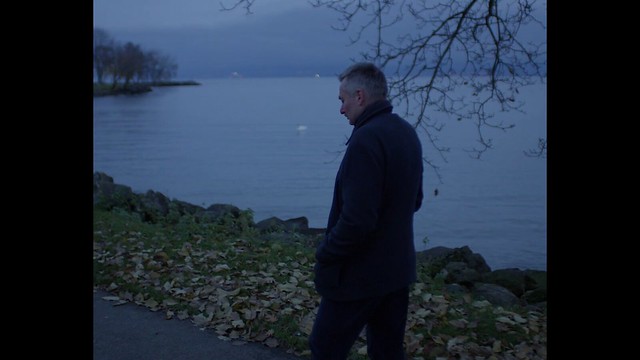
        Gilles Deleuze talks about ‘time out of joint’ in Cinema 2: The Time-Image. It was the Second World War that changed cinema from movement-image to time-image based medium. It signifies that time is no longer subordinated to movement, but rather movement to time. This break happened because of the devastation the war brought: atrocities in situations we no longer knew how to react to, rubbles in spaces we no longer knew how to describe. In these leveled cityscapes, a new race of characters was born: they saw rather than acted- they were seers. Transit starts with Georg (Franz Rogowski) being asked to deliver two letters to Weidel, a writer of some importance in Paris by an acquaintance at the bar. It's a dangerous mission- there are police raids daily and it's harder to get around on the street without constantly being asked for proper papers. Everyone knows a major crackdown is about to happen: already there are people being dragged away in the streets by the heavily armed authorities- 'the purge/cleansing' is just around the corner. But with some money promised, Georg is game. Georg is a typical (anti)hero of the Berlin School films - unmotivated, lost, just going through the motions, like a ghost among his fellow citizens. He is an observer, not a participant. He scoffs at the notion of “danger visa,” when the acquaintance tells him why he can’t make the delivery himself since he is deemed ‘dangerous’. Georg is nobody special. Just a face in the crowd. Petzold makes sure that he is not the narrator of his own story by inserting a voice over of a man, completely unrelated to the main characters, who turns out to be a bartender in Marseille later on. Once Georg gets to Paris, he finds out that the writer has committed suicide, leaving his documents and the latest manuscript behind. With some more money promised, he reluctantly takes a sick man wanted by authority along with him on a train (as stowaways) to Marseilles. Once he gets there, he is to notify the Mexican consulate about the death of the writer. Weidel’s documents reveal that he had a safe passage arranged for him and his wife Marie (Paula Beer) to go to Mexico. The letter Georg was supposed to deliver to Weidel is from Marie, declaring that she is leaving him.

        Once he arrives in Marseilles, Georg assumes the identity of Weidel as he is mistaken for the dead writer at the Mexican Consulate. He makes friends with an Arab immigrant boy whose dad (the sick man) died on the way. He also sees Marie everywhere, scouring the city for Weidel, her husband, day in and day out. Her search is intensified since Georg assumed her dead husband’s identity. So she thinks he is still alive, but avoiding her. This is where Transit embraces a full noir/thriller genre. Petzold’s penchant for genre cinema is pretty well known, as his films often borrow major aspects of their plots from the “cemetery of genre cinema, from the remainders that are still there for the taking.” For example, Jerichow is his adaptation of Jame M. Cain’s pulp noir Postman Always Rings Twice, with the victim switched to a successful small-time Turkish businessman. With Yella, the director takes direct cues from an American b-horror movie Carnival of Souls. In Something to Remind Me and Phoenix, the plots play out like an inverted Vertigo with the loss of identity/false identity playing a big role (also in Transit). His love for the noir/thriller genre is well known; his recent praise of generic American heist thrillers such as Den of Thieves confirms this fact. They are also present in his TV work (Polizeiruf 110), as well as most of his films.

CE_Transit2         Transit’s alternate reality fits the description of Deleuze’s modern cinema very well. “As for the distinction between subjective and objective, it also tends to lose its importance, to the extent that the optical situation or visual description replaces the motor action. We run in fact into a principle of indeterminability, of indiscernibility: we no longer know what is imaginary or real, physical or mental, in the situation, not because they are confused, but because we do not have to know and there is no longer even a place from which to ask. It is as if the real and the imaginary were running after each other, as if each was being reflected in the other, around a point of indiscernibility.” Marseille is ‘any-space-whatever’ Deleuze talks about in Cinema II as well. In Transit Marseille is not quite the rubble or empty factories that lay waste in the aftermath of WWII. But it’s not the bustling second largest French city with shops and beaches either. In the film, it is a sparsely populated, lifeless place where lost people in transit converge, waiting to set sail for their new destinies. It is a mere place to pass through. Waiting however, is exactly what these people do which seems eternal. Marie is involved with Richard (Godehard Giese), a doctor who has put his departure on hold because he doesn't want to leave her behind. No one wants to be the one who leaves. These characters are stuck in there, trapped by love, by the sense of loyalty, by guilt. Transit's got a lot to do with guilty conscience: guilt of leaving someone behind. Guilt of forgetting. Guilt of being indifferent. Time seems to stand still in Marseille, as characters run around in circles, day after day, waiting for what they desire that will never materialize, while the ‘cleansing’ is inching closer to them (the rumour has it, the cleansing is happening in nearby Avignon).
         

        ‘Wartender/Waiting’ happens to be the title of Weidel’s last manuscript that Georg carried from Paris to Marseille. It turns out to be a good reflection of what Georg and Marie are experiencing. Out of boredom in transit to Marseille, Georg reads the manuscript and has an opportunity to tell its story to an arrogant consul at the American embassy when asked about his/Weidel’s new book. In this ‘story within a story’, the main character is dead and waiting to register in hell at the gate. The waiting turns from hours to days to weeks to months to years. After many years have passed, the character asks the gatekeeper just when he will be admitted to hell. The gatekeeper tells him, “Why man, this IS hell!” 
71-la-douleur-duras

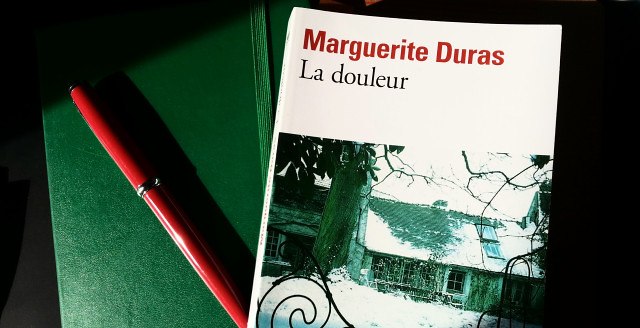
        Experiencing any war is painful. Its effect lingers for a long time - maybe for decades, over generations. The American Psychological Association defines trauma as the lingering psychological and emotional response to a singular traumatic event that threatens injury, death, or the physical integrity of self or others and also causes horror, terror, or helplessness at the time it occurs. The French literary giant Marguerite Duras, in an introduction to her memoir with a very literal title- La Douleur/The Pain, culled from her essays and diaries in the occupied France during WWII, as she was involved in the resistance movement and waiting for her husband’s return from a concentration camp, she claims that she doesn’t remember writing those words, "When would I have done so, in what year, at what times of day, in what house? I can't remember." The emptiness left by the absence of her loved one is so great, she would lose herself.

        If there were another title that can encapsulate the theme of all of Petzold’s films other than Transit, it would be ‘ghost’. Some critics grouped three of his earlier films ‘The Ghost Trilogy - The State I am In (2000), Ghosts (2005) and Yella (2007) for portraying characters who have to contend, one way or another, with the economic hardships and invisibility in post-wall neoliberal Germany. But his subsequent works, along with the theme of transient lives, Petzold’s protagonists suffer from loss of identity and invisibility also. Burdened with terrible secrets they can’t reveal, they tread their paths as if on eggshells - like the East German doctor who hides her intentions to defect to the West in Barbara, a disfigured concentration camp survivor who has to go along with her new identity in Phoenix, Georg who assumes the dead man’s identity but can’t reveal his secret in Transit. It might be a different pain: one caused by economic hardship in highly capitalistic society, the other caused by violence of war. But they both make ghosts out of people who experience them. The economic disparities and characters with lost identities in Petzold’s earlier films and many other works by the Berlin School filmmakers can be attributed all the way back to atrocities of the nazi Germany in WWII. Losing oneself, losing one’s identity is deeply entwined with the survivors’ guilt, the guilt of leaving others behind/betraying others. That guilt for those who remember the past, never really went away. They have been the theme of Duras and many of the Nouveau Roman writers as well as all Petzold’s films and many of other directors in the Berlin School.

Syrian refugees         Let’s put the film in context of the world events in 2017-18; the Syrian civil war was still raging and the refugee crisis was deepening, Trump enacted the Muslim Ban restricting visas from 7 predominently muslim countries, started to build the wall in the southern border with Mexico, the Israel-Palestine conflict intensified, just to name a few. It is not difficult to see what is reflected in Transit is not far from what’s been happening on the news on TV every night. The future is already here: the film’s premise, the ugly past repeating itself and its temporal dissonance says a lot about the highly advanced capitalist, neoliberal society. The world is moving too fast, while humanity has a little time to reflect on the past. I see Transit as an allegory of Germany’s war past and its citizen’s collective, willful amnesia, caused by the war itself. Hence, the merry-go-round of war - trauma - collective amnesia - war - trauma - collective amnesia being repeated. Suffering from an identity crisis, Georg desperately tries to save Marie while concealing the bitter truth that Weidel is dead and gone all in the midst of fascist takeover: Georg is a stand-in for Germany, Weidel for the utopia that never materialised and Marie for the country’s future/younger generation. Going back to Sehnsucht/longing for the utopian Germany that never was, and regarding Germany’s dark history repeating in Transit, I believe Petzold is telling us that however painful it is, we will have to face the past in order to understand trauma so we don’t repeat it.

Sources Consulted 


1. Abel, Marco. ​The Counter-Cinema of the Berlin School​. Boydell and Brewer, 2013: 1-28, 69-110

2. Chang, Dustin. “I Envision All These Great Small Movies in the Ruins of Hollywood: Chrsitan Petzold Interview, Screen Anarchy, December 12, 2012

https://screenanarchy.com/2012/12/i-envision-all-these-great-small-movies-in-the-ruins-o f-hollywood-christian-petzold-interview.html

3. Deleuze, Gilles. Cinema 2: The Time-Image, University of Minnesota Press, 1989: xi, 1-67

4. Hamann, Hilary Thayer. “A Harsh Tale of War, But Unforgettable Read,” NPR, February 16, 2011

https://www.npr.org/2011/06/29/133811002/a-harsh-tale-of-war-but-an-unforgettable-read

5. Mirthy, Vikram. “Christian Petzold on Transit, Kafka, His Love for Den of Thieves and More,” RogerEbert.com, February 24, 2019

https://www.rogerebert.com/interviews/christian-petzold-on-transit-kafka-his-love-for-den-of-thieves-and-more

6. Mudd, Cass. “What the stunning success of AfD means for Germany and Europe,” The Guardian, September 27. 2017

https://www.theguardian.com/commentisfree/2017/sep/24/germany-elections-afd-europe-immigration-merkel-radical-right

7. Staff. “Germany sees extremely alarming rise in racist and anti-semitic hate crime,” The Local, May 14, 2019

https://www.thelocal.de/20190514/germany-sees-extremely-alarming-rise-in-racist-and-anti-semitic-hate-crime

Tuesday, May 19, 2020

Political, Cultural Resistance: The Spirit of Third Cinema Lives On in Contemporary Brazilian Cinema:

Political, Cultural Resistance: The Spirit of Third Cinema Continues to Live on in Contemporary Brazilian Cinema: Kleber Mendonça Filho & Juliano Dornelles’ Bacurau and Gabriel Mascaro’s DivineLove/Divino Amor
1164415391
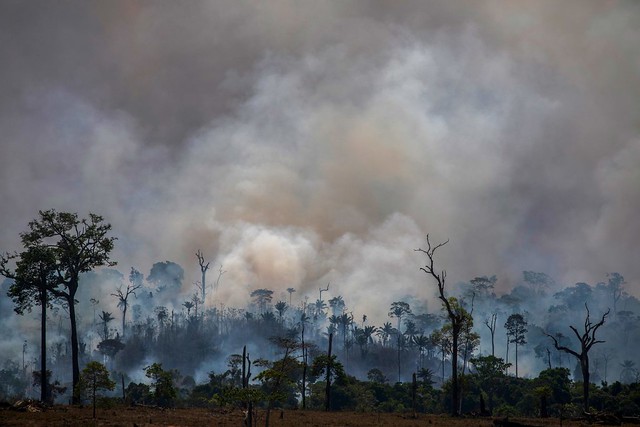
      Let's consider what's been happening in Brazil recently. In early 2018, Luiz Ignacio Lula de Silva, affectionately known as Lula, a much loved labor leader and former two-term Brazilian president, was barred to run for president again because of the trumped up corruption charges and sentenced to 12 years in prison, in all likelihood by opposing conservative Social Liberal Party, led by Jair Bolsonaro, a foul mouthed, all out bigoted racist who ran on his presidential campaign of fearmongering. It was widely expected that Lula was going to win. But with him being jailed, his Worker's Party's nominee Fernando Haddard ended up losing in the runoff. So now Brazil has the socially conservative and known racist Bolsonaro for president. His U.S.-friendly, pro-corporate, pro-logging, anti-regulation agenda with contempt for indigenous population has created perhaps the most serious eco-disaster in the Amazon rainforest in decades. The most devastating forest fire erupted in 2019, as the rest of the world helplessly watched it burn on the sidelines. Its oxygen rich ecosystem and natives’ habitats were irrevocably damaged.

      Brazilian film scene was having its renaissance in the last two decades under the Lula's Worker's Party leadership. The money was flowing into the arts and to the once neglected regions of Brazil. Pernambuco, a northeastern state with its multicultural capital Recifé has emerged as an economical, cultural center, producing many emerging local film directors like Kleber Mendonça Filho, Adirley Queirós and Gabriel Mascaro, taking the limelight away from the rich Southern part of the country - Rio, Bahia and Sao Paolo. Bolsonaro's austerity measures are undoubtedly putting a hard brake on this growing Brazilian film movement which is perhaps the most significant since the days of Cinema Novo, and the full impact is still yet to be seen.

      Third Cinema, the term coined by two Argentines, Fernando Solanas and Octavio Getino in their influential manifesto :Toward a Third Cinema (1969), decries neoliberalism, the capitalist system, and the Hollywood model of cinema as mere entertainment to make money. This is largely to do with the fact that both Marxism and Third Cinema are preoccupied with inequalities resulting from capital accumulation, of which colonialism is the most extreme manifestation. Aesthetically, the movement drew on Soviet montage, surrealism, Italian neorealism, Brechtian epic theater, cinema verité and the French New Wave. Cinema Novo in Brazil, along with other Latin American countries’ revolutionary filmmaking, was a big part of Third Cinema. Championed by Glauber Rocha among others, Cinema Novo saw an inseparable connection between political struggle and cultural production. Cinema Novo flourished under popular Democratic President João Goulart until he was removed by the U.S. backed military coup in 1964. But it continued to produce films until the mid-1970s. It was Rocha’s 1969 manifesto The Aesthetics of Hunger which directly lays out the principles for Cinema Novo.
This economic and political conditioning has led us to philosophical undernourishment and to impotence - sometimes conscious, other times not. The first engenders simply an alarming symptom; it is the essence of our society. Herein lies the tragic originality of Cinema Novo in relation to world cinema. Our originality is our hunger and our greatest misery is that this hunger is felt but not intellectually understood…. We know- since we made those ugly, sad films, those screaming, desperate films in which reason has not always prevailed- that this hunger will not be assuaged by moderate government reforms and that the cloak of technicolor cannot hide, but rather only aggravates, its tumours. Therefore only a culture of hunger can qualitatively surpass its own structures by undermining and destroying them.
      Rocha goes on to defend violence depicted in films of Cinema Novo as a noble cultural manifestation of hunger. It’s at the violence the colonizer suddenly becomes aware of the existence of the colonized. Some of the notable Cinema Novo films are Rocha’s Black God, White Devil/Deus e o Diabo na Terra do Sol (1964), Antonio das Mortes (1969) and Nelson Pereira dos Santos’s How Tasty was My Little Frenchman/Como Era Gostoso o Meu Francês (1971). Rocha’s films drew from Western genre (both Hollywood and spaghetti Westerns), taking places in sertão (backcountry- the vast arid region in the Northeast Brazil), with cangaceiros (bandits) and land owners. Steeped in mysticism and political allegory, these films tell stories about class struggles and redemption. In How Tasty Was My Little Frenchman, Pereira dos Santos uses ethnological documentary aesthetics into a period piece that is a biting political/cultural satire which takes The Aesthetics of Hunger quite literally.

      This paper will be an exploration of Third Cinema and its influence and continuation through two recent Brazilian films Bacurau and Divino Amor by directors Kleber Mendonça Filho & Juliano Dornelles and Gabriel Mascaro. The directors hail from Pernambuco, the formerly neglected northeast region of Brazil and its capital Recifé. Along with fellow Northeasterner Adirley Queirós (from inland Morro Agudo de Goiás, near the country’s capital Brasilia), they have been making politically charged, genre bending films, countering long dominance of more wealthy southern states’ commercialized film industry and ratcheting up their antics after the extreme right wing politician Bolsonaro was sworn in as the country’s president in 2018. I will discuss current Brazilian cinema’s defiance against political tyranny, carrying on if not the aesthetics, but the spirits, of Third Cinema in two chapters. Chapter one will concentrate on anger: Mendonça Filho’s Bacurau. In this violent revenge fantasy, borrowing heavily from genre cinema and tapping into the anger of Third Cinema as expressed by Rocha, the film actively challenges the First World hegemony and recent political climate, critiquing impending ecological peril the country is now facing in the age of globalization. Chapter two will focus on the conservative regime’s cultural crusade against what they see as decades of ‘moral decline’ under the communist-socialist ideological wing of the country. Mascaro’s Divino Amor, a dystopian tale set in the near future is a barely disguised critique on Bolsonaro’s agenda against minorities and the poor in one of the most culturally, ethnically diverse countries in the world.

Chapter 1: Anger
Bacurau
      Filmmaker Kleber Mendonça Filho’s two previous feature films Neighboring Sounds/O Som ao Redor in 2012 and Aquarius in 2016, both shot in his hometown of Recifé, were rather subtle, yet pointed critique on rapidly gentrifying neighborhoods in a country where people saw growing middle class in a relative economic prosperity under the democratic government after decades of military dictatorship. Both films deal with gentrification and underlying tensions between different classes while giving historical contexts of the region - often written in blood with cattle ranchers and bandits. These tensions, not explicitly stated, were shown in spurts; in Neighboring Sounds, which is from the perspective of a young upper-middle class gentrifier, there is a bath scene where the waterfall turns into blood. In Aquarius, a middle class family matriarch who stands alone against a development company to defend her apartment that she spent her whole life in from being demolished. But she can’t hide her ignorance at her long time housekeeper’s living conditions; while walking on the beach with her old friends, she points to the invisible line in the sands, “Over this line is the part of the town where poor folks live,” and her housekeeper replies, “Yes, Clara. That’s where I live.” Both Neighboring Sounds and Aquarius are far from “ugly, sad films, those screaming, desperate films” described in The Aesthetics of Hunger by Rocha. They are well made films with professional crew and actors and high production value. But they certainly have scathing moments of social commentaries. Still, they don’t prepare you for the tremendous anger felt in Bacurau. co-written and co-directed by Mendonça Filho and his long time production designer Juliano Dornelles, Bacurau is a Sci-fi Western that takes place in sertão in the near future. It’s also a revenge film with almost cartoonish violence inflicted upon its mercenary First World (mostly American) invaders. As Rocha and other filmmakers decried centuries old colonialism by the imperialist First World countries (first by Portugal, then by U.S. in the form of military coup) and its repercussions 50 years later, we get to witness a new kind of colonialism taking place in the globalization era in the form of foreign financial conglomerates. According to Amazon Watch, a non-profit watchdog group, the devastating fires is the direct result of deforestation brought on by cattle ranching and soy farming, with beef and soy being the two major exports of Brazil. With deregulation and pro-foreign investment favored by Bolsonaro’s regime, big US agribusiness companies like Archer Daniels Midland (ADM) and Cargill, investment firms and banks- BlackRock, T. Rowe Price, Chase, City Bank, Bank of America are major beneficiaries in these transactions. In the Bolsonaro era Brazil, it is quite clear that the country is experiencing neo-colonialism.

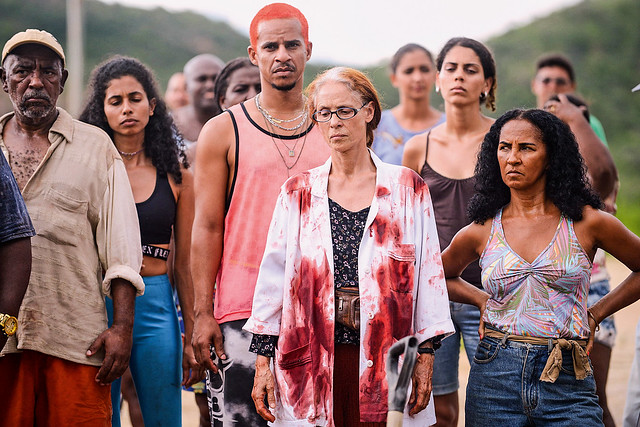
      In Bacurau, Brazil in the near future is in a state of emergency and government troops are everywhere with road blocks and limiting people’s mobility. Bacurau is a dusty town too small even to be on the map in the Northeast region of Brazil. It is inhabited by a fiercely independent, self-sustaining, proud people largely cut off from the outside world. The glimpse of satellite TV and radio tell grim stories of lawlessness in urban areas. Teresa (Barbara Colen) is returning to attend the funeral of the town's matriarch. Evading the law and roadblocks guarded by heavily armed government troops, she is bringing medical supplies and water to the residents of the town. There's a shortage of everything - food, water, medicine, household items, tampons, etc. Everything is brought in from the outside world and distributed among the townsfolk for their needs. Bacurauans seems to be a well organized social collective, living relatively well despite the rest of the world seems to be falling apart. The town, like any other small town, people know one another and there are some frictions among them. But generally they get along. Then we see a sign of trouble brewing. First, a farmer spots a UFO shaped drone in the sky. And two city folks in fancy motorbikes in neon colored spandex show up in town, confusing everyone. Their cockiness and otherworldliness is duly noted by its residents. They turn out to be a sort of a local guide for heavily armed mostly American mercenaries, led by Michael (Udo Kier). They are there to literally wipe Bacurau off the map. Most of these gungho people-hunters are ex-military officers trying to blow off some steam by going to (any) ‘Third World’ countries and killing its inhabitants with the support of the local government. After a few horrible massacres in the outskirts of the city, Bacurauans realize what's happening to them. But what the hunting party doesn't realize is that these Brazilian country hicks are weather worn, experienced and deeply proud people who are not going to go down easily. One by one, the hunters become the hunted. By using Udo Kier, the blonde haired, blue eyed icon of European and American cult cinema (The Story of O, Blood for Dracula), as the leader of the deranged human hunting game expedition and Sonia Braga (Lady on the Bus, Kiss of the Spider Woman) the beloved legendary Brazilian actress (who also stars in Aquarius), as a matriarchal leader of Bacurau, the filmmakers are making an unsubtle point here; it’s us Brazilians versus Europeans and gungho gringos. The violence that Bacurauans inflict on the hunting party way over the top, especially when it’s performed by Lunga, a charismatic leader of the modern day cangaceiros, played by a famous transvestite stage personality and queer activist, Silvero Pereira. It is a bold choice to use Silveira in such a role since Bolsonaro and Pereira have been engaging in verbal jabs in public. As the Bacurauans get rid of foreigners and local traitors, at a glance, without the context of what's happening in Brazil, the film is a silly, tacky man-hunting-man akin to The Most Dangerous Game or Naked Prey. But it isn't. Bacurau highlights the resilience and resolve of Brazilian people against mounting assault of multinational corporations backed by the Government military in a neo-colonial global economy.

Chapter 2: Christianity as a Form of Colonialism
Screen Shot 2020-04-07 at 5.14.57 PM
      Rocha warns in The Aesthetics of Hunger that “what distinguishes yesterday’s colonialism from today’s is merely the more refined forms employed by the contemporary coloniser.” and “Thus, our possible liberation is always a function of a new dependency.” In his first film, Black God, White Devil/Deus e o Diabo na Terra do Sol (1964), he calls for denouncing all political and religious doctrine in favor of individual liberty at one with nature.

      2010 census reveals that sixty five percent of Brazilians consider themselves Catholic (down from ninety percent a few decades ago), followed by twenty two percent Evangelical Protestant with numbers of agnostics growing rapidly. Since the Portuguese colonial times, confluence of religions of African slaves and natives, Brazil has always maintained a diverse array of syncretistic practices under the overarching umbrella of Brazilian Catholicism. But it’s that tropical multiculturalism with diverse race, culture and gender is what Brazil has been always known for. While Catholics are evenly split between the right and the left in their political spectrum, Evangelicals are mostly conservative and over the years have become an increasingly influential presence in Brazilian politics. And Bolsonaro’s religious themed presidential campaign spoke to them. His retrograde message was a reaction to the advances they have seen since the 1960s in discussions about the family, the place of women, youth and sexuality. It was a Christian morality that tries to recover an idealized past that never existed. Bolsonaro brilliantly tied the message of ‘political corruption’ with ‘moral decay’, and the voters, suffering from recent recession in need to be dependent upon something, found solace in Bolsonaro’s conservative message.

      Gabriel Mascaro, filmmaker and visual artist, of such sensual films as August Winds/Ventos de Agosto (2014) and Neon Bull/Boi Neon (2015), have been subverting the stereotypes in gender roles. His films are filled with strong women and men with domestically inclined tendencies. With his new film Divine Love/Divino Amor (2019), Mascaro is charting a new territory, using Sci-fi genre (like Mendonça Filho and also Adirley Queirós with their films) to reflect on the current political climate. It's 2027 Brazil. The country has gone full Christian fundamentalist. Mascaro's version of it is all neon and electronic music. Joana (Dira Paes) and Danilo (Julio Machado) are a middle class couple. She is a notary public, working in a gigantic concrete government building and he is a florist, working in their ground floor apartment complex. They haven't been able to conceive a child even though they try every possible way, method and modern medicine. Something is wrong with Danilo's sperm. They belong to Divine Love, a Christian religious group exclusively for couples. It's a cult like therapy/support group for couples who've had marriage troubles before. They do trust-exercises and even share partners in bed. Joana, using her position of power as a bureaucrat, has been discouraging couples who seek a divorce at her job. Her sometimes aggressive tactics don't sit well with her clients as well as her superiors. She constantly visits a drive-thru, storefront church that seems to be in every other corner, to seek advice from a pastor. The god is silent on her questions and her husband's infertility and her faith is waning. Then a miracle happens. She is pregnant. But who is the father? Mascaro somberly reflects on life under the extreme right-wing, religious zealotry of Bolsonaro regime here. The film inserts in just enough details for us to see that the country has changed: women on the beach are wearing head to toe black garb - very much like burkini, every building, businesses and shops have customer identifying prompter at the door, by their name, marital status and whether they are pregnant or not. There is no mention or show of homosexuality whatsoever anywhere. In true Mascaro fashion, sex scenes are very graphic and honest, but only are limited to married couple or consenting adults and only heterosexual. The film is narrated by Joana's child who might be born out of immaculate conception and just might be the savior people have been waiting for, but left nameless and unregistered, because of he is born into religious fundamentalist country which was once was known as the most culturally, racially diverse country in the world that was Brazil, less than a decade ago.

      Along with other countries in Latin America - Mexico, Argentina, Chile, Peru, Columbia and others, Brazil was battered with financial crises over the years, but the sound financial structure in place with natural resources, their recovery was quicker and better than the rest of the world. Combined with political stability of Lula years, Brazil’s cinematic output has become more diverse, sophisticated and technologically apt, compared with the films of Cinema Novo days. The intellectual hunger that Rocha talked about in his passionate declaration in The Aesthetics of Hunger, has been largely satiated and anger subsided. But every living organism needs to feed itself constantly to survive. The pang of hunger comes back whenever their stomach is empty. The neo-colonialism brought on by globalization with Bolsonaro helping, that hunger is rearing its head again and in it, the anger is again manifesting. As Mendonça Filho and Dornelles tell in an interview conducted in early 2020, Bolsonaro’s regime is already cutting funding to arts, putting a halt on film productions, compared with record number of productions that were happening in 2018. But I have no doubt that they will keep making films, as long as they stay hungry.

Sources Consulted:
1. Braudy, Leo, and Marshall Cohen. Film theory and criticism: introductory readings. New York: Oxford University Press. 2004.

2. Chang, Dustin. “Interview: BACURAU Directors Kleber Mendonça Filho and Juliano Dornelles.” Screen Anarchy. March 13, 2020.
https://screenanarchy.com/2020/03/interview-bacurau-directors-klebermendonca-
filho-and-juliano-dornelles.html

3. Jeantet, Diane, “Far-right Bolsonaro fires latest round in Brazil culture war.”Crux, January 17, 2020.
https://cruxnow.com/church-in-the-americas/2020/01/far-right-bolsonaro-fireslatest-round-in-brazil-culture-war/

4. Lappé, Anna. “Follow the Money to the Amazon.” The Atlantic September 4, 2019
https://www.theatlantic.com/ideas/archive/2019/09/follow-moneyamazon/597319/

5. Rocha, Glauber. “The Aesthetics of Hunger” [1965], in Film Manifestos and Global Cinema Cultures: A Critical Anthology, ed. Scott MacKenzie (Berkeley, CA: University of California Press, 2014), pp. 218-20.

6. Solanas, Fernando and Octavio Getino. “Towards a Third Cinema: Notes and Experiences From the Development of a Cinema of Liberation in the Third World” [1969], in Film Manifestos and Global Cinema Cultures, pp. 230-50.

7. Shaw, Lisa and Stephanie Dennison, eds. Brazilian National Cinema. Routledge. 2007.

8. Stam, Robert. Film theory: An Introduction. Malden, MA: Blackwell. 2000.

9. Stam, Robert. Tropical Multiculturalism: A Comparative History of Race in Brazilian Cinema and Culture. Duke University Press. 1997.

10. Xavier, Paloma. “Vou ali num tal churrasco Bacuralizar’ brinca Silvero Pereira, intérprete de Lunga.” Uai.com. May 9, 2020.
https://www.uai.com.br/app/noticia/mexerico/2020/05/09/noticiasmexerico,258242/vou-ali-num-tal-churrasco-bacuralizar-brinca-silvero-pereirainter.shtml

Wednesday, April 8, 2020

Technocracy

La France contre les robots (2020) - Straub
LA FRANCE CONTRE LES ROBOTS_1
This is a very timely text from 1945, as the whole world is going through dark times. You can watch it here in its 9 minute entirety. Well actually 4 1/2 minutes but two takes:

"The word 'revolution' to us Frenchmen is not a vague term. We know that Revolution is a rupture, that Revolution is an Absolute. There is no such thing as a moderate revolution, there is no such thing as a planned revolution—as one speaks of a planned economy. The revolution we are announcing will overturn the entire existing order or it will not take place at all. If we believe that the present system is capable of being reformed, that it can, in itself, check the fatal course of its evolution towards Dictatorship—the dictatorship of money, of race, of class, of the Nation—we will certainly refuse to run the risk of an explosion capable of destroying precious things that can only be rebuilt with much time, perseverance, selflessness, and love. But the present system will not change the course of its evolution for the good reason that it is no longer evolving; it is merely reorganizing itself with the view of lasting a little longer, of surviving. Far from professing to resolve its own contradictions, which are, in any case, impossible to resolve, it seems more and more inclined to impose them by force through strict regulation of individual effort that grows more rigid and more particular every day, carried out in the name of a sort of State Socialism, which is the democratic form of Dictatorship. Every day, in fact, brings us another proof that the purely ideological era has long since passed, in New York as well as in Moscow and London. We can see the Imperial English Democracy, the Plutocratic American Democracy and the Marxist Empire of Soviet Dominions walking, if not hand in hand—far from it!—at least pursuing the same goal, that is to say maintaining at all costs and even while appearing to oppose it, the system in which they have acquired wealth and power. For, in the end, Russia has profited no less from the capitalist system than America and England; it has played the role of the Member of Parliament who makes a fortune in Opposition. In short: regimes formerly opposed in ideology are now directly united by Technology. A world dominated by Technology is lost for Liberty."

Monday, September 6, 2010

Forgive but never forget

Romero (1989) - Duigan
Photobucket
Photobucket
Raul Julia plays Oscar Romero, the archbishop of El Salvador who was gunned down for speaking out against military violence on its citizens in 1980. Romero, a timid, frail man of books and privileges gets elected by the stolid church to keep things the way they are- El Salvador under military dictatorship, even though the civil unrest is growing.

It's not until his radical friend Father Grande (great Richard Jordan) gets assassinated Romero realizes that the cycle of violence is stemming from economic inequality and there needs to be justice for the poor. Julia is amazing. He gives a subtle yet passionate portrayal of the man of god.

Romero is a powerful film. Duigan (usually known for his fluffy fluff movies- Flirting, Sirens) doesn't shy away from showing the brutality of what had been going on with graphic scenes and actual pictures of the deceased Salvadorans. After the assassination, the country enters the 12 year long civil war.

The smallest country from Central America, El Salvador now is still far from perfect, but it joins many Latin American nations that went through horrendous turmoil against military dictatorship supported by the US government and have become reconciliatory, democratic societies. I hear the phrase 'Forgive but not forget' a lot from that part of the world. And it always amazes me. If it was done to me and my family, I don't think I could ever forgive anyone who raped and murdered, ever. My admiration goes out to them.