Showing posts with label Taiwan. Show all posts

Sunday, September 8, 2024

Floating

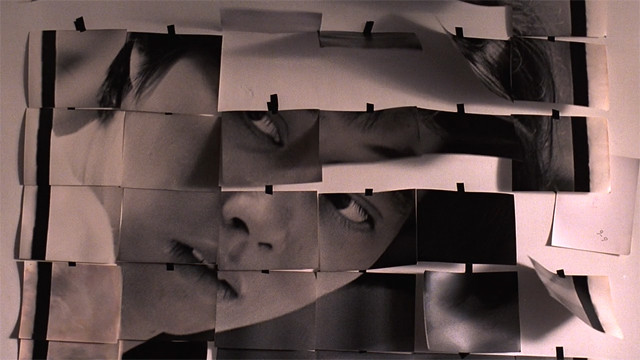
El auge del humano 3/The Human Surge (2023) - Williams Screen Shot 2024-09-07 at 9.32.05 AM Screen Shot 2024-09-07 at 8.29.54 AM Screen Shot 2024-09-07 at 9.27.03 AM Screen Shot 2024-09-07 at 9.27.48 AM Screen Shot 2024-09-07 at 9.04.27 AM Screen Shot 2024-09-07 at 8.51.42 AM Screen Shot 2024-09-07 at 8.29.59 AM Screen Shot 2024-09-07 at 9.02.30 AM Screen Shot 2024-09-07 at 9.05.14 AM Screen Shot 2024-09-07 at 9.06.22 AM Screen Shot 2024-09-07 at 9.18.24 AM Screen Shot 2024-09-07 at 9.25.09 AM Seven years have passed since Argentine experimental filmmaker, Eduardo Williams's Human Surge made a splash in the international film scene. The elusive threads of young people's lives in the global south, shot in various media that incorporate video games and internet, challenged and refuted the rigid old notion of cinema and its first world colonialist hegemony without being seen as overtly political or preachy. Globalization, in Williams's presentation, at least for young people, is both fantasy and real, and among them, connection is easily made crossing national boundaries over abundant technology and is no big deal, in their impoverished daily lives.

Williams comes up with The Human Surge 3. Never mind its title. It's been a while, things have been happening in the world. It's appropriate that he jumps to the third one to keep up with the times. (The prolific filmmaker has been constantly making shorts) In Surge 3, using a 360 VR camera, he charts the non-binary young people's lives in Peru, Taiwan and Sri Lanka. As always, their daily lives in exotic surroundings and daily conversations can be a little discombobulating to the viewers at first. But as it plays out and we settle with some recognizable faces over time, we get settled in and notice that their thoughts intermingle. Certain conversations are repeated in different languages: their animosity toward millionaires, polution and environmental destruction. Then they appear in each other's surroundings and communicate with each other, either in English or in their own language without missing a beat. Someone mentions, "I saw you in my dream, eating a mango on a raft in the water," matching with the image in the Peru section.

In Williams's hand, globalization in the internet age opens up limitless possibilities for the young people to connect - they literally float in the air. For the viewers, he presents an immersive visual/aural journey while also reminding the limitations of technology (for now) by leaving in the distortions of wide angle VR camera imagery in the film.

There are some great established filmmakers who take great chances with experimenting with narratives and the medium to further their artistry in telling human experiences within historical and cultural contexts: Lisandro Alonso and Miguel Gomes- Harmony Korine to a lesser extent, come to mind. Eduardo Williams, with his minimalist/maximalist free-flowing aesthetics, with acute observations of the world here and now, with a great deal of sense of humor and compassion & tenderness toward its subjects, emerges as one of the most daring, important filmmakers working today.

Tuesday, September 29, 2020

Agony and Ecstacy

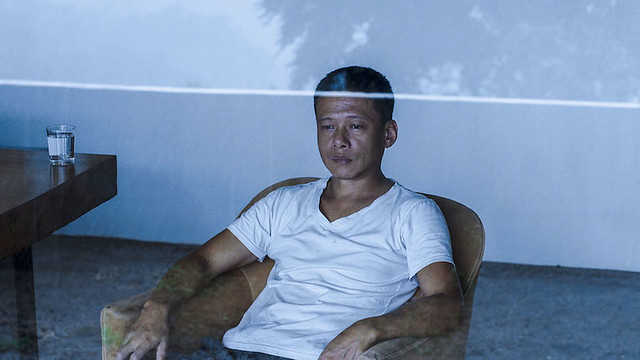
Days (2020) - Tsai Days Taiwanese auteur Tsai Ming-liang abandoned scripted narrative with Stray Dog. Days is his first feature film in 6 years. His output since 2013 has been limited to short-to-medium length films, related to What Time is it There? (2001) and Wayward Cloud (2005), as well as various commissioned films, omnibus contributions and gallery installations, but of course all of them starring his muse, Lee Kang-sheng. In personal life, Lee was struck with debilitating health problems in recent years and Tsai documented his recovery over the years in various places. So it seems it's only fitting that the couple's new film would feature some of Lee's harrowing medical treatments. Days is also the most intimate and touching Tsai film in years.

The film consists of series of uncut long takes where camera is stationary, except for certain scenes in the middle. It starts with Lee sitting on a chair looking out the window. The scene seems to go on forever. It is slowly revealed that he is in some sort of health rehab in the countryside. In the next scene, he is seen soaking in a tub motionlessly. Next is wide shot of a squalid kitchen where a young foreign man (Anong Houngheuangsy) making a fish soup. It's the whole process from beginning to end. He cleans the fish, rinses vegetables, drains, starts a fire, gets the soup start, tastes it constantly as he puts more ingredients, lets it simmer while he goes in and out of frame, all taking before your eyes.

Next is Lee getting what seems to be an elaborate and painful acupuncture procedure. This long scene also consists of long takes but from different angles. It's an agonizing scene to look at- the treatment Lee is receiving is a combination of acupuncture, electro stimulation wired on the needles and moxa (burning of mugworms) on top of those needles. From the low angle in an extended period of time, we see both agony and ecstasy reflected on Lee's face. It is quite jarring as some of the moxa embers fall on Lee's skin and the pins catch fire near his face. This combo of agony and ecstasy turns out to be quite a theme in Days.

The next scene is Lee with a neck bracelet, precariously supporting his head with his hand, walking down the busy Hong Kong street while onlookers glancing at the camera.

We see these daily routines of two characters separately as they go on. It is crazy to think that baby faced Lee is 50 years old now. In a series of unflattering close ups, you could tell the time has taken a toll. His gait also is not as youthful. He knowingly lets his ailing flesh to be recorded in a brave performance exposing his vulnerability out in the open for all to see. 

The two men, one old and the other young, finally get together in the second half of the film, albeit as a business transaction. It's Houngheuangsy as a erotic masseur and Lee his client in what seems to be a fancy hotel room. Again, this sexually explicit scene is that of an agony and ecstasy: the young man give the old man a massage and a handjob. Lee moans in pain and pleasure.

After their intimate sessions, Lee gifts Houngheuangsy a tiny music box that the young man plays for a long time. They engage conversation in broken English over the noodles in a street market.

Portraying sexual intimacy and urban loneliness  are not new territories for Tsai, but its his acknowledgement that beauty is fleeting is something new in his oeuvre. This nearly silent film is both melancholic and tender. It's a deeply philosophical examination on human connections and the fleeting beauty of life.

Friday, April 24, 2020

Childhood as an Epic

A Brighter Summer Day (1990) - Yang
Screen Shot 2020-04-24 at 4.22.16 PM
Screen Shot 2020-04-24 at 4.12.40 PM
Screen Shot 2020-04-24 at 4.13.37 PM
Screen Shot 2020-04-24 at 10.05.58 AM
Screen Shot 2020-04-24 at 11.51.13 AM
Screen Shot 2020-04-24 at 12.08.18 PM
Screen Shot 2020-04-24 at 12.10.13 PM
Screen Shot 2020-04-24 at 1.58.59 PM
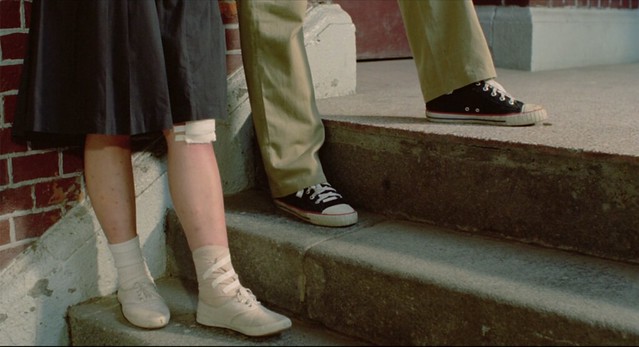
Brighter Summer Day my ass, it's more like Grimmer Sad Day. Edward Yang's grand tale of coming of age in 60s Taipei might not match the other 4 to 5 hour sweeping epic stewing philosophical meanderings about life, time and space (there's War and Peace mentioned a couple of times by characters), but I guess that's the point. Life of the ordinary people as an epic. And an epic A Brighter Summer Day is: an epic downer.

Our expectations would be different if the English title of the film was the same as its Tawanese title, Youth Murder Incident at Guling Street. Based on the real incident in Taiwan, which explains everything. But because it was based on lyrics from Elvis's Are You Lonesome Tonight?, and I had no idea what it was about other than vague notion of it being coming of age film, it was all the more devastating.

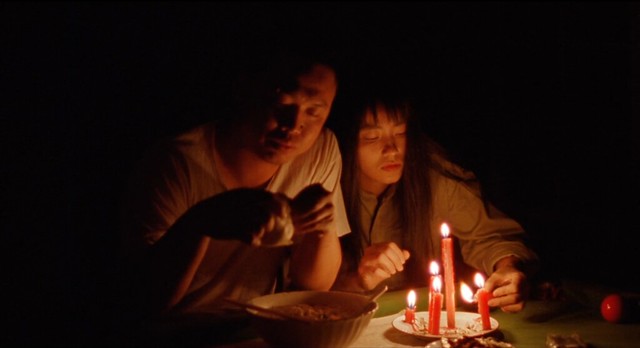
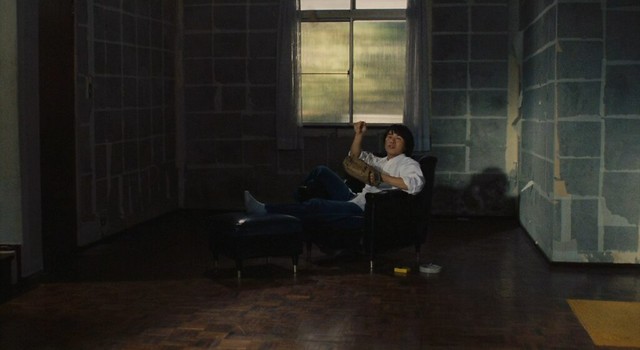
It tells a story of Si'r (Chang Chen), a 14 year old night school student embroiled in two gang factions in the neighborhoods and his family, as well as his friends, enemies and about 100 different characters. It's a sprawling, novelistic work that plays out like a good book. Si'r's friends belong to Little Park Gang and sings in a band that plays American rock'n'roll. He finds himself attracted to Ming (Lisa Yang), the girlfriend of Honey, the missing leader of the gang. She turns out to be a femme fatale of sorts and Si'r fixates on her a little too much it stops to be cute but obsessive. There is a story with his parents coming from the mainland China and his educated father being harassed and discriminated at work in context of complex Taiwanese history.

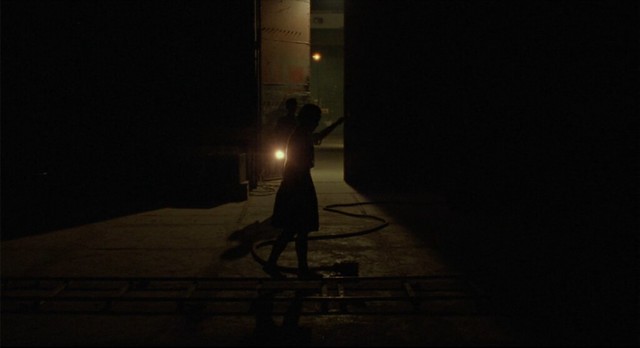
There's a lot of details in this film that are just gorgeous cinematically- the local movie studio next to the night school provides plenty of great cinematic moments, the Gang raid and sword fight in the pouring monsoon night also present some excitiing visuals.

Yang had a great understanding of using childhood memories and making it universal, that this is not some random violence but each one of us are capable of the violence at the end. A Brighter Summer Day is a rich, beautiful filmmaking that needs to be watched and appreciated.

Sunday, October 14, 2018

Running Away is Not a Solution

Taipei Story (1985) - Yang
Screen Shot 2018-10-13 at 12.25.30 PM
Screen Shot 2018-10-13 at 12.27.29 PM
Screen Shot 2018-10-13 at 12.30.37 PM
Screen Shot 2018-10-13 at 12.28.22 PM
Screen Shot 2018-10-13 at 12.31.58 PM
It is hard to let go of old ways. Taipei Story tells the story of Lung (Hou Hsiao Hsien) and Chin (Tsai Chin), an on and off childhood sweethearts adulting in the fast changing world. And it's a good one.

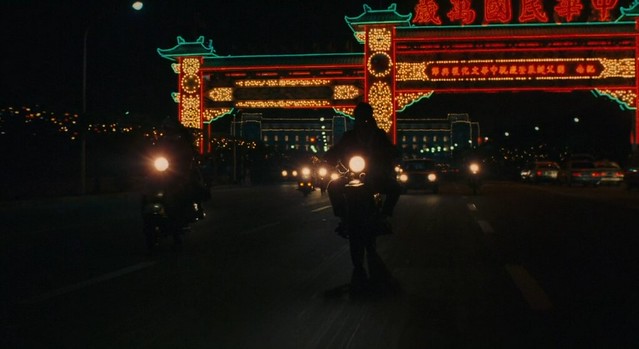
Lung just got back from living in California and finding it way too easy and comfortable slipping in to old ways - managing his father's fabric shop, visiting his old baseball coach and reminiscing good old times with Chin's father. It seems Lung left Taiwan because of his love Gwan (Ko Su-Yun) chose Kobayashi over him and moved to Japan. Chin, working at a classy architecture firm as an assistant to powerful Mme. Mei, finds herself out of the job after a company takeover. Chin decided to take some time off, hoping that now Lung's back, maybe they can get together and move to Cali. In the mean time, she hangs out with her little sister's motorcycle riding group of youngsters. And this provides some of the most memorable visual sequences in the film.

Still bound by tradition and loyalty, Lung blows an opportunity partnering with his brother-in-law in Cali by lending his nest egg money to Chin's father who is a sentimental drunkard and helping his old buddy who now drives a cab to make ends meet. Lung hates all these sinewy old connections in Taipei, but realizes running away is not the solution. You can't run away from who you are.

Chin's brief fling with her married co-worker doesn't go anywhere and she gets super jealous when Gwan visits the city. And her shenanigans with cram school kids brings more complications when one of the boys taking a liking to her. Where is her prince charming, her knight with shining armor to take her away from all this clinginess? Always hiding behind her dark shades, Chin wants very much to be free.

Somehow I could see the ending from a mile away. But don't matter, Taipei Story is a terrific film with great characters charting growing pains of 30 somethings in a specific city which also happens to be very universal. Hou is amazing as Lung, a moody man with a chip on his shoulder.

Sunday, May 7, 2017

A Puzzle Piece

Terrorizers (1986) - Yang
terrorizers
Some no good gang is holed up in a shady apartment, shooting people on the street at random. A young photographer takes pictures of a man shot dead on the street by the same gang. A fiction writer is having a writer's block, but her supportive but meekly doctor husband who is up for promotion doesn't understand what she's going through. Edward Yang's Terrorizers briskly, busily sets up the premise in the beginning twenty minutes. The film is a puzzle piece that doesn't resolve neatly, yet done in smart, intriguing way, you can't help but admire Yang's skills as a filmmaker.

In the center of it all is a young street hustler (Wang An) who alone escapes the police raid, but is captured by the young photographer's lens. She breaks her leg during her escape and put on a house arrest by her mother. So she spends her time prank calling people at random. The photographer who is obsessed with the girl in his photos, ends up breaking up with his girlfriend and moving into the shady apartment where the gang was holed up at, making it his dark room. The writer becomes a victim of the girl's prank call and it becomes the catalyst for her finishing the novel and leaving her husband.

It's the young photographer who pieces it together and informs the doctor about the girl who maybe responsible for his wife leaving. After that, the unhinged doctor, whose life is in shambles, carries out revenge, mirroring his wife's now famous novel.

On paper it reads like a sordid crime film very much akin to what the author says in an interview after she won the first prize, that she was "inspired by Japanese crime novels". But Terrorizers is nothing but. Everyone is well equipped with back stories and their motivations, except for the wayward youth with no moral compass, suggesting that this girl, the catalyst for everything that happens in the film might be the work of fiction, that her appearance is what people are wishing for in their daily tedious lives.

With Haneke like double take at the end, the film puts an emphasis on the fiction overtaking reality overtaking fiction. Ambitious and seductive, Terrorizers beckons me to watch more of the Taiwanese master's films.

Wednesday, December 23, 2015

Don't Cry, So Why Don't We Sing?

Good Men, Good Women (1995) - Hou
 photo 292ad633-a2d1-47c4-baf3-abac0b593c49_zpsixgenv4i.png
 photo 3dc6908f-b160-4d10-9e3c-3c2fbe9ad058_zpsjvr1f4xl.png
Compared with Hou's another Taiwanese historical epic City of Sadness which is told as a straight forward family saga, Good Men, Good Women is a much more complex film, both structurally and thematically. So it makes a much more challenging viewing experience. It starts out with a young actress Liang Ching (Annie Shizuoka Inoh) with a troubled past as she prepares the role of Chiang Bi-yu, a real life character in a film version of Good Men, Good Women, about a group of young Taiwanese idealists going over to the mainland China to join the resistance against Japanese in WWII. The monochrome version of the film within the film is scattered through out, giving the island nation's tumultuous history through these well intentioned characters who fell victims to political circumstances. It also loosely connects with the life of Liang in the present time who has been leading rather a trashy, decadent life.

Someone is stalking Liang with late night phone calls and faxing her the snippets of her own diary which was stolen. The diary reflects on her seedy past to herself as a bar hostess and a drug addict. She is also haunted by the memories of her lover, Ah Wei, a low level gangster who was murdered some years ago. We spend most of the running time with Liang in her present life and in flashbacks with Ah Wei, shot and framed beautifully in typical Hou mastery. The seemingly unconnected story resonates in the film's end as the same wide shot of people crossing the field of Chinese countryside, singing (one in monochrome and one color) reminding the prologue: "When yesterday's sadness is about to die/When tomorrow's good cheer is marching towards us/Then people say, don't cry. So why don't we sing." Liang's life can be construed as the director's comments on decadent present Taiwanese society. But Liang is a deeply unhappy character who can't escape the shadow of her past. We can't help but sympathize with her. There is obviously a larger context in play here - the nation's shameful past needs to be recognized in order to go forward.

Complex, asymmetrical and enigmatic, yet richly rewarding, Good Men, Good Women is the Hou film I was craving for. But now I have to watch Puppetmaster to finish the Hou's Taiwanese History Trilogy.

Sunday, December 20, 2015

Beautiful Melancholia

Dust in the Wind (1987) - Hou
 photo b7898d79-c7f4-43e5-a887-6e40bcd354a4_zpsnkbrzxik.png
Wan (Wang Chien-wen) and Huey (Hsin Shu-fen) are teenage lovers in a small mining town. After graduating middle school, they decide to go to bustling Taipei to earn money for their families. Wan takes a job at printing factory then later as a motorcycle delivery man while going to night school. Huey works as a seamstress. They befriend with billboard painter and his gang at a movie theater, hang out and drink sometimes. But life is tough and as you know, things never go the way you wanted.

Hou's elegy to his adolescent times is full of stunningly beautiful moments - a train ride home in the beginning, normally shy Huey taking off her shirt in a spur of the moment, grandpa's firecrackers, suspicious, shipwrecked Chinese family in the army barracks, watching people fighting fire from across the street, drunken dad trying to lift a stone, etc. It feels almost indecent to share these memories of Wan and Huey as intimately and vividly as I watch Dust in the Wind. But like past memories, Hou's treatment of these moments are so fleeting and democratic, it just quietly floats by without much time for reflection (which comes later). And before you know it, the film ends and leaves you with beautiful melancholia. Another bittersweet masterpiece by Hou.

Thursday, October 8, 2015

Wuxia of a Different Kind

The Assassin (2015) - Hou
 photo 701ba8b9-a2f1-44ae-bb37-12d832b3131e_zpsvxmnfvrv.jpg
The Assassin plays out like a overly conscious filmmaker going over the script of Crouching Tiger, Hidden Dragon and say, "OK, we will do complete opposite of what's written here, line by line." But it's Hou Hsiao Hsien. So you know he is aiming for something else entirely.

There is a complicated plot set in 8th Century Tang dynasty, in the region of Weibo where the talk of revolt against the imperial court is brewing. There is a love story somewhere and a beautiful assassin Yinniang (Shu Qi) wrecking havoc. In a beautiful crisp black and white intro, Yinniang is seen cutting her target's throat who's mounted on a horse in blinding seconds. Again, it being Hou's wuxia, action sequences are brief and often cut abruptly by the following scene without any resolution. Yinniang was taken and trained by a nun princess (the backstory we only briefly hear about) who chides not for her swords skills but the resolve in her heart because she refuses to kill intended targets when they are with their children. Just as fleetingly as the flow of the film, Yinniang is assigned to kill her cousin/childhood sweetheart Tian (Chang Chen), the governor of Weibo. Would she fulfill her mission? Or is it ever a point of the film?

Watching the Assassin is like watching the river flowing down in autumn sunset. You were watching an object reflected in golden sunlight just above the surface of the water all the way on the right corner of your eye, you were mesmerized by the sparkling, undulating water and before you realized that the object was flowing down the river all the way to the left corner of your eye and one hour and forty minutes have gone by. Hou is the kind of director who's more interested in steam rising from the ornate bathtub than his actress's beautiful naked body. His decisions are so efficient, yet it conveys everything any costume melodramas convey, without corny tears, excessive expositions and phony intrigue. He doesn't need to show the wounded bare back of Yinniang for emotional effect. We already know she is a kick-ass assassin and she will get over it with some Chinese herb patch. Sumptuously shot on film in full frame by Hou's regular cinematographer Mark Pin-Bing Lee, The Assassin is rapturously gorgeous. Shu Qi looks amazing in her black Assassin's outfit. Marvelously elegant in its simplicity and subtlety The Assassin is a true beauty to behold.

Saturday, April 19, 2014

Taiwan, My Love

Almost Home: Taiwan (2014) - Linchong
 photo 9ac25b3b-1ec4-4485-b33f-3831c191ab49_zps3d129ac1.jpg
Back in March, I had a privilege to attend the sneak preview of Victoria Linchong's lovely documentary Almost Home: Taiwan, at Clemente Soto Velez Cultural Center, down in East Village. Armed with handicam, Victoria and her family travels to Taiwan, her parents' homeland, to visit their relatives and pay respect to their ancestors. I've joked with Victoria about how our knowledge of Taiwan is limited to watching master Taiwanese filmmaker Hou Hsiao-Hsien's films. But I wasn't really prepared for the natural beauty of Taiwan in her footage. Amazing mountains in the fog, hot springs, temples, beautiful coastline..., Victoria's travelogue has awakened wanderlust in me like no other films have.

The documentary also serves as a great history lesson. Victoria interviews political figures who were involved in Taiwan's independence movement and even employs funny DIY animation sequences to illuminate Taiwan's very complex and little known history. Linchong managed to strike a fine balance between an intimate, personal travel documentary and political essay. Almost Home is not only a beautiful tribute to her homeland, but also extremely educational film that needs to be seen.

My wife, Nicole Schulman, also contributed to the poster project to help finishing the documentary.
Please visit Almost Home: Taiwan website.


Almost Home: Taiwan - Trailer from Victoria Linchong on Vimeo.

Saturday, June 1, 2013

Film as History

City of Sadness (1989) - Hou
Image
Image
Image
Image
Image
Hou quietly observes a prominent Lin family in a mountain town as it breaks apart during turbulent times in Taiwan after WWII. Handsomely photographed static interior shots accompanied by naturalistic performances, City of Sadness looks and feels like Ozu. Sung Young Chen is great as boisterous eldest son, so as Jack Kao as the middle child who suffers from PTD who were drafted to fight in a Japanese army and later is tortured by Kuomintang as a collaborator. Young Tony Leung also shines as the youngest, sensitive, deaf (because Leung couldn't speak Taiwanese, I found out, but it works him being as a slient witness) brother of the family. It's he and his long time family friend and later wife Hinomi (Xin Shu Fen) who bear witness to the changing times.

I had a very little knowledge of Taiwanese history going in City of Sadness: didn't know about their 51 year Japanese Occupation (compared to Korea being under 30 year occupation, and we still hold grudges) and the rather unique colonial past (as the first Japanese colony since 1894, taking cues from the Brits, the Japs governed them differently at first and to this day, I hear Taiwanese don't have too much adversarial feelings toward Japs as the rest of Asia do) , didn't know about their diverse ethnic groups, culture and languages, didn't know about Kuomintang's atrocities after the WWII against its own people. It is rather wrong to base your knowledge of a certain people's history solely on one mere film, but knowing Hou and his detached yet humanistic approach, I'd take his film over any dry history textbooks.

Thursday, May 30, 2013

Party Like It's 2001

Millenium Mambo (2001) - HouImage
Image
Image
Image
Image
Image
Gorgeous, just gorgeous. With mangled timelines and sporadic and repetitive voiceovers, the film focuses on a beautiful wayward youth Vicky (Shu Qi). She is in a sadomasochistic bind with controlling Hao Hao (Tuan Chun-Hao), breaking up and going back to him many times. While working as a bar hostess, she meets Jack (Jack Kao), an older gangster type who takes her under his wing. I loved the scenes shot in snowy Hokkaido where Vicky loses herself to her surroundings. Colors, compositions, all amazing. With Hou, it's all touch and go for me. I adored Cafe Lumiere, Goodbye South Goodbye but meh about Flight of the Red Balloon. Mambo really clicked with me. And like with all Hou, the film, the characters are in love with its past. It's a 2001 movie told in 2011 being nostalgic about 2001! A free flowing, beautiful film.

Wednesday, September 12, 2012

Bye Bye Cinema

Goodbye Dragon Inn (2003) - Tsai
dragon inn
dragon inn 1
dragon inn 2
dragon inn 3
dragon inn 4
Minimal dialog, great use of large spaces and framing, Tsai Ming-Liang's Goodbye Dragon Inn is a mesmerizing experience. Taking place almost exclusively in a grand, dilapidated movie theater, this atmospheric, moody, nostalgia driven ode to cinema doesn't sacrifice Tsai's usual theme - isolation and disconnectedness and a bit of eroticism. Exquisite. One of the best shot films I've seen in recent years.