Thursday, July 14, 2011

I Can be Funny Too: Errol Morris Interview

I'm not a big fan of roundtable interviews. It's not as intimate as one-on-ones and you have to share the short given time with other interviewers. But when an opportunity comes along to interview Errol Morris, one of the most revered American documentary filmmakers, in the week of the release of his uproarious new film, Tabloid, who am I to say no?

Luckily, the time slot I was given was at the end of the day with only two other journalists so I was able to slip in fair amount of questions. Even after repeated interviews, Morris appeared to be chatty and generous in his answers about the film, the state of modern journalism and a new narrative project with This American Life's Ira Glass while showing a bit of his 'funny' side as well. Here are the excerpts from the interview:

[All the questions are mine, otherwise marked with *]

Even though Tabloid is being regarded as aesthetically different from your previous films, I still see it very much as an 'Errol Morris' film. In a way there are a lot of similarities in Fred Leuchter [Mr. Death], Robert McNamara in The Fog of War and Joyce McKinney. Was it that self-delusional, ironical aspect of her story what attracted you to do this film?

Yeah. Maybe in part, I think.

Did the Mormons give you any trouble making this film?

No. Mercifully.

You are not expecting a backlash from them after the release?

We were showing the movie in Salt Lake City and people there seem to love it! I think Joyce might have liked it more if the movie was more antagonistic to the Mormon Church. But as you know, it's an element of the story, not THE story.  

The tabloid culture seems a lot different now than in the 70s with the decline of serious journalism in general, many newspapers going under, the popularity of the reality TV and now The News of the World scandal. What's your take on it?

Things have clearly gotten worse. The News of the World story is not so much of a tabloid story. I mean there are elements of that kind of story in my movie where people no longer care about the facts or the representation of reality or truth. The News of the World story cranks it up a couple of steps further and shows that they not only don't care about the truth, but they don't care about anything at all. It's all lies and manipulation, crimes, hacking into people's phones and playing games with people's lives. With Joyce you can say 'ok she is not a completely innocent victim of the tabloids, she is a participant at least on some level that she sought some kind of fame or notoriety and she got it.' But you take the parents of the girl who got abducted and killed, they didn't seek any fame or attention. And the police were trying to decide whether the girl was alive or dead and the tabloid was fiddling around with the evidence? That's different. That's really truly screwed up version of journalism.

*One good thing that came about was that they shut the paper down.

No, it's not clear if anything is going to happen to the Newscorp. Some low level workers who were dependent on the paper got the blame but at this point, I'm not sure what it means over all.

Do you see Tabloid as your own response to your previous, more 'serious' films?

The Standard Operating Procedure wasn't particularly well received. The reviews were all over the place. I felt that the movie was misjudged by many people. Whether I went loony-toons in it or not, I felt the movie was never really appreciated. It didn't do particularly well at the box office either. And I thought it was good time to do this [Tabloid] because I consider myself as a funny person and this is a funny movie. So people can't quite say ERROL = NOT FUNNY because of The Fog of War and Standard Operating Procedure. So in a way I wanted to do this movie as a way of saying, "FUCK YOU I AM FUNNY!"

*You've collaborated with Philip Glass and Danny Elfman in the past...

Yes and I will work with both of them again. Philip and I did 3 features together and then we did a short project for IBM for its hundredth anniversary, it's on youtube. It's about a half an hour film and he did an original score for it (search: IBM Centennial Film: They Were There - People who changed the way the world works). I love Philip's music and I'd love to work with him again. I'm planning on one with Ira Glass as it was reported in This American Life. It's a narrative feature about the first cryogenic freezer, which is kind of a tabloid story. Either Danny or Philip will do the music. They both are great and they seem to tolerate me. (Laughs). John Kusiak did the soundtrack for Tabloid and he did a fantastic job.

Are you nervous that it's coming out the same week as the last Harry Potter movie?

I'll just have to face it down.

How are the Boogers [Joyce's dogs] doing?

I think they are doing fine. One of the Boogers was at the screening yesterday in a matching sequin dress with Joyce.

So that means there is really a future for successful human cloning, perhaps?

The clones would be very convenient for the screening appearances and interviews. (laughs)

*So Joyce is coming for the screening tonight too?

We certainly invited her. I get the feeling she will show up at the LA screenings too.

*So her not being happy with the movie and appearing at the screenings uninvited are...

We really had a good time the other day at the screening. She was funny, unlike when I was editing the film for the last six months. She was threatening and talking about suing me and all that. Is it all an act? We don't know. One word that comes to mind in dealing with Joyce McKinney is 'Kevlar'.


IFC Films will open Tabloid in theaters on July 15.

My thanks to Taiyo Okamoto from COOL Magazine and Adam Schartoff from filmwax for their camaraderie during the interview.

Wednesday, July 6, 2011

Long Live VHS!

Videodrome (1983) - Cronenberg
Photobucket
Long gone are the days of magnetic tapes. Today, it's all about shapeless, formless streaming video. And there is nothing physical about the technology anymore. It might be false and frivolous on my part to be nostalgic about a finite format, but hey, I spent my formative years in the 80s, so I am a product of that silly decade. I can be emotional about seeing a disheveled rubics cube with a couple of its tiles missing in a pitbull's mouth, if I want to. But David Cronenberg shows what was there back then- a subversive filmmaking. I can't think of any recent film or filmmaker that is as daring as Videodrome.

I saw Videodrome as a horny teenager, not grasping its implications about the physical manifestations of watching sex and violence in the media. Seeing it now, it's an electrifying experience. Casting the 80's sex kitten Deborah Harry in a s&m loving TV personality role is pure genius. James Woods has never been better since or prior to as a sleazy public TV show programmer.

One could see a strong correlation with Videodrome and Cronenberg's later, Burroughs adaptation of Naked Lunch. But I think I'd prefer media induced hallucination over drug induced one anytime. The film definitely becomes my favorite Cronenberg.

Tuesday, July 5, 2011

*Psychedelic Indie Nerd Glam

Ringing in Their Ears (2011) - Irie
The film starts out with Noko, a lead singer of Japanese metafunk band Shinsei Kamattechan, on stage, singing while holding a laptop in front of him. With fans' comments flying across the live streaming images of the concert in the background, Noko sings off key, accompanied by childish pop melodies and loud guitar. His voice is awkward and powerful at the same time. Unlike the group's less than rock star attire and cheerful sound, their lyrics are often dark and borderline weird.

Yu Irie, who graced last year's NYAFF with a pair of sleeper hits, 8000 Miles and 8000 Miles 2 about Japanese wannabe rappers and the suburban ennui, comes back this year with a decidedly mature film, Ringing in Their Ears, featuring aforementioned, Shinsei Kamattechan.

Taking place over a week building up to Kamattechan's big concert, Irie skillfully weaves the trials and tribulations of several Chiba-ites into a funny, touching film. Kaori (Kurumi Morishita) is a struggling single mother doubling as a nightclub dancer and a cleaning person to bring up her forever-glued-to-a-laptop, kindergartener, Ryota. The boy, being a big Kamattechan fan, gets into trouble when he teaches his classmates a disturbing song, obviously influenced by the band:

I want to live/I want to die/Either way is fine, ma, ma, ma, ma
I want to fade away/I want to die/Neither way is fine, ma, ma, ma, ma

A high school senior Michiko (lovely Fumi Nikaido) clashes with her parents because she wants to be a professional shogi (Japanese chess) player instead of going to college. Then her boyfriend who'd introduced her to Kamattechan's music, leaves her for the more conventional college-bound girl. The band members, with the exception of reclusive (apparently in real life too) Noko being AWOL until the concert, play themselves as they rehearse for their big concert, while their conflicted manager (Mikito Tsurugi) hesitates to break the news that they are getting picked up by a major label and about to become a sellout.

It makes sense that Irie, who demonstrated the knack for channeling the disaffected youth in his previous efforts, is the one showcasing this Chiba based (like 8000 Miles 2), web savvy, word-of-mouth, indie rock phenom. But Ringing in Their Ears is not just another publicity tie-in or fanboy movie. It stands on its own as an affecting narrative. It just happens to have kick-ass music too. Irie's nuanced, minimalist approach is never on the nose about the issues - shut-ins, outcasts and the generation gap. He conveys all those things through likable characters and the spirit of rock'n'roll without being showy or cocky. Ringing in Their Ears will satisfy music fans and film lovers alike.

Ringing in Their Ears will be screening as part of the 10th annual New York Asian Film Festival in conjunction with Japan Cuts 2011 on Thursday, July 7th and Monday, July 11th. You can find out more information at the NYAFF website and Japan Cuts website

*Psychic indie nerd glam is the term used to describe Shinsei Kamattechan's music by good people at jrawk.com. Please visit their page

Sunday, July 3, 2011

Korean Food Anyone?

The Recipe (2010) - Lee

The Recipe's Korean title, 'doenjang' refers to 'fermented soybean paste' which is the base of almost all Korean cooking- it is in soups, stews, marinades, condiments, side dishes... the list is endless. With such an ever-present, everyday ingredient as the subject, I thought the film would be a tongue-in-cheek, Tampopo style comedy. Director Lee Seo-goon rather takes a tear-jerking, populist approach, a la Le Grande Chef, and the result is lukewarm at best.

It starts out quite promisingly- a death row inmate's last wish to taste the same doenjang jigae (soybean stew) in a small mountain restaurant where he was caught, triggers a TV producer Choi (Ryu Seung-ryong) on a wild goose chase. The police report and eye witnesses support that it was the aroma of the stew that stopped the violent criminal in his tracks.

With the help of his always hungry police friend and a lab technician, Choi searches for the story behind that mysterious soybean paste. The story cuts back and forth between Choi's investigation and Hye-jin (Lee Yo-won), the young woman carrying a small crock pot.

Growing up surrounded by meju (square blocks of fermenting soybean) hanging from the ceiling, Hye-jin has the talent for finding the right ingredient for making the best doenjang. Orphaned early on, Hye-jin travels countryside to find the right elements for her magical paste. In a southern rural village, she meets a handsome plum wine maker and falls in love.

As a Korean food aficionado, I expected to see some mouth watering Korean food in display in The Recipe. Unfortunately, the film turns out to be less about food and more to do with its gooey melodrama that involves an unrealized lovers' pledge, a fateful car accident, tears, butterflies and a goblin.

The most interesting part of the film is the process of making doenjang. Lee tries to elevate the art of doenjang making as that of wine making. A lot of elements play the roles: the location, soil, soybeans, water, salt, yeast, pollen, clay (for the large crock pots that would house the fermenting ingredients) and of course that special individual touch. Lee shows the process faithfully, if not a little too cutesy, sterile way.

Still looking for that one good film that would satisfy my desire to see delicious Korean food parading in front of me, I walked away from The Recipe with my mouth completely dry.

The Recipe will be screening as part of the 10th annual New York Asian Film Festival on Tuesday, July 5th and Saturday, July 9th. You can find out more information at the NYAFF website

Wednesday, June 29, 2011

Pretty Jamie Gumm

The Collector (1965) - Wyler
Photobucket
A young, introverted butterfly collector (Terrence Stamp) in a secluded big house with a separate cellar, moves up his territory when he kidnaps a pretty art school student (Samantha Eggar). After begging and pleading and escape attempts, they sort of agree on their terms - he will let her go after 4 weeks, hoping she will fall in love with him.

With only two principal actors (plus one small character in the middle), this John Fowles adaptation feels more like a play. Young Stamp is intense, playing the role of creepy, shy man with chips on his shoulders. Is it sex that you want from me? Miranda the art student asks him. No. He wants to respect her as a proper woman.

There is a big confrontation over Catcher in the Rye. Their class differences are highlighted and the gap between them is obviously too wide. The film suffers from Fowles passive aggressiveness of the characters and their shallow psychological makeup. Stamp is effectively creepy but the film doesn't quite escape from its Stockholm Syndrome/captive drama mold.

I Hate Musicals

Sell Out! (2008) - Yeo
The Filmbegins with sultry Rafflesia (Jessica Lai) interviewing a Malaysian film auteur for her low end TV talk show called "For Art's Sake". The auteur is Yeo Joon Han (the director making a cameo) who just won the prestigious Young Overseas Chinese Women New Directors Honorary Mention Award at the Krychindangzhongbushaus Village Far Eastern Film Festival. When asked about why his almost silent indie art film "Love is Love and Nothing Else", is so slow and boring, Yeo, who appears in the nude for the interview (and seems very comfortable), vehemently defends the authenticity of his film by citing that in real life, nothing really happens, that no one actually breaks out into a song in the middle of it. He goes on even further, stating that people who make musicals should be chopped into 18 pieces!

This prologue shows director Yeo's mischievous intentions. Sell Out! is an all-out, over-the-top satirical musical romantic comedy where many things happen and people break out into songs, many times over. And it's uproariously funny.

After capturing her lovelorn boyfriend's death on camera where he recites his poem before he dies, Rafflesia comes up with a concept for the ever-popular reality TV - a televised death. This will surely show her pretty half-English rival who the boss is. The only problem is, she has to wait by the deathbeds until her sadsack subjects croak. A potential megahit in her hand but under the tight deadline, she has to find a more reliable subject very soon. What kind of deaths are predictable? Suicides.

Enter Eric (Peter Davis), an honest engineer who works for the same greedy conglomerate that Rafflesia works for, named, ahem, Fony Corporation. He is in a pickle because the clownish corporate bigwigs can't believe their ears when they hear his 8-in-1 soy bean machine is built so well, it won't break right after its warranty runs out. How can you make money out of the product that won't break down? This is followed by musical number, "Money". They end up exorcising Eric's creative 'dreamer' side out of him, But the exorcism goes wrong, resulting in two Erics - the dreamer and the practical. Deeply depressed by all this, the practical Eric comes up with a plan involving lovely but heartless Rafflesia.

Director Yeo jabs at many things with his ironic sense of humor - snobby art film scene, money hungry corporate culture, absurd reality TV shows and even Malay English (Manglish). The film's filled with horrible, insensitive jokes and people but in Yeo's hand, they never feel malicious.

Sell Out! caught me by surprise, since I didn't know what to expect watching my first Malaysian movie. It's a light romantic comedy version of Network set in bustling modern day Kuala Lumpur with its own karaoke singalong time built in for the audience. I haven't had this rib roaring good time watching a film in a long while.

Sell Out! will be screening as part of the 10th annual New York Asian Film Festival on Friday, July 1st and Monday, July 4th. You can find out more information at the NYAFF website.

Sunday, June 26, 2011

Lunch break Contemplation on Life

Tree of Life (2011) - Malick
Tree of Life
It is a noble attempt to visualize someone contemplating his life for five minutes in his office during a lunch break. But The Tree of Life as a film just doesn't work. It is a fluffy snoozefest, 'Cotton: the fabric of our lives' commercial stretched out for two and a half hours with a better quality National Graphic episode thrown in. An old photograph from one's own past can more effectively evoke such thoughts than that of Malick's pretty picture diorama.

It's beautiful I admit on many occasions and some of the details of growing up are beautifully done. My problem is not with its semi-narrative structure. I appreciate poetry as much as the next guy. It has to do with how it's put together. It's way, way too meandering. And the walk on the beach scene showcases Malick's gooey life affirming tendencies at its most cringe inducing worst.

Rageaholic

Under the Volcano (1984) - Huston
Photobucket
Al Finney's boosy Brit diplomat the south of the border is fun to watch. But it's a bit too melodramatic for me. I've heard a lot about Malcolm Lowry's book that the film is based on, filled with symbolism, details and whatnot about the looming WWII. The ominous vocano, white horse, Day of the Dead are all there in the background but they don't make that much of an impact on the story of a man who can't get over his wife's infidelity. Solidly done, and Finney's great. But I couldn't get over how a scrumptious woman like Jacqueline Bisset would come crawling back for pale, flabby man who is drinking himself to hell. He gets away with saying hurtful things because he is drunk. I've always hated that passive aggressive tendency about drunks. It still makes me curious about the book.

Wednesday, June 22, 2011

Fire Within

Saturday Night and Sunday Morning (1960) - Reisz
Photobucket
Whatever people say I am, that's what I am not.

With his rugged good looks and swagger, Arthur (young Albert Finney) is a hard working, hard drinking factory worker. Constant trouble maker in arrested development, he has to face the consequences and think about settling down when he gets his girlfriend at the moment- a wife of a co-worker, Brenda (Rachel Roberts) pregnant and meets pretty, young Doreen (Shirley Ann Field). Would he change his ways and become like his characterless parents who only know work and TV?


Saturday Night is a matter of fact depiction of working class. "All I'm out for is a good time - all the rest is propaganda." Arthur declares in his narration early on. Finney's at his best being a brut without real menace. Straight laced Roberts plays an object of desire for a good looking working class bloke here and again in This Sporting Life for young Richard Harris three years later.


Quoted and loved by many British rockers- from Steve Ignorant of Crass to Morrissey to Arctic Monkeys, I can see how Arthur's take-it-or-leave-it attitude appealed to many young men before Travis Bickle age.

Monday, June 20, 2011

Heartbreak Capital

Cafe Noir (2009) - Jeoung
Cafe Noir is screening for free Tuesday, June 21 at 7:00 PM, as part of Korean Movie Night at Tribeca Cinemas. You can find more details and information on the Subway Cinema site.


Jeoung Sung-il, a well regarded Korean film critic, makes a directorial debut with Cafe Noir, largely based on two works of literature - Goethe's The Sorrows of Young Werther and Dostoevsky's White Nights. This sprawling three hours plus contemplation on love and heartbreak also draws from many different cinematic sources. This concoction doesn't always work, but is still quite intoxicating. And in Jeoung's hands, Seoul, the neon megalopolis, becomes the new capital of the heartbroken.


The film opens with a young woman unwrapping and eating a hamburger while looking up forlornly to the heavens in what appears to be an indoor mall. Tears roll down on her cheeks as we see her stuffing her face in real time. She is our Joan of Arc of the fastfood age, christening the film.


Young-soo (Shin Ha-gyun, Sympathy for Mr, Vengeance, Save the Green Planet), a music teacher, is first seen getting dumped by his lover- a mother of one of his pupils, on a Christmas eve. Not accepting the defeat, he devises a plan to off the obstacle (the woman's monstrous, Rilke quoting husband). When he fails to kill the husband of his lover, Young-soo realizes that for the happiness of the woman he loves, it is he who needs to be out of the picture.


For the second part of the film, Young-soo re-emerges, only to go through another crushing heartbreak. He meets a young woman on a bridge by chance (showcasing the brightly restored Chung-gye creek which runs through the heart of Seoul). She begs him not to fall in love with her, but to be a confidant and proceeds to tell him a sob story in one long take- she has been waiting for her lover on the bridge for a year. They made a promise to meet after a year if they still love each other. Tonight might be the night, or tomorrow night, or the night after.... Her lover is obviously not coming, and our melancholic hero can't help falling for this delusional, yet vibrant, lovesick woman.


With its deliberate episodic pacing, arduous monologues, forever tracking shots, mix of B&W/color photography, a lot of intriguing supporting characters and a lot of film references (from The Red Balloon to The Band of Outsiders' dancing sequence to jabbing at recent Korean movie hits- Old Boy and The Host), Cafe Noir is a truly astounding cinematic examination of unrequited love.


With everything mapped out to a tee, Jeoung's style is quite the opposite of Wong Kar-wai. But it wouldn't be a stretch to regard him from now on as Wong's cerebral brother.

Tuesday, June 14, 2011

Wrong Play!

The Dresser (1983) - Yates
Photobucket
Photobucket
The setting is WWII London. Norman (Tom Courtenay) is a dresser to an aging Shakespearean actor, known only as Sir (Albert Finney in his career best). The only reason the senile actor can marginally perform his Othello, Macbeth, Richard III, King Lear night after night without fail is because of Norman. He dresses, washes, coerces, pep-talks, encourages, feeds lines to, takes insults and rants from the old man.

Sir has a close call and ends up in a hospital after he throws a fit in the bombed out London street. As the theater staff contemplate on shutting down the production, they find him returned to his dressing room and being incoherent. Is he going to be somewhat ready for tonight's performance of King Lear?

With Ronald Harwood (The Pianist, Diving Bell and the Butterfly)'s blistering script, the two of the most gifted British actors go mano-a-mano. Watching them in real time as Norman harangues downright deranged Sir to get ready is an exhausting experience. Norman is at once Salieri to Sir's Mozart, Felix to Oscar, Ratso to Buck, King to Fool. Thanks to Courtenay, Norman's affection and devotion for his master is real and heartfelt. Very awesome.

Sunday, June 12, 2011

Feline Curse

Kuroneko/Black Cat (1968) - Shindo
Photobucket
Photobucket
The film starts with the farmers- mother and her daughter-in-law, gang raped and their house burned down by a band of lawless samurai. The women's black house cat ringers around their charred corpses. The setting is warring medieval Japan.


When they appear again, they are beautifully dressed courtesans luring the samruai in to the bamboo forest in the middle of the night and sucking their blood dry. Distressed leader sends the rising young samurai to destroy these monsters. The fate would have it, the young samurai happens to be the son and the husband of the two farmers who were raped and killed.


As shown in his Onibaba, Kaneto Shindo again, shows his hatred for the ruling warrior class and greed. Black Cat follows the best Japanese ghost story traditon, a la Ugetsu. Also it is the rape revenge story that is far more artful and elegant. The theatrical set and dramatic lighting are beautifully composed. It also features some great wire work and beautiful day for night shots. Very worth checking out.
_________________

Friday, June 10, 2011

What is Flesh Alone?

Je Vous Salue, Marie/Hail Mary (1985) - Godard
Photobucket
Photobucket
Photobucket
Photobucket

Photobucket
Photobucket
Photobucket
Photobucket
Godard's take on Virgin Mary might have been seen as an assault on Christianity and the idea of Immaculate Conception but it's actually about one of his usual themes- body/soul dichotomy. What's refreshing about Hail Mary is it's also about relationship between two young people being tested: can they love one another without touching? I can see the film's influence on many younger filmmakers whom I once religiously followed, namely Leos Carax and Hal Hartley with their brooding anti-heroic archetypes.


Hail Mary is perhaps the most beautiful color film I've ever seen. Punctuated by amazingly graceful nature photography and anchored by Myriem Roussel's Marie, a high school basketball player and a virgin who finds herself being pregnant. Marie's questioning "what is flesh alone...?" and her struggle to keep herself chaste is touching and deeply felt. It's the presence of Roussel that differentiates Hail Mary from Godard's post-Anna Karina cynicism.


From what I hear, Hail Mary is one of the last films before Godard turned his direction toward visual essays of the 90s which I find dry and uninteresting. Call me old fashioned, but for me ideas are still best conveyed through stories and characters, not in the lecture halls(movie theaters) that Godard still seems to preside over. Cinematically no one can top Godard's playfulness in the 60s, not even Godard himself. But this is a gorgeous stuff. Easily a top ten material for me.

To Hellman and Back

Road to Nowhere (2010) - Hellman
Photobucket
As a fan of Monte Hellman, the famed director of the 70's seminal counter-culture classics such as Two Lane Blacktop and Cockfighter, it is very hard for me to report to other Hellman fans that Road to Nowhere, his new film in more than twenty years, is...umm...absolutely...dreadful. There I said it. Such is the burden of being the messenger of bad news.


Prior to the screening Hellman told the audience the advice he got from someone once- 'never explain your film, never apologize for your film and never reimburse tickets.' He succeeded in getting couple of laughs out of that. In retrospect, he wasn't joking. It was his ominous preemptive strike.


The film concerns a young, esteemed Hollywood director Mitchell Haven (Tygh Runyan) adapting a real life story involving intrigue, corruption and double suicide, dug up and sold by a young blogger (Dominique Swain). Haven finds his muse in an amateurish actress named Laurel (Shannyn Sossamon) and becomes infatuated with her while the rest of the cast and crew get increasingly frustrated by his devotion to her.


Road to Nowhere fancies itself to be a meta movie of sorts. It's a movie within a movie, life imitating art imitating life. Laurel might be the real person she is portraying, so is the film's co-star (Cliff De Young). There is an insurance investigator/film consultant (Waylon Payne) who can't seem to distinguish fiction from reality.


Written by Steven Gaydos (executive editor of Variety), the film's Hollywood savvy, corny dialog is just too earnest to be taken as ironic. All the actors involved are not skilled enough to improvise with the given material, making their characters unbearably vapid.


Hellman's contemplation of filmmaking as realizing one's dream in the age of internet and HD photography, gets lost in its trite, tabloid worthy premise. As the film ends with an amazingly terrible song sung by some Bruce Springsteen impersonator, one realizes that even the greatest director needs a good script (doesn't have to be written by Rudy Wurlitzer) and good actors to pull off a DIY style vanity project to be halfway decent.

Thursday, June 9, 2011

Splatter from The North Pole

Play God (2010) - Nikki
Photobucket
[Play God plays as part of DocPoint NYC, a program of 47 films hosted by its New York partners: The Museum of Modern Art (MoMA), Scandinavia House, 92YTribeca, UnionDocs and the Tribeca Film Institute, on June 10th at 7pm]

A successful Helsinki based commercial director, Teemu Nikki looks back on his failed attempt at making the first Finnish splatter movie, Play God. This 38 minute, behind-the-scene, inside look at filmmaking gone awry doc is sort of 'making of' featurette on a movie that never happened.


There have been quite a few documentaries in the past that highlighted the trials and tribulations of filmmaking. Burden of Dreams: Making of Fitzcarraldo and more recently Best Worst Movie: Making of Troll 2, immediately come to mind. Keith Fulton and Louis Pepe's Lost in La Mancha chronicled the disintegration of Terry Gilliam's Don Quixote. However entertaining that documentary was, it depressed a lot of burgeoning filmmakers including myself. I mean, what chance did we have if no one was willing to finance a Gilliam movie? The process of the making Play God documented here seems like a therapy for the director- to be rid of the omen that's been gnawing at him for several years. And he seems to have a sense of humor about the whole experience.


Growing up with the steady diet of splatter films on VHS, Nikki's foray into filmmaking is akin to that of many American indie filmmakers. Seeing homemade footage of Nikki and his Finnish compatriots making their own brand of splatter movies with their dad's video camera in their backyard reminded me of how universal the film geekdom is.


Play God, a shoot'em-up chop'em-up superhero movie in epic proportions (Sci-Fi backdrop, large number of extras, battle scenes and a chainsaw wielding Evil Santa) with an incomprehensible storyline and the puzzling English dialog, was all enthusiasm and not much else. Nikki's plan was simple: shoot the first 20 minutes of the film, show it to the possible investors who would then naturally be blown away by its brilliance and would dole out the money to make the rest of the film, then off to a successful career in Hollywood.


With extremely bad weather conditions (minus 40 Celsius degrees) and everything else going wrong, the production of the movie hit the wall from day one and never really got off the ground. The cast and crew, all Nikki's friends and family members, just as enthusiastic but all novices in filmmaking, faced some very treacherous working conditions. Without the script and direction to guide them while working hard for free, they slowly lost faith in Nikki. Then people started turning on each other. Yes, it can be frustrating when you're not able to cut Evil Santa in half with a chainsaw. But stop crying forgodssakes!


Interviewing various cast and crew members, Nikki faces some biting criticisms from his friends and family face to face. The movie didn't happen. The project was way too ambitious to pull off. And he blamed everyone but himself. Thankfully, the doc is also filled with plenty of awesome footage from Play God. There are definitely times in the film that you wonder whether it is a mocumentary or real. It is a playful, funny as hell and endearing documentary. And by the slick look of the trailer Nikki finally made, Play God could've been really an awesome splatter movie. I am hoping that Hollywood will take notice of now 'mature and competent' Teemu Nikki, and actually help him make Play God for real, starring, Mickey Rourke perhaps.


For tickets and more information please visit MoMA Presents: DocPoint

Monday, June 6, 2011

First Contact

The Andromeda Strain (1971) - Wise
The Andromeda Strain 1
The Andromeda Strain 2
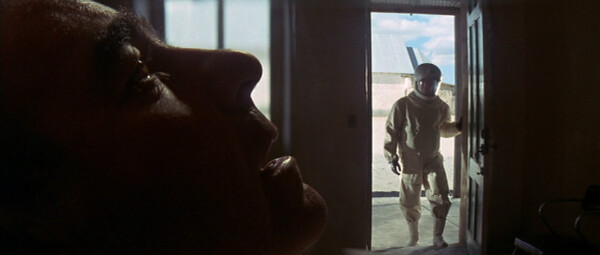
Wasn't too sure about watching this. I remember it as boring ass movie as a child and indeed, the 2/3 of the film is purely procedural - in Michael Chrichton's 'I have to explain this made up world to you in detail' way. But once you settle in, it is a very enjoyable ride.


What if our first contact with alien species is with a too small organism our naked eyes can't see(which is the most probable scenario anyway) and deadly to us? After a satellite probe crashes into small town Nevada and kills off townspeople in their daily tracks, the US gov't assembles top scientists to an undisclosed superslick Nevada underground facility to determine whether to nuke the town. It's the usual gambit- the time is running out, perspiration, contamination, red lights, countdown, laser beams, the key...


Robert Wise goes town with the whole gov't top secret mumbo-jumbo stylings here - split screens, color coded floor corridors, mechanical arms, plus Doug Trumbull's innovative, pre-computer graphics FX. Now I can see where all the SCI-FI/spy films parodies originated from. It is super silly but at the same time, awesome.

Sunday, June 5, 2011

The Defiant One

The Loneliness of the Long Distance Runner (1961) - Richardson
Photobucket
Colin (Tom Courtenay) is a bitter young man from a poor household. His dad is dead and his mom is blowing dad's insurance money while his body's still warm. He is sent to a reform school for stealing 75 quid from a bakery. The governor of the institution (Michael Redgrave) takes a shine on him because of his running ability. He unwittingly becomes enemy of many people in there but he doesn't want to play anyone's game. As the film builds up to its climax where he and the lads go up against privileged public school running team, we get to know more about Colin. It's his stare that pierces one's heart.


Richardson's British class observation is very acute. At one point, Colin retorts when asked about getting a job, "It's not that I don't like work. It's just that I don't like the idea of slaving me guts out so the bosses can get all the profits. Seems all wrong to me."


The Loneliness of the Long Distance Runner is the ultimate F U to the system movie and I really loved it. Glad finally got to see the greatness of Courtenay. Compare to Malcolm McDowell's all-knowing cynicism, his anger and loneliness seem genuine and all the more innocent. Gotta seek out more of his performances.


The film also features twitty (even back then) James Fox as the nemesis runner at the end.

Saturday, June 4, 2011

Curiouser

Alice in Wonderland (1966) - Miller
Photobucket
Photobucket
Photobucket
Photobucket
Photobucket
Photobucket
Photobucket
Photobucket
This trippy BBC production of the Lewis Carroll's classic tale of a girl's journey to womanhood is quite remarkable in its subtle ingenuity and weirdness that could only possibly be produced in Britain in the 60s. Its B&W photography is no hindrance at all to tell this colorful story. And it's pretty straight forward in presentation(no costumes or masks). There are many familiar faces making appearances here- Michael Redgrave as Caterpillar, Michael Gough as March Hare, Peter Sellers as King of Hearts and John Gielgud as Mock Turtle. And it's a beauty to behold. Oh and Ravi Shankar provides the groovy soundtrack.

Thursday, June 2, 2011

Growing Pains

Mary Marie (2010) - Roxo
Photobucket
In the beginning of the film, Mary (Alana Kearns-Green) and Marie (Alexandra Roxo) spend the night at the grandpa's house at the wake of their mother's passing. Mary insists on sleeping in the same bed with the old man. This sweet, innocent gesture sets the tone of Mary Marie, an erotically charged yet gentle 'growing up' film by writer/director/star Roxo.


The two girls resume their lives in a suspended state of childhood in a big house filled with the family artifacts and memories. They take baths together, sleep in the same bed, and play dress-up. This fragile, temporary/eternal tranquility is disturbed as Peter (Tim Linden), a local handyman hired to take care of the house, enters the picture. After initial flirting, Peter and Marie hit it off and leave Mary in the lurch. Is this just a summer fling or the beginning of the end of the unnaturally tight bond between the girls?


With its scenic summer pastoral backdrop, Mary Marie's ethereal world is stunningly photographed by Magela Crosignani (The Imperialists are Still Alive!). The film resembles, in many ways, Sophia Coppola's enigmatic Virgin Suicides. But whereas the Lisbons are unreachable fantasy creatures admired from afar, here we are invited to share the intimate moments between Mary and Marie. Their lives are otherworldly but not impenetrable. The strength of Mary Marie lies in its intimacy created by its two brave principal actors without much dialog. They are at once immature and wise, prude and sweet, secretive and open, seductive and silly, delicate and bold. Building on a seemingly simple love triangle premise, Roxo and her team successfully realize the state of the two young women with burgeoning sexuality (still teetering on the edge of childhood) and their desire not to let go.


Mary Marie is a competent and beautiful first feature by a new major talent and I'm very much looking forward to see more from Roxo and Kearns-Green in the near future.


Mary Marie screens on June 4th and 10th at 8pm as part of Brooklyn Film Festival, for more information and tickets' please click here

Mary Marie trailer from Alexandra Roxo on Vimeo.

Tuesday, May 31, 2011

Mary Marie: Alexandra Roxo & Alana Kearns-Green Interview

Photobucket
[Mary Marie, a no budget, erotically charged, DIY style new film by talented young filmmaker Alexandra Roxo, is premiering at the Brooklyn Film Festival on the 4th of June. I sat down with director/actor/writer Roxo along with the film's co-star and collaborator Alana Kearns-Green (via Skype) for a spirited chat.]

Congratulations on Mary Marie getting into Brooklyn Film Festival. I saw it last night and it was very impressive. You guys did a tremendous job.

Alexandra: Thank you. It was made on a penny.

Alana: A penny broken in half. (laughs)

Can you tell me a little bit about your artistic background and how you met and collaborated with each other?

Alana: Well, I went to NYU with Alex and we collaborated on two plays in college and many other projects. Then I went to LA to pursue acting, but Alexandra and I continued our artistic relationship. I've been involved in indie filmmaking for a while in LA.

Alexandra: I went to school for acting and started working at NYU Film Production Center and saw the creative possibilities in filmmaking. Then I started doing photography, to sort of transitioning into visual storytelling. Alana was the model of 90 percent of my work, because she was up for anything. I think it's important to have a collaborator who is that fearless. I'd go, "Ok, Alana, Take off all your clothes and crack this pomegranate in half with your hands and bite into it. Make sure the juice gets all over you." (While standing on a cliff on a brisk fall day). And she'd be, "Ok, let's go, let's go!" I'd tell her, "How about you lay down naked in this white water river holding a doll?" and she'd say, "I'm in!" I mean, not many people would be down for that. I think that attitude was very important for both of us as developing artists.

Alana: I owe a lot to Alexandra. It was her drive and passion that saw me through a lot of things we started. Through Mary Marie, I got to taste the artistic freedom, something I wouldn't have had otherwise.

Where did you shoot Mary Marie?


Alexandra: In Harrisburg, PA and Beavertown, PA.

The reason I ask is that the film is very small town Americana. Quite surprising knowing Alex's background a little.

Alana: I am actually from Pennsylvania and that's how we ended up shooting there. We shot in both of my homes where I grew up. That's how we got the hookup. I just told my family we were going to shoot a movie there for a month. (Laughs)

Alexandra: Luckily they're are not coming after me right now, because we moved a lot of furniture around and misplaced quite a few things. (Laughs) We had already done a photo shoot in the house in Beavertown and the place was very inspiring. It had that old timey, nostalgic, faraway feeling. The inspirations for the movie came from that first shoot, and being there together in a magical space. And it also had family history with Alana. We liked the pastoral, summery setting. I think that's where that Americana feel comes from, even though we both are kind of international- my dad is from Brazil and Alana's grandmother is Puerto Rican. So though we look like two normal American girls we both have a bit of Latina in us.

And that's how Mary Marie came about?


Alexandra: Yes, that's what happened with Mary Marie. We were at the stage where we were out of school for a bit and just wanted to make something happen. Neither one of us had any experience making a feature film before let alone had written a narrative or raising money for a film. We had absolutely no idea what we are getting into. No idea. (Laughs) I've heard people doing it for cheap, so I said to myself, "I don't see why we can't. We should at least try. The worst thing that can be is that we fail." We learned a lot from it. And that's how you develop as an artist. Or we just wait for the right time or the big money. You know? But we just dove right in.

How did you construct the film?


Alexandra: We wanted to act together in something. We just pulled archetypes from many different sources to create the characters. I'd write a scene and then Alana would write a scene. It was kind of an experiment we've never done before.

Alana: Alex had an idea. We took turns building on it. I was in LA, so we just wrote scenes and sent them back and forth to each other. And things started taking shape.

Alexandra: I don't know about how other films are made, but this was a giant collaboration among four of us: Alana, Rachel (Rachel Earnest, producer), Magela (Magela Crosignani, cinematographer, The Imperialists are Still Alive!) and me. Rachel and Magela were big part of writing and editing process of the film. Our first draft was very different than the actual movie. There were flashbacks and this complex sexual history of the girls. Magela and Rachel helped us edit the script. Their input was very important. They helped us really simplify to meet time and budget constraints.

Was it already decided that Alex would play Marie and Alana would play Mary?

Alana: I think from the beginning we knew whom we'd play and wrote the parts accordingly.

Did you ever think about switching the roles?

(Both laugh)
Alana: No, we've never thought about that.

Alexandra: Part Two!

Alana: Or was it Marie Mary?!

Alexandra, how was directing and acting at the same time?

Alexandra: We wanted to make the film on a super small scale believing that would give us a lot of freedom artistically, as well as be within our means. But the film crew grew a little bigger, and we had to sacrifice some room to improvise because of time constraints and sheer number of people on the set. You know, it can be distracting when you are lying in the bathtub naked, crying and there are 15 other people in the next room. As you know there are quite a bit of scenes where Alana and I are acting together, and since Rachel and Magela were involved in writing the film too, it was pretty natural they would step in some times (and that's why Rachel Earnest is credited as "additional direction" as well).

How was it being directed by Alexandra?

Alana: It was different than our one on one collaborations we've done over the years. The scope was bigger and there were time constraints. But since we've established the working relationship, it was quite easy. Of course there were some tough scenes but Alexandra was very encouraging and assuring and lead me where I needed to go.

Were there disagreements or fights?

Alana: Difficult challenges arise in any kind of collaborative process. Alex had to make executive decisions and vice versa. But it was really intense working like that, giving it all for 40 days.

Alexandra: It was 14 days of shooting, but we were there prepping prior to that. And you are looking at the clean up crew right here (pointing at herself and Alana). We really turned that place upside down. (laughs) Collaborations are hard. There were thing we needed to cut out. With time and money limits, you just had to make compromises. There are some scenes we really regret cutting, but in the end it was all worth it.

Can you tell me some of your influences?

Alana: Prior to the shoot, we started to compile lots of images and photos for visual ideas and aesthetics. We wanted to have a clear visual idea before the shooting started. It was always Alex's forte.

Alexandra: I love photography. I started gathering all sorts of references images, a lot of fashion photos that captured the feeling we wanted to create. I wanted to capture the erotic tension between the two girls, and later with Peter (the other main character), through imagery. We tried to show the love triangle in a way that we haven't seen before, with more focus on the love between the two girls. There is a sense of arrested development in the way these girls lead their lives.

There is obviously 'girls becoming women' theme. Can you elaborate on this a little bit?

Alexandra: We wanted to create a sense of a suspended childhood with these girls caused by the mother's passing and their desire to remain in their own world, so to speak. They play dress up and share baths. But they are obviously not children. They are young women with blossoming sexuality, trying to find their places in the world. Mary Marie is our attempt to share that certain kind of unseen world through these girls. We are glad that came through.


For more information and tickets to see Mary Marie, visit The Brooklyn Film Festival
Visit the Mary Marie official website
Follow Mary Marie on Facebook

Saturday, May 28, 2011

Dark Night

Night of the Demon (1957) - Tourneur
Photobucket
Photobucket
Photobucket
An American psychiatrist, Dr. Holden (Dana Andrews) is summoned to London to help investigate a satanic cult involved in the death of a farmer. There he encounters the insidious cult leader Karswell (Niall MacGinnis) and Joanna (Peggy Cummins), a niece of a freshly deceased, corresponding British scientist. Very skeptical of anything hocus pocus, Holden nevertheless is embroiled in supernatural, coincidental happenings all around him. Karswell's prediction of his death on certain date doesn't help his state of mind either.


Not unlike Jacques Tourneur's better done films that deal with supernatural (I Walk with a Zombie, Cat People), Night of the Demon (Curse of the Demon is the US release title) is filled with Tourneur signature atmospheric lighting and eerie mood throughout. I hear he was dead against and lost the battle in showing the close up of the demon which appears in the beginning and end of the film. And it's totally understandable why he was opposed to it. But still, the special effects (the demon materializing from the smoke in the sky) are pretty spectacular for its day and pretty unsettling.

Cat People Review

Thursday, May 26, 2011

Love Fiend

Fellini's Casanova (1976) - Fellini
in pictures:
Photobucket
Photobucket
Photobucket
Photobucket
Photobucket
Photobucket
Photobucket
Photobucket
I've been looking for Fellini's Casanova for a long time ever since I saw the profile of Donald Sutherland as the famed lover, looking like a drag queen. The film is fantastically absurd to the max. We follow our hero- poet, philosopher, scientist and all around enlightened man who happens to have a stamina of a stallion, as he conquers every female in his path throughout Europe. Fellini's penchant for big women and circus are in full bloom here. Sutherland is at his freakish best.

Monday, May 23, 2011

Man Bites Dog

Missing Person (2008) - Lee
Photobucket
Missing Person is screening for free tuesday, May 24 at 7:00 PM, as part of Korean Movie Night at Tribeca Cinemas. You can find more details and information on the Subway Cinema site.


Milan Kundera once said, "Mankind's true moral test consists of its attitude towards those who are at its mercy: animals."


Startling in its moral depravity, writer/director Lee Seo's Missing Person is a deeply disturbing film. Winner of the Best Film at Jeonju Film Festival and Artistic Achievement Award at the Thessaloniki International Film Festival, it tells a story of master and his subject in an urban slum. Won-yeung (Choi Myeung-su), a sleazy owner of a small real estate business, is first seen lecturing on the importance of one's gaze in survival to an unnamed, small, funny looking man (Kim Gyu-nam) on all fours with a dog collar around his neck. "You gotta stare like a tiger, with your teeth showing!" He then proceeds to chain the man and beat him. This is their arrangement.


While Won-yeung spends most of his days gambling with his co-workers or screwing an inattentive single mom, In-ae (Kim Ki-yeon), the nameless man earns a pittance kidnapping and killing dogs, then pasting missing dog signs around the neighborhood. The man is a fascinating case: he assumes the role of a dog (to Won-yeung) without question. When his master needs to lash out his frustration against the unfair world, he is there to receive the punishment. In a rather heavy handed metaphor, Lee shows that the man lives like a dog in a shack, sharing food with his dog from the same bowl.


Owning a pet is a status symbol even among the poor. In-ae goes hysterical when she loses her pet dog while totally neglecting her wailing young daughter. As the missing dog signs are replaced with the missing person signs, the film gets even darker. When Won-yeung, tired of his messy love life and tired of his boorish ways himself, finally shows his tender side, his 'dog' turns on him.


Missing Person paints a bleak picture of social hierarchy of violence with the strong preying upon the weak, who in turn preying upon the weaker. Further, the film suggests that morality is only for the people who can afford it. No one in the film acknowledges the existence of our little man or his pain. He is worse than a dog. In Lee's view, we are failing Kundera's moral test badly. And the underprivileged of the society are as inconsequential as that of those discarded missing person signs.