Showing posts with label Jia Zhangke. Show all posts

Sunday, October 6, 2024

Silent Observer

Caught by the Tides (2024) - Jia Caught by the Tides The master chronicler of China's changing times, Jia Zhangke keeps up with Caught by the Tides, again starring his collaborator/wife, Zhao Tao, taking the lead in a silent role. The film charts from 2001 to the pandemic era China. Culling from unused footage from his own films of the last 22 years, Jia, as always, inventively looks back and forward to tell the characters swept up by the times and tides of life.

When we see Qiao Qiao (Tao) for the first time in the city of Datong, She is a hustling dancer, singer, model in nightclubs and shopping malls in her Cleopatra wig. She is in a relationship with her manager Bin (Li Jubin), a two bit, small-time businessman. One day Bin texts her via mobile phone that he is moving to another province to look for business opportunities, that he will pick her up after he makes some money. His business overseeing construction takes him to The Three Gorges Dam and the cities are condemned to be demolished because of the rising water level.

Qiao Qiao decides to follow Bin, even though he doesn't reciprocate her feelings and seldomly contacts her over many years. In the meantime, Bin, trying in several business ventures, gets embroiled in political corruption when his boss takes money and runs off. When Qiao Qiao finally catches up with him in Fengjie, the town condemned by the rising waters with the dam being built, she finally breaks up with him using texts on the phone. The year is 2006.

We find Bin, now old and walking with a cane, taking a plane down to Guangdong Province, to visit an old time business associate. Everyone is wearing masks and some are in hazmat suits. He came to see if there's business opportunities in the south. But his friend is now in a hospital and because of Covid restrictions, they communicate through video chat on the smartphone. When Bin asks if there's anything he can be useful at, as he is well versed in constructions, the bedridden friend tells him that it's all about advertisement revenues off of tiktok. He manages several country bumpkin tiktok stars.

Bin goes back to Datong and finds Qiao Qiao working as a grocery clerk. Even though they wear masks and have aged significantly since they saw each other (Tao not as much because she doesn't age), they recognize each other. A lot of water under the bridge. They walk together silently as the snow falls.

Due to the Covid pandemic and restrictions, Jia couldn't shoot another film. So while looking at unused footage and b-rolls he shot over the years in various formats, he decided to incorporate them into Caught by the Tides. This experiment, in line with his formal cinematic exercises in his previous works - the blending fiction and documentary, tinkering with different genres and using different formats, adds another layer to the poignancy of the film - time passing. Not only rapidly changing technology (there are scenes shot in 360 VR camera in Tides) and landscapes, we see his actors aging right before our eyes.

Without saying much, in Tao's case, nothing at all, it's Qiao Qiao's sad smile looking at a robot greeter at the mall that tells a thousand stories. And it's much more effective than any expositional dialog. Jia finally makes a silent movie star out of his muse, who witnesses the passage of time with her sad gaze.

Thursday, October 1, 2020

Read Books Kids

Swimming Out Till the Sea Turns Blue (2020) - Jia Untitled 
Jia Zhangke, the master chronicler of China's changing times, presents Swimming Out Till the Sea Turns Blue, a touching documentary on four contemporary Chinese writers. This is his third feature documentary on contemporary Chinese culture after Dong, about painter Liu Xiaodong and Useless, about the clothing industry. 

The film lays out four writers and their works chronologically. Sometimes in lengthy interviews, sometimes other people reciting the samples of their writings in various places, Jia highlights their individual stories. It starts from the beginning of the People's Republic, the land and marriage reform, the wars, the Cultural Revolution and to the recent economic prosperity. But instead of going through historical events, Jia opts for anecdotal storytelling of his subjects and people around them. Going micro and personal instead of expansive and historical, he achieves something far more intimate and engaging.
 
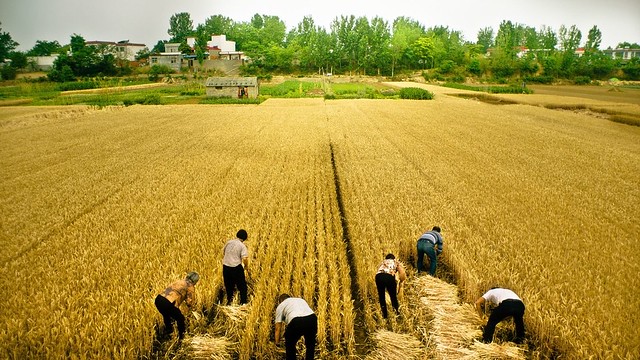
Jia starts the film by visiting his hometown Fenyang in Shanxi province. This is the region where the famous writer Ma Feng is from. He interviews the town elders who have been living in the region all their lives. They remember the deceased writer through the war against Japan and Russia and the Cultural Revolution. We get the glimpse of tumultuous Chinese history in rural areas through these interviews. As Chairman Mao's many initiatives, including marriage reform, the fabric of the society changed dramatically. Ma Feng's writing reflected these. 

Jia Pingwa, born in the 50 and from Shangluo, recounts his past: how his father's association with KMT was hard on his family and him getting a job. He tells how his good handwriting started his career, and how he was able to move to cultural bureau from doing physical labor. 'Returning to the place you grew up in, even though you are educated somewhere else' is the running theme with all four writers' life trajectories. It's something in the land that they grew up which Jia Pingwa describes it as 'blood land'. 

Then there's Yu Hua, born in the 60s in Haiyan, near the yellow sea. His anecdotal stories of trying to be a writer are often hilarious. He mastered his writing by reading handed-down books (banned during Cultural Revolution) that are missing front and back covers and often missing the end part of the book, so he had to imagine the endings himself. Growing up in rural community, he wanted to be somebody. After countless rejection letters, his writing finally caught an eye of a big time editor in Beijing. One of his books was To Live, one that got a screen adaptation treatment from Zhang Yimou in the 90s. 

Liang Hong, born in the 70s, is a writer and professor. Growing up in a big household in Liangzhuang, a small village in Henan province, she had to endure her mother's illness, her village people's prejudices (her father remarried after mother's death), and crippling poverty. Her work became synonymous with a case study for China's rural villages and migrant workers. In corresponding chapters (like a book, 18 chapters total), we get to hear about and from her family members, including her 14-year-old son. 

The title of the film is from Yu Hua's phrase, as he reminisces about his childhood. The sea is supposed to be blue in his school textbooks, but the sea near his house has been always yellow. 

As always with his films, Jia tells the story of changing times, migration and coming home. Added here is his love for literature. It's a big plus that all writers he features are gifted storytellers as much as he is. As an avid reader who is very concerned about the younger generation only capable of fragmented thoughts growing up with Twitter and Weibo, Swiming Out Till the Sea Turns Blue is not only a lamentation of the disappearing past but also an effective reading initiative campaign.

Monday, March 11, 2019

Interview: Jia Zhangke on Gangster Genre and Ash is Purest White

5dbf9a22b1e6441e379836ea00ac25da80b8caae
With his sprawling gangster epic melodrama Ash is Purest White opening this Thursday in New York, Jia Zhangke, the master chronicler of changing China, was in town and I was lucky enough to snag an interview. Spanning 17 years, Ash is a culmination of all of Jia's work, once again, starring his wife/muse, the great Zhao Tao in a performance that gathers more power and poignancy as the film goes along. The film ended up near the top of my favorite list for 2018 and everyone needs to see this beautiful film. So without further a do:

It seems you are going back to the long form storytelling with ASH IS PUREST WHITE, harkening back to your old films like PLATFORM or UNKNOWN PLEASURES rather than episodic storytelling of your past two films, A TOUCH OF SIN and MOUNTAINS MAY DEPART.


So first, thinking about doing a film about underworld (Jianghu), not only as a subject but as a genre. What attracted me about those jianghu films, is about the philosophy and their codes of conduct into personal relationship, cultivation of sense of loyalty. These are the values that I wanted to examine but did’t want to somehow pinpoint one particular era or one particular time pertaining my youth or contemporary time. What I wanted to examine was how these values and philosophy of the underworld evolved and changed and eroded in these long stretch of time so I can explore the connections between these- how it had changed and shifted to pursue wealth and power in the mainstream society. That’s the reason why I decided to not only narrating this particular underworld genre and motif but also long time span of 17 years in order for me to do so.

And another point of departure is I remember that when I was young and growing up in Shanxi Province, there was a big brother character, like a Brother Bin (Liao Fan of Black Coal Thin Ice) in the film in my own neighborhood. I remember that he was strikingly handsome and very masculine and well versed in cultivating that kind of personal bond and resolving conflict. He made a huge impression on me growing up. Later when I went back home from College I saw him middle aged, squatting by the street eating a bowl of noodles. All his underlings and brothers were gone. So I think that not only examining this particular underworld genre portrayal of how they evolved and how the values have been eroded, I also wanted to see how time change and change an individual such as this particular case the head of the gang and how this person changed internally but also externally in terms of appearance. How this face aged through time. Those are the two elements I wanted to examine.

It’s interesting you say that because the big part of the film belong to Zhao Tao’s character. In some strange magic she hasn’t changed not only physically but she had this inner strength and it’s her who goes to jail for and rescues Brother Bin at the end. She was the only one who was loyal to him all throughout those years. How did you come up with that character?

I wanted to make a comparison gender-wise in jianghu and also society in general. China is a very male oriented society and that kind of principles we used to have have changed. Male population seems to be more inclined to pursue those wealth and power and lose themselves in it. And on the other hand, the female population ironically are the ones holding on to those traditional values and cultures and those principles they didn’t lose. I wanted to create those contrast in current society. I’m not saying that the past was better. I‘m just showing what is changed in society.

The film is French co-production. How was working with the French crew?

In terms of collaboration with my french partner MK2, the distribution company which I worked with past 3 films. So I do think that gave me more options in terms of finding the talents and the people I can work with from the French side. For this particular film, the cinematographer was Eric Gautier collaborating with me for the first time. Sound mixers and also the hair and makeup were all french artists. In the past I tend to have a very close-knit crew from China. It was not so much about the funding and investment on the film that was important. It was more to do with creative team that I can pull from French side. I enjoyed a lot more that collaboration.

Was it a challenge to create that period in terms of production design?

The challenge was how to recreate this period that was seen in 2001. Because the people back in the day the way they look and their faces were completely different from how people look now. When doing the casting process I needed to make sure that I find the faces that had a bit of wear and tear, that show the ravages of time and hard work. They tended to have darker complexion and so on. Today’s young people, even if they are from the same province, same county, same hometown, they have a lighter skin tone with smoother surface - hamburger face that I constantly joke about- well-fed, well- nurtured and well protected in terms of sunblock and all that. So how I’m going to choose the right faces - actors and actresses and extras. So when I was actually positioning my main characters with all the makeup and movie magic, I was very concerned about how they would look believable so people will say yes these are indeed from 2001. So restaging of it was pretty challenging.

What’s interesting to me is that you are retracing your steps of your previous films be it Shanxi Province or Three Gorges Dam. How much have they changed since then?

So in terms of revisiting those places I previously shot my films in, instead of change of scenery that I witnessed that astonished me, it was how much it hasn’t changed for 17 years. For example, a lot of public spaces that were there are still standing, shockingly, compared with most of the 1st tier and 2nd tier mega cities- tend to demolish everything and restart completely. So the skyline would be completely different. Places like Datong and Three Gorges Dam, 17 years ago and when I made Still Life, many of the buildings and public spaces are still there and still very much the same. So many feels that as a country, China is a fast changing society and of progress. At the same time, it’s not balanced in urban city and in rural areas. So a lot of people are left behind and they never had a chance to catch up with mainstream progress that’s been so visible to the world.

Qiao (Zhao Tao’s character) in the first part of the film, when she bid farewell to her father at the train station and also the worker’s dormitory in the background - those were already there when I made unknown Pleasures in 2001, so I was so shocked. You see it a little weathered and can see the traces of time, but they are still there!

The question I had about Qiao is that she had a chance to leave everything behind and go west (Xinjiang) with this venture capitalist that she met on the train. But she doesn’t. I wonder about the choices that she made.

I think after breakup with her long time lover, she decides that it’s time to make a change, to break away from that past relations and trying to find the new one. It just happens to be this chance encounter with that person. It was almost like a very very short fling. But after that experience that she realizes that to go with him, to Xinjiang in this case, she would be removing herself completely from the underworld that she still very much see herself a member of. So she at the end makes the final decision. At the end of the film she says “I am jianghu and you are not.” She is actually telling this to Bin. It’s that spirit of jianghu she is abiding by, not any men.

You told me in 2014 that you might be doing a period piece about Chinese journeyman traveling West first, Europe and then South America. Is it still happening? If not, what’s next for you?

It’s not anywhere in preparation stage. It’s still one of the films I very much want to make. The next film we are preparing for is a period piece set in the late Qing dynasty. It’s going to be Wuxia genre film.

I am very much looking forward to that!


My review of Ash is Purest White

Friday, September 28, 2018

Jia Zhangke's Ash is Purest White is an Epic Melodrama at Its Finest

Ash is Purest White (2018) - Jia
Screen Shot 2018-09-22 at 10.22.58 AM
An epic melodrama spanning 17 years, Jia Zhangke's new film, Ash is Purest White, harkens back to the Chinese auteur's earlier films. I say this not just because it mostly takes place in Shangxi province (the director's home province where he made 3 of his early films), but also because he abandons the episodic/omnibus storytelling of Touch of Sin and Mountains May Depart, two of his last films. Instead, he concentrates on a long and arduous relationship between Qiao (Zhao Tao, Jia's long time partner in crime) and Bin (Liao Fan of Black Coal Thin Ice). Ash can be seen as the compendium of 48-year-old auteur's filmography and its 144 minute running time can feel like a slog at certain points. But it's one of those films that gains strength and poignancy over time and certainly is the future classic in the making. It's definitely his most mature film to date.

The film starts in Datong, the nothernmost area of the director's home province Shangxi. The year is 2001. Qiao is seen in full frame video shot footage instructing dance moves in a dance hall. With her bangs and youthful looks, this footage might as well be from Unknown Pleasures (which came out in 2001). She enters the majong parlor, and it's in 1:85 aspect ratio (they used several different formats for varying degrees of success). She is the squeeze of a local low level mob Bin, who runs a majong parlor. It's a dangerous business and there are competing younger mob factions ready to take him and his men down when given an opportunity. Times are a changing.

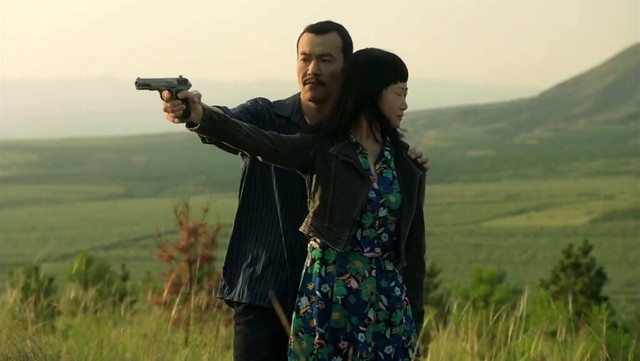
Bin brings Qiao to a field which saw volcanic activity thousands years ago, to teach her how to shoot a hand gun. It's an unregistered, illegal gun he acquired. The Chow Yun Fat-starring Hong Kong action movies had a bad influence on Bin and the rest of his generation. He mentions that the ashes from the volcanic eruption is the purest white, foreshadowing the rapid change in China, where anything old is demolished, buried or drowned for the new generation. A clean slate. A new beginning where no regrets, no tears, no sentimentality are allowed.

After a hit on Bin's crew sees him fatally attacked, Qiao fires the said illegal gun to save his life and is sent to jail for 5 years. Now it's 2006, and Qiao is out of jail and looking for Bin. He never visited her in jail and has moved to a town near Three Gorges dam. So this is where the road movie of Qiao starts: she meets various characters on the road/river with the rapidly changing nation in the background. The technology has changed appropriately, the fancy office buildings go up, all sorts of business ventures spring up. But people, the flood of people, trying to eke out the living with the changing times and circumstances, remain the same.

Bin, with a new girlfriend, refuses to see Qiao. Heart broken and with nowhere else to go but back to Datong, she almost agrees to go with a new venture capitalist whom she meets on the train, to the west. Decisions we make in our lives, good or bad, would lead to a different life than where we are right now. But how much can we deviate from our natural instincts, our traits, our character?

It's the New Year, 2018. Qiao finds Bin back in her life in Datong. He's had a stroke due to excessive drinking and is now a wheelchair bound. Qiao, who never married, silently takes care of him. He throws a fit sometimes, reliving his jianghu (underground gang) days in his head. She doesn't let him go off though. Is he ever going to change?

Ash is Purest White is a full-on (un)sentimental melodrama in epic scale. It's perhaps Jia's most down to earth, character study work. The long stretch in the middle gains more poignancy as the film goes along and afterwords. Some people reinvent themselves along with the changing times and some people don't. Some things in them though, remain the same. Jia expertly juxtaposes these conundrums, reflecting the soul of a changing nation. Ash is the Purest White is a deep and poignant masterpiece from a seasoned filmmaker.


Tuesday, June 21, 2016

You don't need to leave to see the world

The World (2004) - Jia
 photo 92adb5fd-3d5b-4aba-88c2-7a29f4907e9d_zps9b0spkfc.png
 photo d0862ea2-a217-4547-a439-8587737b6be8_zpslwrunl1q.png
 photo d08fdb31-652a-4a64-8dc4-5218bf056382_zpsqgjiyddp.png
 photo bd8a65b7-0ab9-44ed-a84b-e5bdc93b4daa_zpsznaiycif.png
 photo 3a1f70aa-5362-49ab-b701-e777e059c3ce_zpsgjxnjfd4.png
 photo d6469c56-0abb-45e6-8f3f-aa9b8f1206ac_zps8r4jkfzy.png
 photo 51103192-20df-438f-8855-7662a552e661_zpsmkm1726t.png
 photo bd854d94-7bd7-418c-a45c-3a2add8a32d2_zpsw7bik0sp.png
The World Park, a never ending expo/theme park in the suburbs of Beijing is the setting for Jia Zhangke's masterful take on, what else, rapidly changing China. The motto of the park is, 'you don't have to leave to see the world'. As usual Zhao Tao plays the central character Tao, a worker at the park, donning many different costumes- Indian, Japanese, African, etc and dance around on a brightly lit stage every night. All her friends and co-workers and would be lovers are transplants from rural China, trying to eke out a living any way they can. Jia patiently observes and explores every part of the changing society in episodic storytelling, reminding the viewers that behind all the garishness and excess, there are human stories hidden in there, obscured and overwhelmed by the 1/3 actual size Effel Tower, Arc de Triomphe, Piramides and camels and space ship-like karaoke bars. He leaves nothing unturned - a sad story of Russian prostitution, fake brand clothing manufacturers, construction workers working dangerous conditions for overtime pay and of course, some on/off love stories thrown in for good measure. This unhurried, soft, fine tuned, long film has many poignant moments that never turn corny. It's one of the best films I've seen in a long while.

Wednesday, March 2, 2016

Melancholy from the Future

Mountains May Depart (2015) - Jia
 photo 0f907ef7-86a4-484b-8524-c6d7c18e92cb_zpsbq6fvdue.png
 photo f1629f10-3e75-4821-be2e-5dd391d98254_zpsce9vk2ub.png
 photo 32b12622-125b-42a5-a216-d75186efda6d_zpsb4rbpxep.png
Mountains May Depart might be Jia's most melodramatic film to date, but it's any less great than his other films in chronicling the rapidly changing Chinese society. His hometown Fenyang in Shanxi Province is once again the backdrop - vast flat area of upturned earth and old ruins. His choice of three time period shot on different aspect ratio: full frame 4:3 for 1999, 16:9 for 2014 and anamorphic for 2025 isn't too distracting, gimmicky or overstated, simply because it's Jia Zhangke film. His muse/wife Zhao Tao might be a little too old to play 26 year old woman, so is Liang Jing Dong or Zhang Yi in the first part of the film. But it does make sense when you think about Jia's first hit Platform came out in 2000. Zhao was in her early 20s then, that the end of millennium was a big turning point for China becoming a global superpower/capitalism on steroids. That these actors have weathered the tumultuous time with Jia, that they are sharing that collective experience with the audience. It is more apparent with his use of music: from Pet Shop Boys' 'Go West' to a sentimental Canto pop, extremely popular in the 1990s in not only mainland China but all over Asia.

First segment tells a love triangle of childhood friends- both Jinsheng and Liangzi loves Tao. Jinsheng hit big and is a raging capitalist now and wants to get rid of the forever third wheel Liangzi for good. First he buys out the coal mine Liangzi works at and fires him. But his intentions are more sinister. Tao, experiencing confessions of love for the first time, chooses Jinsheng over mild mannered Liangzi. In the back of her mind, she knows she is making a bad choice but ends up marrying Jinsheng anyway. Liangzi ends up leaving Fenyang.

The second segment is set in present: Tao and Jinsheng are divorced. He got the custody of their son Dollar (I kid you not). The father and son live in Shanghai. Liangzi's got a lung cancer working in the mines and comes back home with his new born baby and a wife. Dollar comes home for Tao's father's funeral. The kid's wearing ascot for crying out loud. There are some bonding moments with Dollar and Tao but will he remember her at all?

The third one takes place in Australia, where Jinsheng and Dollar live. Dollar is a college student now, thoroughly westernized and doesn't speak a word of Mandarin. He is not happy about the school or life in general. There he meets an older Chinese professor, Mia (great Sylvia Chang) who becomes Dollar's surrogate mother of sorts. He experiences a sense of deja vu when he's with her. She encourages him to visit his long lost mother whose name he doesn't even remember.

I would describe Jia's melodrama, reflecting rootlessness and losing soul in a rapidly industrializing society, as something that Ozu might have considered making in the 60s. It's interesting to see that Jia foresees this rootlessness happening for the next generation of Chinese. It's like predisposed collective melancholy that will hit China like tidal waves in the near future. Poignant and sad, Mountains is another great film from the modern master.

Mountains May Depart is now playing at FSLC's Howard Gilman Theater. Please visit their website for tickets.

Friday, October 4, 2013

A Touch of Jia: Jia Zhangke Interview

 photo ea69187b-d643-48e6-b6bc-c2df29b981b3_zps14d5c59f.jpg
A Touch of Sin is an anomaly for Jia Zhangke. Or at least it feels like it. Known for his unique melding of documentary and fiction, observing China's transformation with critical eye and nostalgia, here he bases the film on four different recent news flashes. First half tells gritty, violent, senseless killing sprees, the second half turns a little giddy in its style with dramatic shifts. The fact that they are based on real events adds another layer to this sprawling, ambitious film. Interesting to note that Jia's version of real life events veers dangerously toward glossy fiction.

I had a privilege of talking to him on the phone while he was in town for this year's New York Film Festival.


First of all, congratulations on winning the best screenplay at this year's Cannes film festival. That said, knowing your documentary work and your documentary style, I am wondering how much of the dialog is actually written and how much of it was improvised.

On the script level, everything was very detailed including the dialog and lines for each character. Actually there are two different, distinct states that were shot within because the characters portray two different states.

Right.

The first one is this very natural, sort of quotidian, relaxed state. When I approached writing this aspect of the script, the dialog was more loosely written and I left some room for improvisation. But the other, the opposite end, there are very dramatic scenes in the film. For those scenes I needed the actors to stick to the script so they could prepare for the scenes. So I required them to stick very closely to the dialog that was written on the script.

Your films always have been reflections of rapidly changing Chinese society, but never really this explicit about death and violence. I wonder what made you to concentrate on that aspect in this film.

Because the violence is an issue in social reality in China that has been accumulating in the past 2-3 years in particular. I digest them via the social media- from microblogs and weibo(Chinese version of Twitter). I noticed that these events are very widely discussed and I wanted to portray this in my film.

The scope of your film has been getting bigger over the years. You were making films in Shanxi, your hometown, then you moved on to other cities- Chengdu, Beijing, Chunquing, then this film takes place in 4 different corners of china with 4 different stories. Is this your biggest production yet?

Yes. It was definitely the biggest and the most challenging one. The geography required us to travel four different locations. We were arranging things in a countryside separated by thousands of kilometers. We kind of joked that we indeed made four different films in one. For instance, casting we had to do four times, scouting locations, four times, and so on and so forth.

It was also an expression of the theme of migration in wuxia films. The theme that characters are always roaming around the country...peripatetic you could say. You can also notice it in traditional Chinese paintings that the landscape also conveys sense of movement. So there was an emphasis on landscape in this film.

Considering the scope of the film did it take longer to make than usual?

The entire production we spent about half a year and the principal photography was about three months.

The fantasy aspect of the film doesn't come out until Hubei story with Zhao Tao where things take interesting turns in terms of mood and rhythm. Was there a specific method on which order the film was going to play out?

The integral structure of the film rested upon two notable considerations: One is temporal - I structured the film temporally around the Chinese New Year. The first segment occurs during the lead up to the New Year where people are migrating. Second part happens during the New Year. The third part occurs after, where everyone travels back to work and the last part is after that. It's the time of the year when this mass migration happens in Chinese society.

The other consideration was that of geography - going from north to south. Four stories together formed a throughway in Chinese geography.

Along with the progression of geography, there is also the progression of drama. For instance, the emotional quality in each event filled with more intensity with each character. So when it reaches Zhao Tao's segment, the drama has expanded and accumulated in such a way that wuxia form begins to inhabit. At the same time it's set in a mountainous region where you tend to associate with wuxia imagery. So it was shot with thorough aesthetic consideration.

The English title A Touch of Sin is obviously a play on old wuxia film A Touch of Zen by King Hu. And you have already answered many of the connections this film has with wuxia. Are there any other connections that I'm missing?

There is one pertinent element, which is that I see King Hu films as political allegories. They portray individuals under duress in their surroundings and they need to fight back. So I find that these stories very much parallel the four stories I wanted to tell. Although times have changed, the connections between people have not necessarily changed so much.

I found it interesting that of all your films, this one, based on true events have the most stranger than fiction quality to it.

Yes. Although all the stories have their roots in the events that happened in the real world, when you consider the characters facing such extreme situations, perhaps the only way to depict this is through the imaginary.

Since your scope of the films is getting bigger, do you ever think about making films outside China?

Currently I am beholden to a project that have already taken six to seven years in preparation. It's set in China between 1800-1900, about the beginnings of modernization of China. I have another project that is set in 1950-60s about a Chinese journeyman traveling through the world- first China to Europe then Europe to South America.


A Touch of Sin has been garnering critical acclaim since it won the Best Screenplay Award at this year's Cannes Film Fest. After TIFF and NYFF screenings, Kino Lober is rolling out the film in theaters on October 4 in New York. Jia will be on hand for the opening night screening Q & A. For tickets, please visit IFC Center website.

Friday, September 27, 2013

Stranger than Fiction

A Touch of Sin (2013) - Jia
 photo 6c26c649-727b-4f61-a559-6e4972799419_zps6c982aa4.jpg
A Touch of Sin is an anomaly for Jia Zhangke. Or at least it feels like it. Known for his blend of documentary and fiction observing China's transformation with critical eye and nostalgia, here he bases the film on 4 different violent recent news flashes. 4 people resort to violence to express their discontent in 4 corners of rapidly changing China. It's an interesting one- first half tells gritty, violent, senseless killing sprees, the second half turns a little giddy in its style. The fact that they are based on recent news events adds another layer to this sprawling, ambitious film. In A Touch of Sin, Jia's version of real life veers dangerously toward glossy fiction.

A Touch of Sin plays part of this year's New York Film Festival. Showtimes and tickets, please visit FSLC website.