Showing posts with label Turkey. Show all posts

Sunday, February 16, 2025

Symbols

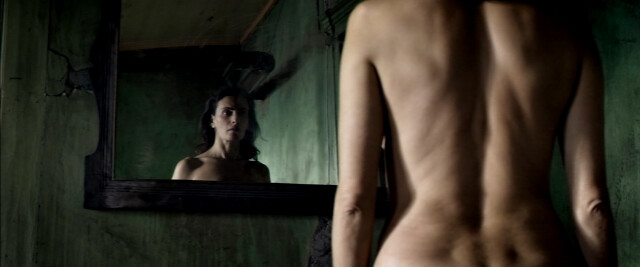
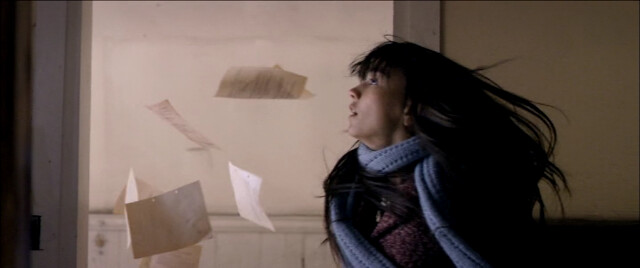
Hysteria (2025) - Büyükatalay HYS_mainstill-c-filmfaust-1 German filmmaker Mehmet Akif Büyükatalay's Hysteria touches upon sensitive subjects in modern day, multicultural Germany: racism and representation. The film plays out like a tense thriller until it morphs into a chamber drama where the identity politics within the immigrant community are dissected and hotly debated. Hysteria might not be as subtle as fellow Turkish descendent filmmaker Thomas Arslan (A Fine Day)'s work, or as flashy as Fatih Akin (Head-On)'s, but the film is more direct and piercing in dealing with the complex subject matter. The plot sometimes feels clunky and forced as it gets tangled up in its own intricate web, and the seemingly important loose ends don't tie up neatly by the end. But Hysteria is an anxiety inducing pressure cooker of a film that concludes with the literal fiery end.

Hysteria starts with an arson, a staged one: it is revealed in a long zoom out that the house being torched is in a giant film stage. The film director Yigit (Serkan Kaya) interjects and gives the context to the image - it's the reflection of the arson attacks that took place in Germany in the 90s by the ultra right-wing groups against Muslim immigrant communities that killed hundreds of innocent people. What Yigit is trying to capture is immigrant non-actors’ emotions, going through the aftermath of the arson attack. These extras are culled from a local refugee center for authenticity's sake. After the shoot, it is revealed that the copy of Quran is burned along with other household items during filming and some of the extras are upset. One of them, Majid, walks off the set. So, the driving duty falls on a young and eager intern Elif (Devrim Lingnau). She has to drive extras back to the refugee center and drop off the film negatives (the project is shot on film) to an apartment that belongs to the film's producer Lilith (Nicolette Krebitz) who is also well known, respected filmmaker herself.

Elif has a healthy discussion with the extras about what the project is about on the way back to the refugee center. Mustafa (Aziz Çapkurt), himself a theater director back home, thinks Yigit is just perpetuating the victimhood on screen, which has been long prevalent in German cinema - so called "Gasterbeiter (Guestworker) Cinema" or "Cinema of Duty" of the 70s and 80s. These are the films the white liberals can have their conscience clear and make them feel good after viewing. Others disagree, including Elif, a university student with a Turkish immigrant father, who thinks the film is saying something important.

After Elif drops them off, she arrives at Lilith's but realizes that she lost the keys to the apartment. After calling a locksmith, she places several fliers about missing keys around the neighborhood. But she conceals the lost key incident to Lilith for some reason. This little deceit snowballs into full blown paranoia when she gets text messages about the lost keys from a stranger. The texts, with bad grammar and their profile picture and their social media linked to some scary looking Muslim extremist group, Elif, sufficiently freaked out, calls Said (Medhi Meskar), a young immigrant who was an extra in Yigit's film and tells him what's been happening. When Yigit and Lilith come back, to Elif's dismay, they find the footage that contains the burning Quran is gone. Someone broke into the apartment and lifted the footage. Yigit, furious and suspects the extras and calls cops on them. Mustafa, Said and Majid all deny any involvement in wrongdoing.

Lilith, who wasn't fan of the footage and in fear of controversy, convinces Yigit to file a theft insurance claim and reshoot the scene without Quran. The problem solved. But for Elif, the problem is far from solved. She confronts Lilith and Yigit with Mustafa, Said and Majid, and asks for an apology. This is where things get a little shaky in terms of narrative contrivances. While I appreciate the need of seeing frank discussions about how people perceive others and others perceive themselves, class disparities, 'write what you know,' etc., but nothing really gets sorted out in Hysteria. The jarring tonal shift, untied loose ends, underdeveloped motivations and obvious symbolism (not only Quran but actual negative film catches fire at the end) devolve into a melodrama. Büyükatalay has a knack for making an anxiety inducing thriller. But issues don't necessarily get solved themselves even when they are screamed out loud for everyone to hear.

Tuesday, February 20, 2024

The Novelist's Films: The Cinema of Nuri Bilge Ceylan

Ceylan The latest film by Turkish film director, photographer, screenwriter, Nuri Bilge Ceylan, About Dry Grasses is three-plus hours of novelistic contemplation on human conditions in a stunning rural East Turkey backdrop.

Among the best Turkish New Wave directors, along with Reha Erdem (Times and Tides, My Only Sunshine) and Semih Kaplanoğlu (Honey, Commitment Hasan) Ceylan built a reputation as the world's most novelistic filmmaker, with deliberately slow pacing, long takes and themes steeped in vagaries of human existence, in often beautiful rural and urban settings in Anatolia and Istanbul. Indeed, experiencing each of his films is similar to reading a great thick book. And it's deeply satisfying, every time.

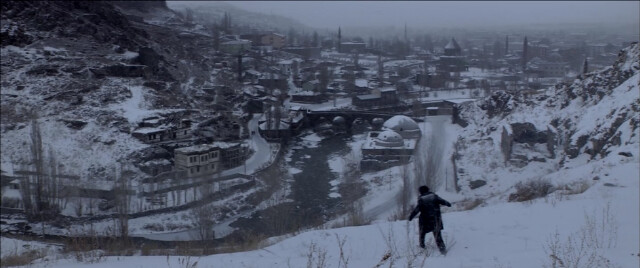
Ceylan studied engineering in school, then became a photographer: it is apparent that he has an eye for landscapes as you watch his films. Consider the snowy streets of Istanbul in Distant, ancient ruins on a hot summer day in Climates, the winding mountain roads from above at dusk in Once Upon a Time in Anatolia, the icicle covered resort in Winter Sleep, and snow-capped mountains in About Dry Grasses, just to name a few. And there is always a cinematic showstopper in every one of his films that makes your jaw drop.

Yet, it's his juxtaposition of close-ups of the faces and their surroundings that gives meaning to his work. We humans exist among those spectacular places, with our jealousies, greed, lust, pride and other qualities intact.

With his wife Ebru Ceylan as a writing partner on most of his films, along with actor/physician Ercan Kesal (Three Monkeys, Once Upon a Time in Anatolia) and actor/teacher Akin Aksu (Wild Pear Tree, About Dry Grasses), he sketches out great, lived-in melodramas like no other.

Within the generous running time -- since Anatolia's comparitively modest 155 minutes, the runtime of Ceylan's films are more than three hours -- we get to know every main character in an intimate way with their faults and weaknesses, as well as their redeemable qualities. We get to live with them, like a main character in a great thick novel, at least a short while in darkened theaters. With Winter Sleep, the Palme d'Or winner 2013, adapting Anton Chekhov's play, The Wife, Ceylan explicitly let his audience know where his influences originate and where his interests lie thematically, while not sacrificing his cinematic playfulness.

About About Dry Grasses: Screen Shot 2024-01-23 at 3.29.12 PM Screen Shot 2024-01-23 at 3.29.52 PM Screen Shot 2024-01-23 at 3.34.36 PM Screen Shot 2024-01-22 at 4.19.55 PM Screen Shot 2024-01-22 at 4.26.07 PM Screen Shot 2024-01-22 at 4.54.37 PM Screen Shot 2024-01-22 at 2.01.27 PM About Dry Grasses deals with the usual Ceylan themes: how to live within your environment without making your surroundings a personal living hell.

Samet, our protagonist, skillfully played by Deniz Celiloglu, is a teacher in a small rural village, returning from the summer recess. He is counting the days until he is to reassigned and out of rural living, after the government's mandatory assignment period ends.

He is easily irritable and self-centered. Overall, he is not a likable character, like many other of Ceylan's male protagonists. All three principal characters -- Samet, Nuray (Merve Dizdar, Best Actress at Cannes 2023), Kenan (Musab Ekici), and Sevim (16-year-old Ece Bağcı) -- are exceptionally great.

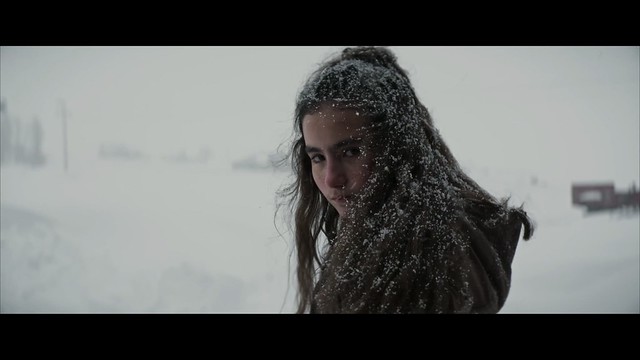
There are many great moments in the film but one showstopper comes in late in the third act of the film. After accusations of inappropriate behavior with the students quiet down, Samet's favorite student Sevim poses for him outside school in the snowy field, as he is an amateur photographer.

It's the closeup of Sevim's face, where Samet sees betrayal, lies and vengeance, while the audience sees innocence, beauty and indifference. While self-absorbed Samet might not realize, but we do, that it's our projection on others that makes our lives miserable.

Also, it is the first time in a long while Ceylan plays with the film medium. He used non-professional actors until the mid-2000s. He even starred along with his wife Ebru in Climates as a fictional couple in a tale of disintegration of a marriage shot on digital video.

If the run of Anatolia, Winter Sleep and The Wild Pear Tree gave the impression that the Turkish auteur is just making wordy filmed plays in a spectacular setting, About Dry Grasses will surprise you. There is a third-wall breaking scene in Grasses, where Samet and Nuray get intimate after being drunk.

The camera follows Samet to the bathroom, then out the door to a film set in a lot, revealing that the tiny apartment filled with trinkets of Nuray's life is indeed a film set, which takes you out completely from the film narrative. It gives you a sudden jolt that all the characters' lives, their thoughts and intimate details and blemishes that you invested in for the last two hours, are indeed a fiction. That now you can take a breather and reset.

With About Dry Grasses, we are witnessing a great, mature filmmaker paving his legacy as a novelistic filmmaker with a visual flair in the league of Tarkovsky and Bergman.

About Dry Grasses enjoys its U.S. premiere Friday, February 23, at Film Forum in New York City.

My review of Once Upon a Time in Anatolia (2012)

My review of Winter Sleep (2014)

My review of Wild Pear Tree (2018)

Sunday, January 12, 2020

How Turkish German Immigrant Experiences are Shaping Post-Wall German Cinema

How Turkish German Immigrant Experiences are Shaping Post-Wall German Cinema:
Fatih Akin’s Head-On and Thomas Arslan’s A Fine Day

Turkey & Germany
Image Ralph Peters

        November 9th, 2019 commemorates 30 years of the fall of the Berlin Wall that effectively ended the Cold War. After the fall, the unified Germany has become the global powerhouse not only economically but politically and culturally as well, with Berlin as its center once again. With the influx of migrants from the global south flooding into the country, caused by political instability and economic hardship, the face of the German society is very different now, where 15 percent of all German population considers themselves immigrants, than almost 60 years ago when the wall first went up across Berlin. The post-wall German cinema with works by directors like Thomas Arslan and Fatih Akin not only reflect this change, but invigorate the whole German cinema which has been laying stagnant since the New German Cinema of the 70s and 80s. 

        The Berlin Wall, built by the German Democratic Republic (GDR, also commonly known as East Germany), to prevent the East Germans fleeing to the West, effectively cut off the flow of manual workers needed for economic revival after the devastation of WWII. West Germany (FRG) then signed a series of bilateral labor recruitment agreements with other countries, including Turkey, on the guest workers program. I thought it would be imperative to examine the history, especially of west Germany, in order to understand how Turkish German experiences are shaping the post-wall German cinema in the new millennium.

Screen Shot 2020-01-12 at 9.23.09 AM
        Two films by two filmmakers I am concentrating on are Fatih Akin’s Gegen die Wand/Head-On and Thomas Arslan’s Der schöne Tag/A Fine Day. I chose Akin and Arslan because they both are second generation Turkish Germans who came of age and start practicing their film craft in the post-wall 1989 Germany, to be precise, Arslan, since 1990 (19 Portraits) and Akin (Sensin- Du bist es), 1995. Even though they both are regarded as practicing hybridity- where they have experienced both Turkish and German cultures and move as freely between them in their craft as possible, they occupy very different areas in German motion-picture industry. I will examine how the representation of Turkish Germans in German cinema evolved through the years and investigate how their culture is contributing to the revival of the German cinema and also reflecting their uneasy relationship within the now-unified Germany. But my inquiry is not a complete picture. Head-On came out in 2004 and A Fine Day was released in 2001. Since then, many things have happened and both Akin and Arslan made other films. These films are snap shots of what was then, early turn of the millennium, and might not reflect what’s currently happening. This inquiry will need a postscript at some point.

        Germany signed labor agreement with Turkey in 1961, the same year the Berlin Wall went up. It was meant to be a guest worker arrangement that soon proved to be neither practical nor profitable for the corporations. Many migrant workers stayed after two-year term and later brought their family in to the country. There are close to 4 million estimated Turks, including ethnic minorities from Turkey, currently living in Germany, a country of 80 million. That’s roughly 5 percent of all population. Germany holds the most concentrated Turkish population outside Turkey. Even though their almost 60 year presence in the country with its government repeatedly trying to join the European Union since the 80s, their immigration status and path to citizenship were in constant limbo until 1999, when the Citizenship Law finally granted the descendants of the first wave of migrant workforce in the 60s and 70s to become citizens, whereas descendants of German blood (having either of German parent)- Russian Germans and Eastern European Germans were automatically granted citizenship. In many ways, the post wall Germany brought out in the open the fragility of its perceived cosmopolitanism and multiculturalism that FRG strove for. 

Ali
        The first wave of Turkish German cinema of the 70s and 80s were mainly domestic dramas or about the problems of the guest worker (Gastarbeiter) by directors identified with New German Cinema. Getting their inspiration from French New Wave and British New Wave, New German cinema strove for reflecting politically and artistically meaningful subjects and rebuffed the standard film production process. Its directors such as Alexander Kluge, Harun Faroki, Werner Herzog, Wim Wenders, Rainer Werner Fassbinder and many others whose films projected their frustrations over artistic and political stagnation in the midst of the economic miracle on the backs of migrant labor. This “Gastarbeiter cinema” was that of “cinema of duty”, drawing on a social realist tradition and relying on ethnic stereotypes, used empathetic identification to promote social reform and political change. They “mostly involved overdetermined figure of the suffering and entrapped Turkish woman, a key witness in both feminist critiques of patriarchy and liberal arguments for secular democracy.” Examples of this period of Turkish German cinema would be Helma Sanders-Brahms’s Shirin’s Wedding (1976), Yimaz Güney’s Baba (1971) and Hark Bohm’s Yasemin (1988). But it’s impossible not to mention Rainer Werner Fassbinder’s Ali: Fear Eats the Soul (1974), when talking about the immigrant experience in Germany, especially for the fact that Fassbinder’s original intention was to call the film “All Turks are Called Ali”. But instead a Turkish protagonist, wanting to give the starring role to El Hadi ben Salem, a Moroccan immigrant, who was his lover at the time, it became Angst essen seele auf/Fear Eats the Soul. Faithfully borrowing the storyline of a classic Hollywood melodrama, All that Heaven Allows (1955, dir. Douglas Sirk), Fassbinder criticizes postwar racism as a continuation of the Nazi past and also reifying the stranger as an object of orientalist fascination, while playing with traditional gender roles. Emmi (played by Bridget Mira), an elderly cleaning woman, meets a good natured Moroccan guest worker, falls in love. Their improbable love is tested by racism and general social condemnation. There’s also a sexual politics and power dynamics at play. Just like many protagonists of the cinema of duty, Ali can be seen as the prime example of an enlightened victimology. But however invigorating and thought provoking New German Cinema movement appeared to be, its legacy, made up a handful of internationally revered auteurs, was overshadowed by its financial failure and the fact it was mostly ignored domestically in favor of commercially viable albeit mediocre films. With strong influence of private and public television companies and proliferation of home videos, the enthusiastic spirit of New German cinema had died out by mid-80s. 

        What came after that was so called “cinema of consensus”, termed by scholar Eric Rentschler. He argued that the vast majority of German film productions in the nineties consisted of light fare meant to please and placate audiences. This trend toward uncomplicated storylines with agreeable resolutions was all the more prominent if one compared German cinema of the nineties with that of the seventies. Rentschler applauded New German Cinema directors who in the seventies “interrogated images of the past in the hope of refining memories and catalysing changes.” By contrast, Rentschler saw contemporary German cinema as lacking “oppositional energies and critical voices.” He mentions exception to this cinema of consensus, “offbeat voices and less reconciled visions” of directors like Tom Tykwer, Fatih Akin, Rosa von Praunheim, Ulrike Ottinger and Harrun Farocki, who made “less visible films with a historical ground, a post-national sensibility and a critical edge.”
Head_On_24
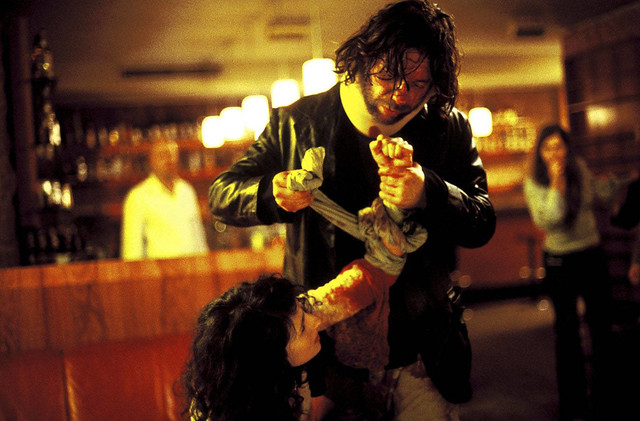
        Fatih Akin is the prime example when considering the shift in filmic sensibilities from “cinema of duty” to the “pleasures of hybridity” Born in Hamburg in 1973 to Turkish immigrant parents, Akin went to University of Fine Arts of Hamburg to study Visual Communications and graduated in 2000. He grew up watching countless films on VHS tapes, both Turkish and Hollywood cinema, professes his love for Scorsese. His debut feature, made while he was still in school, Kurz und schmerzlos (1998) was said to have “represented New German-Turkish Cinema.” His films contributed to a street culture known as Kanak - first used as a derogatory term for Turks and other Arab countries’ immigrants in Germany, later became a normal colloquial term for Turkish Germans and used as self-identification. His kinetic and visceral films, mostly concerning second generation of Turkish immigrants and bonds between immigrants from other countries living in Germany became a commercial and critical success. But it was his fourth feature Gegen die wand/Head-On (2004) that really pushed him to be the face of contemporary German cinema. It won numerous awards, including Golden Bear at Berlin Film Festival, Best Film and Audience Award at European Film Awards and Best Foreign Film at the National Board of Review in 2004, while directly dealing with the theme of the Turkish-German experience, albeit secular. It grossed 14 million USD at the box office. But when we talk about the perception and marketing of Fatih Akin in the German press, his films are treated as still the ones of cultural in-betweenness, not the cultural hybridity and transnationalism. Head-On follows heavily on the tradition of melodrama - explosion of emotions with larger than life characters. It deals with many of the societal taboos - sex, drugs and suicide that are normally seen as opposite in a traditional, family oriented, patriarchal immigrant community. The film is a head on collision with these familial concepts. It’s a fatalistic love story of two suicidal individuals who happen to be of Turkish descent. Cahit is a heavy drinking widower who crashes his car into a wall, and Sibel is a young woman who is trying to get away from her traditional, patriarchal Turkish German family by slitting her wrist. They meet at a mental hospital. Sibel has a proposition - she wants him to marry her in order to free herself from her traditional family. And because he is a Turk, they will consent. For this fake marriage, she will cook and clean the house and they can see other people in the meantime. After her dramatic second suicide attempt, Cahit gives in, and their strange romance starts. It’s Sibel’s presence in Cahit’s life that gives him meaning to continue living. But Cahit kills a man one day to protect the honor of Sibel and goes to jail and Sibel moves to Turkey to start a new life. And It’s her retreat to Turkey that ultimately connects Cahit to his forgotten Turkish roots for the first time.

        In the world of Head-On, Germany in mid-2000s, Hamburg to be exact, there are no Germans treating Cahit or Sibel any different because they are Turkish descent. Cahit doesn’t even speak Turkish very well. Only their names give away their backgrounds. In a funny scene, a German psychologist asks what the meaning of Cahit’s name is. Cahit, completely perplexed by the question, asks back why. The psychologist tells him that all “their” names mean something, something beautiful, deep and profound. Cahit tells the smiling doctor that he is completely nuts. Germany in 2000s is seen as secular, transnational society where Turkish Germans freely question the possibilities of simultaneous transnationalism and rootlessness. 

        The Berlin School is perhaps the most significant film movement in Germany since the New German cinema of the 70s. The first wave of film directors it produced were Angela Schanelec, Christian Petzold and Thomas Arslan. First coined by film critic Merten Worthmann in describing Schanelec’s Passing Summer (2001) and later that same year by Rainer Gansera in his review of Arslan’s A Fine Day (2001), the Berlin School is loosely connected group of filmmakers (the second wave of Berlin School directors don’t necessarily come from DFFB) who are countering what mainstream German cinema has become - the cinema of consensus. Working in each other’s projects and constantly in communication through interviews and publications (Revolver - an influential film magazine, founded by the second wave directors of the movement, Christophe Hochäusler and Benjamin Heisenberg, which gave the Berlin School its further legitimization) in the industry. Their films are not easily defined and can’t be readily be explained with few words but the main theme these filmmakers are grappling with in the post-wall Germany is “sehnsucht” (longing)- a longing for Deutschland that never materialized under neoliberal capitalism. The Berlin School, in effect, is ‘reseeing’ Germany without being tied to its war past, without exploiting history. It’s the ‘here and now’ of unified Germany.
A Fine Day
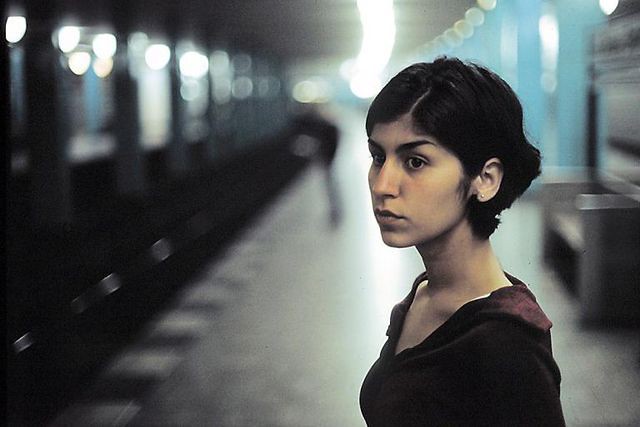
        Thomas Arslan was born in 1962 in the north-central German city of Braunschweig, to Turkish immigrant parents. He went to an elementary school in Turkey, but lived his formative years in Germany, studying German literature and eventually ending up in DFFB: Deutsche Film- und Fernsehakademie Berlin/The German Film and TV Academy Berlin. He has said in interviews that Godard, Bresson and Rossellini’s works have influenced him. At a glance, by virtue of his ethnic background is cast as being concerned with the representation of (ethnic) identity. With nine feature films under his belt, he is best known for his later termed “Berlin Trilogy”- Brothers and Sisters, Dealer and A Fine Day, chronicling the lives of young Turkish Germans in Kreuzberg section of Berlin. I chose A Find Day (2001) because the first two of the trilogy might mark the shift from a ‘cinema of the affected’ to a ‘cinema of hybridity’, but their protagonists continue to “struggle with the similar problems as their predecessors in the Gastarbeiterkino,” whereas in A Fine Day, Deniz, its protagonist, at a glance, doesn’t seem to be afflicted with the immigrant’s blues. In the film, we follow Deniz, a young Turkish German woman living in Kreuzberg, Berlin, as she takes public transportation and walks around the town to meet her friends and family, to go to work, to get around in general. She navigates briskly and confidently around town. The film is devised as one day in the life of… story. She breaks up with her boyfriend, attends her job as a voice-over actress, does her laundry at her mother’s, hangs out with her successful architect sister who is briefly in town, lectures young neighborhood kanaks who whistled at her and starts flirting with a neighbor. Nothing dramatic happens. Everything is almost documentary-like. Yet, with deliberate camera movement, Deniz’s gaze, gestures and seemingly trivial things that are said in conversations, one can detect Deniz’s isolation and loneliness and explains many of the symptoms of integration problems the right wing politicians like to talk about after almost 60 years of assimilation. Even though it is the new millennium and the second or third generation Turkish Germans have gained their rights to their eventual citizenship, their identity, their sense of being German is shaky. Arslan simply demonstrates this fact in a single scene in the beginning of the film where Deniz breaks up with her German boyfriend - she walks into a cafe to meet her boyfriend. during their conversation, which is over the shoulder shot of Deniz, the camera dollies over to the other side of his shoulder, breaking the 180 degree law for coverage and completely changing the audience’s point of view of Deniz. Then the camera reverts back to the original position. Is she as confident as she presents herself? Are we seeing the other side of her? The whole reality is shaken. Her cosmopolitan existence may not be as solid as it presents itself to be. If not Deniz herself is struggling with traditions, it is shown through her Turkish mother’s dilemma - she is widowed a while ago. But to honor the memories of her late husband, she says she would never be in another relationship, even though Deniz reminds her that she is still young and can remarry. She chastises her mom for being old fashioned. Just like many of Arslan’s protagonists, Deniz hardly shows any emotions. There is something definitely missing in her life. Her rootlessness is shown in many different occasions throughout the film. Arslan cleverly suggests through her being an actress, that she can or pretends to be any body- Deniz is told to be a little more emotional when she is in a dubbing session, for Eric Rohmer’s Summer’s Tale, in German. Whatever she is yearning for, she tries to find it in other people. Her gaze is not that of romantic gaze in Rohmer movies. Her gaze is searching kind, trying to find a stability, in a place, in a person, in a culture. 

        Like in Akin’s films, there is a solidarity among other immigrants, Deniz flirts with a young man from Spain. She might have some common understanding with the Spaniard, but she doesn’t find what she is looking for in him either. Arslan suggests in the smallest ways the fragility of the secularism for the Turks living in a supposedly cosmopolitan country. The fall of Berlin Wall in 1989 and difficulties of German reunification undermined the public commitment to diversity and gave way to a period of unprecedented rightwing violence that began with attacks on asylum seekers and contract workers. Then the violence of 9/11 and its worldwide reverberation – London and Madrid bombings, changed the dynamics again. I dare say that in a very subtle way, A Fine Day was not only reflective but prophetic in seeing these changes and uncertainties in German society. 

        The Berlin School might be well known in festival circuits and film academia, but it shares not only the spirit of the New German Cinema but the burden of being a financial liability. An interview with Christoph Hochäusler reveals as much: 

“Of course the implication of the label is sometimes harmful. For example, when it comes to financing a film I've heard many times that they say 'we don't want to finance the Berlin school films'. Because the industry is full of expectations - 'they (the Berlin school films) are too slow' or call it whatever else you can think of when you don't like something. So there is always a problem being labeled like that.”

        Both Akin and Arslan had made several other films since Head-On and A Fine Day. They have moved on from films with Turkish protagonists and expanded their palettes. Akin directed another acclaimed searing melodrama of forgiveness and redemption with Turkish protagonists in The Edge of Heaven (2007) and revenge thriller In the Fade (2017) with the international star Barbara Kreuger in the lead role who is avenging her Kurdish-German husband’s death in neo-nazi attack. Most recently he directed a serial killer movie based on a best selling novel, The Golden Glove (2019). Arslan, like the Berlin School comrades, namely Christian Petzold and Christoph Hochhäusler, delved into genre filmmaking. In the Shadows (2010) is his no nonsense thriller of the highest order, with an Eastern European hitman protagonist operating in Germany. Then he did a Western, Gold (2013), starring Nina Hoss, a Petzold regular, about German prospectors in British Columbia in the 19th century. Recently he did Bright Nights (2017) which was shot in Norway. It is about an Austrian man’s road trip to re-tracing his father’s past who just passed away. 

        A lot has happened in the last two decades. Arab Spring, terror attacks, ISIS, Syria and its refugee crisis put a lot of pressure on European Union to reassess their immigration policies. We are living in an unprecedented political, economical, environmental crises world wide. The rise of nationalism in many European countries, including Germany can’t be ignored. The future seems all but uncertain. Germany has undoubtedly benefited from its Turkish immigrants, economically and culturally. But we are living in a different world than 20 years ago. If Akin reflected the pulse of the cosmopolitan spirit of 2000s Germany, Arslan showed the reflection of that fragile cosmopolitanism and somehow predicted its uncertain future. 


Sources Consulted

Abel, Marco. The Counter-Cinema of the Berlin School. Boydell and Brewer, 2013: 31-78

Baute, Michael, Ekkhard Knrer, Volker Pantenberg, Stefan Pethke and Simon Rothhler. “The Berlin School - A Collage.” Senses of Cinema, Issue 55 (July 2010)
http://sensesofcinema.com/2010/feature-articles/the-berlin-school-%E2%80%93-a-collage-2/

Bennhold, Katrin. “Germany Has Been Unified for 30 Years. Its Identity Still Is Not,” New York Times, November 8, 2019

Gueneli, Berna. Fatih Akin's Cinema and the New Sound of Europe. Bloomington, Indiana: Indiana University Press, 2019

Hake, Sabine, and Barbara Mennel, eds. Turkish German Cinema in the New Millennium: Sites, Sounds, and Screens. NEW YORK; OXFORD: Berghahn Books, 2014

Hoad, Phil, “Continental drift,” The Guardian, February 14. 2008. https://www.theguardian.com/film/2008/feb/15/worldcinema

Hochhäusler, Christoph “Interview: Christoph Hochhäusler On The Lives of Victors And Dangers Of Being Labeled.” by Dustin Chang, Screen Anarchy, April 13, 2015. Web Magazine. https://screenanarchy.com/2015/04/interview-christoph-hochhausler-on-the-lies-of-the-victors-and-dangers-of-being-labeled.html

Martin, James P. "Crossing Bridges/Crossing Cultures: The Films of Fatih Akin." South Atlantic Review, Vol.74, No. 2, 2009: 82-92

O’Brien, Mary-Elizabeth. Post-Wall German Cinema and National History: Utopianism and Dissent. Boydell and Brewer, 2012

Roy, Rajendra and Anke Leweke. The Berlin School: Films from the Berliner Schule. Museum of Modern Art, 2013

Takenag, Lara. “I Will Never Be German: Immigrants and Mixed-Race Families in Germany on the Struggle to Belong,” New York Times, November 8, 2019

Sunday, December 2, 2018

Literary Cinema

The Wild Pear Tree (2018) - Ceylan
Screen Shot 2018-12-02 at 4.03.36 PM
Screen Shot 2018-12-02 at 3.46.12 PM
Screen Shot 2018-12-02 at 3.47.41 PM
Screen Shot 2018-12-02 at 3.48.40 PM
The Wild Pear Tree is yet another Nuri Bilge Ceylan's leisurely paced, literary filmic experience. Just like his previous efforts, Once Upon a Time in Anatolia and Winter Sleep, it starts out slowly and you don't know where it's going exactly. The film is basically a post-college blues movie where the young protagonist is excessively downtrodden and cynical. It provides some Ceylan-ian visual showstoppers in beautiful rural Turkey setting, again sumptuously lensed by Ceylan's long time collaborator cinematographer Gökhan Tiryaki. Watching The Wild Pear Tree feels like, as always with Celyan's films, reading a dense, good book, filled with rich characters and delicious philosophical musings.

Sinan (Dogu Demirkol) is a young man who just graduated from college wanting to be a writer. He just came back home to his parents in small rural town. He has some decisions to make - does he get some silly job in town writing travel brochures or does he go to mandatory military service and delay entering the adulthood a little bit longer? His schoolteacher father Idris (Murat Cemcir) is squandering all his money on gambling, and digging a well where the water never comes, while annoying everyone around him with his stubbornness.

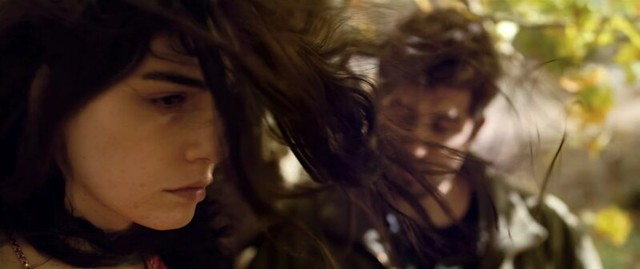
A showstopper comes early with Hatice (Hazar Ergüçlü), Sinan's High School sweetheart, not sure about her impending marriage to an older man which will surely guarantee a safe but boring life. They converse under a leaves-turning tree and share a forbidden kiss. The whole sequence, as the golden autumn sunlight bathes the young lovers and the wind caresses and ruffles Hatice’s raven hair every each way – is stunning.

There are two very lengthy conversation scenes that shows Sinan's world view - one with him confronting a successful local author at a bookstore. Half jealous and half resentful, he questions the author's legitimacy of success. Later in the film, Sinan follows him the author along the docks of the coastal city of Çanakkale to harass him and almost ends with a physical confrontation in which the author accuses Sinan of "callow excess of young heart".

The other one shows him getting in to testy discussion with two young imams about interpretations of Koran and the religion's place in the modern world. Obviously, the young man could do without faith.

Balancing petty earthly matters (his family dynamics – long suffering mom, feisty younger sister and of course the no good dad) and the philosophical musings and steeped in metaphors, The Wild Pear Tree plays out like a thick Russian novel. Murat Cemcir deserves a recognition for his portrayal of Idris, a dreamer and a gambler whose self-deprecating humor, goofy chortle and occasional otherworldly wisdom, is right out of a Dostoevsky novel.

The Wild Pear Tree is that rare film that captures the trial and tribulations of a young person who is intelligent enough to be both self-aware and pessimistic. His disdain for his father and the older generation obviously stems from his disenchantment about the dim future prospects that awaits him. The film's title is also the title of Sinan's book, which is supposed to be an honest observation of humanity filled with colorful characters. Therefore we realize unceremoniously that his book is actually what we’ve been watching. Wild Pear Tree is yet another rich, resonant film from Ceylan.

The Wild Pear Tree opens 1/30 at Film Forum, New York

Monday, October 23, 2017

Memory Mystery

L'Immortelle (1963) - Robbe-Grillet
Screen Shot 2017-10-23 at 7.11.06 AM
Screen Shot 2017-10-23 at 7.12.26 AM
Screen Shot 2017-10-23 at 7.13.13 AM
Screen Shot 2017-10-23 at 7.16.23 AM
Screen Shot 2017-10-23 at 7.18.30 AM
Screen Shot 2017-10-23 at 7.29.50 AM
Screen Shot 2017-10-23 at 7.25.05 AM
Screen Shot 2017-10-23 at 7.23.33 AM
Screen Shot 2017-10-23 at 7.30.46 AM
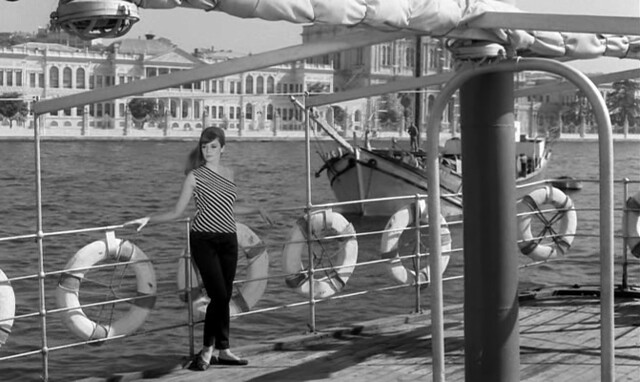
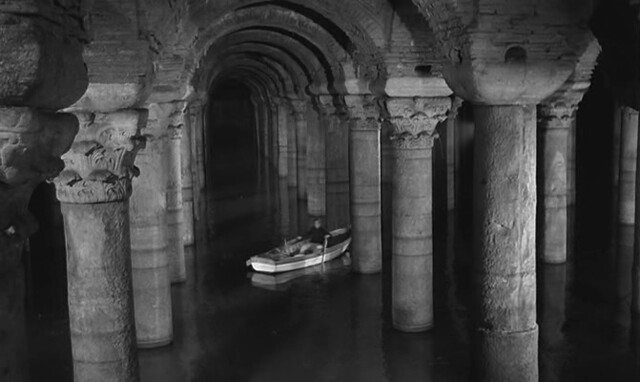
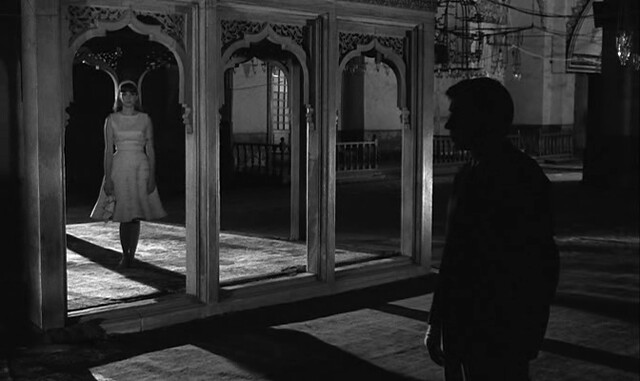
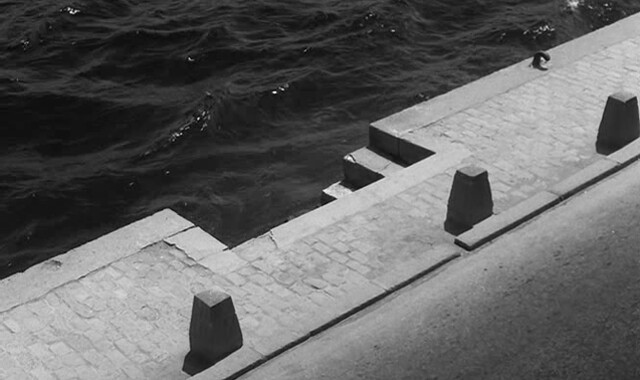
More so than Robbe-Grillet scribed Last Year at Marienbad, L'Immortelle plays with the images and its hidden meanings. In Robbe-Grillet's world, every ordinary gesture, pose, object resonates to its nameless protagonist, and in time, to us. A pair of woman's sandals, a caress of a neck, a view from a window - every shot becomes iconic and powerful.

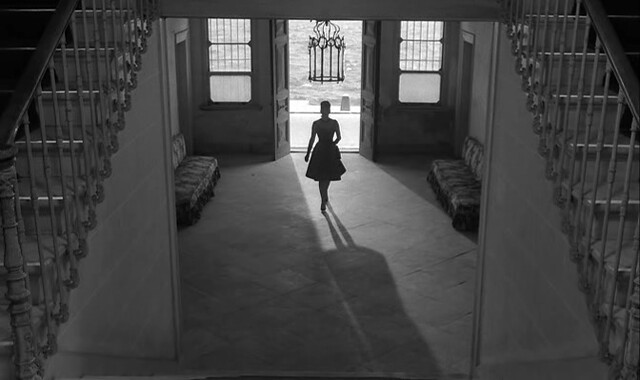
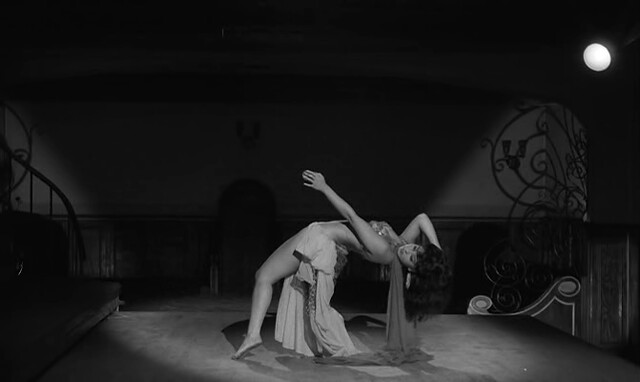
It tells a story of a French teacher in Istanbul, just arrived and don't know the language or custom of the locals. He meets a mysterious, beautiful woman (Françoise Brion), who wouldn't divulge anything about her - address, profession, not even a name. "It's the mosque of your dreams," she says as they pass by the famous New Mosque by the water on a boat, suggesting that what he sees and perceived as reality might be all but an illusion. She interacts with the locals in their native tongue in front of our frenchman. But when asked, she plays innocent, pretending she didn't understand a thing they said, keeping him in the dark. But we as an audience understand the exchanges via subtitle. After some intimate days, she disappears. Left only with the memories of her, he takes a detective role to find her or rather, to find about her. But since he doesn't know the language, the investigation turns futile. Even though she turns up later, he loses her again before he finds out about anything.

L'Immortelle is an intricate visual puzzle piece that's beautifully put together: repetition of images, still and panning shots and the accumulation of these give meanings in edits. Just like the palace in Marienbad (Schloss Schleissheim), Istanbul and its waterways serve as a magnificent backdrop. Brion, as the mystery personified. is magnetic. The elliptical narrative and the images give the feeling that time doesn't exist in the film. Your own memories are immortal for long as you live, the film tells us.

Thursday, February 9, 2017

Catstanbul

Kedi (2016) - Torun
KEDi - 17
Long before the internet made cats everyone's favorite animal, the cat love has been going on for thousands of years in the city of Istanbul, Turkey. In the sprawling metropolitan city of 20 million people, hundreds of thousands of street cats co-exist, vying for every inch of its ever expanding territory.

Director Ceyda Torun and her cinematographer Charlie Wuppermann capture some of these beautiful, eccentric feline creatures and people who love them in the stunningly picturesque city.

Kedi starts out with a yellow tabby as she makes the daily rounds in the bustling neighborhood. She meows at humans at outdoor cafes for food. It seems she has her route all mapped out. She brings a piece of pastry in her mouth all the way across town for her four kittens. 'She's got character,' her human caregiver tells us. As the film concentrates on a handful of cats with their stories told by their human counterparts, we get the distinct feeling that many Istanbulites have accepted that cats are just as human and full of distinctive characters as they are.

Everywhere the camera points, we see cats: they are on the rooftops, building ledges, steps, cars, boats, tombstones, in the streets, basements, outdoor markets, cafes, restaurants... It's a city that seems to be completely devoid of animal pounds.The city can be easily renamed Catstanbul.

There is Gamsiz, a short haired black-and-white badass who forever seems to be in trouble. 'He was a mess, getting into fights with other cats every time,' his baker carer tells the filmmaker. 'Doesn't it get expensive?' Torun asks him off-camera. He tells her that everybody in the city has a running tab with the vets.

Then there is the neighborhood psychopath, a female cat who is very territorial and very good at stealing fish from fishmongers. She also prefers heavy petting. 'She likes it rough', her carer says at the outdoor tea house, massaging her as she lounges on a chair.

There is an aristocat named The Gentleman, an overweight smokey who appeared at a fancy restaurant one day and never left. He doesn't like to be petted nor wants to come in and beg for food, but when he gets hungry, he paws at the window.

Many humans in the film says it was the cats who saved their lives. When they were down and life seemed hopless, caring for them gave them peace and worked as the best kind of therapy. 'No drugs would cure me, but the cats did,' one carer recalls.

The general sentiment of the film is that if you don't love animals, you don't love people. The voice over in the beginning goes, 'Unlike dogs, cats know god exists. Dogs think we are god, but cats know we are just a middleman. ... If all the cats disappear one day, Istanbul will lose its soul too.'

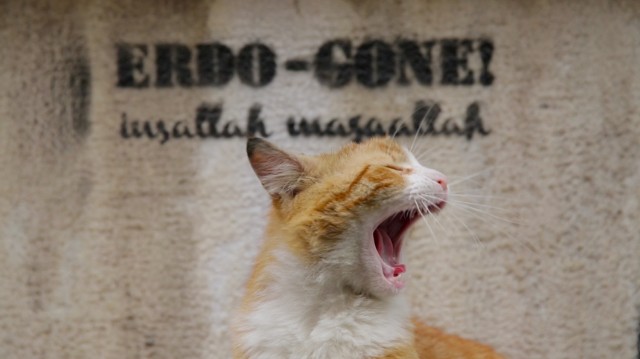
Istanbul is a great mix of ancient culture and cosmopolitan living. Torun slightly makes a socio-political statement with the opposing shots of iconic mosques and their towering minarets by the sea and new modern skyscrapers. People in many gentrifying neighborhoods worry about not themselves, but the fate of thousands of cats who will be losing their green territories to the glass and concrete. There are stenciled graffittis against highly unpopular president Recep Tayyip Edogan- 'Erdo-gone!' in the background.

With the camera constanlty on the cat's eye level, the filmmakers follow the creatures through labyrinthine back streets. With some beautiful shallow depth photography and spectacular drone shots of the city, Kedi is a love song to Istanbul and its cats.

Just like watching cat videos on Youtube when you are feeling down, Kedi works as a purrfect antidote for all the ugliness going on in the world.

Oscilloscope Laboratories will release Kedi on February 10 in New York at the Metrograph and on February 17 in Los Angeles at the Royal. National expansion will follow

Monday, January 16, 2017

Cosmic Energy

Kosmos (2010) - Erdem
Screen Shot 2017-01-16 at 9.58.04 AM
Screen Shot 2017-01-16 at 9.59.02 AM
Screen Shot 2017-01-16 at 10.05.27 AM
Screen Shot 2017-01-16 at 10.06.38 AM
Screen Shot 2017-01-16 at 10.14.30 AM
Screen Shot 2017-01-16 at 10.07.53 AMScreen Shot 2017-01-16 at 10.22.03 AM
Screen Shot 2017-01-16 at 10.30.29 AM
A bug eyed stranger (Sermet Yesil) comes into snowy border town in northeast Turkey. Upon arrival, he saves and miraculously revives a drowned boy from the river. The boy's father, a local butcher, grateful, tells the stranger that he is welcome and can stay in an abandoned city hall building. But it's the stranger's eccentricity that attracts the locals attentions- it's his philosophical talk in a high pitched voice, only eating lumps of sugar at a tea house for sustenance, having no concept in labor or money, and is later revealed, has abilities to cure and heal people and even defy gravity. He impacts some of the locals' lives for the better, at first. After healing an old man's bad lung (he has to pick his patients up from behind and shake them like a rag doll), there's a line of sick and invalid people gathering at his door which he avoids.

The story of two factions in the village, ones who embraces opening the borders and by trading with the others that will bring the wealth, the other who blames the loss of cultural, traditional ways and recent social ills (mostly robbery committed by the stranger) on the foreigners, resonates the world we are living in. As the miracles fade and turn into tragedies, people start to resent the stranger they first saw as a savior.

This allegorical tale packs a lot of themes and stories in to a 2 hour running time. It reminds me of Werkmeister Harmonies and Tarkovsky's work. But unlike those clinically astute aesthetics of Tarkovsky or Tarr, Erdem's Kosmos is an energetically charged film from beginning to end. The stranger who calls himself Kosmos is always moving about, and the camera, through tracking shot and handheld, constantly move through snowy landscape and chaotic interiors: It being a border town in an unending conflict with neighbors, there are constant low booms of cannons heard from near distance. A satellite falls from the sky. There are also noises of cows from the slaughterhouse, birds, dogs and music- the film is cacophony of sounds and motion all of the time.

Neptün (Türkü Türan), daughter of the butcher, connects with Kosmos. There courtship is that of feral animals - they communicate by howling and running around. Perhaps she is the only one who understands when he says there is no difference between human and animals.

Kosmos is an unwieldy, messy, sprawling work. There are many moments of brilliance and striking visuals. But all that chaos is what Erdem is intending to show. But Kosmos is definitely not a moral lesson, there is no ultimatum or strong message. That the world is indeed chaotic, indecipherable, unknowable and mysterious. The director leaves it at that. Perhaps not narratively satisfying, but Kosmos is full of beauty and wonder.

Monday, November 16, 2015

An Impressive Debut of a Turkish Woman Filmmaker, Deniz Gamze Ergüven

Mustang (2015) - Ergüven
 photo 9e3d3c12-726d-478e-84a6-fbb7e14955b3_zpsiaxfmjv4.jpg
The school's out for the Summer, but for the 5 luminous protagonist orphan sisters, the indignity of being virgin brides in a 'wife factory' has just begun. After some innocent water splashing horseplay with the boys on the beach, they become prisoners in their own home. It was a neighbor woman in (in the girls' own words) "shit colored traditional garb" who informed their grandmother that they were acting indecently with the boys. The panicked grandmother locks them up in the house but still shields them from their brutish uncle's fury who is even more conservative. You see, according to Lale (Günes Sensoy) the youngest of the sisters who narrates the film, Istanbul might be about 'a thousand miles away', but the small coastal town they live in is about a thousand years backwards in terms of women's rights.

First, the older three, Sonay, Selma and Ece, are milled over to the hospital to see if their hymens are intact. The metal grates go up over the windows and the girls' possessions which might lead them in to perversion (a TV, phones, colorful clothes, books) are locked away. Shit colored formless dresses, cooking and cleaning lessons follow, and the girls are bored to death.

But this imprisonment provides some sun soaked, blissful playtime among girls and give them opportunities to get out of those dresses and lounge in their colorful underwear. They also sneak out every chance they get. They even end up hitching a ride to see a soccer game (for the women-only spectators game of course) and appear on TV screen to their grandma's horror.

They are hurriedly trained and clothed into arranged marriages. After the two eldest get married off- Sonay (Ilayda Akdogan) to the love of her life (by threatening to scream in front of the family guests), more resigned-to-fate Selma (Tugba Sungroglu) to some stranger, whom she 'will grow to love', it's Lale who starts seeing the indignity of the whole situation. It's only matter of time that it will be Nu (Doga Zeynep Doguslu) and her turn. Before it's too late, they need to escape!

Mustang is not as politically pointy as Jafar Panahi's Offside and doesn't point finger directly at the traditions in some Middle Eastern regions per se, but things are pretty obvious how absurd the situation is. First time director Deniz Gamze Ergüven has the light touch even when things get dark. And it gets very dark at times. The film thematically and spiritually shares lot in common with Sofia Coppola's Virgin Suicides (which was also a debut film by a young female director).

The third act seems to lose its organic feeling and magic of the first 2/3rds but that's only a minor quibble. It's a beautifully realized film about being a young female in a very conservative society. It's also good to see beautiful Elit Iscan of Hayat Var (My Only Sunshine) making an appearance as Ece, the defiant middle child. She hasn't aged a bit!

Mustang is the French Submission to the 2016 Academy Awards. It hits US theaters on November 20th, 2015

Friday, December 19, 2014

Winter Ennui

Kis uykusu/Winter Sleep (2014) - Ceylan
Winter Sleep
Aydin (Halruk Bilginer) is a proprietor of an ancient, picturesque carved-cave inn. He also owns a lot of properties around this Anatolian mountain community. He is an insolent, arrogant man who inherited his father's wealth and once a stage actor. He lives with a much younger, beautiful wife Nihal (Melisa Sözen) and equally insolent divorcée sister Necla (Demet Akbag). Aydin writes flowery columns for a community paper and is preparing to write a book on history of Turkish theater. When he is not writing, he talks to various guests who are staying at the inn. Things hasn't been good between Aydin and Nihal. She's been accusing him of not being interested in her philanthropic work and he in turn talks down on her lack of life experiences.

Winter Sleep is mostly composed of long winded indoor scenes broken up by some striking outdoor scenery. It's like kitchen table stage play where everyone sits down and argues for ages while drinking copious amount of tea. I really hated all three major characters who are extremely self-centered and very good at hurting each other's feelings with their petty resentments. I hate dialog where characters are all wearing their hearts on their sleeves and it happens A LOT in Winter Sleep. The only remotely interesting parts are about how Aydin and Nihal deal with poor folks - it starts out with Aydin and his property manager Hidayet visit one of the piss poor family after a young son from that family throws a stone at Aydin's car and breaks the passenger side glass. The family has been suffering financially and can't pay the rent. Hidayet had to remove their TV and other home appliances for collateral. Aydin is far removed from these tit-tat earthly affairs and has a hard time when confronted by it. Guilt ridden Nihal tries to help them but her ways lead to highly melodramatic results. What I didn't like about Ceylan's international breakthrough Distant was its pretty pictures have little to do with uninteresting main characters. There is no cohesion with its surroundings and these people who inhabit it. I have the same problem here with Winter Sleep, but only this time, they yak all the way through. It's as if Ceylan lifted his magic filter used in Once Upon A Time in Anatolia. The magic is gone: dialog is atrocious, slow zoom-in has no context whatsoever and voice over at the end felt like a cheat.

Winter Sleep is based on Chekov's short stories "Excellent People" and "The Wife". It's basically a filmed chamber play. I can see Nehal being a young wife trapped in a loveless marriage with a emotionally abusive older husband, a typical Chekov stuff. The thing is it's way too familiar, too predictable and too melodramatic, whereas in Anatolia there was a mystery that we are sort of trying to solve (setup being a police investigation). I checked imdb for writing credit as Ceylan writes everything with his wife Ebru and Ercan Kesal (Anatolia and Three Monkeys). Kesal's not credited as one of the writers for WS. Maybe that was the problem?

WS imho, definitely one of the weakest of all Ceylan I've seen. However unaffecting it was, Distant's minimalistic approach was refreshing and relies a lot on the viewer's imaginations to get into the minds of those two characters who are very different and distant. Chekov's work is all about confessing, divulging their inner thoughts for the readers/audiences. This may work on stage, but cinematically, it's too general and one note - Yeah it's winter and desolate. Yeah that's how they feel. FOR THREE HOURS. Anatolia was more layered, thematically and cinematically. I felt WS was just plain lazy filmmaking.

Thursday, January 19, 2012

Once Upon a Time...

Once Upon a Time in Anatolia (2011) - Ceylan
Anatolia
As the title suggests, Ceylan's new film unfolds like a good book. What seems a police procedural on the surface, Anatolia is a deeply felt human drama that is rich and nuanced as any great Russian novel. The story begins at a crime scene (or rather, on the road searching for one) and ends at a morgue. But in between those places for two and a half hours, you are constantly on the winding, hilly dirt roads with policemen, a confessed killer, a country doctor, diggers, transcriber with a laptop and a Clark Gable-ish prosecutor. As they move from one place to another in the night (because the confessed man doesn't remember the exact location), they converse and lament about their lives. Thanks to the scarce electricity in the small village and only car headlights beaming the much of the action on the road, Anatolia is visually striking in its widesceen format and has many images that linger for days after viewing. The distant thunder and lightening tells the rain is on the way. One character laments, "That hasn't changed for thousands of years, but 100 years from now, who will remember us?" But Anatolia is filled with memorable, deep characters drawn beautifully by its multiple character interactions and leisurely running time.

Anatolia completely avoids clichés of the usual crime drama. Although police incompetency and provincialism are not the main attractions at all, it has a lot of self-deprecating humor and constantly very funny under the given grim circumstances. Only thing that I saw coming from a mile away (not that I'm complaining) was the appearance of the beautiful village mayor's daughter. Only a few female characters appear in the film. Granted all the Turkish girls are beautiful, but the glimpse of this stunning beauty under the kerosine lamp (for everyone to see, as she serves tea to each characters) and them commenting on her beauty was a little too predictable. With quiet but touching revelations, some even only to the audience, it's a very rewarding film.

Monday, January 2, 2012

Anchor Song

Hayat Var/My Only Sunshine (2008) - Erdem
Photobucket
The film begins with a 14 year old school girl Hayat (Elit Iscan) waiting on the dock for her father's little motor boat. It's a choppy ride home, passing by gigantic cargo ships in a busy Istanbul harbor. Erdem sets up his main character's daily routine early on, providing some breathtaking scenery.

Hayat, her no-good father and her bedridden, childish grandfather live in a shack near the water. They barely eke out a living by her father's peddling- using his boat to transport drugs and prostitutes to the sailors while always being under the threat of immediate police arrest. But her dysfunctional home life, bullying at school and sexual harassment from a sleazy shop keeper don't seem to faze Hayat. What's admirable about her is her defiance to the world that is pigeonholing her. Even though she is attention starved, she doesn't want to be treated like a child, nor she wants to be a full pledged woman (even though she is still a thumb sucker and physically on the cusp of womanhood).

Iscan's Hayat is radiantly beautiful and the camera adores her. Erdem takes his time to create a rich character. Hayat Var is filled with the sound constant foghorns, streets, animals, water, breaking glass and Hayat's humming. Also it's beautiful to look at from start to finish. With its hopeful and exhilarating ending, I didn't mind its slow pace.

Saturday, October 29, 2011

Don't Tell Your Dreams to Anybody

Bal (2010) - Kaplanoğlu
Photobucket
Photobucket
Photobucket
Photobucket
Photobucket
Photobucket
Photobucket
Remote mountain village in Turkey is perhaps the biggest star in Bal (Honey), Semih Kaplanoğlu's last installment of the trilogy that includes Egg and Milk. Sunlight and silhouette dominate. It tells a very simple story of Yusuf, an 8-year old boy. He worships his beekeeper father, has some difficulties in reading, hates milk.... It's a bad bee season. So his father goes out of town to find a better spot to plant a new beehive. A couple of days pass and the father doesn't come back and things become uneasy for him and his mother.

There are many small beautiful moments with Yusuf and his father. One breathtaking dreamlike sequence takes place indoors: it's a slow tracking shot following Yusuf through the house that strongly resembles the indoor farm sequence in Tarkovsky's Mirror. Overall, In mood and tone, Bal has more common with The Spirit of the Beehive. A beautiful film.