Tuesday, July 18, 2023

People Who Remain

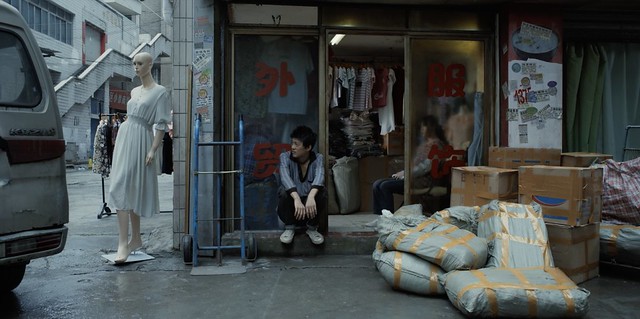
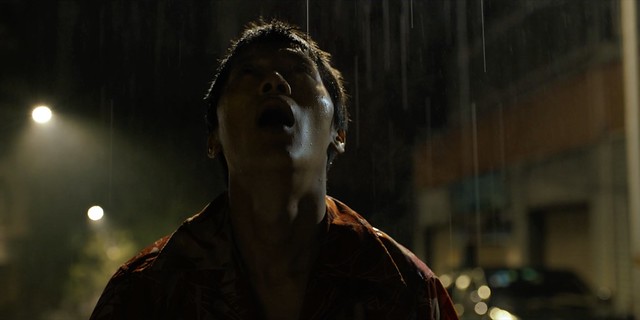
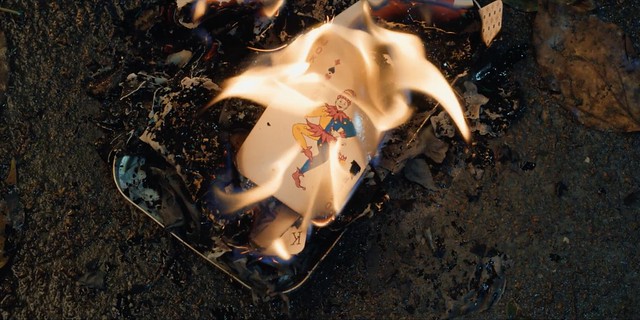
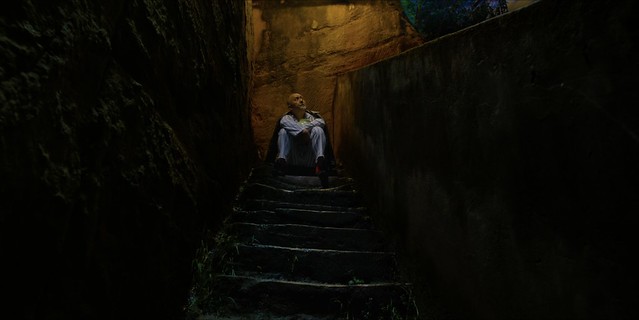
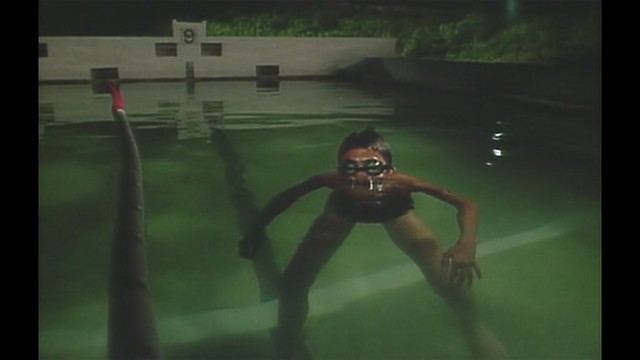
Streetwise (2021) - Na Streetwise 1 Streetwise 6 Streetwise 7 Streetwise 8 Streetwise 10 Streetwise 12 Streetwise 13 Streetwise 15 Streetwise 17 Na Jiazuo's rain soaked neonoir, Streetwise, gets a much-deserved theatrical run stateside. I say this because it's just gorgeous to look at in its grimy, urban decay glory. Set in anytown China in 2000s, where economic growth has considerably cooled, and once bustling streets are now deserted and shops shuttered. There's sense of hopelessness in the air.

Streetwise tells a group of the lonely, lost souls who occupy these wet, decaying dwellings and their sordid lives fatefully entwined like a tangled web which they can't escape from. Zidong (Li Jiuxiao), a gawky young man, is first seen tearing up a mahjong parlor where a debtor hangs out. He is a muscle man for a wry debt collector, Jun, who walks with a limp, probably from some shenanigans from his shady past. By the looks of it, Zidong is a rookie at whatever he does, with Jun constantly showing him the ropes.

Zidong keeps borrowing money from the local tattoo artist Jiu (Huang Miyi) to pay for his dad's mounting medical bills. Dad, once a leader of the street gang, due to his age and health, is forever committed to a hospital bed. Still spry, he still gets into fights and unsavory situations. Zidong and Jiu seem to have a special relationship where they keep each other company without wanting anything other than consoling their loneliness. Their relationship is a purely platonic one, like that of brother and sister. And they might as well be- Zidong's dad keeps insisting that she is a bad luck and they shouldn't ever sleep with each other, not only because she is the ex-wife of the boss, known as Four, the head of a local gang who oversees Jun and Zidong, but also was a protégé of Zidong's dad.

Zidong and Jiu contemplate skipping town and go live somewhere else countless times, even though they don't know where to go. Four, getting rejected repeatedly by Jiu for his pleas to get back together, is getting antsy about Zidong hanging around the tattoo parlor too much. In the meantime, Jun plots revenge after Four humiliates him in front of everyone.

Everyone in Streetwise is trying to runaway from something- the past, dire financial circumstances, love, misplaced loyalty, and themselves, but fails to do so. They can't get away from their own reflections in the putrid puddle strewn with trash in the street.

Jiu briefly leaves the cursed town, only to come back for Zidong and confront her fate.

Li in the role of Zidong bristles with youthful energy and puppy dog innocence. Huang, a graceful beauty, fits reminds me a lot of young Shu Qi.

Na creates a perfect neon colored urban purgatory where lost souls can't ever leave. Everything has a hazy, dreamy, not quite real feel to Streetwise. Even in crowded places like karaoke bars or hospital elevators has otherworldly quality to it. No one is purely evil or saintly. Everyone has baggage and weak spot for certain things or someone. It's that sinewy human connections that Na explores with exceptional visuals and everyday poetry.

Monday, July 10, 2023

Interview: Paula Beer talks Afire and working with Christian Petzold

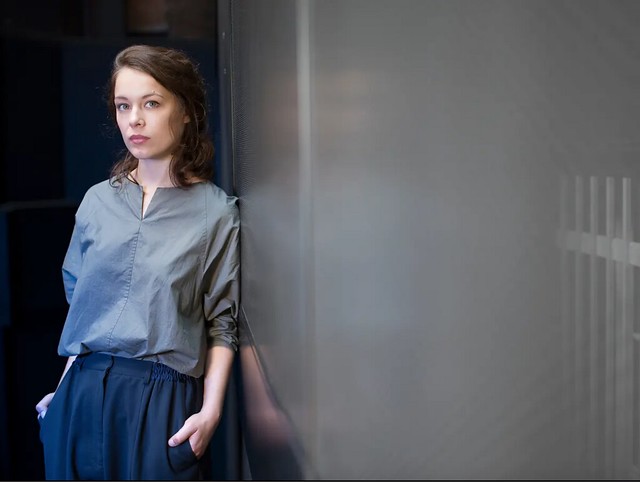
Screen Shot 2023-07-08 at 3.22.36 PM Paula Beer, a German stage and film actress, first got her international recognition in François Ozon's Frantz (2016). Since then, she has been working with director Christian Petzold to a critical acclaim. Their fruitful collaborations resulted in Transit (2018), Undine (2020), and now Afire (2023). In Afire, Beer plays Nadja, a love interest of self-absorbed young writer with a huge writer's block in the summer at Baltic Sea. The movie seems like a departure from Petzold's normal, serious themed filmography at a glance. A German 'summer movie' if you will. But as it plays out, with Beer as his muse, it morphs into the usual Petzold territory and more: secrets, loneliness, and creative process and self-reflection even, and of course, an acute observation of the world facing crisis. It's a delicious Petzold stuff as usual.

Beer was in town for Tribeca Film Festival to promote Afire and I jumped at the chance to talk to the lovely, intelligent actress about her methods and working with Petzold.

Afire opens in theaters 7/14 in New York and Los Angeles. The national roll out will follow.

I saw AFIRE about a week before the smoke from the Canadian wildfire reached New York and turned the sky an eerie dark orange color. And I am flabbergasted by how prescient the film is! Everything Christian Petzold makes, it’s so prescient- whether it’s the reemergence of fascism, gentrification or climate catastrophe. I had to add an addendum to my review after experiencing that thick dangerous air first hand. So I had a chance to talk to Christian remotely after he did Undine and this was when Covid was still happening. He told me that after Covid hit, he abandoned a dystopian project he was working on, to get away from all the depressing things and decided to make a summer movie, about young people in love, with you in mind. How did it come about?

The weird thing is that we were in Paris for the press for Undine. Everything turned out really good. Everyone was happy about the movie. It started playing in Berlin, and we were expecting to open in Paris as well. But our distributor said, “We have to wait for a speech from Macron (about the Covid situation) tomorrow morning.” So OK. But then the next day they told us that they were sorry that they couldn’t bring the movie to the cinemas in April (this was March 2020) that we had to cancel everything and try it again in September. So we knew the situation was getting very serious. When we got back to Berlin, we both got infected- maybe in Paris, who knows, but we got back home and were sick. So we stayed at home and waited. Then the first lockdown in Berlin came in the middle of March. And then Christian told me that he was working on the script for the other movie but he told me that the world is in crisis and that he couldn’t do a depressing movie right now.

He told me a story of Afire while eating falafel together. He told me about the summer and young people in love. “What do you think?” He asked me. During the pandemic we had so much time so we both watched a Rohmer box set that someone gave him as a gift. I understood his wish for taking all the drama of the world away and trying to introduce this light ambience to the world. But of course it’s Christian, so I knew it would dig into a deeper level, not some random light story.

Christian has a really steady career- there’s no movie that you’d think that it’s off or unlike him in his filmography. He has two kids who are a bit younger than me and finishing their school during Covid. He is such an open hearted and open minded person, and he sees what’s going on and what their concerns are and adapts that into a story. It really amazes me. From the very first time he told me about that story I knew that it was going to be something new. I can’t really say how, but the movie just felt different. I sensed his film language moving a little bit.

You’ve done three films with Christian now. How is his directing style different from any other directors you worked with?

It’s completely different. Before I started doing Transit with him, People told me that he has a very unique way of shooting. I was like, “ok, everyone says that. so there must be something true about it.” And as soon as I got to know the production and other people working as a crew for Transit, there was a different vibe. It didn’t have the pressure of a normal film set. There’s no big office with a lot of people. It’s always about the movie and the story: everyone is very engaged and very focused on that. And Cristian collects people around who are really good at what they do, but also calm and easy going. I go, “yeah this is a very good atmosphere to work in.” There’s none of these usual onset frenzy. It’s more like, “cool, we have a good script. Let’s make a good movie out of it.”

One thing we do as a crew and cast is to travel to the shooting locations together - without anything there. Just for us to have an impression of what the place is like.

That’s interesting.

For this movie, it helped a lot. It takes place in the Baltic sea. And we were shooting on a private island. There were no people at all. And it was just raw nature - peaks and forests as you’ve seen in the movie. It's what nature could be if people weren’t destroying everything. And being in the sea - yes the sea itself - the sand and the trees - what impact all of that has on a human being! This is what summer feels like - we have a lot of time. It's hot. no pressure, no stress, no nothing.

And then we have reading rehearsals. It's always important to see how everyone sees the character. For me it was very important to see Tomas (Schubert) who was reading Leon. It was amazing to see because Leon is such a hard character to like and to follow. When he read it. I thought, wow that’s enough. No worries, it’s going to be an amazing one…

You knew Tomas before this movie. You’ve worked together before?

Yes, when we were eighteen, a long time ago. (They were in Austrian director Andreas Prochaska's Dark Valley together). He played so well in that movie.

Then for the shooting, we would rehearse in the morning: it’s Christian and his assistant and all the actors in costume and no other people involved. We have coffee and tea, we look at the scene - we go to make up and they prepare the set, we come back, everything is ready, we shoot, one direction, usually one take, change set up, another shot from another angle, Then we have lunch. His set is very structured and very well organized. It helps you to focus and not—

Pressure

Yeah and there’s nothing to distract you from focusing on what’s important.

Was AFIRE all shot on location?

The house was close to Berlin. And that’s why it was important that we went to shooting locations before. We saw the sea and then we came back to Berlin to start shooting. Everything else was shot near the Baltic ocean.

Among the roles you played, how was Nadja compare to others in terms of preparation?

It’s different with each character. Each character requires different preparation and sometimes it seems so clear but I don’t get anything, others it’s the other way around and just great and you have fun. So it is hard to say how I prepare for a certain role. Every new character I play I go back to the beginning - that I don’t know how or where to start because it feels like a new job with every character. I will need to understand what I need, to play this character. Because I don’t think there is no…formula, to say 'this is how to create a character.' It’s how I play this character. It helped me a lot working with Christian two times before because I got to see how things work on his set and now I kind of know how or where…oh I am blanking, it must be the jetlag, (laughs) … where I will be ending up with him.

I know how his process of filming goes. And this helps me a lot to free myself. I am always like, “I have to prepare this and I have to prepare that. I have to be super prepared,” but his process gives me a lot of freedom and with Nadja, I can go with what I feel at that moment. This is Nadja, this vibe, now I just experience and enter her realm and react to other actors and their energy, off of my costumes and places. It's like an energetic trip through a movie.

The reason I asked is in UNDINE, there is this long monologue scene where Undine leads the tour in a museum and I was wondering how you managed that. That must’ve taken a long long time to prepare.

Yeah. When I was reading the script. I called Christian and said, “well you are making jokes right? You just don’t want me for the part!” In a way it’s very helpful to…. First for an actress, it’s a job to do. But then, the story that she tells is her text. She wrote that story. So it tells you a lot about her. Like how she sees things, how she is telling about it. But when I see the room where we are shooting that scene, it’s like diving through history. And I just loved doing all the preparations. She is from water, to our city and lives with human beings, she is searching for love and she doesn’t find it, she has to kill and go back to water. For me, it was, "OK, she actually lives in two worlds." The other world, which we don't see in the movie, is where she is most of the time, so I want to get to know this world in water. Then how she sees you- she knows Berlin from when the first house was built there. Because Berlin was this watery…

Swamp.

Yeah yeah, exactly. So she was there before the city was built. So she is not doing a presentation but telling her whole story of what she experienced and I love the idea of her explaining things - “So this bridge was built in so and so and this guy was doing this…” She was telling what she saw.

In Petzold’s characters, especially female characters, there’s always some sort of secret in them. Whenever they are looking at you and talking to you, it’s as if they are looking above your shoulder. Do you feel that way about Nadja?

I felt the same way about the Petzold’s characters I play, that they live in a kind of their own world. That they look for their own truth. But for Nadja, when I was reading the script, she doesn’t have that interiority even though you don’t really know. It’s the view from Leon’s perspective. The camera is a bit attached to him emotionally and it’s his point of view.That’s why you don’t really know who she is or what she’s up to. Reading the script I got that feeling as well. That’s why it’s fun to play. I think Christian gives characters their own worlds. For Nadja, I think he protected her world. She can have her own world and not get destroyed by others. She is present among people but she is not throwing everything at them. She knows who she is and she is self confident but she doesn’t have to show it. I like that about Nadja. It’s like when Tomas tells her, " You didn’t tell me that you are not just an ice cream seller.” and she says, “You didn’t ask.” I’m not going to give you everything because you are the man. I like that about her.

Nadja always whistles a tune. I am dying to know what that tune is.

Oh I just made that up. It’s Nadja’s vibe I felt when we were shooting. OK, she is full of life and full of joy. She knows how to live. And that ended up in the movie. (laughs)

That’s awesome.

Is there a difference between how Nadja sees herself and Leon sees her as? The reason I am asking is that it turns out Leon, the writer, embellishes everyone but Nadja, who is strong and confident, stays the same.

Yeah there is always that surprising moment in Chrsitan’s films that you doubt yourself as how things are, then “Aha!” As you said, who is she? Is she just his view or is she really that person… I love these games that Christian plays.

It’s great.

I know you are busy with other projects. I hear you are doing STELLA (based on a controversial figure Stella Goldshlag), and THIRTY THREE with Niels Arden Oplev. Is the latter project in English?

I believe so. There might be some parts in German.

Tuesday, June 27, 2023

The Eighties Paris

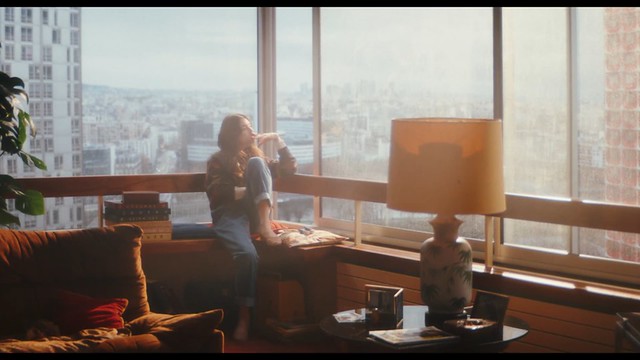
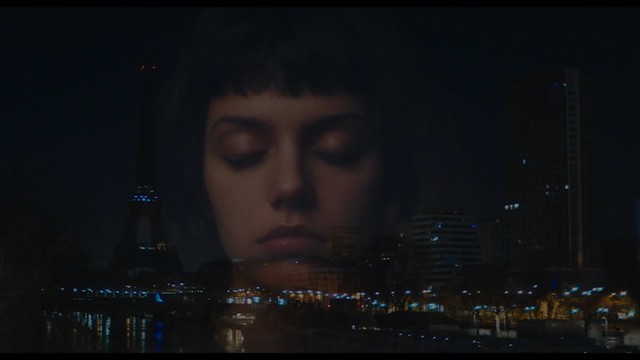
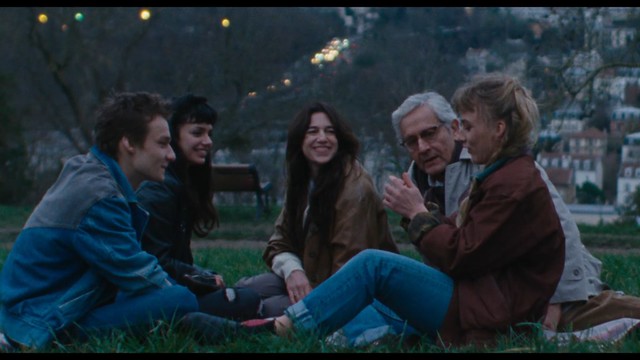
The Passengers of the Night/ Les passagers de la nuit (2022) - Hers Screen Shot 2023-05-26 at 8.22.52 AM Screen Shot 2023-05-26 at 10.15.12 AM Screen Shot 2023-05-26 at 10.39.21 AM Screen Shot 2023-05-26 at 11.31.08 AM If you are like me, who's very sensitive to noise and think modern films have become too loud, both in theaters and at home, then you might find Mikhaël Hers films to your liking. In one corner of Paris, he's been making finely tuned, melancholic urban tales of delicate human connections since the mid 2000s. And with Amanda in 2018 and now, The Passengers of the Night, he is turning his attention to the subject of family- some surrogate, some not, and away from his usual group of 20 or 30 something protagonists. It's not a question of this change is good or bad, just different. With The Passengers, his usual theme of death and grief are gone, yet the sadness and melancholy still remain. Also it takes place in Paris in the 80s, marking it his first period film.

Hers's quiet, singular filmmaking seems to attract big stars also. It features Charlotte Gainsbourg in a great role as a divorced single mother, who is discovering herself for the first time. Emmanuelle Béart, the once French megastar of 80s and 90s, also makes a welcome appearance, giving a confident, nuanced performance as a late night disc jockey. There is also a relative newcomer, Noée Abita as a beautiful drifter. Hers's regular, Thibault Vinçon, is there as a love interest as well.

The film opens with the night of the 1981 presidential election where François Mitterrand and his Socialist party won big. There's an electricity in the air and everyone's celebrating in the streets. The title, The Passengers of the Night, is the name of a late night radio show where insomniacs and lonely souls tune in, to hear the host Vanda (Emmanuelle Béart) and talk to her on air. Her voice and wisdom are comfort to thousands of listeners. One such fan is a recent divorcée Elizabeth (Gainsbourg). She and her two growing high school age children Judith and Mathias live in a penthouse apartment with windows overlooking Paris. But since her husband left, she needs to find a job pronto. It's a scary time for Elizabeth, as she never held a job before. It is alluded that her husband left, because she had a brest cancer and went through a mastectomy. Lacking any employable skills and failing badly at menial office jobs, she writes a passionate letter to Vanda, and lands her a job at Vanda's radio station as a switch operator. Her job is to filter the listeners' calls, then connect them to Vanda on air. She and the team hit it off. Her daughter Judith is a firebrand and very into progressive politics, but her young son, Mathias is struggling in school and is rather directionless.

One night, a young drifter and a listener of the show named Talula (Noée Abita) shows up at the station. It turns out she doesn't have anywhere else to go. Elizabeth ends up bringing her to her flat and letting her stay in her spare room in the attic. Soon Mathias falls hard for the stunning drifter. They go to the movies, an activity that Talula says she does a lot because the movie theater is good place to go when the weather turns cold. There are hints of young people's passions and interests forming, foreshadowing their future path. But when Mathias gets too close, Talula leaves.

It's 1988, working at a library during the day, Elizabeth finds a new love in a younger man (Vinçon), Judith has moved out and Mathias now works at a local pool. One day, Elizabeth and Mathias find Talula passed out near their apartment. She has become a junkie. Same as before, they help her from the goodness of their hearts. Talula struggles with her addiction while Elizabeth and Mathias prepares to move out of the fancy apartment they've been calling home.

Hers has perhaps the gentlest touch of all French directors working today. Shot dreamily hazy with the mix of film and digital images, The Passengers combines the director's penchant for good music - the 80s in this case: Lloyd Cole & The Commotions, The Pale Fountains, Television, Low, and also pays tribute to 80's romantic cinema shot in the streets of Paris - Eric Rohmer's Full Moon in Paris, Jacques Rivette's Le pont du nord, and one of my early favorites during my formative years, Eric Rochant's The World without Pity.

No one dies or anything drastic happens in The Passengers of the Night, but as usual, Hers observes life's ups and downs and connections people make along the way. Gainsbourg is luminous as Elizabeth, giving a fine-tuned performance as a middle-aged woman finding herself in a changing world. Watching this film reminded me very much of Hou Hsiao Hsien's Tokyo set Ozu tribute, Cafe Lumiere in terms of its tone and place.

Thursday, June 22, 2023

Warcry

How to Blow Up a Pipeline (2022) - Goldhaber how-to-blow-up-a-pipeline-film We really did a terrible job safeguarding our environment. We are way passed the point of no return for major ecological disasters and this is going to be our legacy to our youth. And they obviously have reasons to be pissed off at us, the government, the world. Every time I talk with anyone younger than 30, their number one concern, without hesitation, is the environment.

I'm not saying that this so called ecoterrorism is new. There were Green Peace saboteurs before our generation; we had ELF (Earth Liberation Front) and have seen our friend Daniel McGowan off to jail for arson of the lumber company. But How to Blow Up a Pipeline is a renewed warcry from a generation that went through so much in so little time in the last two decades where everything seems to be accelerating toward the what seems to be now inevitable oblivion. The gig economy is not providing them any security or benefits (as the film touches on the subject). Forget about the culture wars or 'voting matters' slogan, in our mainstream discourse. They don't give two shits about any of those. The world will soon be totally uninhabitable, definitely in their lifetime. This is existential threat of today. It's the topic that they lose sleep over.

How to Blow Up a Pipeline is an angry propaganda disguised as an eco-thriller. With complex flashbacks structure, the film tells a group of conscientious young people deeply dissatisfied with the state of the world. Their definition of 'doing good for the world' is not volunteering at some soup kitchen. Incrementalism is not the solution. They'd rather move toward the path of a direct sabotage. All the paticipants of the deeds of the film title are personally affected, in one way or another, by the environmental destruction near where they live; their family member died because they live close to a chemical plant, get cancer because harmful air and water they breath and drink, get kicked out of their lands by developers, their land ceased by gov for digging oil wells, etc. They find each other online and by mutuals to form a group, like, in a heist movie. Daniel Goldhaber along with his writing partner producer Jordan Sjol (Cam) and Ariela Barer (who plays Xochitl in the film) writes a lean but urgent and angry script, devoid of sentimentality.

Xochitl (Barer) who lost her family to illness due to living near the chemical plant, comes back to Southern California after dropping out of college, disillusioned by non-urgent state of college protest scene. She reconnects with her best friend Theo (Sasha Lane) is dying of leukemia from the harmful chemicals, and her girlfriend Alisha (Jayme Lawson). She also hooks up with a like minded college friend, Shawn (Marcus Scribner), who agrees with her that the act of sabotage - violent actions of property damage (but without any loss of life), are necessary to shock the system. They contact a reclusive, angry young man Michael (Forrest Goodluck), living in a reservation, who posts 'how to' videos of homemade bombs on the internet. They also recruits Dwayne (Jake Weary), a family man, who lost their family plot in Western Texas to imminent domain for digging oil rigs. Then their is a druggy Seattle couple who may or may not be informants for the FBI. With these young characters, the film shows what unites them, across cultural and racial divide, is the anger that fuels their desire for direct action beyond protests, petitions or boycotts. The shrewd

They find their targets in Western Texas - one underground pipeline and the other above. The coordinated attacks will paralize the supply of the oil getting distributed across the state lines and cause economical damages to the company. A major disruption will be the goal.

The matter of fact presentation of bomb making and careful planning are the meat of the film. How to Blow Up a Pipeline plays out like a great little thriller. Their meticulous plan hit a snag when the rope holding the heavy barrel containing the bomb breaks, but despite the setback, they carry out the attack. The twist at the end is well earned as well. How to Blow Up the Pipeline is a compelling film. It is a justifiably angry film for the generation out of time and out of options.

Saturday, June 17, 2023

Six Love

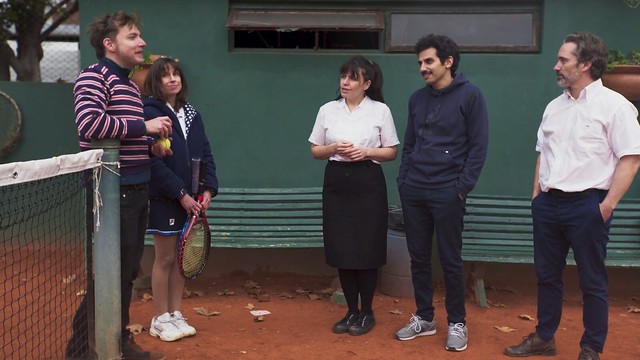
Smog en tu corazon (2022) - Seles Screen Shot 2023-06-17 at 10.00.38 AM Lucia Seles's wry comedy about a Tennis club and its employees and their romance may sound like a premise of a TV sit-com, but its presentation is nothing but. The editing style of Smog is truly innovative. With cutting between parallel actions, long sequences, jump cuts and repetitions, the film is jarring at first until you settle into its own rhythm, as we get invested on the characters. Most of them are neurotic mess: the owner of the place is Manuel, who is affable enough but still wants to present himself as a boss, Lujan, an employee with a penchant for classical music and her precious 16 CD collections precariously stacked on her tiny desk, Javier, a nervous accountant who likes to gather the team around and announce his incongruous findings about the world, Sergio, Manuel's childhood buddy who just came from San Juan to help the business out and Martha, a former player who is hired to give lessons and very sensitive about being called other than 'tennis player'.

As their daily activities play out with their silly and amusing anecdotes and stories, we find everyone is in love with someone else and the feelings are not reciprocal at all and no one is brave enough to come right out and say what they feel. In many ways, Smog en tu corazon is like a Shakespearean screwball comedy or Chekhovian chamber piece that takes place in a rundown small tennis club in Spain. It also reminds me of the sprawling yarn that has been coming out of Argentina in recent years- La Flor and Trenque Lauquen. It's good trend to have these little small films with no budget sprouting up.

Smog en tu corazon is most notable in its editing. It's not tethered to having an extra meaning or used as some sort of signifier; it presents a different cinematic language and rhythm. And I am surprised at myself how easily I get sucked in to these lives and completely forget about the formalist presentation. Enjoyed it immensely.

Monday, June 12, 2023

Look Around, The World is Burning!

Afire (2023) - Petzold Afire As the Canadian wildfire rages on and its smoke, carried on by the wind, covers the entire US Eastern coastline in thick orange hazardous air last week, Christian Petzold's new film, Afire, playing in this year's Tribeca Film Fest and coming out in US theaters in July, is such a prescient film about the world we live in now. You think Petzold shifts gears and concocts a seemingly a lighthearted summer fling story during covid? No. Quite the contrary. His previous films, Phoenix, Transit and Undine are laced with potent German history and reflecting on 21 century living. But at a glance, Afire doesn't seem too concerned about the German history, but it's still very much steeped in Petzold's usual themes: guilt, shame, forgetfulness and loneliness. And the Baltic sea set Afire is very much about the present- the world on the brink of ecological catastrophy. Afire is distinctly a Petzold's version of a 'summer movie'.

We are introduced to Leon (Thomas Schubert) and Felix (Langston Uibel), unlikely friends going to the Baltic seaside where Felix's mom has a summer house. The car breaks down and they have to walk the rest of the way. It is apparent that Leon is the designated pessimist of the two; too serious for his own good kind of a guy. Once they get to the house, they find that it is already occupied by Nadja (Paula Beer). They learn that Nadja is a family friend and now they will need to share the house during their stay. Leon is doubly disgruntled because he needs peace and quiet to finish his second novel, incongruously titled, Club Sandwich, but Nadja's nightly activity with a local lifeguard Devid (Enno Trebs) is just too loud.

After meeting the other occupants a couple of days later, Leon keeps being a major A-hole and a party pooper every chance he gets; whenever asked to come to swim and join them, he coldly tells Nadja, "Work doesn't allow it." a phrase that he instantly regrets saying right after, which fills him with much self-loathing. He just can't help it. His arrogance and superiority complex always get the better of himself, while struggling with writing his 'masterpiece'. But, when alone, he bounces the rubber ball off the house wall and falls asleep on the patio in front of the house that he claimed as his workspace.

To Leon's surprise, there's a budding romance between Felix and Devid. It's more like Leon is too obsessed with his own little world, he hardly notices anything else around him. It's like a forest fire that is raging in the distant which lights up the part of the sky red every night. It won't reach us, they tell themselves.

Nadja gives Leon every chance to open up, but his stupid pride keeps walling off her friendly gestures. At one of those of her attempts, he reluctantly agrees for her to read his manuscript. She reads it in one sitting one afternoon, as he nervously walks back and forth from distance. She returns it to him, "It's bad and you know it too." What does she know? She is just a seasonal ice-cream seller at a nearby town. He bitterly tells himself.

When Leon's agent, Helmut (Matthias Brant) comes into town to go over his manuscript and decides to stay for dinner which Nadja provides, it is revealed that Nadja is a literary scholar doing her Ph.D. She recites Heinrich Heine's poem Asra, about an Arab tribe, who perish when they love. Felix, who's in love with Devid now, so moved by the poem, asks her to recite it again. Foreshadowing what's to come.

There's a striking scene, where the ashes of the nearby forest fire descending upon the group. It's a surreal moment - mixture of beauty and imminent danger. It's one of the showstopper in Petzold's cinematic world. Helmut collapses at the same moment and must be taken to the hospital. Fire is fast approaching, and Leon witness firsthand the destructive power of all consuming fire.

Afire is very much a Petzold's version of a summer film like that of Eric Rohmer's (which he says he watched a lot before conceiving Afire, during the covid lockdown) and other French summer fling films but with stinging message. Instead of summer love, we get Leon, our anti-hero completely blindsided by his self-centered world view and misses out on life. And even ecological disasters at his doorstep can't make him see what's in front of him.

The film tells a lot about the self-absorbed world in the face of climate change and global catastrophe unfolding. You might ask, 'Leon can't be that thick headed. How is he a friend with good natured, younger, optimistic Felix?' 'There's no chemistry between Leon and Nadja, how can he declare his love for her?' and so on. Afire is also about creative process and self-reflection. And it's beautifully, deliciously constructed by the master storyteller. It's as if Petzold saying get out of your head once in a while and look around you because if you don't, it might be already too late.

Friday, June 9, 2023

Eternal

Music (2023) - Schanelec Screen Shot 2023-06-09 at 1.39.38 PM Screen Shot 2023-06-09 at 8.55.54 AM Screen Shot 2023-06-09 at 9.07.47 AM Screen Shot 2023-06-09 at 10.59.02 AMScreen Shot 2023-06-09 at 10.34.16 AMScreen Shot 2023-06-09 at 10.40.36 AM Screen Shot 2023-06-09 at 11.08.05 AM Screen Shot 2023-06-09 at 1.45.29 PM Screen Shot 2023-06-09 at 1.20.43 PM Screen Shot 2023-06-09 at 1.22.29 PM Angela Schanelec's new, nearly silent film, simply titled Music, is supposedly 'freely' based on the Greek Myth of Oedipus. It might be the most enigmatic offering from the esteemed German director. But its depiction of melancholy and fragility of human life is nevertheless so beautiful and timeless, I can't help tearing up by the end.

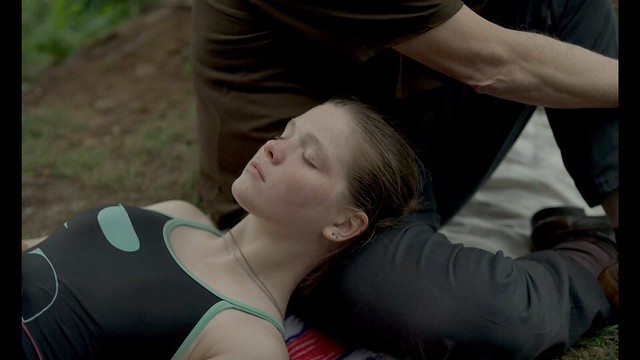
As always with Schanelec's films, there are striking images and a ghost of a narrative thread with lots of gaps that you will need to fill in yourself. Time is elastic in Music; in one scene you see an infant being found and adopted, the next we see Jon (Aliocha Schneider) accidentally killing someone (his father?) and going to prison. There's a prison guard Iro (French actress Agathe Bonitzer) who attends to his swollen feet (like Oedipus by his unsuspecting mother/lover), and gives him the list of classical composers to listen to. Then he's out of the prison, and they are expecting a baby. But fate would have it, tragedy follows Jon as his past catches up with him. He is a musician now, living in Berlin with his grown up daughter. He sings melancholic songs in falsetto on stages. And also, he is going blind.

Static framing and stoic acting that Schanelec cultivated over the years are all present here. Pivotal, life-altering actions happen mostly off frame. It's almost dialog free. And it doesn't really matter if Jon looks the same after many years, if not decades.

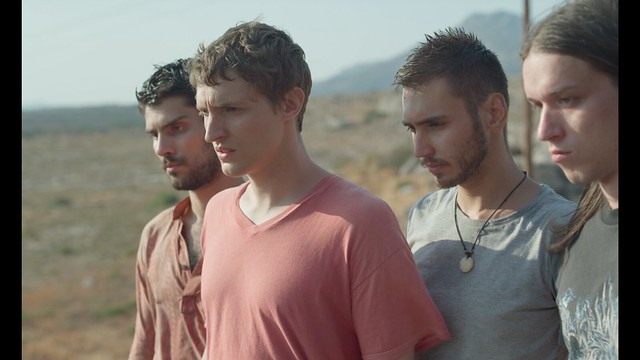
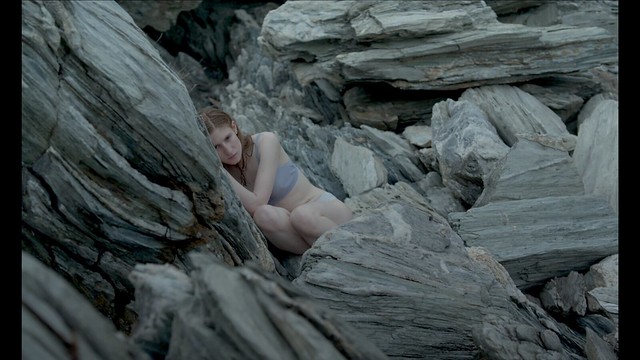
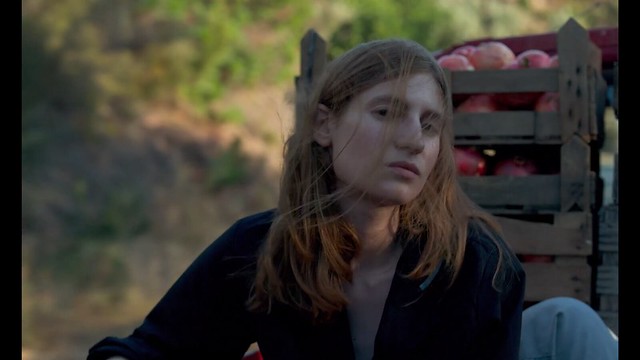
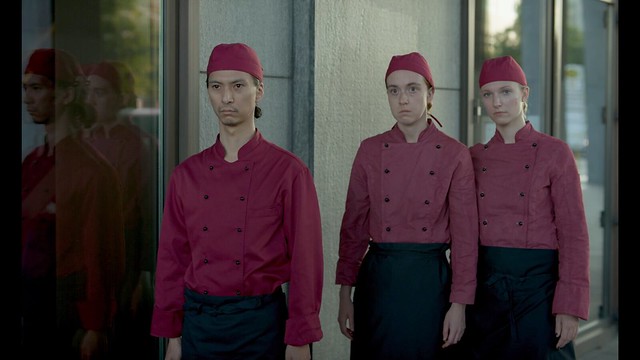
Schanelec told me once that she usually maps out an idea for a project from one or two images. This time, she takes a cue from a Greek theater. And images in Music are indeed striking. The windswept rocky Greek terrain against stunningly blue Aegean sea and sky in the first half invokes both the timelessness of nature and our impermanence in it. The static, staged scenes featuring groups of young people - street gang, wistful prison inmates, bystanders in uniformed kitchen staff strongly remind you of the world of Aki Kaurismaki. And of course, music flows where dialog would have been with the help of Canadian musician Doug Tielli in his high-pitched voice (a cross between Sigur Rós and Nick Drake). His songs not only serve as a Greek Chorus chronicling Jon's melancholy, but also as testaments to the beauty of music, transcending this fleeting dream we call human existence.

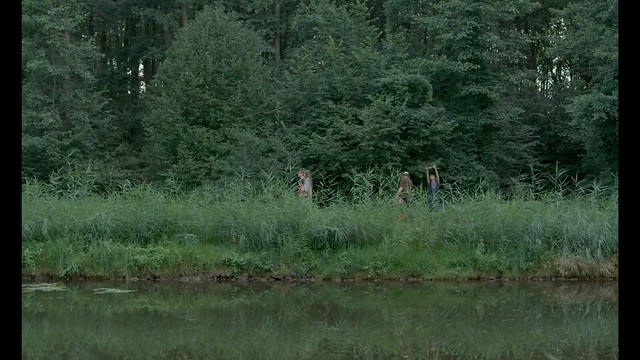
The long tracking shot that ends the film, filmed from the other side of the river embankment as the characters walk and sing in the beautiful summer day has the feeling of an eternity. It's an achingly beautiful film.

Wednesday, June 7, 2023

Storm Front

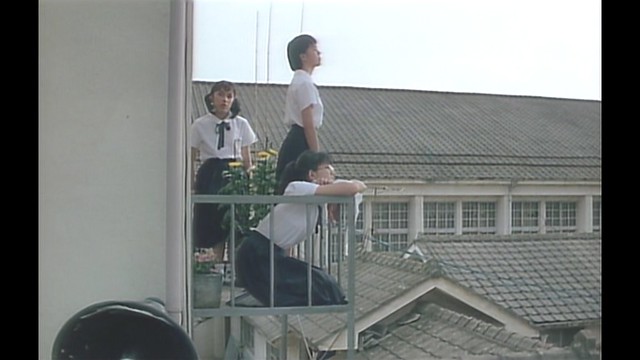
Typhoon Club (1985) - Sômai Screen Shot 2023-06-07 at 8.37.57 AM Screen Shot 2023-06-07 at 8.52.50 AM Screen Shot 2023-06-07 at 8.55.24 AM Screen Shot 2023-06-07 at 9.26.13 AM Screen Shot 2023-06-07 at 9.54.17 AM Screen Shot 2023-06-07 at 10.12.03 AM Screen Shot 2023-06-07 at 10.14.36 AM Screen Shot 2023-06-07 at 10.44.03 AM Screen Shot 2023-06-07 at 10.21.22 AM Junior high school years are confusing times. It's on the edge of the adulthood- full of excitment and hopes yet extremely scary. Typhoon Club is an anti-coming-of-age movie. The film tracks a group of junior high students during a typhoon. They are just ordinary disaffected youths. They all have their flaws and issues. But why would anyone want to grow up if all the adults around them are stewing in their messy lives or absent altogether?

Two baseball players, Ken and Mikami are besties. Ken has issues at home and has trouble expressing himself to the girls - things always comes out wrong and he gets violent. Studious Mikami is feeling existential angst. Rie (baby Youki Kudoh), is anxious about losing Mikami after graduation and being stuck in small town and getting old. She runs away from home, where she shares with her invisible parents, to Tokyo on the eve of the tempest. The rest of them get marrooned in school after getting locked up unbeknownst the grownups. All the bottled up fear, angst, desire explodes with the torrential downpour, as they get to spend the night. All the inhibitions are gone, the wet, torn clothes fly off in the gym as they dance in the tune of Japanese rock, then out into the muddy fields.

Breakfast Club it ain't. There's no highlighting their individual quirks. They instinctly understand each other and forgive one another. Mikami screams on the phone to his unhelpful drunken teacher, "I will never be like you!" In the meantime, Rie's Homerian journey home during the typhoon continues. She gets picked up by a college students while shopping in Harajuku. He invites her to his apartment. It's not as exciting as she thought. After changing back to her school uniform, she decides to come back home.

Typhoon Club predates all the 90s and 2000s Japanese teen angst films. Somai really had a great eye for small details and intricacies of human relations. It's one of the best Japanese films ever made.

Tuesday, May 30, 2023

Currency of Ghosts

Phantoms in the capitalist system in Vagabond, Germany Year 90 Nine Zero & Personal Shopper Germany 90 5 A phantom, a specter, a ghost, a spirit, or what Heidegger termed as “ontological obscurity, (Derrida, p461)” is closely linked with cinema. Seeing flickering moving images projected on the screen, one must connect the question of technicity with that of faith. A phenomenon of belief, of “pretend as if,” is an inherent quality of the narrative film. The spectral dimension is neither the living nor the dead, neither hallucination nor perception. According to Jacques Derrida, “Cinema is the image grafted from the past, a spectral memory, a magnificent mourning. (Baeque, Thierry, and Kamuf, p27)” It’s that mourning part of Derrida’s discussion that I want to examine and draw the correlations to the idea of phantoms in the capitalist society in which we live in, in three different films, Germany Year 90 Nine zero (Godard), Vagabond (Varda) and Personal Shopper (Assayas). Each director has a vastly different approach to cinema. But they have some common threads running through all their films; changes in society, advancement of technology and its effects and the exploration of cinema/personal history. But moreover, I believe there are sharp critiques of capitalism in these three films and similarities in their calls for the need of spirituality in our society.
After his Dziga Vertov Group/political film days and his collaborative period with Anne Marie-Mieville where he exclusively made political documentaries and experimental video works in most of the 70s Godard returned to feature filmmaking with Sauve qui peut (la vie) (1980). During the 80s and 90s, one striking feature of his style was the presence of nature punctuating the rhythm of his films. I view Godard’s output during this period as more spiritual than his earlier works. Nature is presented, not with characters or weaved into the narrative, but rather used in opposition to, and for criticizing a morally bankrupt, rampant capitalist society. It’s the use of nature that counterbalances capitalism and its effect on people, whether it’s a close up of setting sun or an empty windswept field in Je vous salue Marie (1985), shots of waves rolling into shore in Prenom Carmen (1983), a cloud obscuring the sun or swaying reeds in Nouvelle vague (1990), the sun in a woman’s mouth in Hellas pour moi (1993), or the foggy lakeside in For Ever Mozart (1997).

The first example from this period, and that showcases nature as something divine, is Germany Year 90 Nine zero/Allemagne année 90 neuf zéro (1991), an hour long film made for French TV, with its title mimicking Godard’s idol Roberto Rossellini’s neorealist, post-WWII drama, Germany Year Zero/Germania anno zero (1948). Godard’s take on post-Wall Germany, after the collapse of Soviet Union, shows the onslaught of earth-churning machines and advertisements for material goods.

screen shot 2023-05-03 at 10.27.17 am Germany Year 90 Nine Zero features the return of Lemmy Caution (played once again by Eddie Constantine), from the hard-boiled detective serial, and also featured in his sci-fi film, Alphaville, 25 years prior. Caution walks through the uninhabited fields and marshland of the German countryside as the morning mists roll over them, the existence of god in a voice over when he reaches abandoned church overgrown with vegetation, “This god of nature speaks to us, educates us and gives himself to us. And if we make our beloved into such a divinity, then this is putting religion into practice. (Godard, 1991)”

Lost in time and place, the last ‘secret agent’ has one last assignment; he must travel through Germany on foot, from East to West. We first find Caution living above a hair salon in East Germany under a different name. While there, he is contacted by a former government official whose identity or allegiance is unknown. Caution is ordered to go to the west in a fool’s errand. Godard makes literary references to Cervantes, putting Caution in a Quixotic quest as he narrates in voice-over quoting Rilke, “The dragons in our lives are only princesses who are waiting for us to act with beauty and courage. (Godard, 1991)” It was Caution, who defeated Alpha 60, the supercomputer in charge of the technocratic totalitarian world, with poetry and the irrationality of love in Alphaville. And the dragon turned into Anna Karina.

Godard uses Don Quixote to emphasize the failure of the heroic individual, as if to suggest that there is only so much that individual belief and desire can do to transform the world. Unfettered capitalism is swooping in to fill the vacuum and people are facing the prospects of wage slavery. The spirit of the 68’ was dead. Caution, a fictional character, is the perfect specter, a relic from the past, sleepwalking through now the unified Germany. Unable to change the world like he once thought he did, but only to witness what’s to come from the sidelines, like a ghost from the past.

Germany 90 Caution encounters the same woman he met in the hair salon now working as a maid at a hotel in West Berlin. He tells her, “So you chose the freedom too, eh?” She repeats the same Nazi slogan that adorned the gates of Auschwitz concentration camp, “Arbeit macht frei/Work Makes You Free.” In not-so-subtle terms, Godard reminds us that Germany’s atrocious war past should not be forgotten, and that in the year 1990, almost a half decades after the end of WWII, Germany is still haunted by its past, only this time, the ghosts are not the war deaths, but a different kind of ghosts, the ghost of the capital.

Gleaners If the onslaught of advertisements for material goods and the prospects of wage slavery were haunting the newly united Germany in Germany Year 90 Nine Zero, the same capitalistic inclination is at work in Agnes Varda’s scathing criticism of the developed world, Vagabond. Varda wasn’t didactic in her films. Nor was she brazenly literal in her political point of view like Godard was in his Marxist period. But her criticism of capitalism appears in her 2000 documentary, The Gleaners and I. With its focus on sustainability and its denunciation of colossal food waste, the lovely portrait of the people living in the margins, nevertheless, remains a sharp criticism of the capitalist system.

Vagabond In Vagabond (1985), the free-spirited hippie woman who dies so unceremoniously in the beginning of the film, always struck me as a phantom. She is a manifestation of what the idea of a vagabond is, in various people’s imaginations- an idea of a rebellious free spirit literally conjured up out of the sea, into the minds of cold-hearted citizens of the global economy. Told in documentary style it interviews with the townsfolk of Nîmes (many who were real residents), who encounter Mona (Sandrine Bonnaire), Vagabond sketches out the picture of an enigmatic young drifter who comes into town in the middle of winter. There are people who see Mona with sympathetic eyes and those who don’t. There are people who lend her helping hands and those who take advantage of her. There are some who are disappointed by her antics and some who are envious of her freedom. She is an object upon which they can project their wishes, envy and hatred.

In one scene Mona and her fellow vagrant traveling companion take refuge in a boarded up, abandoned mansion. The sleeping pair is discovered by a maid who imagines a romantic notion of the free souls in love. The sight resembles almost a religious renaissance painting. Just like Godard’s quoting Rilke over divine landscapes, I think this shot represents Varda’s inclinations to bring in the spirituality to otherwise bleak assessment of humanity in a capitalist system where one can die of exposure without people turning heads.

Vagabond For me, more than anything, Mona’s death is symbolic of the death of the Flower Power generation of the 60s. Born out of the resistance movement against the Vietnam War, they soon became synonymous with the hippie movement, counterculture, and drugs. Even though she was a decade or two older, the movement wasn’t lost on Varda, who experienced it firsthand when she moved to San Francisco in 67’, when her husband Jacques Demy landed a contract with a Hollywood studio. She subsequently made three films in California - Uncle Yanco, Black Panthers and The Lion's Love (...and Lies). “It was a shower of freedom," she recalled in a 2009 interview. “Suddenly, everything was different. It was a peace and love time. They were trying to have sexual revolutions and colors were daring. They were eating different. I had to learn the language and we threw ourselves into the generation and we loved it so much. (King, 2009)” In this sense, Mona in Vagabond was an image grafted from the past, a spectral memory.

Vagabond is a formal, rigorous work, concentrating more on the tapestry of movement, sound and image and less on character psychology. But the project was born out of Varda’s dismay that people were still dying of exposure in the civilized modern world. Therefore it’s important to examine what was happening in France in the mid 80s’, when the film was made. The robust post-war economy of the last three decades was slowing down. The promises of François Mitterrand and his Socialist government went largely unfulfilled. After the promising start of “regularization” of migrant workers (most of them North Africans from the former French Colonial African nations), due to economic pressure, the friendlier immigration policies were mooted by 1983. There was general discontent and high unemployment. And the height of American economic and cultural hegemony was epitomized by the Euro-Disney breaking its ground in Paris, in 1985. Mona, who manifested out of the sea, like Venus in a renaissance painting, who refused to conform by refusing to be a secretary and dropping out of the grid, had no place in the cold hearted capitalist system in France in the 80s.

Godard and Varda were from the same pre-WWII generation and grouped together as French New Wave, both starting to make films in the 1950s, Olivier Assayas, a post-war generation filmmaker, moved away from the radical politics of the French New Wave of the 60s. He has been in pursuit of something different, something newer. His films divert from conventional narratives. He mixes different genres and thematic tones to reflect our increasingly complicated hyper capitalist society. His films are seen as postmodern, not only because he portrays modern phenomena, such as the internet porn, industrial espionage, and celebrity culture, but he is interested in the friction in storytelling devices, in casting and between satire and reality. He has been the chronicler of hyper capitalist, celebrity addicted society like no other, with Irma Vep (1996), Demonlover (2002), Boarding Gate (2007), Clouds of Sils Maria (2014), Personal Shopper (2016), Nonfiction (2018), Wasp Network (2019), and Irma Vep the TV Series (2022).
demonlover A good example of a disorienting yet discernable modern world is portrayed in Demonlover. It’s a formless, lucid fever dream, a corporate espionage intrigue that reflects a borderless, transient world in which the internet, globalization, and corporate mergers and takeovers have obliterated any sense of continuity or personal loyalty. In it, people are endlessly talking in business jargons while backstabbing each other in the confines of private jets, luxury hotel rooms and the antiseptic glass towers of their corporate headquarters. Sex is a commodity and a spectacle in Demonlover. The film is so over the top, convoluted in its narrative, and devoid of humanity, you can’t not think of it as an unfunny parody of the late capitalist system on steroids.

Personal Shopper marks Assayas’s second collaboration with American Actress Kristen Stewart, who at the time was a main subject of tabloid and celebrity gossip. In it, she plays Maureen, a young American woman living in Europe who has a very modern job, shopping for a celebrity who doesn’t have time to do it herself. It’s a fantasy world (yet real) of the rich and famous. And it’s a vacuous world. The job is a concept majority of people can’t relate to, yet know that it exists in our consumerist, celebrity obsessed society. But ironically, with the stroke of genius in casting, it’s the presence of Stewart that provides much needed humanity in the film. Assayas said about Personal Shopper, “I think the film is totally over the top ridiculous about the fashion world or celebrity worshiping culture, but I wouldn’t say I am satirizing them. I am presenting them as reality. That there is that side of the world that actually exists. (Chang, 2016)”

Untitled Maureen is also a medium, trying to connect with her twin brother who died suddenly, from a heart condition they both share. She starts getting text messages from someone she doesn’t know. At first, she thinks it’s a sign that her dead brother is making contact with her from the other side. But increasingly, the text messages become more sinister and voyeuristic. Then someone murders her employer and unexplained things start happening; objects move around by themselves, an invisible being detected at an automatic sliding doors and an ectoplasm vomiting translucent being. Is it the creepy ex-boyfriend of her dead employer who is a murderer and texting Maureen? Is he orchestrating the elaborate hoax on her? The film plays out like a thriller with some supernatural elements.

Personal Shopper features Maureen reading about the turn of the century Swedish painter and spiritualist, Hilma af Klint, first on her smartphone and then in a book on the pioneer abstract painter. Klint, after losing her younger sister at a young age, joined a circle of women spiritualists known as “the five” and dedicated herself to connect the spirits of the dead with her abstract art. Again, like Godard and Varda, Assayas uses art to represent spirituality. af Klint’s powerful large scale, colorful paintings counter that of the shallow and decadent world that Assayas presents in Personal Shopper. Maureen is desperate to hold on to something that is missing from her surroundings.

Hilma Phantoms in Assayas - Irma Vep and Personal Shopper, are quite literal in cinematic sense. They are fantasy elements from the cinema’s past. Irma Vep draws its inspirations from the character from Feuillade’s silent serials Les Vampires. Personal shopper’s rather shoddy, simple ghost effects resemble spirit photography of the 19th century, and a floating glass cup in mid-air is from House on a Haunted Hill variety.

No films are ever not political political and I see Personal Shopper, however superficial it seems, touching upon a yearning for spirituality in a soulless hyper-capitalist society. Assayas said, “We live in a world that is very materialistic and we all have some sort of spiritual longing. To me it was very much of a portrait of a contemporary character with some universality to her. I went to extremes that her day job was working as a proletarian of the fashion industry. She does a superficial job that she dislikes where she doesn't find satisfaction. There is spiritual longing, trying to connect with an invisible world. (Crummy, 2016)”

personal shopper In all three of these films, the directors invoke phantoms in three distinctly different ways. Lemmy Caution, a spy whose job is rendered useless in post-wall Germany, is now a tired, incapable old man, a lost spirit, mourning the death of idealism of the 60s, and of the dream of unrealized communist utopia, in Germany Year 90 Nine Zero. Based on a news article about a homeless man being frozen to death, Vagabond finds Mona, an embodiment of the Flower Power generation, whose anti-conformist ideals, dead in a frozen ditch. Maureen desperately hangs on to the idea of an invisible world while living in an absurdly materialistic, superficial world in Personal Shopper.

With the choking death of Jordan Neely lingering in the news, I can’t help connecting the dots. Times have changed. People were on the road like Mona in Vagabond by choice, not by systematic economic injustices suffered by today’s homeless population. Christian Petzold, a German filmmaker who constantly portrays people on the road in his work, responded to a question about the differences in his characters who are on the road and the characters from the New German cinema of the 70s: “...in the 70s, everyone was rich in West Germany. We thought that we'd won 68' and we thought we could change society…. Films by directors like Wenders- when they (characters) are on the road; they are on the road not because of economic reasons or pressure. They are like Novalis or Hölderlin. They are on the road because they are romantics. (Chang, 2012)”

In the shadow of material wealth brought on by capitalist system in global economy, grew a glaring discontent in those left behind. In Petzold’s films, people are on the road not by their choice, but because of economic situations that made them uprooted and spat out onto the road, left directionless, haunting the world as living ghosts. The accelerations of the wealth gap saw explosions in homeless populations across the US. According to Housing and Urban Development (HUD), 580,000 people experienced homelessness in 2020. According to Gothamist, 1 out of 120 New Yorkers are living in the streets. But the similarities are in the general indifferences on their death. Varda’s deliberate, matter-of-fact presentation of Mona’s death in the beginning of the film is just as inhuman as the news headlines on Neely- “Shocking video shows NYC subway passenger putting unhinged man in deadly chokehold.” (NY Post, 2023) It is equally disturbing that the choking death was filmed by onlookers and posted up on social media. Everyone cheered even for a “good Samaritan” who killed Neely for being loud and asking for food and water by putting Neely on a chokehold for 15 minutes.

The Communist Manifesto starts with “A specter is haunting Europe.” The specter in this case was communism. But idealism lost out to the capital in the end. Maybe the real specter isn’t Lemmy Caution or Mona or some malevolent entity that might or might not be Maureen’s dead brother, but capitalism itself. And the phantoms in these films are mourning the society we are living in. A specter haunting the World.

Bibliography:

Baecque, Antoine de, Jousse, Thierry and Peggy Kamuf. “Cinema and Its Ghosts: An Interview with Jacques Derrida.” Discourse 37, no. 1–2 (2015): 22–39.

Chang, Dustin. “Interview: Olivier Assayas Talks Kristen Stewart and Breaking the Boundaries of Narrative Filmmaking.” Screen Anarchy. March 11, 2017
https://screenanarchy.com/2017/03/interview-olivier-assayas-talks-kristen-stewart-and-breaking the-boundaries-of-narrative-filmmaking.html

Chang, Dustin. “I Envision All These Great Small Movies in the Ruins of Hollywood: Christian Petzold Interview.” Screen Anarchy. December 12, 2012
https://screenanarchy.com/2012/12/i-envision-all-these-great-small-movies-in-the-ruins-of-hollywood-christian-petzold-interview.html

Crummy, Colin. “The Spiritual Inspirations Behind ‘Personal Shopper.’” i-D, March 17, 2017
https://i-d.vice.com/en/article/papy99/the-spiritual-inspirations-behind-personal-shopper

Derrida, Jacques, Geoff Bennington, and Rachel Bowlby. “Of Spirit.” Critical Inquiry 15, no. 2 (1989): 457–74.

Kelly, Alexandra. “HUD says homelessness in the US has exploded, before and during pandemic.” The Hill. March 18, 2021
https://thehill.com/changing-america/respect/poverty/543868-hud-says-homelessness-in-us-has-exploded-before-and-during/

King, Susan. “Varda looks back at her life loves.” Los Angeles Times. July 3, 2009
https://www.latimes.com/archives/la-xpm-2009-jul-03-et-agnes3-story.html

Morgan, Daniel. “The place of nature in Godard’s late films.” Critical Quarterly 51. 3 (2009): 1-24.

Stewart. Justin. “Vagabond.” Reverse Shot. October 17, 2016
https://reverseshot.org/archive/entry/2269/vagabond

Wednesday, May 24, 2023

Kaleidoscopic Picture of Africa Here and Now

Omen (2023) - Baloji Omen Omen, a new film by Belgian rapper, Baloji, presents a compendium of pan-African experience told in a vibrant palette. It addresses variety of different issues in modern day Africa: African diaspora, colonialism, youth gang, sexuality, tradition, progress, among other things. You won’t see any other films this unique and different, this year.

The film starts with Koffi (Marc Zinga), cutting his sizable afro off as he prepares to travel to his home country with his pregnant Belgian wife, Alice. They are expecting twins. He is seen practicing his Swahili. It will be a tense trip for him because he hadn’t been back home for many years and now must present their biracial marriage to his family and get their blessings. Also, they need to give $5,000 dowry to his parents as it is a custom.

It is a total chaos when they get to the unnamed African city (the film is shot in bustling Kinshasa, in part). His very busy sister Tshala (Eliane Umuhire of Neptune Frost) doesn’t pick them up at the airport and the young couple must navigate the crowded city in their rental car. They first drive out to the coal mine where Koffi’s father works but it turns out that it’s his day off. It becomes a running joke that Koffi’s father is never around every time he wants to see him.

No one, in their extended family, including his stern mother, Mujila, seems to be happy to see them. Things get a lot worse than they anticipated at the family luncheon, when Koffi accidentally nosebleeds (due to stress) on one of his sisters’ new baby. Born with a large purple mark on his face, Koffi is known to be a sorcerer from his mother’s side of the family. The religious elders, practicing a mix of Christianity and shamanism, perform a gruesome ritual on him in full costume that involves a head mask and nails, to lift his curse while Alice helplessly protests.

Koffi and Alice cross paths with a pink dress wearing street gang, Goonz, headed by Paco (Marcel Otete Kabeya). Still mourning the death of his little sister, Paco is in a fierce turf war against a rival gang. They have to fight out their differences in the makeshift wrestling ring under the mountain of coal.

With multiple storylines and characters, Omen introduces a different kind of storytelling that the Western filmmaking is not used to. Much like Anisia Uzeyman and Saul Williams’s Neptune Frost couple years back, the film is not bound to a straightforward narrative. Presenting a multicultural society in flux, where things clash with each other for dominance, the film’s colors and texture vie for your attention. It takes everything from everywhere – from the Democratic Republic of Congo, South Africa, and multiple other African nations, even from the Creole culture of Louisiana.

The film is mainly told through sensations and visual poetry. It’s in Mujila’s breastfeeding the river in the beginning of the film with purple milk as purple milk slowly spills out. It’s in a decrepit school bus full of pink dress wearing street urchins violently being towed. It’s in a group of women mourners crying until the floor of the house is ankle deep with their tears. It’s in witch doctor trying to exorcise a couple with sexually transmitted disease by painting their bodies and pelting them with a tree branch soaked in palm oil.

Omen is a truly unique experience to be had. Using the magical realism and symbolism steeped in tradition old and new, the film is a kaleidoscopic picture of bustling Africa that is here and now.

Omen plays as part of Cannes 2023’s Un Certain Regard section.

Tuesday, May 23, 2023

New Wave Noir

The Other Laurens (2023) - Schmitz The Other Laurens A case of mistaken identity in Claude Schmitz’s The Other Laurens plays out like a neo-noir directed by Aki Kaurismaki or a Belgian Big Lebowski with New Wave aesthetics.

In the center of all the convoluted plot twists and turns is Gabriel Laurens (Olivier Rabourdin), an unkempt, sad, middle-aged, private investigator specializing in lurid marriage infidelity cases whose mother is dying in the hospital. It is pretty clear that it’s his more flamboyant twin brother François, who has always been his mother’s favorite... and everyone else’s, it turns out.

Gabriel’s uneventful life gets turned upside down when his sexy niece, Jade (Louise Leroy) shows up at his doorstep, informing François’s death and suggesting there might have been a foul play in his accidental death. She doesn’t trust the local authorities and insists Gabriel to investigate. She also feigns that she is being followed by a dangerous man on a bike. Gabriel reluctantly agrees to accompany Jade to her home in the south.

When they get to Perpignan, A town in Southern France bordering Spain, Gabriel is coldly received by François’s American wife Shelby (Kate Moran of Yan Gonzalez films) and her entourage of aging biker gang, headed by Valery (Marc Barbe) living in her opulent white mansion. Shelby says drily of Gabriel’s appearance, “like seeing a ghost, the same but out of focus.” Even though Gabriel is eager to get back to Brussels, things keep getting in the way of his departure every time. And he begins to doubt that the car accident that resulted the death of his brother. Someone’s hiding something.

With theatrical lighting and primary and neon colors, The Other Laurens has the look and feel of highly stylized 1980’s New Wave aesthetics. Think of Jean-Jacques Beineix’s Diva or Luc Besson’s Subway. It’s in the yellow of the sports car, Jade’s tight blue jeans and black leather jackets and neon signs of a nightclub.

Rabourdin’s accidental hero, skulking around like 80's Gerard Depardieu is a charming mess caught among shady side of his brother’s dealings, Shelby’s scheming, the Spanish mob, and Jade’s affection.

While snooping around Spain with Jade, to find out what François was up to there, Gabriel attempts to leave everything behind once again, denouncing François’s gaudy lifestyles and how his bad taste permeates everything around him. It is revealed he has never got over the fact that his twin brother stole away the love of his life- Jade’s mother, from him. Gabriel and Jade exchange some hurtful truths to each other.

Then in an act of revenge, Gabriel hooks up with François’s Spanish mistress, whose affair started the whole mess in the first place, by pretending that he is his twin brother. Then he figures it all out.

It all builds up to the final shootout between the Shelby’s biker gangs and the Spaniards, resulting a daring helicopter escape involving Shelby’s American pilot.

The Other Laurens is an enjoyable deadpan noir with visual flair resembling the cool era of filmmaking.

The Other Laurens plays as a Director’s Fortnight selection at Cannes Film Festival.

Sunday, May 21, 2023

Frightening Female Sexuality

Creatura (2023) - Elena Martin Gimeno Creatura A subtle observation on female sexuality by Catalan director/writer/star Elena Martín Gimeno, Creatura examines a childhood sexual repression manifesting in physical form on the body of Mila (played by the director herself).

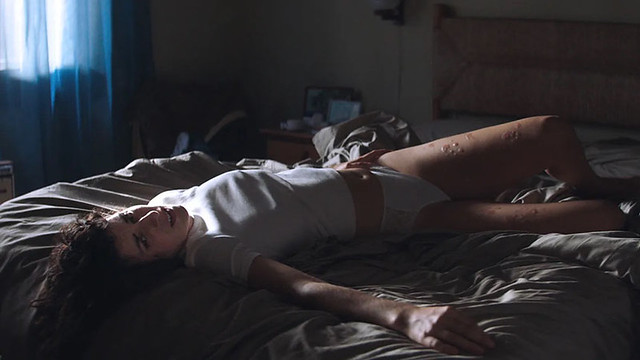
The film starts with Mila and her mild-mannered boyfriend Marcel (Oriol Pla) moving into the house of Mila’s parents, Gerard and Diana, as the old couple moves out. It’s the house by the sea that she grew up in. Mila is always horny, but her demands are met with Marcel’s frustration because he doesn’t know what Mila really wants. Mila in turn, gets hives all over her body because of the stress. She says to him she got the condition from her childhood.

The lengthy flashback in the middle concentrates on Mila as a 15-year-old girl. With her more promiscuous bestie Aina, they discover boys and explore sticky situations, as well as anonymous internet messengers for voyeuristic sexual encounters. But it’s still all normal stuff that teenagers are into.

Mila experiments with a hunky boy that she has hots for, but it doesn’t end well. She finally hooks up with a neighborhood boy whom she has known all her life. But when she asks for permission for a sleepover at his house, her father, usually very calm and loving, angrily rejects the idea. Again, Mila breaks into hives all over her lower body.

Creatura is an interesting film about how the female sexuality frightens men. The word 'uncomfortable' gets repeated twice with both Mila’s father and her boyfriend who can’t handle it whenever she expresses her desires.

In a patriarchal society, the idea that girls are either sluts or virgins, depending on their level of curiosity in sex, is embedded early on, while boys grow up expecting, at least, to get a handjob from a girl who shows even the slightest interest in you.

Martín Gimeno goes even further back to find the origin of Mila’s physical conditions with her as a pre-pubescent child, spending the summer days with her parents on the beach. She develops a strong attachment to her father, as he gives her a piggyback ride and giving her swimming lessons in the ocean.

It’s a man stroking his female companion’s bum on the beach that sears into little Mila’s head. She asks her parents to stroke her bum so she can sleep. At first, the parents are not alarmed about her clingy behavior. But her display of learned behavior frightens her father deeply, as it is not ‘normal’ for a girl to behave in what can be construed as sexual in any way.

Her father gets upset when little Mila barges into their bedroom demanding to see him naked. She breaks out in hives and it’s her mother’s turn to console her and wash her in the sea, because sea water cures it all.

After the adult Mila’s role-playing sexual game gets too uncomfortable for Marcel, he leaves. Then Mila gets to spend time with her parents alone, as they come back to console her. Now a grown woman, Mila asks her dad, who is still uncomfortable around her, if he ever felt physically affectionate toward her. This talk is a revelation to him, as he never thought about it in his life.

Creatura delves into a difficult subject to many men: female sexual desire and its brutal suppression early on. Martîn Gimeno gives a committed, bracing performance and bares it all in a film with a difficult subject matter, taking a nuanced yet frank approach, without sensationalizing its subject.

Creatura is a selection in The Director's Fortnight at this year's Cannes Film Festival.

Wednesday, May 17, 2023

Changing Times

White Building (2022) - Neang Screen Shot 2023-05-01 at 10.19.23 AM Kavich Neang's White Building is a beautiful elegy for Phnom Penh's checkered past, observed by a young man full of dreams and hopes. The old, crumbling, leaky white building of the title is the multi-household urban slum for its longtime residents. Samnang and his friends Tol and Ah Kha dream of TV stardom by entering a dance contest. When they are not practicing in front of their small camera, they drink and talk about losing their virginity until the wee hours of the morning. The vibrant Phnom Penh's colors and sounds through the eyes of these youths on their motorbike at night are very much like the early films of Hou Hsiao Hsien and Tsai Ming Liang. But things don't pan out for the youngsters as they hope. Ah Kha's family are moving to France to join their relatives and their dreams of becoming dance stars fizzle out.

In the meantime, government officials are offering residents of the building to move out, offering crumbs to relocate. Residents are split between taking the settlement money or stay put to renegotiate the terms. The idea of renovating the building on their own is not feasible anymore. The building is decaying with them living in it. Things are getting progressively, intentionally worse. The city officials are cutting off the water supply to the building. The Monsoon season is coming, and the ceilings are leakier than ever. Samnang's dad, the chief of the building on behalf of the residents, is conflicted on the matter. And his diabetic conditions worsen as he refuses to go to the doctor and must face the possibility of a leg amputation.

All things must pass. The residents can't compete with the rising tide of progress. And Samnang's family relocate to the countryside. His mom laments that despite her wishes to live as a family, all her children are leaving and going back to the city.

Gentrification happens everywhere in the world. But the building, which was a subject for Neang's 2019 documentary, Last Time I saw You Smiling, has been home for more than 400 souls. And his family was one of the those who had to relocate before the building was demolished. The director actually lived through that change. The film is soaked with melancholy, and it's all captured with crispy digital cinematography by Douglas Seok (Minari) - it's in the nighttime scooter ride, it's in the clothes lines hanging in the building, it's in the growing big moldy stains on the ceilings, it's in the empty apartments with the remnants of past lives, it's in the silhouette profile of Samnang's dad under the mosquito nets at night. Contemplative and full of longing with its characters witnessing the progress replacing the memories of its inhabitants with glass and metal skyscrapers in real time, White Building serves not only the filmic record of lives from not so distant past but also reflects on youth and their resilience and optimism in the face of change.