Showing posts with label Film Series. Show all posts

Wednesday, March 12, 2025

Preview: First Look 2025 at MoMI

A highlight of the MoMI’s annual film programs, the 14th edition of First Look returns March 12–16 with a diverse lineup—38 films including 4 world premieres and 23 U.S. or North American premieres, representing 21 countries—beginning with the New York premiere of Durga Chew-Bose's Bonjour Tristesse with the director and star Lily McInerny in person. Half of all films in the festival this year, including opening night, are directed by women. The full schedule and advance tickets are available here.

Below are some of the most intriguing titles I was able to sample:

Bonjour Tristesse - Durga Chew-Bose Screen Shot 2025-03-10 at 12.54.48 PM The original 1958 version, a cautious coming-of-age tale directed by Otto Preminger, made a star out of pixie-cut Jean Seberg (later to be immortalized in Godard's Breathless). It seemed Bonjour Tristesse was primed for an update. Durga Chew-Bose, a Canadian filmmaker, makes it her feature debut with Claes Bang as Raymond, a widowed father, Chloe Sevigny as Anne, Raymond's old friend, an elegant fashion designer from Paris and Lily McInerny as Cécile, a wide-eyed seventeen-year-old, trying to fix up her father's love life. In Chew-Bose's hand, this sun-drenched, French Riviera set fairy-tale-gone-wrong plays out like an elegant chamber piece, beautifully shot by Maximilian Pittner. She concentrates on the tender father-daughter relationship with a hint of sadness.

Sevigny, playing against type as an uptight, motherly Anne, with an air of unapproachability, a wounded woman being denied of her long-lost love for the second time. With decidedly old fashioned - costumes, the old parent-trap theme, Bonjour Tristesse doesn't feel like it belongs in 2025, but this reboot is fun, nonetheless. Desert of Namibia (2024) - Yoko Yamanaka Desert of Namibia Yoko Yamanaka, who made splash with her first low budget feature Amiko (2017) when she was just twenty, is at it again with her second feature, Desert of Namibia. This time, her protagonist is not a High School girl, but a wayward 21-year-old, bouncing from one boyfriend to another, having a hard time fitting into a rigid society, where things are in decline and there's no real prospect for the future, as a young zoomer woman.

Kana (Yuumi Kawai), a gazelle like beauty is first seen wondering around Tokyo, meeting a friend, who informs her the suicide death of one of their friends. But she is distracted by other peoples' conversations spilling in her earshot. The dissociation is a dominant feature in the film. One minute Kana is happy and sunny, the next, she is moody and unresponsive. After leaving a live-in boyfriend in their tiny apartment, she moves in to another crammed one with Hayashi (Daichi Kaneko), an artist. Both men are enamored of her. But she soon finds faults in men and become volatile in her relationships.

There's a scene Kana takes a tumble on the stairs outside their apartment after a heated argument. She is briefly hospitalized with a neck brace. But Kana's anger doesn't stop there. Everyone tells her that she is free to do whatever she wants and choices she makes in life is entirely hers. But it's as if she is watching her daily life (physically fighting with Hayashi) on her phone while on treadmill - which Yamanaka includes later, as a movie within a movie. The general idea of survival and foreignness Kana feels is suggested in the film's title. The handheld camera work and long takes in tiny spaces, Yamanaka captures the intimacy and suffocation that Kana feels expertly.

Israel-Palestine on Swedish TV 1958-1989 - Olsson Israel-Palestine Göran Hugo Olsson's new, well-timed archive-based documentary once again culls materials exclusively from Swedish Public Broadcasting (SVT), seeing the Israel-Palestine conflict from an as much non-partial point of view. But even with the wealth of footage, Olsson puts in the beginning of the film that 'the archive material doesn't necessarily tell us what really happened but says a lot about how it was told.' What's not shown or omitted holds just as much importance, he seems to suggest. These snapshots of 40 years of footage, with numbers, dates, the producer's names, the original title, and the type of film stock (up until the 80s) on 'archive cards', chronicles the rise of the State of Israel and 'The Palestine Problem'.

It features many of the movers and shakers of the region over the years, all of whom contributed to the downward spiral of the circle of violence and suffering. It illustrates when the powers-that-be lose the sight of the people, even while attempting to solve the Problem. It also suggests that it is unreasonable that a state exists on religious foundation in this day and age. As we go through early reports on Israeli society through 1967 war and tumultuous 70s, Sabra and Shatila Massacre and the collapse of Soviet Union, it shows how the public opinion has shifted as Israel's aggression intensified over the years. If anything, this clear-eyed, 3 1/2-hour documentary gives the historical and political context to what is happening in Gaza right now.

100,000,000,000,000 (2024) - Vernier Virgil Vernier Taking place in glitzy Monaco near Christmas time, Virgil Vernier's new film focuses on Alfine, an escort who describes himself as having a nice ass, nice lips, nice cock but lacking initiative. Not having a permanent residence, Alfine jumps from one client's luxury home to another and wonders around the port city-state lit up with Christmas decorations and lights, luxury shops, and shorelines filled with million-dollar yachts. He and his escort friends talk about opening an agency and their shallow dreams. Then he gets to babysit Julia, a twelve-year-old Chinese girl whose super rich developer parents are away on holidays. She says that her father is building an offshore island equipped with bunkers. She ominously tells Alfine that something bad is going to happen in the near future and she wants him to be on the island. The society we are living is in many ways incomprehensible. A million, trillion, quadrillion- numbers so big they lose all meaning and don't contribute to anything to our lives.

As usual, Vernier (Mercuriales, Sophia Antipolis), examines the seedy underbelly of our shallow modern society, urban isolation, loneliness, and human connection. Virgil Vernier remains to be one of the most interesting contemporary French directors working today.

Wednesday, April 25, 2018

Art of the Real 2018 Preview

Art of the Real, FSLC's annual celebration of non-fiction cinema is back and remains my most anticipated cinema event even in the city that is not in short supply of great film series all year round. An amazing array of genre-defining, ever expanding cinematic experiments are presented to satiate your inquisitive cinematic minds! This year's lineup includes Infinite Football by Corneliu Porumboiu, Sergei Loznitsa’s Victory Day, Kazuhiro Soda's Inland Factory, and many more.

Again, Art of the Real is an immensely rewarding cinematic experience both in form and content. Don't miss it!

Art of the Real runs from April 26 through May 6, 2018 at Film Society of Lincoln Center in New York. Please visit FGSC for more info.

Here is preview of six notable films for your pleasure:

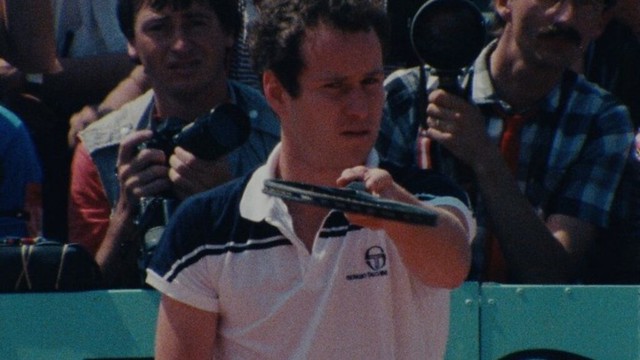
John McEnroe: In the Realm of Perfection *Opening Night Film
Screen Shot 2018-04-14 at 3.04.00 PM
This terrific, archival footage documentary starts with a Godard quote - "Cinema Lies, Sport Doesn't." A French archivist Julien Faraut stumbled upon hours and hours of 16mm shot French Open matches at Roland Garros, initiated by Gil de Kermadec, the first director of French Tennis Federation, to study and make instruction films for aspiring athletes. But what Faraut saw was a compelling, verité style portraits of each players, and especially of McEnroe, who was at the time, the number one player in the world.

It happens that McEnroe wasn't a good model as an athlete who had atypical style for these often rigid, dry instructional films. His form was unusual and his methods were unpredictable, which gave his opponents a hard time. As a perfectionist of the game, he hated incompetency of people in the court and as a result, we've got to know him as who shouted and argued with umpires endlessly. He also hated being filmed or photographed. There are several moments where he stops the game to complain that the rolling cameras were bothering him while looking straight into camera.

Like last year's Dawson City: Frozen Time which uncovered the intersection of Gold Rush and cinema, In the Realm of Perfection finds the intersection of sport and cinema. Drolly narrated by Mathieu Amalric, Faraut creates Chris Marker style film that is both entertaining (thanks largely to McEnroe being himself) and thoughtful. The epic match between McEnroe and his long time nemesis Ivan Lendl in 1984 captured in grainy 16mm is literally, epic.

Casanova Gene
Screen Shot 2018-04-15 at 11.12.14 AM
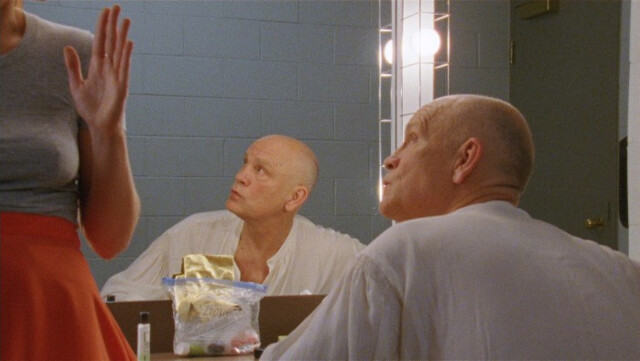
German filmmaker Louise Donschen examines desire of all forms in Casanova Gene and it's a fascinating one. In evolutionary biology studying finches in a science lab in the woods, an ornithologist tells us why female finches cheat on their partners - they inherited the Casanova gene from their fathers, as male finches are polygamous. "Is it beneficial to female finches?" the filmmaker asks off the frame and the ornithologist doesn't have an answer. John Malkovich plays Casanova or Malkovich the actor playing one, as he is interviewed by the filmmaker. He simply describes himself as a slave to his senses and explains the difference between character and temperament.

Carnival in Venice is juxtaposed with a church and the clergymen. Kids play in the forest, lights change, illuminating the rooms through the window, a dominatrix in SM studio holds a session, a hypnosis takes a place where a woman experiences intense orgasm. Then there is staged bar scene where transman complains that he misses uterus.

The colors - the red of the roses, orange beak of the finches, grey and red of the clothes- everything surreptitiously intermingles in this seemingly fragmented, yet arresting film that reminds me of the work of Alexander Kluge. A real gem.

Infinite Football
Screen Shot 2018-04-17 at 9.12.33 AM
Romanian helmer Corneliu Porumboiu (Police Adjective, 12:08 East of Bucharest) makes a wacky yet poignant documentary about his childhood friend Laurentiu Ginghina, a middle aged bureaucrat who is obsessed with changing the rules of soccer to make the sport safer. At 19, he fractured his right fibula as many players in the opposite team ganged up on him in the corner when he had the ball. Because of the injury, he had to give up hope of going professional. Now he is hell-bent on changing the game - he wants to implement octagonal shaped soccer field with sectioned groups where 5 offensive and 5 defensive players can't cross each other's lines and no offsides. He says this improvement will speed up the game and make it smoother and safer.

He wanted to go to Forestry university but it required physical where you had to run which he couldn't do with his leg. His dream of coming to the US twice - first to run the ranch out in the West, then in Florida, gets thwarted by 9/11 and its aftermath with tighter restrictions. He ended up where he is, some desk job which is not that exciting. Ginghina's sad sap story, told in his office where he keeps getting interrupted with his daily tasks- an old lady with her inheritance questions, paperwork, meetings and appearances, brings out chuckles rather than sympathy.

Porumboiu prods his friend's obsession about 'the ball being free' in a sport where beauty is in player's skills and the ball is just an object. Our bureaucrat obviously is self aware, that deep down he equates himself with the ball and trying to escape from tight corners. That he sees himself as a superhero from comic books, like Superman or Spiderman who has a normal boring dayjob. Is his situation a stand-in for the general disillusionment with European Union, felt by majority of its members? Maybe.

After seeing his plan implemented on the indoor soccer field to not so enthusiastic results, he keeps changing his rules and therefore his creation being tagged as Infinite Football by Porumboiu. The film ends with Ginghina's poignant and touching monologue about the world where there is less violence which the director equates for political utopia. There is no fast zoom in/freeze frame or zany music for cheap laughs. Nor the film intentionally demeans our silly bureaucrat. Just like other Romanian new wave compatriots, Porumboiu knows how to justly reflect the lives of ordinary Romanians finding themselves riding along in a rapidly changing world and facing mildly amusing situations.

Braguino
Braguino
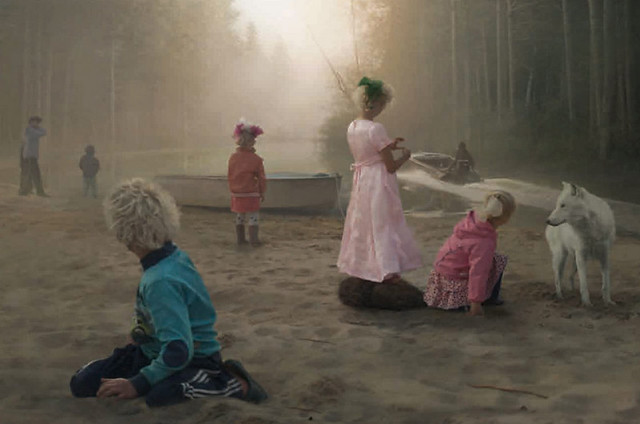
A French visual artist and film director, Clément Cogitore whose supernatural tinged Afgan war thriller, Neither Heaven Nor Earth, made waves at the film scene few years back, travels to remote Eastern Siberia to document the Braguinos, a family living off the environment. The head of the family tells us that they wanted to get away from it all, so they just packed up and left on their boat. Their 6 children were all born in the taiga. It is clear that the Braguino clan is not only dealing with family rivalry with the neighboring Kilins just other side of the river, but dangerous animals - especially bears and also ever expanding human presence in the region.

Cogitore and his cinematographer Sylvain Verdet is there to capture what can only be described as Tarkovsky-an beauty in rather dream-like Siberian taiga. The natural beauty is only accentuated by fair-haired Braguino children in their colorful dresses and clothes. As the helicopters full of heavily equipped newcomers landing on their territory, we all know that the happy days of the Braguinos are numbered. It's a striking non-fiction filmmaking featuring otherworldly beauty.

Milford Graves Full Mantis
Screen Shot 2018-04-21 at 10.06.50 AM
Milford Graves, a free-jazz percussionist, records his heartbeat with a self-made EKG machine hooked up to the computer and makes electronic melodies out of it. He is also a martial art enthusiast and practitioner- he learned his moves through studying preying mantis instead of going to a local dojo. His style is Yara, a yerba word for 'Nimble', a mixture of West African dance moves and martial arts. In the labyrinth of books, machines, instruments, artifacts of his house/studio in sunny South Jamaica in Queens, Graves reminds you of your eccentric uncle- a smart person with full of self-taught knowledge who forms a philosophy of life with first-hand experience. And when he plays, it's electrifying.

Relying completely on Graves' words, Jake Meginsky and Neil Young creates a compelling portrait of a modern day sage and a fantastic storyteller who is approachable and very down to earth. As he talks about his music being the conduit of vibrations of cosmos, you listen. He might be the remnants of 60s mind-body-spirit mumbo jumbo, but the way he is so in tune with nature, as he does gardening in his back yard, as he in tune with his body- his world view makes sense, especially now, when the whole world seems to have gone crazy.

All That Passes Through a Window That Doesn't Open
ALL THAT PASSES BY THROUGH A WINDOW THAT DOESN'T OPEN
Martin DiCicco's film charts transcaucasian trail on two side of tracks - Azerbaijan and Armenia. Once a vibrant railway system linking Turkey - Georgia - Armenia and Azerbaijan which served as the crossroads of Eastern Europe and West Asia left in ruins by decades of neglect and regional conflict. Without saying much of its very complicated geo-political history, DiCicco elegantly concocts tale of two countries, one with full of hope and looking forward, the other reeling from the ghost of the past.

In the first 2/3rd, it concentrates on Azerbaijani side, where mostly young migrant workers living on the train cars while they travel to upgrade the railways. Voices of some of its workers narrates their days on the rails, how it's lulling affects their bodies own senses and memories. One says he likes railway works because it's measurable against time. That there's sense of accomplishment as he and his co-workers go closer to their destination. There's dancing, drinking and sense of camaraderie and dangers of accidents too.

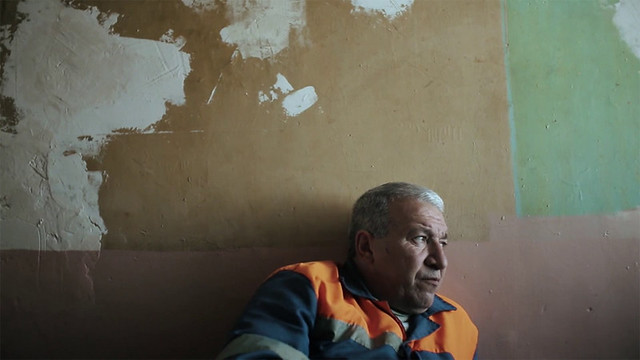
After the war between two countries and neighboring Turkey supporting the muslim Azerbaijan and closing off its borders in 1993, Armenian side of the tracks which was a lifeline for trade to the west and east, left to rot. The last 1/3rd of the film features an Armenian station agent guarding the one such neglected station, waiting for it to be open again. His words and accompanying visuals are poignantly drawn out.

All That Passes Through... invokes the poignancy of Kiarostami's road films in contemplating on the time passing. DiCicco and his editor Iva Radivojevic draw a evocative picture of the region full of history, longing and hope.

Thursday, January 7, 2016

Get Your New Year's Cinephilia on with MoMI's First Look 2016

 photo f47fab6b-321b-4584-95eb-715da807daa9_zpsg3wnub0n.png
Starting this Friday and running for three consecutive weekends (1/8-1/24), in their beautiful state of the art theater in Queens, Astoria, the Museum of Moving Image's First Look Film Festival is fast becoming a new New York institution for many film aficionados. Selecting its roster from cinema's most cutting edge filmmakers, the 5th edition of First Look opens with the US premiere of Alexandr Sokurov's new film Francofonia.

Switching gears a bit this year with guest programmers such as Jean-Pierre Rehm of FIDMarseille, and Aliza Ma of Metrograph and Mónica Savirón, along with chief curator David Schwartz, this year's eclectic roster is heavy on the experimental/avant-garde/documentary.

It includes renowned experimental filmmaker Ken Jacobs' new films in 3D, Canadian video artist Dominic Gagnon's youtube culled Inuit epic Of the North, artist Margaret Honda's 70mm silent film Spectrum Reverse Spectrum, short films of Austrian visual artist Björn Kämmerer and Philippe Grandrieux's new film, Meurtrière (his continued exploration of bodies which started with White Epilepsy).

Then there are behind-the-scenes documentaries from Léa Rinaldi (This is What It Is- about Los Aldeanos, the most popular hip-hop group in Cuba, Traveling at Night with Jim Jarmusch and Behind Jim Jarmusch), a documentary on João Bérnard da Costa, a director of the Portuguese Film Museum in conjunction with Nicholas Ray's Johnny Guitar.

Here is how chief curator David Schwartz describes this year's edition in the press release:

This year's edition is a true cinephile's feast, filled with works that reflect on the medium itself, that urge us to reconsider our intimate connection to the ways that we experience cinema. as always, the films in First Look cannot be easily defined. They are artisan works, expressing distinct personal visions, with a strong emphasis this year on avant-garde cinema. To engage in the new possibilties of an art form is also to engage with the past, and this edition of First Look contains an ongoing dialogue with film history, with a selection of older works in dialogue withthe many premieres.

Twitch's own Christopher Bourne will be reporting on some of these selections in a short while, so keep a look out.

First Run Film Festival 2016 runs 1/8 to 1/24 at Museum of Moving Image. Please visit MoMI website for further information and showtimes.

Tuesday, April 7, 2015

KINO! 2015 Contemporary German Film Festival

KINO!, a celebration of contemporary German films, returns to New York for its 36th edition, setting up shop at Cinema Village in the West Village for the second year, April 9 - 16.

Selected from across the great expanse of different genres and from seasoned directors and newcomers alike, this year's edition features 10 features and 8 shorts, including new works from Christoph Hochäusler (The City Below, I am Guilty), Christian Zübert (Three Quarter Moon) and TV veteran Uwe Janson, as well as from rising stars Baran bo Odar (The Silence), Philippe Lienemann, Stephan Altricher and Neele Leana Vollmar (Vacation from Life).

In addition to the screenings, there will be panel discussions at Goethe Institut and Deutsches Haus for Beltracchi: The Art of Forgery and The Lies of the Victors with filmmakers attending.

KINO! 2015 runs April 9 - 16. Please visit Kino! 2015 website for more info and tickets.

Here are samples of five films I was able to catch:

The Lies of Victors
 photo 47e75f6a-42bb-4e81-ac3d-27363af69813_zpsydn81dls.jpg
Christoph Höchhausler's latest is a sleek, taut political thriller in the vein of All the President's Men and Z. Florian David Fitz (also representing Tour De Force in the series) plays a hotshot reporter named Fabian who had established himself with his Afgan war coverage for the fictional Berlin magazine Die Woche (The Week).

He is digging up some dirt about PTSD and toxic poisoning in vets returning from tours in Afghanistan. He is assigned a new perky intern Nadja (Lilith Stangenberg) to help him out by his editor-in-chief. Fabian who has always worked alone, resents her company at first and throws some unrelated story at her to investigate. It turns out that the story of a man who threw himself into a lion's cage has a connection with his PTSD story. But is he getting played by everyone? Is Nadja really who she says she is?

Without ever using car chases or gun fights, Höchhausler creates an engrossing thriller. Fabian doesn't really know that a powerful firm representing a big German chemical company which has ties with the politicians, is watching his every move and feeding false leads, every step of the way. And when Fabian realizes the fact, it's already too late.

With stylish back and forth dolly shots and 360 pans and a Howard Shore resembling, tense soundtrack (expertly arranged by Benedikt Scheifer), The Lies of the Victors is a sumptuous neo-noir experience.

Beltracchi: Art of Forgery
 photo ad26f2a0-045d-4c3d-ba54-8fbc58a70c7e_zpss09ify9f.jpg
This documentary tells an exciting story of master art forger, Wolfgang Beltracchi, who claims to have forged over 300 paintings by 20th century masters - Max Earnst, Heinrich Campendonk, Fernand Léger and others over 35 years. He's no mere copy artist. What's impressive about this long haired, affable aging hippie is his ability to convincingly forge 'new' paintings of those said artists' 'gap years' through meticulous research and craftsmanship thus tricking even the scholars and specialists of the art world.

Beltracchi and his accomplice/wife Helene, played the art market well, and made millions without getting caught until recently. Beltracchi not only illustrates the brilliant conman's career but also tells the sweetest love story ever told.

King's Surrender
 photo a4ae8dc7-c2be-404d-960a-805a38cab89a_zpsphuzxlze.jpg
A taut police thriller starring Ronald Zehrfeld (Barbara, Phoenix) and Misel Maticevic (In the Shadows). They play members of a tight knit special unit SWAT team. The country under austerity measures, things are tightening up even in the police headquarters. Some of the special unit resort to taking bribes.

After a bungled raid, team members are dropping like flies in what seems to be execution style revenge killings. Hot-headed Mendez (Maticevic) calls for blood while Kevin (Zehrfeld) digs deeper into corruption inside their unit and up the chain of command.

These testosterone filled, wayward cops involve themselves inadvertently in a conflict between local gangs and that proves to be a fatal mistake. With great cast, tense atmosphere and heart pounding suspense, King's Surrender is a gripping policier that rivals any Hollywood production.

Schmitke
 photo fa0a0393-cf5f-415a-8738-453a3be407d3_zpsdywocslm.jpg
Stephan Altricher directs a modern day retelling of Don Quixote in Schmitke. Schmitke (Peter Kurth) is a middle aged wind turbine engineer who dreams of being in the forest, away from his city life filled with jack hammers and traffic noises. Every morning he listens to the news of the discovery of a man who's been living in the forest alone. This so called Bear-Man is apparently refusing any help from authorities and only longs to go back to the forest. But being a prototypical German engineer who takes pride in his work and efficiency, Schmitke doesn't really buy into spiritual mumbo-jumbo that his daughter who just got back from India, talks about or the Bear Man.

He gets a chance to go into the mountains in the Czech Republic for maintenance work on a wind turbine, a model he practically designed, which stopped working. With his young, slacker assistant Tomas (Johann Jügens) in tow, he drives to the small mountain town.

Upon arriving, they notice an unending loud noise that sounds like a constipated dinosaur coming from the mountain. It turns out to be coming from the creaky wind turbine in question. But whatever he tries, the turbine is not responding. After getting icy receptions from the townsfolk and sleepless nights at the local inn, our engineer discovers that Tomas has disappeared. From a sexy local business woman Julie (Helena Dvorakova), Tomas was last seen talking about some mystical power of the forest and Bear Man. Schmitke's wild goose chase begins.

The yearning for nature and the process of giving into something bigger than yourself against reason takes a center stage in Schmitke. Kurth's plays the title character straight with his stone face and matter-of-factness which works well in this droll comedy. Shot beautifully by Cristian Pirjol in the Ore mountains of the Czech Republic, and with amazing sound design by Paul Wollstadt, Schmitke is a great surrealistic comedy.

Who Am I: No System is Safe
 photo 9bf0d468-c03b-419d-80b6-4ad08e2f18da_zpsp0xqlfdb.jpg
In the wake of North Korean hackers scandal, Baran bo Odar (The Silence) offers a fast paced, slick cybercrime thriller Who Am I: No System is Safe. It starts out with our unreliable narrator, Benjamin (Tom Schilling, looking like young Edward Norton) turning himself in to authorities, telling how it all started. Ben is a socially awkward, self-admitted misfit, who grew up in front of the computer. He is recruited by a group of fame seeking hackers and together they build CLAY (acronym for Clowns Laughing At You) with clown masks from his grandma's house.

They hack into various financial systems and pharmaceutical buildings, mostly for laughs. But more than anything, they want their cyber idol MRX's approval, whose driving mottos are 1. No system is safe, 2. Aim for the impossible, 3. Don't limit your fun to the virtual world.

They hack into German cybercrime unit to impress MRX but it turns out that MRX has other plans when it comes to eliminate the competition. Now the crew doesn't think the fame is worth risking their lives.

Co-scripted by his writing partner Jantje Friese, bo Odar creates a tension filled, cat-and-mouse thriller with lots of twists and turns. Elyas M'Barek (The Wave, City of Bones) plays charismatic Max, Hannah Herzsprung (4 Minutes, Beloved Sisters) plays Marie, the love interest and great Danish actress Trine Dyrholm (The Celebration, A Royal Affair) rounds up the top notch supporting cast as the seasoned Europol investigator. Who Am I is a superbly created entertainment. Hollywood should recognize bo Odar's talent sooner than later.

Thursday, February 19, 2015

Film Comment Selects 2015 Preview

Film Comment Selects, Film Society of Lincoln Center's annual film series that showcases the best films from all corners of the world selected by folks at Film Comment magazine, marks the arrival of spring for New York cinephiles in otherwise dreadful February/March movie season.

This year's selections are as diverse as ever; the series blasts off with Mark Hartely's hilarious doc Electric Boogaloo: The Wild, Untold Story of Cannon Films with some of Cannon's greatest hits as the sidebar selections, includes Larry Clark's Kids part deux- The Smell of Us (skater kids in Paris, this time), the late Mike Nichols tribute to his underrated, underseen The Fortune, Philippe Garrel's rarely screened elegy Un ange passe, a special screening of the original preview cut of Joe Dante's Gremlins (featuring five additional minutes!), as well as many festival favorites- Shinya Tsukamoto's remake of Fires on the Plain, Justin Benson & Aaron Moorhead's Spring, Tetsuya Nakashima's The World of Kanako and Christian Petzold's new film Phoenix. The series also shed a six-film spotlight on autobiographical Danish auteur Nils Malmros.

I was able to sample films below from the series lineup. The Film Comment Selects runs 2/20 - 3/5. For more information and tickets, please visit FSLC website

THE SMELL OF US - Larry Clark
 photo 4edb0dde-9c7c-4051-8bde-68cc9c616a41_zps9qj6n6qi.jpg
It's been 20 years since Larry Clark made Kids. Now in his 70s, Clark hasn't changed his tune one bit. The setting now is in Paris and young skaters and hustlers are now armed with iphones to memorialize their sexual escapades. But everything else is pretty much the same. Even though there are a lot of skins and explicit shots, the impact is far less shocking to anyone in this internet age.

The thin story centers around Mat/pacman (Lukas Ionesco), a San Sebastian-esque beauty who is 'only gay for cash'. Everyone is in love with him, including his best buddy JP/Babyface and only visible girl in the group, Marie. There are a lot of flabby, monstrous old men/women lusting for young flesh in this film, including cameo from Clark himself as a drunk homeless man they call Rockstar (yeah right).

The Smell of Us makes the word 'disaffected' even more tiresome. The kids in the film are not only rebels without a cause but brain, emotions and everything that makes interesting characters. It is too obvious that only thing left to sell is their youthful body. In this day and age, I don't think that cuts it anymore.

SHOCK VALUE: How Dan O'Bannon And Some USC Outsiders Helped Invent Modern Horror
 photo 6269208a-e93c-4413-a70e-e7a05945d9a6_zps56dbf2am.jpg
USC, the school responsible for incubating such Hollywood filmmakers as George Lucas, Ron Howard and Rian Johnson, was also the place to be for successful genre filmmakers in the late 60s early 70s.

USC archivist Dino Everett lovingly strings together the works of USC Film School collaborators - Dan O'Bannon, John Carpenter, Charles Adair, Terence Winkless and Alec Lorimore in this no frills anthology. Obviously these are raw, amateurish student films but there are clear evidence of seeds of what's to come in genre filmmaking being planted, especially in Adair's riveting The Demon, predating Texas Chainsaw Massacre and sharing the same spirit of Night of the Living Dead and Winkless & Lorimore's Judson's Release being a precursor to Carpenter's Halloween. I would loved to have seen Carpenter's thesis film Lady Madonna- the anthology includes some of the sound recordings of the film without the picture since the negatives of the film are said to be lost.

BYPASS - Duane Hopskins
 photo 4b04fa5d-c60b-48c4-a9d2-352a87514f6a_zpsi0jvlr6q.jpg
Duane Hopkins' Bypass is yet another great example of social realism set in British working class neighborhood. It fits somewhere between the works of Lynne Ramsay, Andrea Arnold and Shane Meadows, owing everything to, of course, Alan Clarke, Bill Douglas and early Mike Leigh. Gracefully lensed by David Proctor and beautifully acted by the principles, the film rises above other depressing, small time thugs dramas set in England.
Bypass tells a story of the Locketts. Fatherless with bedridden mom, the eldest Greg (Benjamine Dilloway), a former soccer player whose dreams are crushed by the leg injury, deals in petty theft to support the family. But when he is caught and locked up, it's a sickly younger brother, Tim (George MacKay, in a star making turn)'s turn to provide for the family, dealing with pretty much the same set of local lowlifes. Things get complicated when bill collectors and child welfare services are hounding him and his younger sister and his angelic girlfriend, Lily (Charlotte Spencer) gets pregnant.

Hopkins shows his talent for effortless pacing, change of POV and smart, economical storytelling without losing sight on the characters innate goodness and warm heart. Brooding and tense, Bypass showcases another major talent in the making in British cinema.

VOICE OVER - Cristian Jimenez
 photo f5da728c-55ad-46d6-b328-b78deb9bcaf8_zpschwhw1vw.jpg
Chilean director Cristian Jimenez's Bonsai has been on my radar for a while. His new family dramedy Voice Over is a well written, well rounded film. It tells the story of Ana (Ingrid Isensee), a pretty, thirty something, unemployed, divorced mother of two young children, dealing with life's all messiness- while taking care of her two kids who are growing up fast, she finds out that her seemingly happy parents are separating, then her bossy older sister comes back home after getting Ph.D on anthropology with her hunky French husband and a new baby in tow. A failed actress, now Ana is trying to be a voice over artist for commercials. Even though Ana is the supposed protagonist of the film, Jimenez gives equal attention to each character and makes them all shine.

I really hate familial archetypes, 'quirky' characters in American comedies. Jimenez wouldn't have any of that. They are well developed, yet far from perfect people who are trying to cope with the curve balls life throws at them. There's birth. There's death, First sign of womanhood, sibling rivalry, rusty nail in the yard, veganism, heartbreaks and forgiveness, but nothing seems far fetched or outrageous for quirk-sake. There isn't a moment in life where a smooth voiced narrator explains everything that everything will be okay, like in movies. Jimenez has a real eye and ear for life's little incongruities. The result is a rich and rewarding viewing experience.

HIGH SOCIETY - Julie Lopes-Curval
 photo 95fd6078-9a9a-4853-b1f3-e59999d5e253_zpsabzenlax.jpg
Alice (Ana Girardot) is at a stage where she is trying to find her artistic voice. The thing is, she's from a single mother household, works at a cake shop and lives in a small town in Normandy. Knitting is her thing. After many weeks of hesitation, she asks for a recommendation letter for entering a prestigious art school in Paris from a wealthy woman in fashion industry who frequents the cake shop and has a villa in Normandy. Once she is accepted by the school, she gets involved with the woman's son Antoine (Bastien Bouillon) who quits a business school to become a photographer. He is a proto-hipster, rebelling against rich parents and living that bohemian lifestyle in Paris.

For the rest of the film, we witness the education of Alice- on finding her artistic voice, on life. Even though she loves Antoine, he involuntarily keeps reminding her the deep divide in their class differences- it's in the things he says and does nonchalantly, even innocently that hurts her.
High Society is beautifully written by Sophie Hiet and director Julie Lopes-Curval. I can't think of another movie that deals with class differences so subtly (explored in Blue is the Warmest Color but better here). Rich and poor aren't grotesquely exaggerated caricatures here. Girardot is adorable as a young woman finding out that there is a bigger world out there and that there is so much to learn and explore without compromising the sense of who she is and not forgetting where she's from. A beautiful film.

TREE OF KNOWLEDGE - Nils Malmros *In Focus
 photo a007ae5a-ff04-4369-bef3-75eb808122ad_zps2heclwoh.jpg
Nils Malmros chronicles bittersweet days of his adolescence in the 50s Danish intermediary school. Tree of Knowledge concerns a dozen kids in the same class, as they start noticing opposite sex- love at first sight, jealousy and heartbreak ensue. It is quite apparent that Malmros was doing way back then what the social realist like the Dardenne Bros are doing now. Almost documentary like, he gets full access to the lives of these youngsters and gets amazingly naturalistic performances. These episodic days of 13 year old boys and girls are mad affecting. Particularly, in the case of Elin, a tall sullen brunette from an ultra conservative household who gets ostracized because she is a prude, both by heartbroken, monstrous boys and cliquey, jealous girls. Then there is Niels-Ole (Jan Johansen), a leader and general rabble-rouser of the pack, falls hard for beautiful Maj-Brit (Lone Elliot), only to find out that our little Maj-Brit 'has been around with many boys'.

Malmros masterfully orchestrates 2 years of the lives of the group (here's looking at you Linklater!) and ends the film just as swiftly, leaving us wanting more and appreciating the fleeting nature of those precious days in equal measure.

*The series include following Malmros films: Arhus by Night, Boys, Facing the Truth, Pain of Love, Sorrow and Joy and Tree of Knowledge

NINJA III: The Domination - Firstenberg *Cannon Films Tribute
 photo e361c52a-15bd-4eee-8e3a-259ad64c4f24_zpsp68rchsd.png
Christie (Lucinda Dickey) is just ordinary working gal: she works for a phone company, climbing up the telephone polls in a cute jumpsuit, then changes to a neon colored leotard to teach an aerobics class. She encounters a dying ninja who just killed about a hundred LA cops along with his intended victim. His soul gets transferred to Christie and she becomes an unstoppable cop killer.

Ninja III, steeped in 80s typical cheesy settings- Patric Nagel poster, squiggly neon tubes on the wall and public phone booth in the living room, is an epitome of a Cannon b-picture ridiculousness. You just have to surrender yourself to it and it will reward you handsomely.

*Cannon Films Tribute includes the following masterpieces: 10 to Midnight, The Last American Virgin and Ninja III: The Domination


Tuesday, October 14, 2014

By Maguerite Duras at FSLC

Screen Shot 2017-06-16 at 6.58.49 AM With 4K digital restoration and re-release of Alain Resnais' 1959 classic, Hiroshima Mon Amour, Film Society of Lincoln Center announces a series devoted to the film works of a Nouveau Roman giant Marguerite Duras who provided the screenplay for the film. Duras, along with Alain Robbe-Grillet, was part of the Left Bank film movement and hugely influential for coming of  French New Wave.

Putting a big emphasis on mood and dialogue, Duras' elliptical stories have long been well regarded and respected by the film giants like Resnais and Godard. The film series presents 10 features and 3 shorts, 9 of which she directed - notables include, India Song, Le Camion, Natalie Granger, Madmoiselle (dir. Tony Richardson), Moderato Cantabile (dir. Peter Brook) and Every Man for Himself (dir. Jean-Luc Godard).

The series is a rare opportunity to catch some of these seldom available films anywhere on 35mm prints, written/directed by one of the most influential post-war French writers.

By Marguerite Duras
runs 10/15 - 22 at FSLC. Hiroshima Mon Amour will open at Film Forum and FSLC on Friday, October 17 in and Los Angeles at the Laemmle Royal Theatre following its sold out screening at the 2014 New York Film Festival. Long unavailable for exhibition in the US due to rights issues, it will be released nationally in a spectacular new 4K restoration.

The Film Society of Lincoln Center announced today By Marguerite Duras, October 15-22, a weeklong retrospective of the film work by the novelist, essayist, and playwright on the occasion of her centennial, and the re-release of Hiroshima Mon Amour at the Film Society on October 17. Duras directed 19 features and short films, many adapted from her own work, all exceedingly difficult to see in the U.S., until now. The lineup includes a selection of her formally daring films, movies adapted from her writing, short films, and more, all on 35mm.
Best known as a leading literary figure in postwar France with award-winning books, Duras's early novels were considered more conventional in form until Moderato Cantabile (1958), which was more experimental and placed the focus on what was not said. At 45, Duras penned the screenplay for Alain Resnais's Hiroshima Mon Amour (1959), whose nonlinear plot and elliptical editing would greatly impact the burgeoning French New Wave (a movement whose literary analogue, the Nouveau Roman, Duras was tangentially linked to). Its radical use of voiceover anticipated the disjunction of sound and image that would become her calling card.
By Marguerite Duras includes her solo directorial debut, Détruire dit-elle / Destroy, She Said adapted from her own play, and Les Enfants, winner of three prizes at the Berlin International Film Festival, which was Duras's final film as a director. Other highlights include Le Camion / The Truck, which was nominated for the Palme d'Or at Cannes; Moderato Cantabile, for which Jeanne Moreau won Best Actress at Cannes, and Jean-Luc Godard's Sauve qui peut (la vie) / Every Man for Himself, which he introduced as "my second first film," and is characteristically cerebral and peppered with literary allusions, including an unforgettable anti-cameo by Duras.
Special thanks to the Institut Francais for the loan of their prints, and the Cultural Services of the French Embassy for their support.

Films, Descriptions & Schedule
Agatha et les lectures illimitées
Marguerite Duras, France, 1981, 35mm, 85m
French with English subtitles

Hiroshima Mon Amour at the shore. A brother and sister (Yann Andréa and Bulle Ogier) meet at a seaside hotel to confront the nature of their relationship and try to achieve closure with the past. Their love for each other and its manifestations emerge in voiceover, with Duras herself articulating the sister's thoughts. Eschewing traditional approaches to storytelling, Duras keeps the siblings off-screen or obscured for much of the film and never allows them to share the frame. Her camera prowls the deserted hotel lobby and sometimes catches itself in the mirror, analogizing the film's reflective themes.
October 21, 8:30pm

Le Camion / The Truck
Marguerite Duras, France, 1977, 35mm, 80m
French with English subtitles

Initially conceived as the story of an older woman hitching a ride with a trucker, bemoaning the demise of the revolution and the impoverished state of society ("the world has gone to rack and ruin"), Le Camion ("The Truck") is the film that ensued when Duras couldn't find a suitable actress for the lead. Instead, she and Gérard Depardieu sit at a table and read from the script, discussing the film that might have been, with periodic cutaways to a truck driving along the highway at night. Celebrated by figures as disparate as Pauline Kael and John Waters, Le Camion was nominated for the Palme d'Or at Cannes and hailed by Jonathan Rosenbaum as "one of Marguerite Duras's most radically minimalist features . . . [also] one of her best, as well as one of her most accessible."
October 16, 8:30pm
October 22, 2:30pm


Détruire dit-elle / Destroy, She Said
Marguerite Duras, France, 1969, 35mm, 98m
French with English subtitles

Adapted from her own play, Duras's solo directorial debut concerns an isolated hotel surrounded by dense forest, with only four guests in evidence: a professor of "future history" and his young bride (Henri Garcin and Nicole Hiss), a troubled woman (Catherine Sellers) recovering from a miscarriage, and a German would-be writer (Michael Lonsdale) with designs on the professor's wife. Despite the roundelay of attraction, Smiles of a Summer Night this is not; its claustrophobia (the women fear the forest) and convergence of identities (Hiss and Sellers share one of the director's trademark mirror scenes) place it much closer to Persona. In Film as a Subversive Art, Amos Vogel praises its "highly stylized, non-logical dialogue [which] creates enigmatic fear."
October 15, 9:00pm

Les Enfants
Marguerite Duras, France, 1985, 35mm, 94m
French with English subtitles

Seven-year-old Ernesto (played by adult Axel Bogousslavsky) leaves school because he doesn't wish to learn, believing knowledge serves no purpose in a bankrupt world. His parents (Daniel Gélin and Tatiana Moukhine) try to make sense of their son's cynical and inscrutable convictions. Winner of three prizes at the Berlin International Film Festival, Duras's final film as director may have taken inspiration from her own unhappy years in a Saigon boarding school. Her penchant for uninhabited spaces is evident in her shots of the schoolyard--the empty playground pairs with Bogousslavsky's casting to make a comment on vanishing childhood and untimely disillusionment.
October 17, 4:30pm
October 22, 4:30pm


India Song
Marguerite Duras, France, 1975, 35mm, 120m
French with English subtitles

Duras's favorite collaborator Delphine Seyrig ("the greatest actress in France and possibly in the entire world") is hypnotic as Anne-Marie, the wife of a disgraced French diplomat (Michael Lonsdale), suffering from "leprosy of the soul" or what might be more chicly termed ennui. Through a mélange of off-screen gossip (again nearly all sound is nonsynchronous), we learn of Anne-Marie's scandalous conduct in 1930s India and her eventual fate, engendered by boredom, colonial guilt, and a string of meaningless affairs. Duras renders her study of mental torment in elaborate style (Dave Kehr calls her "the Busby Berkeley of structuralism"), and Bruno Nuytten's cinematography captures the glittering emptiness of life in a gilded cage--the feeling that privilege can be its own form of illness.
October 15, 6:30pm
October 17, 2:00pm


Mademoiselle
Tony Richardson, France/UK, 1966, 35mm, 103m
French, Italian, and Latin with English subtitles

Duras adapted Jean Genet's story of a repressed schoolteacher in rural France (an unflinching turn by Jeanne Moreau) who causes mayhem in her village and allows prejudiced locals to blame an Italian woodcutter (Ettore Manni), with horrific results. Director Tony Richardson renders a one-of-a-kind hybrid of arthouse drama and psychosexual thriller, which even its detractors found too audacious to ignore (Roger Ebert declared Moreau "flawless"). Fraught with Freudian symbols (snakes, felled pine trees) and a scathing vision of corrupt and unknowable humanity, Mademoiselle was nominated for the Palme d'Or and earned a BAFTA for Jocelyn Rickards' costumes.
October 16, 4:30pm
October 18, 9:15pm


Moderato Cantabile
Peter Brook, France/Italy, 1960, 35mm, 91m
French with English subtitles

"Moderate and songlike"--a musical tempo, but also an apt descriptor of this moody, deliberate drama co-scripted by Duras from her novel. Jeanne Moreau won Best Actress at Cannes for her haunting portrayal of a wife and mother whose husband is the chief employer of their steel town near Bordeaux. Her life consists of little more than shuttling their son to piano lessons, until one day, mid-sonata, she hears a scream. Before long she's conducting a murder investigation with one of her husband's workers (Jean-Paul Belmondo), unleashing her own morbid impulses and perhaps a private death wish. Theater giant Peter Brook's restrained direction casts rare moments of intensity in relief, and Armand Thirard's crisp cinematography conveys the desolation of life in a windswept town where "summer never comes."
October 16, 6:30pm
October 21, 5:00pm


Nathalie Granger
Marguerite Duras, France, 1972, 35mm, 83m
French with English subtitles

The woman's picture gets the Duras treatment in this spare account of two female cohabitants and their assorted vexations. One (Lucia Bosé) has a daughter in primary school (Valerie Mascolo in the title role) whose teacher reports violent outbursts despite her passive demeanor at home. The other (Jeanne Moreau) greets news of a killer on the loose with the same indifference she directs at burning trash. Gérard Depardieu shows up as a door-to-door salesman who may in fact be peddling himself. Customarily placid but for surprising dashes of absurdism ("There is no telephone here, madame," Moreau says into the receiver), Nathalie Granger is domestic melodrama as only Duras could pervert it.
October 15, 4:30pm
October 18, 7:00pm


Le Navire Night
Marguerite Duras, France, 1979, 35mm, 95m
French with English subtitles

Ever the iconoclast, Duras proffers two lovers who never meet face to face. Dominique Sanda plays a woman with tragic reasons for keeping her paramour (Mathieu Carrière) at a distance, confining their affair to phone calls initiated by her--a Durasian construct, language detached from images. The director invites us to share their frustrations by limiting our contact with the stars, sequestering them in dark rooms and cutting to empty streets as their words take on lives of their own. Featuring the voices of Duras and protégé Benoît Jacquot.
October 17, 7:00pm

Sauve qui peut (la vie) / Every Man for Himself
Jean-Luc Godard, France/Austria/West Germany/Switzerland, 1980, 35mm, 87m
French with English subtitles

Concluding a decade of experimentation, Godard returns to character-based storytelling with this portrait of restless, intertwining lives, survival in a capitalist state, and the myriad forms self-debasement can take. TV director Jacques Dutronc (playing a character named Paul Godard) has left his wife for a co-worker (Nathalie Baye), who--disenchanted with television and Paul--plans a move to the country. Meanwhile, a country girl (Isabelle Huppert) works nonchalantly as a prostitute in the city. Introduced by Godard as "my second first film," Sauve qui peut (la vie) is characteristically cerebral and peppered with literary allusions, including an unforgettable anti-cameo by Duras. "Breathtakingly beautiful and often very funny ... I trust it will outlive us all."--Vincent Canby, The New York Times
October 17, 9:15pm

Duras Shorts Program:
Cesarée
Marguerite Duras, France, 1978, 35mm, 11m
French with English subtitles

Duras's heartrending narration elegizes Queen Berenice, banished from Rome by Emperor Titus in the First Century. (In typical Duras fashion, the two are referred to only as "Elle" and "Lui.") Footage consists of discarded shots from Le Navire Night, with the Seine and Tuileries Gardens "playing" the title locale, the speculative site of Berenice's exile.
L'Homme atlantique
Marguerite Duras, France, 1981, 35mm, 42m
French with English subtitles

In this avant-garde short, Duras uses outtakes from Agatha et les lectures illimitées, removing Agatha and leaving only the voice and likeness of her brother (Yann Andréa). Duras scholar Leslie Hill contends that for the first time in her work, "the gap between image and sound is now aligned with the fissure of sexual difference itself."
Nuit noire, Calcutta
Marin Karmitz, France, 1964, 35mm, 24m
French with English subtitles

Duras scripted this sketch of Jean (Maurice Garrel), a writer struggling to complete a Calcutta-based novel while battling alcoholism and creative impotence. Most of the text is spoken off-screen, evoking dislocation that's echoed visually in the world beyond Jean's window--could the woman outside be the character he's unable to capture in words?
October 21, 7:00pm

Monday, June 2, 2014

Open Roads: New Italian Cinema at FSLC

When we think of Italian cinema, we think of undisputed old masters - Fellini, Visconti, Rossellini, Antonioni, De Sica, Bertolucci and so on. But for the longest time, Italian cinema had fallen out of favor. Sure, there have been flourish of genre films in the 60s - 80s. But the Italian public's national pride and interests in their film industry subsided. Even the locals pffffttted away my inquiries about current Italian cinema when I was attending an art festival in Ravenna, in 2005. Back then, they were all about Kim Ki-Duk and Asian cinema.

But after the rampant political corruption and infamous "boom boom" era of Berlusconi came to a close, and regional support for the arts growing, it seems Italian cinema is finally finding its footing again. And with the international success of Mateo Garrone's Gomorrah and Reality and Paolo Sorrentino's The Great Beauty winning the Best Foreign Language Oscar last year, we are indeed witnessing the resurgence of Italian cinema.

For this year's New Italian Cinema series, Film Society of Lincoln Center presents exceptionally strong and diverse edition which includes the latest work from established veterans (Gianni Amelio, Roberto Andò, Daniele Luchetti) and top award winners, alongside promising new talents from both the commercial and independent spheres, with in-person appearances at many screenings. The series runs June 5 - 12. For more tickets and more info, please visit FSLC website.

I am very happy to get the first dibs on these five diverse films for the festival:
 photo 64c8d71f-fe06-4132-a0be-6c2bd18d48eb_zps3dd986af.jpg
Those Happy Years (dir. Daniele Luchetti) *Opening Night Film

Daniele Luchetti (My Brother is an Only Child, La Nostra Vita), one of the staple names in current Italian cinema, presents a deeply affecting family drama based on his childhood- growing up in socially tumultuous 70's Italy.

Told in grown up Dario (Samuel Garofalo)'s voice, the film chronicles ups and downs of a couple- Guido (Kim Rossi Stuart), a conceptual artist and his slowly blossoming wife Serena (Micaela Ramazzoti) and their two young sons. A son of an artist and an overly critical mother, Guido is swept up in 'being an artist', surrounded by naked models and dreaming of that big break. He and jealous Serena always fight about his infidelity in front of kids. She doesn't understand why she and kids can't visit him at the studio and he protests that as an artist he needs space.

The big break comes along and Guido has a naked body painting performance in Milan. Serena shows up with kids and Guido barks at her. She then takes off with her friend Helke (Martina Gedeck) to France in a feminist retreat with kids in tow. For many Italian women, it's the time of self-realization and free love. She hooks up with Helke and everything is being documented by Dario, the budding filmmaker with his super-8 camera. In the meantime, Guido's Milan show flops.

Those Happy Years is a delicate, detailed period piece that's intimate and inviting with affecting performances by everyone involved. It might be reflecting specific time and place, but also shows struggles of being an artist and the process of creating something worthwhile which often is linked to life experiences.


 photo 1b439029-16d0-4328-90aa-d8b71a158408_zpsae884fa5.jpg
I Can Quit Whenever I Want (dir. Sydney Sibilia)

Pietro (Edoardo Leo), a 30 something, financially struggling biochemistry professor, loses his contract with the school. There is no funding for his algorithm research. Even with his tutoring jobs, he and his social worker girlfriend are not making ends meet. Then after tracking one of his student who owes him tutoring money into a night club and unintentionally taking drugs, Pietro realizes that he can make quality grade 'smart drugs' - made from yet to be illegal substances in Italy and sell them. All he needs is assembling a willing and able crew from his down and out middle-aged academic friends doing menial jobs to survive - a fellow biologist working as a dishwasher at a Chinese restaurant, microeconomist as a carny, archeologist as a construction worker, anthropologist as a junkyard worker and a couple of Latin scholars as night gas station attendents. Hilarity ensues.

This satiric take on Italy's economical downturn and joblessness among the over-educated, under-employed generation is a slick, funny entertainment and destined for a Hollywood remake. I can totally see the remake starring Paul Rudd, Adam Scott and Zach Galifianakis.


 photo 5bf2b19e-4165-40ee-ad68-f787798387fd_zpsf6eab6ba.jpg
Sacro GRA (dir. Gianfranco Rossi)

I love this region specific observational documentary. The film depicts the lives of those who live around the Sacro GRA (Grande Raccordo Anulare), the ring highway system that surrounds Rome. It has no narration or a specific destination. We move from person to person as they go on their lives. We observe them in their most natural states in their homes and jobs- an EMT worker, as he drives along the highway saving lives, a beetle expert listening to the inside of palm trees with a stick-in microphone, an old fisherman who catches eels in the river Tiber with his stoic Lithuanian wife, an aging actor who stars in 'still photo novelas', people who live in their cars, bar floozies, prostitutes.... Then we get to observe people living in a ultra modern, highrise apartment, conversing with each other about life's incongruities and sweet nothings through the lens of the camera rigged just outside the window, looking in.

The whole film feels like the real life 'Wings of Desire' where the audience take on the roles of the heavenly creatures listening in. Shot in two year span in different seasons, Sacro GRA is a beautiful observation of human life that is gentle and thoroughly engaging. *Winner of the Golden Lion at Venice Film Festival (the first documentary to win the top prize in the fest history).


 photo 93cb3762-9555-4852-adcf-6083d2f58150_zps3bbc32db.jpg
South is Nothing (dir. Fabio Mollo)

Organized crime still has a tight grip on many communities in southern Italy. South is Nothing, a brooding drama reflects the dark shadow it casts in the lives of people who live there. Grazia (Miriam Karlvist) is a highschool tomboy living in a such southern Italian port town. She helps out her tight lipped father at his fish store. Her family is broken after the disappearance of her older brother. Her father doesn't answer any of Grazia's inquiries about her brother. What is not spoken can't hurt you, so the saying goes.

Meanwhile, Grazia sees her brother's ghost when she swims in the ocean, as if in a dream, trying to tell her something. Convinced that her brother's alive, she looks for him with the help of a transient fellow student who takes an interest in her.

Mollo gracefully makes a point of the pressure these people live under without overstating any real physical presence. It's the crushing silences and whispers among the inhabitants that speaks volumes. The fear and frustration is ingrained in their faces. You either give in to the mafia and move up north, or you perish.

Karlvist is remarkable here as short haired, flat-chested Grazia, grappling with an unimaginable loss. Was she always a tomboy? Or is it her over protective brother's absence made her that way? South is Nothing also works as a great character study and cinematically exemplary film in current crop of Italian cinema.


 photo 6354e5ca-2ce3-4d65-8d99-dd4e56057b4c_zps42ff9c54.jpg
Small Homeland (dir. Alessandro Rossetto)

Documentary filmmaker Alessandro Rossetto's narrative debut, Small Homeland is a sprawling observation of rural Italy's working class town with the regionalist/nationalist movement simmering in the background. It starts out with a sweeping aerial shot of rural landscape that ends on a black monolith which is a chintzy hotel. The film takes some time to introduce all the characters and settle on the meat of the narrative, concerning two young rebelious women, Luisa (Anna Carnielo) and Renata (Roberta Da Soller) doing menial jobs as maids at the hotel surrounded by cow heaps and horse stables. Luisa and Renata dream of getting the hell outta town. For money and subsequent blackmailing, the duo and Luisa's good natured Albanian lover Bilal (Vladimir Doda) also perform private sex shows for a local sleazeball Rino (Diego Ribon), who happens to be a friend of Luisa's gun totting, xenophobic father, Franco (Mirko Artuso).

Under Rino's leadership, the local hicks are riled up over swelling numbers of immigrants in Veneto region, scarcity of jobs, violent crimes and constant fear mongering media featuring picture of Osama Bin Laden.

With three people credited as writers, Small Homeland loses focus a bit. The slow build up of simmering tension leads to inevitable melodrama at the end. Still, the film is an absorbing reflection of current Italian society going through sociopolitical turmoil.

Thursday, April 10, 2014

Preview: Art of the Real Tests Boundaries of Documentary Filmmaking

Film Society of Lincoln Center's inaugural film series Art of the Real - a showcase for nonfiction films that pushes the farthest boundaries of documentary filmmaking, is for me, one of the most exciting film series I have a privilege to be part of, even in New York standards.

It's only been the last couple of years that I've been writing about film seriously, realizing that film medium can go much further than just mere entertainment and that freeing from the dominant narrative structure can be exhilarating.

What started out as a simple question that if there was an adequate name to describe the current crop of shape-shifting postmodern cinema pulled me into the very depth of the cinematic rabbit hole, left me exhausted and confused and exhilarated at the same time. As I was reminded watching Film Socialisme (Godard), Sans Soleil (Marker), Fontainhas Trilogy (Costa), Koker Trilogy (Kiarostami), Tren de Sombras (Guerrin), Tabu (Gomes), A Man Vanishes (Imamura), and Two Years at Sea (Rivers) that I am just scratching the surface of this great artistic medium. At the same time, I feel glad and relieved that there are so much more to explore.

It was Lucien Castraing-Taylor and Verena Paravel's Leviathan screening at New York Film Festival in 2012 where everything clicked for me. Watching the film and noticing French filmmaker Philippe Grandrieux, whose visceral art films which happen to be some of my very favorite film watching experiences, in the audience. They turned out to be good friends. And the subsequent discussion I had with Castraing-Taylor and Paravel reaffirmed me that there could be much more to film as an art form than mere storytelling.

Curated by Denis Lim and Racheal Rakes, and presented in collaboration with the 2014 Whitney Biennial, along with the focus on the Sensory Ethnography Lab, I have no doubt Art of the Real's enthralling lineup would delight serious, adventurous film lovers senses and help expand their minds.

The series include last year's festival favorite Manakamana, works by renowned experimental filmmakers/documentarians - Thom Andersen, Harun Farocki, Robert Gardener, Alain Cavalier, Raymond Depardon, James Benning and more.

The series runs April 11 - 26. For tickets and more information, please visit Film Society of Lincoln Center website.

LUKAS THE STRANGE - John Torres
 photo 34d81fe8-72f3-44e1-95f1-97f1a957cb7a_zps1b8bf065.jpg
A girl narrator, friend of a 13-year old Filipino boy named Lukas, whispers to him softly and gives a loose, elliptical narrative to the all together dreamlike, strange film. The narrator tells him that it's the beginning of the film and he doesn't know it yet, but he will fall in love with an actress later in the film. One night, Lukas is told that his father is tikbalang (half-man, half-horse). In turn, his father abandons his family and disappears across the river. There is a film crew in town, casting roles and everyone in town is in a buzz. So goes Lukas the Strange - part documentary, part narrative, part free-association visual essay, part...

Lukas thinks he inherited some super powers and needs to test his abilities. He can run fast, he can jump high. He is bullet proof and has scars to prove it. Meanwhile, his father has settled in neighboring town. He earned a scar when he crossed the river but left his memories behind. The river has magical powers like that. There are videotapes that the narrator girl collected from the river. It contains grainly black and white footage of the actress the narrator talked about in the beginning. Lukas watches and falls in love (at least he tries to masturbate to it).

Shot on 35mm in full frame format, the rural Philippines in rainy season has never been more beautiful. The faces of none actors with out of synch sound (or just made up sound to push along the narrative) gives the film its light, playful tone. Perhaps the dreamest, strangest film about boy entering manhood. Folklore, improvisation, formal rigor...this is good stuff, very much akin to Weerasethakul films.


ACTRESS - Robert Greene
 photo aa3453ea-088d-4198-8338-da18d5704fac_zpsbaa30f69.jpg
Brandy Burre was an actress who was in The Wire. She gave up acting to have a family, moved to Beacon, NY with her partner, Tim. They have two young children. They own two restaurants/bars. But now in her late 30s, she realizes that being a housewife/mom of two kids is not what she wanted. She wants to get back to the business. Director Robert Greene chronicles trials and tribulations of an actress as she struggles with her life. Brandy's story is nothing really special. A lot of people go through the same family vs career crises. She has an affair, Tim moves out, she looks for a job, battling ageism and stage fright. It couldn't be any more special than a Lifetime channel movie. But that's just it. Because she is a real person, not an actress, it is quite compelling.

There is a scene where Burre putting away toys in the 'toy room', labeling them carefully with label maker. She says, "This is how I express my creativity." Then she says it again, as if reciting a line from a script. It's meta-ness aside, Actress, thanks to Burre's brevity to reveal her life in such a frank way and Greene's intimate approach, is quite mesmerizing experience. I had to imdb Burre and she has one more film under her name after Wire. Good to know that she is working. Hopefully she will retain her freedom by making a living as actress again.


TIME GOES BY LIKE A ROARING LION - Philipp Hartmann
 photo 9099ce83-ffc3-48b2-b833-b85aae813247_zps412dd276.jpg
An average German male who was born in the 70s, lives up to be 76 1/2 years. Philipp Hartmann started filming in 2010. He, then 38 1/4, was exactly at the half point of his life. Suffering from chronophobia - fear of passing of time, he made this movie, clocking at 76 minutes, one minute counting as one year of his life. At the half point of the movie, he hurriedly catches up to "now" in a very inventive fashion. This philosophical visual quandary isn't as dry as it sounds. It's warm, funny, and thought provoking.

The still photos of Hartmann's childhood in the beginning, all only half part exposed, are the compilation of the beginning of each film rolls, signifying the images just before his father captured that moment. He visits scientists at the site of atomic clock in Braunschweig. Apparently, because the earth is spinning slower at times, the clock needs to be adjusted a second every 18 months. The scientist futzes around with the switches and says, "Uh oh, I don't think it goes back..." Hartmann travels to the world's largest salt desert in Bolivia and contemplates the absence of time. He sets up situations with actors, narrating scenarios dealing with time. He asks one of his subjects/friends, who is a compulsive gambler about how he feels about ruining relations, his future. The friend replies that as the time passes faster, it hurts a little less. We watch Hartmann's shadow, sitting on a ski lift rolling over the green hills for the last 3-4 minutes of the movie. Contemplative and lyrical, Hartmann's inquiry is sincere and heartfelt rather than clever.


THE ANABASIS OF MAY AND FUSAKO SHIGENOBU, MASAO ADACHI AND 27 YEARS WITHOUT IMAGES - Eric Baudlaire
 photo eca48ec0-c3e0-40d1-ad1d-baa8702b6336_zps5fb5a2ca.jpg
Paris based visual artist Eric Baudlaire films modern day Lebanon in super 8 at the request of Masao Adachi, a former United Red Army (later Japanese Red Army) member and guerrilla filmmaker. The film juxtaposes the footage of Lebanon and Japan. It is narrated by Adachi and May Shigenobu, a daughter of JRA leader Fusako and a Palestinian guerrilla fighter. Both Adachi and May spent 27 years in hiding in Lebanon, then extradited to Japan in 2001. Their lives are filled with fascinating stories: Adachi, along with Koji Wakamatsu and Nagisa Oshima, plays a pivotal role in Japanese New Wave. But politically more extreme and hands on, Adachi chose a path that led him to devote in Palestine's cause for statehood, lived with guerrilla fighters in Lebanon refuge camps. May, who was born in Lebanon, never had a national or cultural identity until she was a teen, narrates her fascinating story in uninflected English. Their shared stories glide over the city and nature landscapes, film clips and news reels, accompanying the narrative. It's an interesting experiment: borrowing images, not to explicitly match them with someone's memories but to help us to imagine their experience. It's fascinating trip.

The series also plays The Makes, Baudlaire's adaptation of Michelangelo Antonioni's notes on unmade films and The Ugly One, a sort of a sequel to Anabasis.


A THOUSAND SUNS - Mati Diop
 photo 6e58f175-a260-4602-b8ab-a019d801b989_zps415e3a47.jpg
Mati Diop, the alluring actress in Clare Denis's 35 rhums directs A Thousand Suns, a dreamy documentary fantasy that encompasses Senegal's past, present and perhaps future simultaneously. Taking cues from her famous Senegalese director uncle (Djibril Diop Mambéty)'s seminal African avant-garde film Touki Bouki, she incorporates the real actor Magaye Liang of that film, now an old man, still living in Dakar, herding cattles, into a fiction and vice versa. New and old collide and co-exist, as Liang watches Touki Bouki on the screen in an outdoor screening projected digitally. He says proudly that the dashing young man on the screen is indeed him. The street kids laugh at him. In that seminal film, Mory (Magaye Liang) stays behind while her lover Anta (Mareme Niang) sails to France. It reflects what happened in real life some 40 years ago, sort of. Magaye tracks down Anta, now supposedly living in America. It turns out she lives in Alaska and works as a security guard on an oil rig or she tells him. The following snowy scene is jaw-droppingly sensual. The film is filled with colors, layers upon layers of hidden stories and rapturous images. I can't wait to see Diop's other work.

The series also plays Diop's Atlantiques which tells the story of a young boy’s tragic migratory voyage over the Moroccan border.


SWEETGRASS - no director credited *Part of Focus on The Sensory Ethnography Lab
 photo 3dc299cf-e237-42ca-bbb9-ae94a96f31b9_zps00a1b4fb.jpg
My full review here.


FOREIGN PARTS - Verena Paravel, JP Sniadecki *Part of Focus on The Sensory Ethnography Lab
 photo 097e0613-5a15-4f67-bcb7-c2977dd1a93d_zps2261e5f7.png
Shot in 2008-2009 in industrial neighborhood of Willets Point, Queens by Verena Paravel (Leviathan) and JP Sniadecki (People's Park) of the Havard's Sensory Ethnography Lab, Foreign Parts presents a rare glimpse into the lives of its inhabitants. Willets Point, in the shadows of 7 Train Line, Citi Field (Mets Baseball Stadium) and the constant planes flying overhead (La Guadia Airport only a stone's throw away) is where cars go die and being gutted and mutilated for their parts to various auto related shops. Without sewage system and sidewalks and most of work force being immigrant workers, you'd think you are in Mexico or some other less developed countries. Paravel and Sniadecki just follow them around as they go about their daily business. There is Joe Ardizzone, a white haired, vocal resident who's been fighting for the city's redevelopment plan, there is Julia, a sweet natured, tiny old lady, and there are Luis and Sara, a couple who live in an abandoned car. They all talk candidly about their lives. The combination of these people's lives and their otherworldly surroundings - mountains of auto parts, unpaved dirt roads, gigantic water puddles, roaming wild feral animals, sonic plane engine and car noise, make Foreign Parts a fascinating concoction.

Thursday, January 9, 2014

First Look 2014 at The Museum of Moving Image

 photo b70b01df-aa44-46a8-ad7b-daeba517e285_zps77a3f4ae.jpg
MoMI (Museum of Moving Image) presents First Look, a bona fide film series showcasing new works by established filmmakers and first timers alike from all corners of the globe, carefully selected by the esteemed curatorial staff (first by Critic Denis Lim now David Schwartz and Aliza Ma). Quietly nestled in post-New Year hangover days with crazy award season just around the corner.First Look is fast becoming one of the most sought after film series in New York City. The series runs from January 9 - 19.

This is where I first saw Chantal Akerman's gorgeous new film Almayer's Folly and Philippe Grandrieux's loving documentary, It May Be That Beauty Has Strengthened Our Resolve: Masao Adachi, on the Japanese New Wave great Masao Adachi in its inaugural edition two years ago. Last year, the series graced me with Bruno Dumont's seldom seen 2011 masterpiece, Hors Satan (one of my very favorites of last year) and a beautiful three-hour documentary on the remote island of Corvo and its inhabitants off of Azores, It's The Earth, Not The Moon.

This year, they are presenting 13 features and 6 shorts on two consecutive weekends, including Godfrey Reggio's new film The Visitors with Philip Glass's score, Glass will be presenting the screening along with Steven Soderberg. The opening night's film, Little Feet is a new work by American Indie staple, Alexander Rockwell (In the Soup, Somebody to Love). I am particularly interested in seeing the Chilean offerings, The Quispe Girls and The Summer of Flying Fish, as well as Ape (pictured above) by Joel Potrycus. For any cinephiles, First Look offers a great start to a new year.

Please go to the MoMI website for more info, schedule and tickets.

Wednesday, January 9, 2013

Global Lens at MoMA

Global Film Initiative (GFI) and MoMA present Global Lens 2013: 10 films from developing film communities as diverse as Kazakhstan and Chile, in a traveling exhibition. From January 10th - 25th, the program holds up shop in NYC, where many of the titles are making their North American or New York premieres.

To celebrate the 10th year, Global Lens starts with a week-long run of Zhang Yuan's Beijing Flickers and Eduardo Nunes's Southwest; an overlooked earlier film, Life Kills Me (2007), from Chilean director Sebastián Silva (whose 2009 film The Maid was much admired); Cairo 678, a big hit at MoMA's 2011 New Directors/New Films festival, and much more. I am just stupefied by the caliber of these films. I just wish I had more time to watch all ten.

moderate reception 1
MODEST RECEPTION (Iran)

Two city slickers, Gaveh (director Mani Haghighi) and Leila (Taraneh Alidoosti) decked with plastic bags full of money and an iphone in their luxury foreign car, set out to distribute the money in an impoverished, mountainous border area. With each poor inhabitant they meet, a new Faustian condition is devised for their handouts: They make one brother swear on the Qu'ran that he won't share his money with the other brother; posing as a vet, they throw money at a man who's about to put down his injured mule not to do it; they try to buy off a dead infant from a grieving father digging a grave, and so on. Their subjects are mostly simple, honest folks who are tested by the protagonists to sell out. But as their sardonic games play out, it's their moral ambiguity that is put to the test. This fable-like nature of the film is still very much based on reality. Biting and thought provoking, Modest Reception is another great film from Iran.


cairo678 1
CAIRO 678 (Egypt)

Based on real life incidents, Cairo 678 delicately interweaves the lives of three Egyptian women from different social standings, all victims of endemic sexual harassment. The film highlights the culture of shaming victims in a male dominant society. The film was accused of 'inciting violence against men and their genitalia with sharp objects'. It not only succeeds in making a point, but showing a glimpse of a rapidly changing Muslim society as well, with the help of superb performances by its leads (Bosra, Nelly Karim and Nahed El Sebai).


southwest 1
SOUTHWEST (Brazil)

Its audacious 3.66:1 ratio b&w photography accentuates the beauty of this fairy tale steeped in that unmistakable Latin American magical realism tradition. Sudoeste is quite the opposite of recent Cinema Novo, exemplified by City of God and Elite Squad.

Clarice, a girl who bears her dead mother's name gets to live the life she never got a chance to, all in one day, from childhood to old age. Every frame is exquisitely composed. Majestic horizontal space boxes in the viewer's perception, creating a fantastic netherworld. Lyrical and dreamlike, Southwest needs to be seen on the big screen.


shyamaluncle 1
SHYAMAL UNCLE TURNS OFF THE LIGHTS (India)

The film tells a simple story of a frugal elderly pensioner's sprawling quest through the Kafkaesque Indian bureaucratic system to turn off the street lights during daytime, because he deems it wasteful. Shyamal Uncle is at once a neorealist tour of a bustling urban Indian jungle and a delightful observational comedy that offers lots of laughs and charms.

Global Lens runs Jan. 10 through 25. Please visit MoMA website for tickets and times.

Friday, March 2, 2012

"Love Will Tear Us Apart" film Series at Japan Society

March is a golden month here in New York, if you are a movie buff like me. All around town, there are plenty of film series to satisfy all your nitty-gritty cinephiliac tendencies. At Japan Society starting today, some amazing films from the past and present under the loose theme of amour fou are present, included are some recent Korean films too. I've seen many of these films and I strongly encourage you to go check them out.

From Love Will Tear Us Apart Press Release:
Bad romance, blind love, amour fou! This spring, we screen a series of twisted, obsessive, heart-blazing love stories from Japan and Korea, because, after all, it takes two to tango and at least two to tumble. The 20+ film lineup, mostly from the past decade, includes the U.S. premiere of Shinya Tsukamoto's latest film, KOTOKO, and the world premiere of Koji Wakamatsu’s Petrel Hotel Blue, as well as Hirokazu Kore'eda's Air Doll, Nagisa Oshima's arch-classic In the Realm of the Senses, Yukio Ninagawa's Snakes and Earrings, Lee Sang-il's Villain, Lee Chang-dong's Oasis, and Kim Ki-duk's Bad Guy, among other twisted tales. The complex relationship between Korea and Japan provides a fascinating coupling of national cinematic identities. Although both Japanese and Korean films and filmmakers demonstrate their own unique preoccupations, narrative traditions, structures and cultural sensibilities, a considerable amount of shared ground leads directly to unique avenues of artistic collaboration (Korean actress Bae Doo-Na and director Hirokazu Kore'eda, Kim Ki-duk and Joe Odagiri), ultimately revealing a similar visual grammar and inclination towards the emotional violence that flows beneath the quiet surface of societal restraints.

I'd personally recommend following films:

Vital - Tsukamoto
Photobucket
Shinya Tsukamoto's experimental horror at its most elegant, touching form.

Running in Madness, Dying in Love - Wakamatsu
Photobucket
One of the Japanese New Wave giants Koji Wakamatsu's examination of the world in turmoil in still rigid society and desperate people in love. One of my favorites.

My Review


In the Realm of Senses - Oshima
Photobucket
Nagisa Oshima's controversial 1976 film. Still shocks with its depiction of graphic sex and obsession.

Tale of Cinema - Hong
Photobucket
Hong Sang-soo's love, jealousy and all its pettiness, excessive drinking and public drunkenness, mountain of cigarette butts are an acquired taste. But once you get into it, it's very funny.

The series runs March 2-18

For more information and tickets, click here.