Wednesday, December 2, 2015

Miguel Gomes on Arabian Nights Vol.1, 2 & 3 and State of Portugal

*Originally published on 10/2/2015 at NYFF. ARABIAN NIGHTS VOLUME 1 Opens Dec. 4, VOLUME 2 Opens Dec. 11, VOLUME 3 Opens Dec. 18 at the Film Society of Lincoln Center
Miguel gomes
It was 3 years ago I first met Miguel Gomes in a cramped office of New York's Film Forum. His third feature Tabu was a big international success and I was just discovering his fantastic films. But it was the state of Portugal under stringent austerity measure that dominated our conversation, not as much the film itself. At that time, Portuguese government was about to announce a new law concerning how the small but vibrant Portuguese film community would get funding, which had completely stopped because of the country's financial crisis (and greed of corporations, you can read it here). As a film lover, it was one of the most invigorating, memorable interviews I've conducted.

Gomes's new film (or should I say films), Arabian Nights Vol.1, 2 & 3, has been my most anticipated film of the year. And I was more than eager to continue our conversation. And I was pleasantly surprised that the director remembered me from the last time.


So, the last time, we were talking about the Portuguese film industry under the country's austerity measure and the government delaying the announcement of the new law concerning the funding. Can we pick up where we left off?

Miguel Gomes: Yeah, we are talking about the year (2012) when the funding was completely stopped. It was the year zero for Portuguese cinema. There wasn't any support like the way we used to have from the Institute of Cinema. From then on, the new law was enacted. But we were more than a little bit disappointed because they said the support would be a lot bigger than what we normally had. I can still remember when I first started to make films, there were about 20 feature films made every year. Nowadays I would say, about 8. Yes, it's better than zero. That was what we had in 2012. But it's very hard for filmmakers because there is no other means to make films in Portugal. The market itself is so small there is no money to be made, hence no corporate sponsors. It's economically...it's almost impossible. But I have to say that at least there are films being made. It continues. They now say they will raise the numbers (of films produced per year). We just have to wait and see.

That's the Portuguese cinema side. What's going on in general in Portugal?

I think it's much more difficult when compare specifically to cinema. The whole society was of course deeply affected by the changes that occurred in the last few years. The country was under the program where we borrowed money to help lower the national debt. But in my opinion, what happened was that the debt didn't go down, it continued to be the same. So for me, it means something failed.

On the contrary, the incomes of general Portuguese population and state welfare were very much affected. The pensions of retirees were cut 30-40 percent, the salaries of public workers were also severely cut and support for the unemployed were also very restricted. In general, the whole Portuguese society is much poorer than 7 years ago.

To be honest, even though there are some signs of economic recovery, it was not because of these programs but because we really hit rock bottom, there was no way but to go up a little bit. Now they are trying to paint a picture that Greece is a bad student and we are a good student. For me it's a bad fiction. This fiction is pretending that it's the reality that people have to go with. This is one of the reasons I made this film because I thought, "Let's fight bad fiction with fiction."

That said, ARABIAN NIGHTS is in 3 parts, 6 hours. It's big and sprawling. How did you come to the decision that you will make something this big?

I would say it was like an accident. I received lots of support because Tabu was very successful. It was released in dozens of countries. So I got more money than I had making all my previous 3 films combined. This is why I think I ended up with three films. But we did know that when we started it, it would be in three volumes. We had more time to shoot than we normally would have, so I spent all my money to shoot more and more stories. But we didn't know how big a stretch of a film it would be. Of course we were worried, we weren't so naïve that we could prolong the shoot indefinitely. But during the shoot, we didn't want to think about it.

Then we had some options. We could have made certain sections of the film completely cut out or to make a very very big film. Then we went back to having three volumes. I had my Portuguese translation of Arabian Nights in three volumes with me. I showed them to my producers that it is possible that the film could be divided in to three and three very different experiences of cinema.

Each part of the film is something I've done before. In Tabu, I organized the structure in two parts. So this would be in three parts and they will be in communication with each other, like Tabu. In each part, there will be stories connecting to each other or opposite of each other, so when you see the film, this would give that narrative labyrinth--

Just like the book.

Exactly. For me the book is like a vertical labyrinth that has great potential for film adaptation which is much richer than my film, I mean, they have more space... (chuckles)

Were there any stories that you had to cut out?

No, in the end, we used every segment we shot. We cut lots of sequences in each chapter. What we cut was ideas - we had many more stories in mind but couldn't afford to shoot. The drama of the shoot was in what we decided to shoot and we had 20 possible ideas that were even better than what we shot. But we had to choose what ideas to shoot.

I liked your use of non-professional actors in fictional settings. Like...

Chico Chapas.

Chico Chapas exactly.

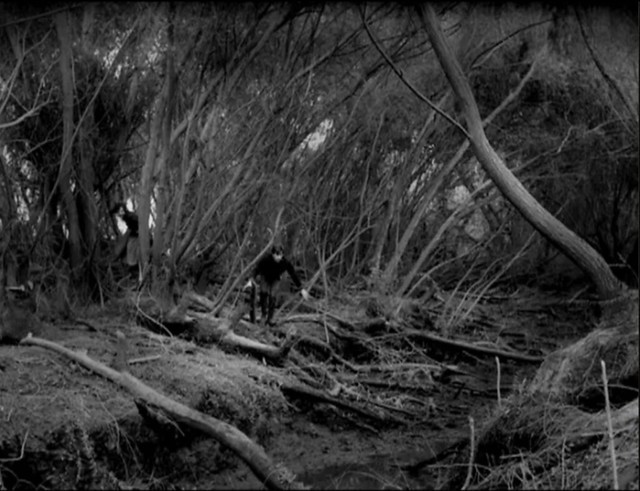
In his case, I already filmed him as himself in the last segment of in Volume Three about the bird trappers (in chapter: The Inebriated Chorus of Chaffinches). We have a very artificial elements in the film because it's not reality but cinema. Cinema talks about life but it's not real life. I myself am much closer to Wizard of Oz than realism. So we already had some professional actors who were playing more than one role. And I saw this guy (Chapas) catching birds in the woods in the countryside of Portugal, then we had this story of criminal running away in the countryside (Chapter of A Man Without Bowels). I didn't have an actor in mind for that role. But I also didn't have anyone who can walk with same elegance as Chico Chapas.

The part didn't have many lines. I couldn't ask him to play the judge because it was played by a very good theater actress Joana de Verona. So for each chapter of the film I had people playing with their specific skills. For Simão in Man Without Bowels, I needed someone who has John Wayne like aura. Chico carries himself like John Wayne. I never told him how to walk or anything. I called action and told him walk from left to right and nothing else and it was always the first take we used. He was a natural.

The owner of the cockerel (Fernanda Loureiro) in chapter: The Story of the Cockerel, for instance, she was also playing herself. She really is the owner of the real cockerel who ended up in court. But the cockerel we had to have a double because it got very famous after the court case and we didn't want anything happen to it. But Fernanda was the real owner. So we found out while talking to her on camera, what she will tolerate, what she can and can't do. We found out that there are certain people who can direct themselves in certain way.

In the Swim of the Magnificents chapter, we had these unemployed people telling their stories. We had to work with them a little bit. I was with them all throughout and asked them every 2 days or so to tell me their stories. It was like directing them to tell certain part of their stories differently just for the better structure, not the content. It was about letting them talk. I wasn't going to write a script for them to recite like robots. That's not what I intended to do.

Every time it was different, even with professionals. Because you are always dealing with different people. But in the end, it's about them. For me it's finding out what you can do to help them bring out the best that they can give you.

I want to hear about how you got together with Sayombhu Mukdeeprom.

In this case, in the beginning I wanted to work with my regular cinematographer (Rui Poças) who shot My Beloved Month of August and Tabu, but he wasn't available. And it was such a rigorous shoot. We shot for a year. But someone in the crew who worked in Italy with Sayombhu, the cinematographer of Apichatpong (Weerasethakul) and she said, "He is a nice guy and I think you two will get along." But I said, "But I don't think he will be crazy enough to come to Lisbon from Thailand for a year. And I have to tell him that we don't know what we are shooting because there is no script. There is nothing." But I phoned him and he said, "OK, let me talk with my family" and one week later, he said, "I'm coming." I was like, you are crazier than I, RESPECT!

So he came and it was very good working with him. He is very good at shooting only with natural lights. One great thing we shared was our love for shooting on film. He gets frustrated if someone asks to shoot on digital. So it was one of the reasons why he traveled so far. It appealed greatly to him for a fact that he can shoot on film for a year. We shot on 16mm and 35mm.

It as very easy to work with him. We didn't discuss anything before starting the film - no look of over all film or anything. It was very natural process. It was always during the shoot we discussed how to go about shooting that scene. Except the Tears of the Judge part - with three moons with three different colors which we did some preparation. We got along fine because we have the same spirit of not calculating everything beforehand.

Would you ever work with him again?

Yes of course. But I'd love to continue working with Rui too. I'd love to work with both.

I saw the new Apichatpong's film yesterday (Cemetery of Splendour), very sweet, very moving film too but he had to use another cinematographer for that because of me. (laughs)

How do you feel about VOLUME 2: THE DESOLATE ONE getting chosen for the official Portuguese entry for Oscar Foreign Language Film?

I had nothing to do with that selection. It was Portuguese Academy who decided that. I think there is some rule that a film should end with a credit. So there is no way the whole Arabian Nights will get nominated as one film.

Ah, the technicality!

I'm not expecting anything. But strange things happen. We will see.

Tuesday, December 1, 2015

Pirates of Whimsy

A Espada e a Rosa (2010) - Nicolau
 photo a3bf3f5f-d317-4051-a521-ef656c569fb3_zpsxnzgsqmf.png
Manuel (Manuel Mesquita) says goodbye to his ordinary life in the city to join pirates, a knick-knack of characters who are his long time friends. He brought on-board a mysterious substance called Plutex that some mad German scientists invented as a gift. The highly volatile substance helps when they are pirating, making their victims to freeze in motion or even disappear. It's a good, free life filled with nightly dances, music and wine. But a treason among them breaks the group's happy-go-lucky mode and they have to resort to kidnapping various types of people- pretty fair skinned French girl, skinny, short German man, a Lebanese girl and so on for the enjoyment of a all too powerful Prospero-like old man whom the group owes favor to. João Nicolau's whimsical comedy includes a singing tax collector, no-budget animation sequences, philosophical musings, lots of dance and a lot of non-sensical humor. It doesn't quite justify its 2 hour 20 minute runtime and the charm kinda wears off mid-way. In tradition of no-budget Portuguese comedies of Miguel Gomes, João Nicolau doesn't lack ideas, but his sensibilities are more suited for episodic TV or shorts.

A Cinephile's Wet Dream

Hitchcock/Truffaut (2015) - Jones
 photo 26e0167a-b9df-4889-8365-4b246e9c5596_zpsoheqa8ms.jpg
We all know that everything has a meaning in a Hitchcock film - gesture, pose, framing, inanimate objects, camera movements, architecture, everything. It's layers upon layers of these cinematic elements that make his films stand the test of time. But to whom do we give credit for discovering this fact?

Surely there have been flow of books, articles, university courses, conference panels devoted to the master and his films over the last two decades or so. But it was François Truffaut, a film critic and French New Wave director of such films as 400 Blows, Shoot the Piano Player and Jules et Jim who interviewed his favorite filmmaker, the master of suspense, in 1962 and published the subsequent book Hitchcock/Truffaut in 1967 that really put Hitch among the echelon of cinema gods.

Truffaut, as a film critic, along with many of his esteemed colleagues at Cahiers du cinema (Jacques Rivette, Claude Chabrol, Eric Rohmer and more), had been the driving force behind elevating the status of many of the Hollywood Studio directors who were regarded as mere entertainers with the auteur theory under the guidance of the magazine's founder, André Bazin.

Hitchcock was already a one-man franchise in the industry and a TV personality with his weekly television show, Alfred Hitchcock Presents. But back then, he was never considered as a serious filmmaker nor he received due respect from anyone. Flattered by the attention given by Truffaut, Hitchcock took up the interview proposition and welcomed the young Frenchman in to his Paramount Studio office and granted a week-long interview. There, they discussed his filmmaking craft in great detail, one film at a time, going through his entire filmography.

Kent Jones, a film critic for Film Comment Magazine and a chief programmer for the NYFF documents the film companion version of this momentous meeting in cinema history, using film clips, audio recordings of the interview, and photographs taken by Phillippe Halsman at the studio and interviews with contemporary directors who are deeply influenced by the master in breezy 80 minutes running time. And it's a cinephile's wet dream.

Jones shows that going through his favorite filmmaker's entire filmography and asking pertinent questions, Truffaut was able to demystify Hitchcock the filmmaker, the man, the artist. Hitchcock's wrongly accused and guilty men alike stem from his Jesuit school upbringing and his fear of police. The interviewee in turn, was very frank and forthcoming about himself reflected in those characters, who had perverted secret desires and tendencies (hence the recurring motif of handcuffs and keys on both fear of police and secret desires).

Hitch Truff poster.jpgIt is a hard task to compress almost 13 hours of initial radio broadcast (out of 30 hours of actual recordings) of the interview and a 350 page book to a digestible feature length film and Jones is careful and considerate in what needs to be include in the film. He avoids the talk of obvious, well known Hichcockian narrative elements like MacGuffin or how many trick shots are in Birds.

Yet there are so many delicious morsels of information, aided by the film clips in Hitchcock/Truffaut. As the interview goes along, we get to see and hear examples of Hitchcock's craft: he answers that suspense doesn't have to come from the fear of violence with the clip from his early silent film, Easy Virtue: where a marriage proposal is only seen through the reaction of a switchboard operator- is she going to say yes, or no? Or insight to his view on actors and the role of the audience by giving an example of the kissing scene between Ingrid Bergman and Cary Grant in Notorious, "They complained how uncomfortable that shot was. I didn't care if they were uncomfortable or not, I was giving the audience a ménage-a-trois with Ingrid Bergman and Cary Grant!"

Jones interviews contemporary directors who are as much cinephiles as they are filmmakers: Wes Anderson, David Fincher, Martin Scorsese, Paul Schrader, Olivier Assayas, James Grey, Peter Bogdanovich, Arnaud Desplechin, Richard Linklater and Kiyoshi Kurosawa. Many talk about their well-worn copies of Hitchcock/Truffaut on their bookshelf.

One of the juicy tidbits that are not present in the film from the vast audio interview sessions, is when he gets down and dirty on actresses: he tells Eva Marie Saint was terrible in North By Northwest, "She cost the studio a fortune for wasting films because I had to do so many takes." And that girl (Kim Novak) in Vertigo was 'no good'. He dismisses actresses who have sex written on their faces (Marilyn Monroe, Brigitte Bardot) because there is no more mysteries left in them. He prefers librarian types, "British women make the best Hitchcock heroines." At this, Truffaut protests, "I don't think majority of men will agree with you. And whether you realize or not, you are making them the standard (for sexual desire) with your films."

But Jones also includes what's not aired (I know this because I listened the whole French radio interview) when Hitchcock talks about famous transformation scene in Vertigo where Judy (Kim Novak) changes to Madeline at Scottie (James Stewart)'s incessant insistence: "When she comes out of the bathroom, Scottie has the biggest erection...don't include that.... Cut the tape!"

While Fincher seems very much tickled by the pervading perversity in Hitchcock films, the French directors - Assayas and Desplechin give insights to Truffaut's singular mission: He genuinely wanted to know all about Hitchcock because he was a fan. Assayas (also a former Cahier du cinema critic) points out that Hitchcock and Truffaut were much different from each other as filmmakers. Even though Truffaut was never a stylist, he always maintained that Hitchcock was his favorite filmmaker. Their amicable relationship continued through correspondences long after their conversations.

Perhaps Jones's biggest contribution here is in contextualizing their meeting and its impact in cinema history, thus also elevating the role of film critics (considering Truffaut was one) that, as raging cinephiles themselves whose respect and fanfare can reconfigure a certain filmmaker to be recognized as a great artist.

Thanks to Truffaut, much of Hitchcock/Truffaut is recognizing the genius of Hitchcock. The film glazes over Hitchcock's influence on Truffaut himself with only a couple of brief clips from his films other than 400 Blows without any voice overs. I wish Jones spent a little more time on Truffaut's filmography where we can see Hitchcock's influence. But still, hugely entertaining and informative, the film is a required viewing for any serious cinephiles.

Hitchcock/Truffaut Opens on Wednesday, December 2 at Film Forum and Lincoln Plaza Cinemas; December 4 in Los Angeles and December 11 in Major Markets Nationally

Sunday, November 29, 2015

Lackluster End to Daniel Craig's Bondiverse

Spectre (2015) - Mendes
 photo 9086f9b0-6036-41d1-9411-09c6e01f4fbb_zps4ov6z48a.jpg
So everything in Daniel Craig's Bondiverse comes together to a close with this forth installment. And everythings lagging - script, visceral action sequences, a great villain, even a spectacular opening usually associated with this franchise. Sure, Day of the Dead celebration sequences in Mexico that opens up Spectre looks like a gazillion dollars (or more) but it lacks the energy. Beautiful settings in Rome, Austria, Tangier shot by Hoyte Van Hoytema (Let the Right One In, Her, Interstellar) wasted. They decided to make a character study out of Craig's Bond from its inception in Casino Royal. They knew that deeper they dig, the franchise is going to be short-lived. Unfortunately, this is the most lack-luster film of the series. It has that by-the-book kind of feeling and unbelievably stupid plotholes everywhere. Monica Bellucci is completely wasted, so as Christoph Weitz for the most part. Lea Seydoux is all right, but her part is not so (her name is Dr. Swann forgodssake). Bond doesn't seem to have any scruples banging the daughter of the man who tortured Vespar Lind whose death catapulted this whole supposed journey.

It's still an entertaining ride to a degree. Since they put an exclamation mark on Craig's Bond era, where do we go from here? The much publicized Black Bond (Idris Elba) taking the barton? Or female double o agent? Would it start with a clean slate, creating another alternate Bondiniverse? Craig had some beautiful moments with the well worn character struggling at being an outdated tool in a changing society (in Casino Royal and Skyfall). I wished their would be a plot line involving the Middle-east, reflecting the current mess we are in without inciting Hollywood's racist caricatures in the past. I mourn this chapter of the franchise.
Saturday, November 28, 2015

Que Viva Eisenstein!

Eisenstein in Guanajuato (2015) - Greenaway
 photo 75637d1a-a804-44fc-a83c-a083176a4efa_zps239tsysw.png
Greenaway depicts Eisenstein's unsuccessful stint in Guanajuato, Mexico, famous for its mummies in El Museo De Las Momias which were featured in the opening sequence of Herzog's Nosferatu. For wide-eyed, clownish Soviet filmmaker (Elmer Bäck) of such films as Battleship Potemkin and October (Ten Days that Shook the World), who just had a bad experience in Hollywood, is seen driving down to Mexico with his small crew, while Upton Sinclair and uncle Lenin bankrolling the money for his Mexican project, Que Viva Mexico! Enamored by his colorful surroundings and swooned by his handsome Mexican guide- a religious scholar and ostensively a family man, Palomino (Luis Alberti), Eisenstein's not too subtly repressed homosexuality come to the fore and distract him from working, at all.

With series of wordy exchanges about politics, death and sex in a whirlwind of spinning visuals (actors in front of projections, seemlessly looping the tracking shot, 360 degree panning shots, etc.- almost fit for 3D at times), Greenaway makes it clear that the film is not about Eisenstein as a filmmaker but a 33-year old virgin (but married) discovering sensuality for the first time. And this being Greenaway film, a full frontal is given and sex acts are graphic. There must be tons of Greenaway's dense stylistic innovations I'm missing with the initial viewing here, but I feel Eisenstein in Guanajuato is a lesser Greenaway, failing at holding attention of the viewers in a relatively short running time (105 min).

Wednesday, November 25, 2015

Therapy

Jimmy P.:Psychotherapy of a Plains Indian (2013) - Desplechin
 photo 506dc721-08f7-4102-b10f-bd1933a5829d_zpsgdwkwljx.jpg
Jimmy P is an odd movie. Even though it lets us know that it's a true story and takes place in the U.S. 1948, it wears its cultural, racial, political contexts very thinly- not actively ignores their importance but rather, it is seemingly uninterested in them. What's left is two leisurely hours of Jimmy Picard (Hulking, understated Benicio Del Toro), a somewhat shellshocked WWII veteran Indian from Montana and Georges (always great Mathieu Amalric), an enthusiastic anthropologist/therapist of an unknown European origin. They meet in Topeka, Kansas, where the veteran hospital is located. It is slowly revealed that Jimmy has some repressed sexual issues with women and suffering from a guilty conscience of abandoning many women in his life. Georges also has a bit of a back story and seems to have a complicated love relationship with a sophisticated married lady friend (Gina McKee). But it's mostly about Jimmy and Georges talking. As the title suggests, it's a psychotherapy session of a Plains Indian so his constant headache and seeing blinding bursts of white spots would go away. But its literal presentation is never clinical nor fairytale like. The performances, nuanced and subtle, make the characters and interactions human. Jimmy P is not a gripping drama and you never quite get too close enough to the characters, but there is a sense of peace and tranquility to the film that I really dig. Great directors don't need to have their signature 'style' or whatever. They can tackle any subject and should be able to produce something that is completely different from one another. Desplechin surprises me in that respect. And I respect that.

Monday, November 16, 2015

An Impressive Debut of a Turkish Woman Filmmaker, Deniz Gamze Ergüven

Mustang (2015) - Ergüven
 photo 9e3d3c12-726d-478e-84a6-fbb7e14955b3_zpsiaxfmjv4.jpg
The school's out for the Summer, but for the 5 luminous protagonist orphan sisters, the indignity of being virgin brides in a 'wife factory' has just begun. After some innocent water splashing horseplay with the boys on the beach, they become prisoners in their own home. It was a neighbor woman in (in the girls' own words) "shit colored traditional garb" who informed their grandmother that they were acting indecently with the boys. The panicked grandmother locks them up in the house but still shields them from their brutish uncle's fury who is even more conservative. You see, according to Lale (Günes Sensoy) the youngest of the sisters who narrates the film, Istanbul might be about 'a thousand miles away', but the small coastal town they live in is about a thousand years backwards in terms of women's rights.

First, the older three, Sonay, Selma and Ece, are milled over to the hospital to see if their hymens are intact. The metal grates go up over the windows and the girls' possessions which might lead them in to perversion (a TV, phones, colorful clothes, books) are locked away. Shit colored formless dresses, cooking and cleaning lessons follow, and the girls are bored to death.

But this imprisonment provides some sun soaked, blissful playtime among girls and give them opportunities to get out of those dresses and lounge in their colorful underwear. They also sneak out every chance they get. They even end up hitching a ride to see a soccer game (for the women-only spectators game of course) and appear on TV screen to their grandma's horror.

They are hurriedly trained and clothed into arranged marriages. After the two eldest get married off- Sonay (Ilayda Akdogan) to the love of her life (by threatening to scream in front of the family guests), more resigned-to-fate Selma (Tugba Sungroglu) to some stranger, whom she 'will grow to love', it's Lale who starts seeing the indignity of the whole situation. It's only matter of time that it will be Nu (Doga Zeynep Doguslu) and her turn. Before it's too late, they need to escape!

Mustang is not as politically pointy as Jafar Panahi's Offside and doesn't point finger directly at the traditions in some Middle Eastern regions per se, but things are pretty obvious how absurd the situation is. First time director Deniz Gamze Ergüven has the light touch even when things get dark. And it gets very dark at times. The film thematically and spiritually shares lot in common with Sofia Coppola's Virgin Suicides (which was also a debut film by a young female director).

The third act seems to lose its organic feeling and magic of the first 2/3rds but that's only a minor quibble. It's a beautifully realized film about being a young female in a very conservative society. It's also good to see beautiful Elit Iscan of Hayat Var (My Only Sunshine) making an appearance as Ece, the defiant middle child. She hasn't aged a bit!

Mustang is the French Submission to the 2016 Academy Awards. It hits US theaters on November 20th, 2015

Sunday, November 8, 2015

Casanova Vs Dracula


Història del la meva mort
(2013) - Serra
 photo 5f8ade98-0713-4715-93e7-1fa261748033_zpshkaoer3a.png
 photo fffdb8a7-ea76-4b5e-a711-37832ee022ab_zpsdg4krxks.png
 photo 8c260a16-94b4-4617-8c8a-0692639dd79c_zpsbxvgy7xl.png
 photo 2d6b0604-0a5b-46da-a917-cb63c65b3679_zpsrj0e2ubx.png
 photo f804b18d-a12f-4fed-8b24-d0266113cdd0_zps44xljem1.png
 photo 695be4fe-b9a9-4911-b1e0-892d3122527a_zpsyy61ncu7.png
 photo 758e6298-9e2b-4c20-8438-af57cd18810e_zpsmiohl0qe.png
 photo 7a99c209-f10d-40c7-923a-ce2cce7f031e_zpsqhraxtrf.png
 photo 3c983e22-d64c-42c4-b1b1-8a98e54a46a5_zpsvabzzjlx.png
Casanova (Vicenç Altaió) is getting old. His forever powdered wig and face can't hide his aging vessel. But he's still obsessed with food, sex and defecating. He is now also contemplating death and afterlife. He takes off from his stuffy, opulent mansion to the countryside with his faithful servant, Pompeu (Lluís Serrat). Staying in the cottage of an old river raft operator with his melancholic daughter and her two scrumptious young servant girls, Casanova and Pompeu try to win over hearts. Thrown in the mix much late in the film is a bearded Dracula (Eliseu Huertas) who screams in agony whenever he takes a life (or turns one into a vampire).

The candle/bonefire lit, grainy cinematography just barely sketches out human forms and faces. Non actors in period costumes do their duties with solemnity. It might be oxymoron but Albert Serra seems to be striving for authenticity that is pure both in form and spirit in literary characters. The result is an often hilarious, leasurely paced yarn that has some really beautiful painterly moments. Història del la meva mort is an interesting experiment that strips down these well known literary archetypes to the bone and have them play it straight and lets the thin narrative reach its own internal logic's end

Friday, November 6, 2015

Gaspar Noé Succeeds in Making 3D Porn Boring with LOVE

Love (2015) - Noé
Love I predicted after watching Enter the Void that Gaspar Noé and the 3D format are the perfect match. So he makes a movie in 3D here and the end result makes Void like Citizen Kane in comparison. People walked out of a Cronenberg's Crash screening I was in. But its repeated sexual act in that film had a point. Lars von Trier's Nymphomaniac at least has the director's anger and cynicism, a general fuck-you to the world. What does Love have? Banality. As usual, Noé mistakes banality for sincerity. And after 4 feature films, he still remains a filmmaker with nothing much to say.

Love starts with a young American film student, Murphy (Karl Glusman) living in Paris, narrating that his life has gone to shit. He lives with a young blonde girl (Klara Kristy) and their toddler named Gaspar. He recalls the good times he had with Electra (Aomi Muyok). He longs to go back to when he first fell in love with Electra who is now missing. We retrace their affairs, not chronologically. We see them engaging in graphic sexual activities for most of the movie's running time - two of them alone, threesome, orgies. Whenever they are not using their mouths for sexual act, they engage in downright laughable conversations. Right. Someone OK'd the project with such precious lines as this:

What's the meaning of life?
Love.
How come there are no movies about first love and sex? I'll make the first movie that shows the sentimentality of sex!

I understand what Noé is going for. Yes, the first love and its sex make a great impression on people's lives. But there are many other filmmakers who tackled it much more gracefully, effectively and touchingly than Noé. The characters are so banal and insufferable, you wish them to stop whatever they are doing and just disappear. Acting is uniformly horrendous. OK, Muyok is slightly better as she has some charisma. There is a hot threesome in the early part of the film, but as it goes along, it becomes more and more unbearable. OK. With all his macho posturing, Noé seems squeamish about showing giant erect penis in 3D. Why else would you shoot a movie without things sticking out and shooting something off of it in 3D? But when the brief "money shot" arrives, it's so uneventful, you can easily shrug it off. One hard task Noé accomplishes with Love is that he makes sex completely boring.

Wednesday, November 4, 2015

Never Known Love

Yearning (1964) - Naruse
 photo 21eb76fa-fad9-43b4-92e8-113758ca0d38_zpsbq6mua06.png
 photo 44ef595e-6b2c-4094-8d02-a6f8e3344ad4_zpsiufdrgcb.png
 photo a270373a-99a0-4693-b08a-372b2de4ec4c_zpstcq290qx.png
 photo 2194cd01-4ed9-453f-a878-6ec32ecbb93f_zpsfqf7ih7j.png
 photo d4655dd9-cc22-4487-839b-546adc975634_zpslsitxnjk.png
Reiko (Hideko Takamine) is a war widow who has devoted herself to building and managing her husband's small family grocery business. She takes care of her elderly mother-in-law and Koji (Yuzo Kayama), a young, loafing brother-in-low while keeping memories of her dead husband alive. But a brand new supermarket in the neighborhood stirs up her otherwise routine life. It prices out many of the neighbors' business and threaten Reiko's shop too. Her sisters-in-law with their well to do husbands are planning building a counter supermarket and force Reiko out. 'She's still young so she can remarry.' To complicate the matters, Koji confesses his love for her that she is the reason why he gave up schooling in Tokyo, came back home and been moping around ever since. Hurriedly married at 19 and fast widowed, Koji's talk of love stirs something inside her that she never truly experienced before.

Naruse paints the predicament of a middle aged woman in post-war Japan with great subtlety and grace. His frame within a frame shots are masterful in showing Reiko's mind state. But the real star of Yearning is of course, Takamine. With her subtle Japanese features and quiet mannerism, she embodies the classic Japanese beauty. A young widow bound by tradition and duty, her Reiko doesn't quite know how to react when faced with the declaration of love. It's a marvelous acting. The ending is quite melodramatic but all worth it for Reiko's reaction shots and a long tracking shot of her running in the backdrop of a beautiful Japanese northern town.

Sunday, November 1, 2015

Smell of the Land

Long Voyage Home (1940) - Ford
 photo 351e58ec-aa53-40cf-b909-02e239f23275_zpsvwn1r9yl.png
 photo 5703d8ca-ff35-41e2-ad9f-dcf0b9180f91_zpskmgfqcsg.png
 photo 5af7dbaa-5cec-4484-aa99-3f5440cb13a9_zpse3jx6krs.png
 photo bdc27c57-1b99-44c8-ad29-26af7934a469_zps48uxvfo1.png
 photo 6b31943d-bebb-4176-8385-6ed1ee1fec43_zpstbnfinkt.png
 photo 20266465-5139-42a7-baa7-88bbed777e69_zps9znxl0yz.png
Great. John Ford's Eugene O'Neill scripted Long Voyage Home offers everything: from Lusty native ladies on a foreign shore, to war time paranoia, to Odyssean journey of its many sea men. Greg Toland's cinematography alone is worthy of admission. You can trace its visual/thematic influence on many later films such as The Last Detail to The Master. Great ensemble cast of interesting faces includes big, young John Wayne as good natured, Swedish farm boy who seems to have a hard time getting home but always ends up at the sea after 'one more drink' trap with his mates. These rugged men's camaraderie is the heart and soul of the film.

Saturday, October 31, 2015

Sense and Sensibility

Crimson Peak (2015) - Del Toro
 photo 46264a3d-f744-435e-9ad7-155ec6880c77_zpsrd7gnhbg.png
Crimson Peak occupies an interesting space and time when moviegoing experience is at its lowest point in cinema history. Barely out for two weeks, I walked in to the theater where only a handful of people came out to see it on Friday night in a multiplex, by 'the director of Hell Boy and Pacific Rim' no less. It made me feel sad because it's precisely a movie that needs to be seen on a big screen. Along with Mad Max: Fury Road, this film was the only few I actually paid to see it in theaters this year and these occasions are getting rarer and rarer for me. I hear so-called mid-size budget indie filmmaking is back and some of them manages to break even with VOD market and online services. But there is no way in hell I'd watch an indie movie, especially American indie movie in theaters, let alone pay for it.

Guillermo del Toro is back in form at what he does best - a gothic horror with Crimson Peak. It's a grand, decaying, violent fairy tale made for adults and therefore harder to make money but beautiful nonetheless. It concerns an aspiring young writer Edith (always delightful Mia Wasikowska) in a well to do household in Buffalo, NY in the 19th century, getting involved with a dashing English nobleman named Thomas Sharpe (Tom Hiddleston) and his cold as ice sister Lucille (Jessica Chastain). The brother-sister team happened to own a decrepit manor in England, surrounded by red earth. They need an investment money to dig up and sell that red bubbling earth. Decaying mansion, snowy weather, blood red clay make a beautiful backdrop for this spoiled school girl ghost/love story (just like Edith's manuscript). You realize that all del Toro's ghost stories/fairy tales are just that. That this fat, bearded Mexican man has always had a sensibility of a school girl and bloodier imagination. Any way you look at it, there is no denying how gorgeous the film is. And all three actors are excellent in it. I'm very glad I got to see it on the big screen.

Wednesday, October 28, 2015

Camel in My Backyard

Le Meraviglie/The Wonders (2014) - Rohrwacher
 photo 0349f295-57c3-4244-babc-091199944f05_zps94a9b856.jpg
Just like her debut film Corpo Celeste, Alice Rohrwacher deals with an eccentric German-Italian working class family in Le Meraviglie (The Wonders). The story centers around Gelsomina, the oldest of the 4 young daughters in a beekeeper household. By how these rambunctious girls are treated by their disheveled, bug eyed, stressed out dad Wolfgang (excellent Sam Louwyck), it is pretty clear that they are the result of daddy and mommy (played by Alba Rohrwacher, the director's older sister) tried and failed to conceive a son. Gelso is a heir apparent to her father's business, as she accompanies him in his daily operations. Even though she is always a child in her daddy's eyes, she is growing up and it's pretty obvious that she doesn't want to be a farmer. Two events rock her world - there is 'village wonders' contest hosted by beautiful and glamorous local TV personality Milly (Monica Bellucci) where people showcase their farm products to win money. And the appearance of Martin, a young, troubled, almost mute German boy the family decided to foster for money. While Wolfgang is distracted and enchanted by the young boy whom he can put to work, Gelso secretly enrolls the family business to the contest.

Rohrwacher observes this chaotic family with much warmth and care. It turns out that the brutish dad actually loves his family deeply. He just wants to protect them at all cost from the end of days. He is just nutty that way. Kinky haired, even tempered mom is the bedrock of the family that everyone gravitates to. Gelso's chubby younger sister Marinella is one of those dreamer siblings, not made for the real world. Then there are two young runts, who gets into everything and everywhere, screaming their lungs out most of the time. Add to the mix is Coco (wiry Sabine Timoteo), another cooky German transplant who helps around the house and butt heads with Wolfgang. And there are real life wonders, all around Gelso's life, from Martin's magical whistling to presence of a camel in the back yard to white haired Milly to bees in her mouth. Rohrwacher reminds us that whatever the circumstances we are in, life is filled with full of wonders. Le Meraviglie deserves all the recent accolades.

The Wonders plays as part of NYFF 2014, on Oct.3 & 4. For more info, please visit FSLC website.

Tuesday, October 27, 2015

'The Treasure is Already on Your Back': Alice Rohrwacher Interview

Previously published in Oct. 2014. The Wonders opens theatrically in Oct. 30th.
 photo 6990735c-f5f4-41fd-9a71-c3b925f602fd_zps676b72d5.jpg
Alice Rohrwacher's The Wonders (Le Meraviglie), a dramedy about a rural Italian agrarian community, took home the Grand Prix at this years Cannes Film Fest. It's an amazing feat considering it's only the second feature of a 33 year old director. So I was expecting a mousy, serious artist type. Bur Rohrwacher turns out to be a bright, spunky, rambunctious young woman with a great sense of humor. As we talked about her film making, it was hard not to fall for her. Thank you Alice, you made my day.

There always seems to be a sibling rivalry in your films. How much of it is based on your relationship with your older sister (Alba Rohrwacher of I AM LOVE, DORMANT BEAUTY)?

Alice Rohrwacher: Not so much. I'm always fascinated by the relationship between brothers and sisters. My sister is the most important person in my life and this is something very personal. But I didn't make this film to analyze our relationship. If I wanted to analyze our relationship, I would've just gone on a vacation with her. I wouldn't have gone all the trouble putting together a production, crew and getting finance and all that.

How was directing Alba? I mean, now she is becoming a big star in Italian cinema.

First of all, it was marvelous really. Let me say that I choose to work with good people. My sister is a really great person so the first step was already completed. She is a great actress with a lot of irony and a lot of imagination. The most important thing is that I've never had an opportunity working with someone who had same imagination before. My sister and I do share the same imagination.

[She stops her interpreter at this point to clarify. She gets very animated.]

Not imagination but a set of imaginations. The collection of the world that we share. In any films, there is going to be autobiographical elements in the images you use and the archetypes you draw on to create those images. Let me give you an example: Let's say I tell an actor to wash dishes and they'll start washing dishes. And I say, "No what are you doing? That's not how you wash dishes!" "First you do the glasses and the plates." When I give directions to my sister to wash dishes, she will do exactly the way I'd do the dishes. [we laugh]

So having her there is both surprise and also confirming something. It was a great experience.

The character of the father, Wolfgang really fascinated me. Did you base him on someone you knew? Is it German characteristics in him that make him that way?

I'm very glad you asked that question because most men are afraid of the figure Wolfgang. He represent a kind of phantom, a masculinity. He is a self-righteous man. But like any self-righteous men, he fears two things about himself: being ridiculous or being violent. The press often talks about Wolfgang being German, but I don't think that's really true. The truth is that he speaks German very badly. He doesn't speak any language well - he speaks German badly, Italian badly and French badly. So in a certain sense he speaks nothing. He is a person who knows what he wants to say but doesn't have the words to say it. He is a foreigner. He is a foreigner par excellence. You can tell the way he speaks languages that he's lived in many different countries but he doesn't speak any of it properly.

I didn't quite get Wolfgang's fascination with the end of the world. Why is he so obsessed with that? Can you give me a backstory on that?

It's mine. [We laugh]

[In English]It's going to be worse and worse my friend! So we need a lot of humor.

I agree.

It seems in your films, Italy is a very conservative society. Religion is still a big part of life and I am wondering if that affected you growing up.

But I would say the right of the conservative, I think they lost. They really don't know what to conserve. It's like some were to write a book and don't know what to put in it. Or to set the table they don't know where to put the silverware or dishes. They don't know what to save or what to throw away. It's all lost in the mess. There are no good or bad people, they are all lost in the same boat, attaching the cult of tourism as kind of a redemption.

There are some big actors in this film, Monica Bellucci and also Sabine Timoteo, of whom I am a big fan. How did you get them involved?

I went looking for them. I recognized them when I saw them. [Laugh]

Monica, she is an actress I admire very much but i wanted to look at her with wide open eyes. I mean she's been given this label , the iconic beauty. so I wanted to open that Pandora's Box. So I put her in the film. And she is very ironic about the way men look at her and she can joke about that. Although everything is fiction, her presence kind of created a different dynamic because people knew that she was coming, there was sort of excitement in the village and all around it. It brought in the true element into the film. Sabine, I like her films a lot and when I met her I had no doubts about her.

And Sabine just said yes?

I think it's important that we create a very collective atmosphere. Before shooting I let everyone come in and live in my house and for children, we basically created a family. And I think Sabine was very generous.

How difficult was it shooting with live animals - bees, a camel, cows all that livestock?

The worst animal is the men. [we laugh]

If you can shoot human beings, you can shoot anything.

It seems that there is a resurrection of Italian cinema in recent years. I am wondering if this is helping you to fund your projects and making things easier for you?

[Coyly]Speriamo (I hope so).

The theme of being foreigners, about being immigrants in a foreign country. Is it something you always have in the back of your mind when you write your scripts?

I always like hybrids. People who are in the border area. Whether the border be age, geographical place, I find these junctures interesting. And it might also depend on the fact that I too am of a double ethnicity. But I hope it doesn't depend only on that. I don't know if you know the book called the Island of Arturo by Elsa Morante. It's one of my favorite books. It's a great source of inspiration for me: what she talks about what it means to be a mixed blood. She says that you are living with this mixed destinies inside of you. There is a man, a thief, looking for treasure everywhere not knowing the treasure is already on his back.

What's next for you?


It's hard to say because I am still in the writing stage. But it's going to be about some kind of community- in Corpo Celeste, it was church and in The Wonders it was agrarian community. Here again will be another community but I still don't know who they will be. It's too early to say. But what it is in the world that moves me, that attracts me, that also pains me, is the way people live together.

I'll seek out that book. I'll read it. Thank you very much. Your presence really made my day. You are so vibrant.

Oh no I feel so tired this morning but I am very happy.


The Wonders opens in New York on Friday, October 30 at Lincoln Plaza Cinemas with a national rollout to follow.

Take Me to the River

O Sangue (1989) - Costa
Screen Shot 2021-04-23 at 10.27.28 AM Screen Shot 2021-04-23 at 10.32.45 AM Screen Shot 2021-04-23 at 10.47.41 AM Screen Shot 2021-04-23 at 10.48.15 AM Screen Shot 2021-04-23 at 10.28.55 AM Screen Shot 2021-04-23 at 10.48.46 AM Screen Shot 2021-04-23 at 10.49.20 AM Screen Shot 2021-04-23 at 10.49.47 AM Screen Shot 2021-04-23 at 10.51.42 AM Screen Shot 2021-04-23 at 10.29.21 AM Screen Shot 2021-04-23 at 10.29.42 AM Screen Shot 2021-04-23 at 10.43.14 AM Screen Shot 2021-04-23 at 10.30.22 AM The film starts with a face slap in the middle of rural road. Dying father hides his illness from his young sons. But Vicente (Pedro Hestnes) is growing up too fast and knows what's going on. He in turn, tries to shield the truth from his sickly younger brother Nino (Nuno Ferreira). "He went away and you will never see him again," Vicente announces after finding an empty hole and burying his father in the cemetery at night with the help of his childhood sweetheart, now a school helper Clara (Inês de Medeiros). The brothers' uncle from Lisbon tries to take Nino away and Vicente attacks him. But gangsters whom his dead father owes money to comes after Vicente and the uncle takes Nino to the city. Clara first needs to get Nino back, then Vicente.

Shot rapturously in monochrome with old timey music, O Sangue feels like watching a fairy tale story from the silent era. You can tell that Costa is a good student of old films- the lyricism in O Sangue evokes those of Jean Epstein, Jean Vigo, Jacques Tourneur and Robert Bresson (especially Four Nights and a Dreamer). Beautiful moments between our two young lovers, always by the river at night, are interrupted by deaths - one such scene even reminds me of foggy boat ride in Ugetsu. Look and feel-wise, it also has much in common with Leos Carax (another good student of old films)'s equally stunning debut, Boy Meets Girl. The loneliness he portrays at the balconies on New Year's Eve is just as picturesque as the rest of the film. At once melancholic and optimistic, old and new (there is a dance party near the river where they play 80s dance music), Costa's sodden poetic images and lost but determined souls have magical power to move you. It's an astonishingly beautiful film. Definitely the top 100 material.

Saturday, October 24, 2015

Rhythmic Passion

Junun (2015) - Anderson
 photo 251ac4df-986f-4097-97d4-e0d77c10c2fc_zps02la1bhy.png
 photo f0ec9158-ba7a-4013-9757-3b099e84f4e7_zpso28yfgul.png
 photo ea0a14e4-c5f3-443c-833e-23a3fe42f53f_zpsbtxjy65k.png
 photo 4aee782a-148f-4ded-8511-eb9529accd87_zpsgvmz3m0m.png
 photo 1faa38dd-d559-431a-9408-90a83b81e76d_zpsopfcep9r.png
PT Anderson documents the recording session of Israeli musician Shye Ben Tzur and Radiohead's Jonny Greenwood, set in ancient Mehrangarh Fort in Rajasthan, India. There is no title card or introduction for musicians involved or about the project. It's context free and all music. Anderson doesn't interrupt anything and just let it play. There are glimpses of beauty of Rajasthan through drone shot footage and some handheld outdoor shots. But it's all music and it's glorious. Interesting that Anderson decided to put it out through Mubi streaming right after its debut at NYFF this year. I guess these streaming platforms could be a playground for seasoned filmmakers' one-off experimental endeavors.

Monday, October 19, 2015

Beautiful Conceit

Letters to Max (2014) - Baudelaire
 photo f37a5a8d-012a-456b-9e73-14fb0eaafdd6_zpsjdtl91ws.jpg
The film's initial conceit- using old fashioned snail mail (in blue and red edged airmail envelopes no less) to communicate with an old friend Max Gvinjia who is a diplomat in the Republic of Abkhazia, in the internet age, doesn't damper the loveliness of this essay/docudrama on national identity, collective memories/forgetfulness and cinematic inventiveness. After the fall of the USSR, Abkhazia, a small nation on the Black Sea bordering Georgia, fell short of declaring independence, fought a war against invading Georgia in 92-93 and won and still in a international diplomatic rigmarole to be recognized as a country (only a few nations recognize it as such). Only appearing in white text of his letter, Baudelaire wonders if his letters are actually finding their way to his long time friend living in a diplomatically non-existing country. In response, affable Max, a devorcé and father of 3, reads his letters and answers, then takes us on a tour of often beautiful scenery of Abkhazia. There are signs of war everywhere too - decaying buildings covered with vegetation, abandoned tanks and artillery, monument to the national heroes and such.

It is pretty apparent with all the western chain shops and cell phones that Abkhazia is just like any other developed Eastern European country, but through Baudelaire's honest and sometimes pointy questions, it's as if he is creating his imagined view of the country, steeped in nostalgic history (albeit recent). He admits that he might be asking the questions to himself since he doesn't know if the letters are getting to their destination. Max plays along, having personal/national triumphs and losses during the span of the film (was a Deputy Foreign Minister, celebrated independence declared by then Russian Prez. Medvedev, becomes a Foreign Minister then loses the post with the regime change).

Thoughtful, intriguing, relevant and intimate, Baudelaire (Anabasis of May and Fusako Shigenobu, Masao Adachi and 27 Years Without Images) is doing something that really speaks to me in testing the boundaries of cinema.