Monday, April 17, 2023

Grey Zone

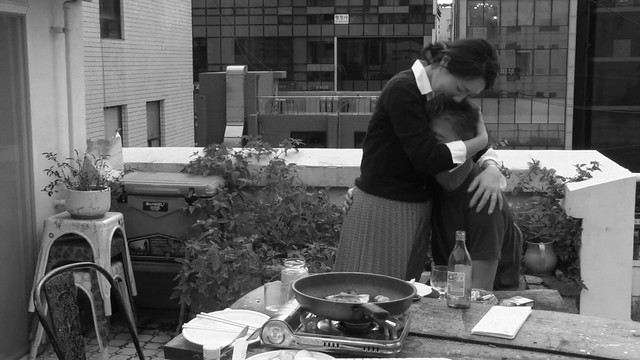
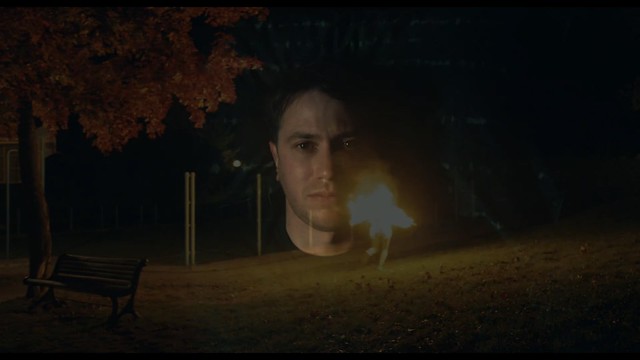
Twilight/Szürkület (1990) - Fehér Screen Shot 2023-04-15 at 11.39.28 AM Screen Shot 2023-04-14 at 9.54.29 AM Screen Shot 2023-04-14 at 9.57.34 AM Screen Shot 2023-04-15 at 11.41.57 AM Screen Shot 2023-04-14 at 11.06.39 AM Hungarian filmmaker György Fehér's seldom seen 1990 masterpiece, Twilight, gets a 4K restoration treatment by Hungarian Film Institute and distributed by Arbelos, the LA based distribution and restoration company, known for their 4K rerelease of such classics as Dennis Hopper's The Last Movie, Matsumoto Toshio's Funeral Parade of Roses, Wendel Harris's Chameleon Street as well as fellow Hungarian master Béla Tarr's Satantango and Damnation. Fehér who only directed two feature films during his lifetime, but was a close collaborator on number of Tarr's films and shared similar aesthetics. Shot by Miklós Gurban (Werckmeister Harmonies), the film is composed only of some fifty long tracking shots. And it is stunning.

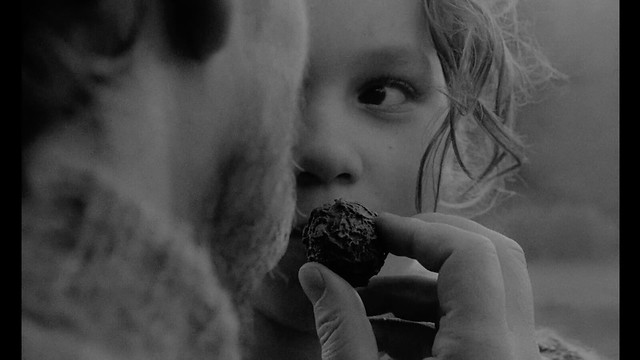
A retiring police inspector (Péter Haumann) is called in to investigate a murder of a little girl in rural town deep in the forest. The local police suspect a traveling salesman who found the body. But our inspector thinks otherwise. From the descriptions of the girl's classmates, the killer is a 'giant' in a black coat who lured her with hedgehogs- chocolate balls that resemble the spikey creature. But even before the investigation concludes, a professor ominously warns our inspector that the murderer won't get caught. He even questions the existence of the murderer.

After the suicide death of their only suspect, the inspector sets up a trap, using a little girl and her mother in a remote cottage in the forest as a bait to lure the killer in. But it only exposes the crippling inability to protect the innocents and a man's violent nature.

Based on an existential crime novella, It Happened in Broad Daylight (also a basis for Sean Penn's The Pledge) by Swiss writer Friedrich Dürrenmatt, Twilight paints a morally and physically murky netherworld where innocents gets punished and criminals never get caught. You can't pinpoint the time frame in Twilight: The description of the suspect's 'old styled automobile' turns out to be a Volkswagen Beetle. The apprehending police officers wear long decorative swords on their waists while the inspector is in his fedora and long raincoat. In its stunning black and white tracking shots in constant rain and fog, the film creates a gray inter-zone, where bad things happen repeatedly as if time stands still.

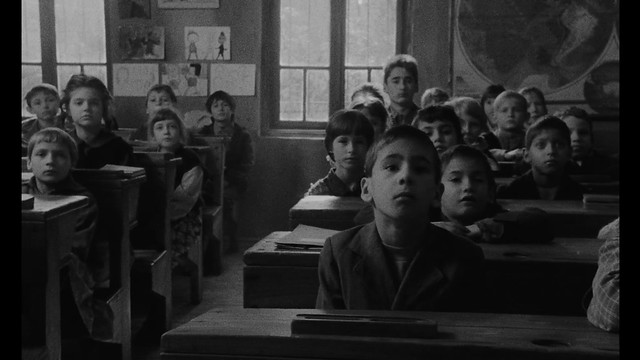
There are some show-stopping, memorable long sequences in the film, including one taking place in a classroom full of children looking at the camera as it dolly past them back and forth, foreground/background use of a suspecting luring in the girl playing with a ball, and the inspector confronting a suspect as the camera wraps around them 360 degrees. You can instantly recognize that Fehér was in the same school of filmmaking as Tarr. With sparse soundtrack by Popol Vuh, it's arresting and hypnotic.

Werckmeister Harmonies, released in 2000, was a cornerstone for many cinephiles to experience the art of slow, contemplative cinema. Sure there were other films with long creeping dolly shots in the past. But Werckmeister was the first one that we really could clearly tell that the director's intent on holding each shots, forever. The masterful compositions, oblique dialog, political subtexts all had hypnotic power. It was an amazing cinematic experience and great introduction to Hungarian cinema. So the question is, some 30 years later, how does Twilight hold up in the world where people watch films on their phones and streaming platforms where you could pause and/or fast-forward at any time? I believe Twilight makes a great case for seeing films in theaters again. With 4K restoration, the black and white film is gorgeous to look at. Its pacing is so refreshingly different than Adderall induced modern cinema. Let Twilight wash over you. It's blissful.

Tuesday, April 11, 2023

Legionnaire's Disease

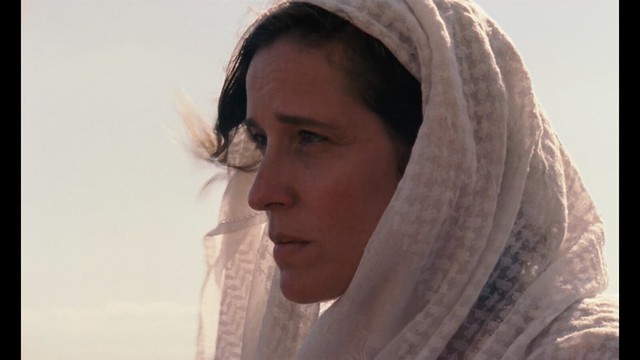
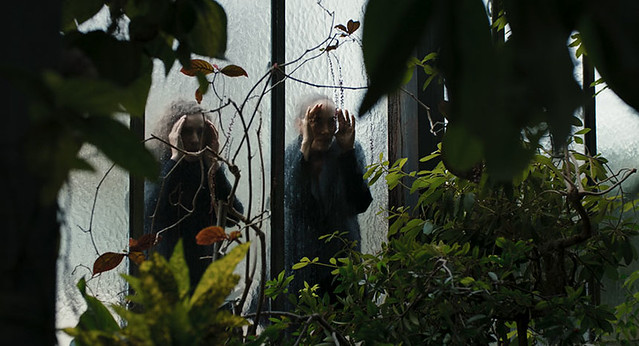
The Human Flowers of Flesh (2022) - Wittmann Screen Shot 2023-04-07 at 8.45.07 AM Screen Shot 2023-04-07 at 8.37.35 AM Screen Shot 2023-04-07 at 8.40.50 AM Screen Shot 2023-04-07 at 9.05.46 AM Screen Shot 2023-04-07 at 9.22.56 AM Screen Shot 2023-04-07 at 9.25.17 AM Screen Shot 2023-04-07 at 9.27.12 AM Screen Shot 2023-04-07 at 9.28.25 AM Screen Shot 2023-04-07 at 9.30.28 AM Screen Shot 2023-04-07 at 9.44.14 AM "When you have no home, a round world is the best you could have," is one of many poignant phrases uttered in Helena Wittmann's sopomore film The Human Flowers of Flesh. Just like her debut film Drift, Wittmann's preoccupation with being at sea continues. "A woman from Marselle who lives on her sailing ship with her crew," turns out to be Ida (Angeliki Papoulia of Dog Tooth). Most of the film we see Ida and her crew doing chores and living on the ship - cleaning, cooking, reading, exchanging annecdotes and stories and swimming.

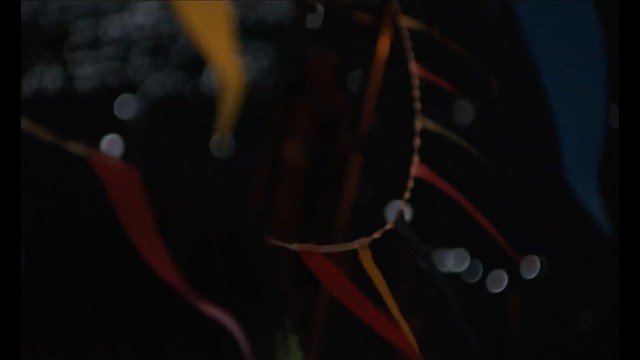
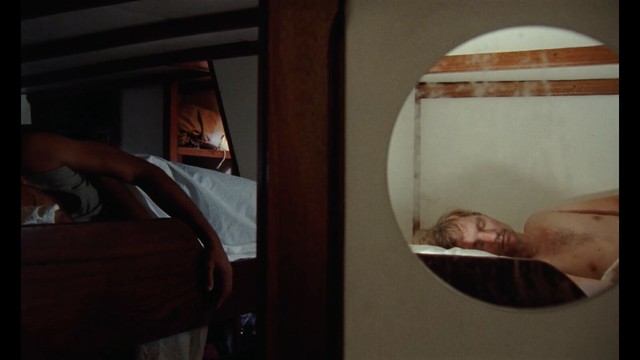
We see forever undulating sea on the deck and through the round windows from inside the ship, the horizontal sea level bobbing up and down as the ship sails through the waves. Just like Drift, the long stretches of these scenes has its own hypnotic rhythm. The crew converse in many different languages - English, German, Arabic, Portuguese, Greek and so on, yet nothing is explained about their background. Instead, Wittmann concentrates on the film's visually blissful moments - the shimmering sunlight reflected on the waves just below the deck, a piece of reef Ida brought from Antigua being passed around the crew, a dance party on the deck at night with colorful flags and lights gleaming and the blue sea as Ida swims back and forth. There are some show stoppers like the camera plunging into the blue depth to find a wreckage of a downed WWII plane at the bottom of the ocean floor. The film's full of sensual images that recalls Claire Denis films. But I think the aime here is different. In Wittmann's hands, the gleaming water and the sun are the subjects. They are vital to human life and we see that in Ida and her crew's uneroticised browned skin.

Speaking of Denis, Wittmann touches upon the legacy of colonialism and French Legionnaires in Mediterranean world and North Africa. As the ship lands on the shores of these parts, we see Ida walking past the military ports. At times we hear the military choir singing a legionnaire's hyper militaristic song of sacrifice. Then we see paratroopers jumping out of the planes, dotting the frame against the blue sky in Corsica. It's Denis Lavant's presence that accentuates this historical context cinematically. As we cinephiles are aware, Lavant played a lovelorn dancing French Legionnaire in Claire Denis's masterpiece, Beau Travail, in 1999. Lavant, almost a quarter decade older but still very much a physical presence, shows up at the end of the film in the streets of North Africa, and invites Ida, who's been following him, for some scrambled eggs in his flat. Is this Wittmann's way of commenting on the colonialism or what's left of it? I'd like to think that it's more of a kinship between two people who understand not having a home and its loneliness.

Poupolina, also starring in any less enigmatic A Little Love Package (by Argentine Gaston Solnicki), rises as a big supporter/collaborator of new talents who are pushing the cinematic boundaries into uncharted territories. And I very much welcome it.

Monday, April 3, 2023

Gazes, Mischief & Defiance

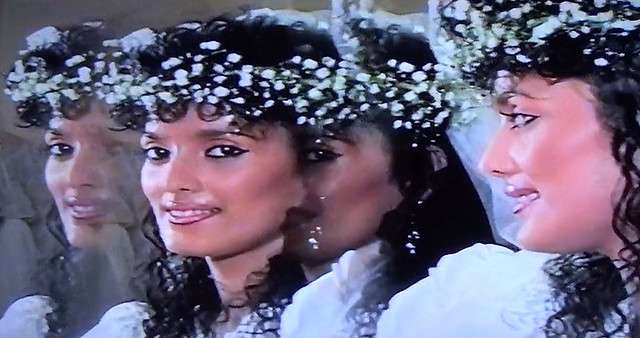
L'opera Mouffe (1958) - Varda Screen Shot 2023-04-03 at 12.09.10 AM L’opera Mouffe is a 16 minute short film Agnès Varda directed in 1958 after her feature debut Le Pointe Courte. Pregnant with her first child, Varda made the film in her immediate neighborhood on rue Mouffetard, in the Fifth Arrondissement of Paris. It is a mix of observational documentary and avant-garde style, filmic diary of a pregnant woman. It is done in her irreverent, self-reflexive, hybrid filmmaking that she was known for all of her career. The tagline of the film is carnet de notes filmées rue Mouffetard à Paris par une femme enciente en 1958. It has a catalog-like structure with the title cards - The Lovers, Feelings of Nature, Pregnancy, Dearly Departed, Joyous Festival, Drunks, Anxiety, Cravings and so on. With the narration/singing, the film depicts the mind of a pregnant woman as she observes both lively and harsh daily lives of the inhabitants of rue Mouffetard.

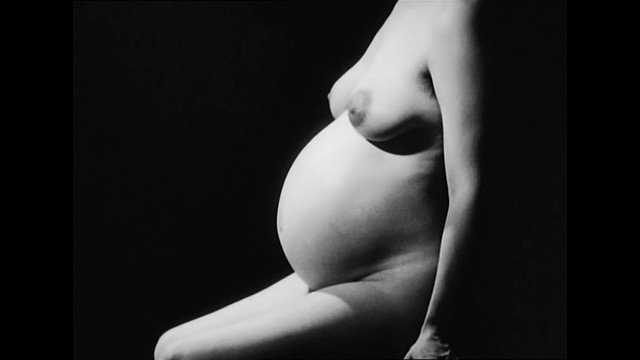
The film jumps around from one imagery to another. With loosely associated images and themes, L’opera Mouffe is a typical, Joyous and life affirming Varda film in a little package that showcases all of her usual themes and preoccupations in her later works - gazes, object/subject relationship, human bodies - especially female bodies, frank depiction of sex, aging and destitution. Screen Shot 2023-03-28 at 3.03.04 PM Varda starts the film with her own naked, pregnant body. Her naked torso, seated against the black backdrop which accentuates her very large pregnant belly. There are many scenes in the beginning of the film with young lovers’ mingling bodies in various close ups- the contours, the crevasses, dimples & goosebumps. It is not the question of whether she was comfortable with showing nudes, as much as seeing the world through her perspective - “the world is defined by how I look and not how I’m looked at.” (Ince, 613)

The haptic visuality, which the eyes function as organs of touch, whereas optic visuality sees things from enough distance to perceive them as distinct forms in deep space, haptic looking tends to move over the surface of its object rather than to plunge into illusionistic depth, not to distinguish form so much as to discern texture. (Ince, 603) Indeed, considering the next shot after Varda’s big pregnant belly are closeups of a giant pumpkin sliced up and its innards scraped out by an unseen farmer at the market. Through the deployment of a haptic gaze, Varda’s body - the filming and the filmed body - becomes here the feeling thing and subject-object Merleau-Ponty describes. It’s a self-portrait in haptic, rather than optical space. (Ince, 605)

Post-feminism constitutes a standpoint from which Western European female filmmakers disentangle their agency from unresolved issues in feminist praxis and theory: how to identify and develop feminine identity and expression within a society and a film system founded on male-dominant models of subjectivity. (Maule, 193) Throwing in her own naked, pregnant body first and foremost at the start of a film, Varda puts detractors questioning her as a feminist filmmaker to rest. And she did this in 1958. Screen Shot 2023-03-28 at 3.05.07 PM A simple narrative in L’opera Mouffe is a tale of young love. We see a young beautiful couple in the beginning: naked, embracing, smiling and making love in bed in their tiny habitat: A snapshot of a paradise in the biblical sense. The sequence is full of joy and happiness, directly contrasting the old and destitute habitants Varda films on rue Mouffetard.

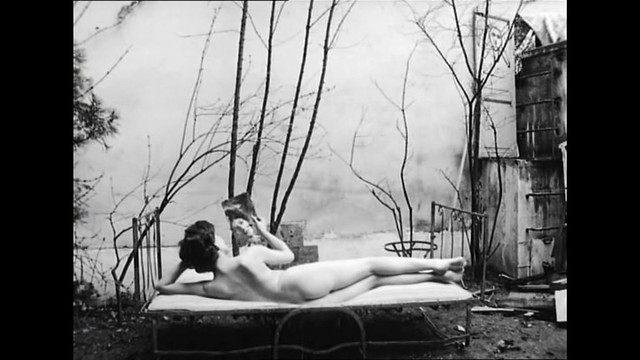
The image follows the young couple’s happy thrist. Beautifully composed in the backyard of Varda’s dwelling on rue Mouffetard, with bare trees in the background, the nude female actor lies in a makeshift bed, looking at her reflections and smiling.

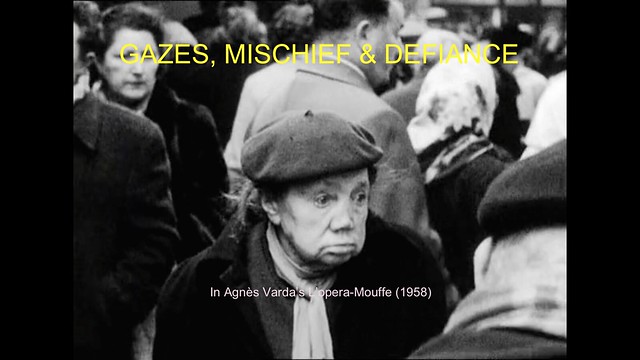
In Lacanian sense, the moment in which the infant looks at his reflection in the mirror is when the child develops a sense of self. Before this, the child doesn’t think of himself as an individual at all, but simply exists as a unified subject, as one with his surroundings. Therefore, the development of a sense of identity leads to a distorted image of true self. This reminds me of many of the mirror scenes in Varda’s filmography, most notably Cleo from 5 to 7 and Beaches of Agnès. In Cleo, when the protagonist first sees herself in the mirror, after being told her fate by a fortune teller, it is to reassure herself the sense of self. That she is still beautiful and that gives her the feeling that she is more alive than others. It’s that youthful beauty that says all is well. As the film progresses, with fractured mirrors, Cleo learns to leave her distorted version of self in the mirror and become free from how the society expects to see her as. In Beaches, Varda sets up multiple mirrors on the beach, as she walks on by and sees reflections of herself in multitudes of angle, suggesting a kaleidoscopic view of her 70 year career and life. The young couple disappears in the middle of the film, then reappears at the end to embrace, not only by themselves this time, but surrounded by the inhabitants of rue Mouffetard, in the middle of crowded street, suggesting that they go out of their own little world to face the real world while still keeping their love and harmonious relationship within the community. Screen Shot 2023-03-28 at 3.08.12 PM There are many instances when Varda’s unsuspecting subjects on the street realizing they are being filmed and looking straight into her camera in L’opera Mouffe. This shot is not the first instance that happens in the film. They are both men and women. But more often than not, it’s the male subjects who wears intense displeasure on their faces.

It is interesting to think about Laura Mulvey’s notion of male gaze in cinema when viewing the film. In a world ordered by sexual imbalance, pleasure in looking has been split between active male and passive female. (Mulvey, 837) The images of woman as passive raw material for the active gaze of man takes the argument a step further into the structure of representation, adding a further layer demanded by the ideology of the patriarchal order as it is worked out in its favorite cinematic form - illusionistic narrative film. (Mulvey, 843)

Again, considering Mulvey’s book was first published in 1975, Varda seems to be a way ahead of the curb in terms of her feminist filmmaking practice, defying patriarchal order of the world early on. Screen Shot 2023-03-28 at 3.38.59 PM The ending sequence features a tracking shot of a visibly pregnant woman carrying a heavy load of groceries on the street. The title card reads “des envies” (cravings), followed by the shots of fishes in the outdoor fish stalls and various meat displays in butcher shop windows. The same woman stops by at the florist and starts voraciously devouring flowers. Perhaps Varda was commenting on weird cravings of a pregnant woman. But when we think of flower eating metaphors in art and literature, we think of lotus eaters in Homer’s Odyssey, an island tribe who are in a state of blissful forgetfulness. The term is often associated with people who indulges in pleasure and luxury rather than dealing with practical concerns. Many of Varda’s films, there are both sad and good moments, but all of her woman characters, there’s joy in being a woman and whether there’s a happy ending or tragedy with the choices they make for themselves. She quotes Simone de Beauvoir, “You are not born a woman, you become a woman.” (Kline, ed. 96) She explains woman’s prerogatives very nicely in an interview:

“If I enjoy pregnancy as a sexual event, it’s my life, my body! Many anti-feminist women don’t. If you choose to have children, pregnancy is a natural event, you should enjoy it. I’m not recommending the way the Church tells me to enjoy it, as a duty, or strengthen the state or the family. It’s never talked about, but most women actually enjoy sexy more when they’re pregnant, for reasons we don’t really understand. I supposed that has to do with many things. But should I deny it? World that make me a better feminist? A woman should let herself feel good being fat and full of baby, that’s her privilege. A model figure isn’t everything, and if that’s what you want, you can go back to it later.” (Kline, ed. 96)


BIBLIOGRAPHY

Ince, Kate. “Feminist Phenomenology and the Film World of Agnès Varda.” Hypatia 28, no. 3 (2013): 602–17.

Kline, T. Jefferson, ed. “Agnès Varda: Interviews.” University Press of Mississippi, 2014: 92-101.

Maule, Rosanna. “Beyond Auteurism : New Directions in Authorial Film Practices in France Italy and Spain Since the 1980s.” Bristol UK: 2008 :Intellect: 1-296.

Mulvey, Laura. “Visual Pleasure and Narrative Cinema. Film Theory and Criticism :Introductory Readings.” Eds. Leo Braudy and Marshall Cohen. New York: Oxford UP,1999: 833-44.

Thursday, March 30, 2023

Familial Boundaries

The Line (2022) - Meier the line The film starts with a tour de force slo-mo of household items thrown against the wall – the plates, bottles, records, vases, anything that is in the reaches of Margaret (Stéphanie Blanchoud) can hurl at her mom Christina (Valeria Bruni Tedeschi). It’s a total mayhem. The scene ends with Margaret striking Christina in the face and her head hitting the grand piano in the living room.

Next, we see is Margaret getting a restraining order. She can’t be within the hundred meters of the Christina’s house. With nowhere to go, Margaret, a singer, take temporary refuge in her former lover and bandmate, now a music producer Julien (Benjamin Biolay)’s apartment.

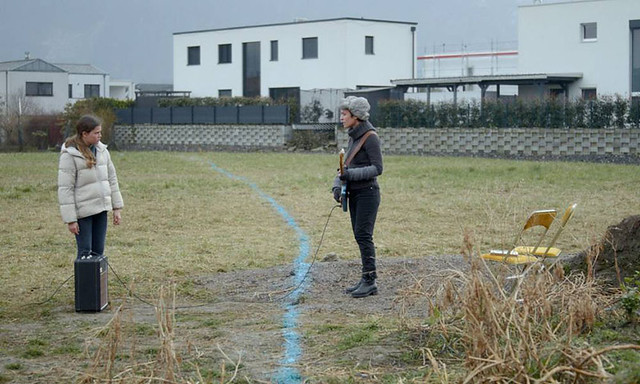
It’s up to Margaret’s young stepsister, Marion (Elli Spagnolo), a churchgoing devout middle schooler, whose communion’s coming up, to keep peace between her mom and her sister as they are both very volatile people. To prevent Marion from getting into more trouble with the law, Marion decides to paint the boundary around the house a hundred-meter distance fence made of light blue paint, this means the field, the road, the creek that goes through the small Swiss town they live in.

In the school, they already make fun of little Marion as a chubby little goodie two shoes. With the scandal Margaret caused is well known in the small town, the taunting is worse. But Marion doesn’t care. She loves them both equally: her imperfect mom, a former famous concert pianist, who doesn’t seem to find a true love and taking up one young boyfriend after another, and her emotionally unstable, violent sister Margaret. She prays day and night for reconciliation of the two.

Marion and Margaret meet at a field just outside the blue line overlooking the house to practice Margaret’s choir singing for her communion with an extended power cable for Margaret’s guitar amp. She incessantly asks for how mom’s been doing. Marion’s reluctant to tell her that her attack left mom half-deaf on her right ear and had to stop giving piano lessons.

Ursula Meier examined what constitutes home and family and its physical and metaphorical boundaries with her previous features – Home (2008), and Sister (2012). With The Line, she continues to illustrate the theme with literally drawing the line on the dirt. The line must be respected and cannot be crossed, not only because it’s against the law, but it is drawn by an innocent child. It would be a betrayal of her love and trust to break it.

Blanchoud, the wild-eyed actress and musician is perfect for volatile Margaret, whose hot temper drives people away from her. Bruni Tedeschi is also superb as a self-centered, nihilistic woman-child who had kids too young and too old.

As usual, Meier sketches out a dysfunctional family which is still a family, nonetheless. And she is wise enough not to question her characters motives or dig their backgrounds too deeply and let silence do the talking.

The Line opens on 3/31 at Metrograph, New York, as part of Permeable Boundaries: The Films of Ursula Meier and also Lensed by Agnès Godard. Meier and Godard will be at the Q&A post-screening on 3/31 and 4/2.

Thursday, March 23, 2023

Sisterhood

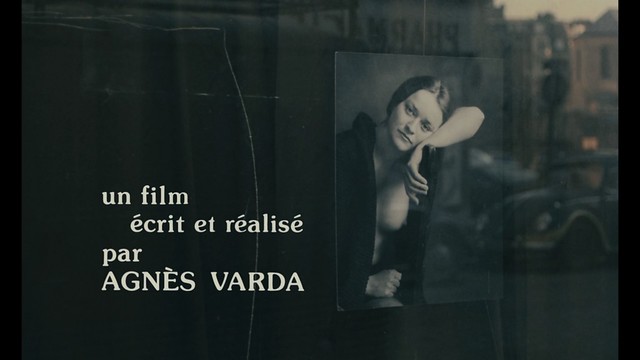
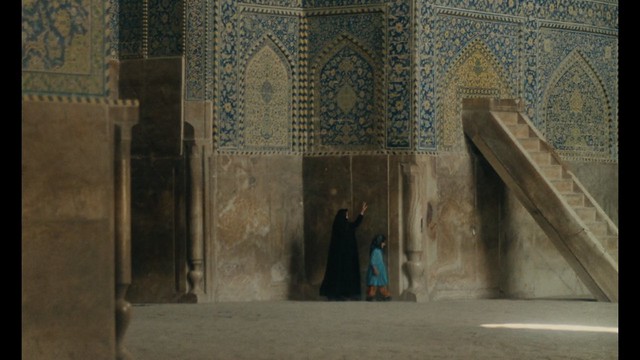
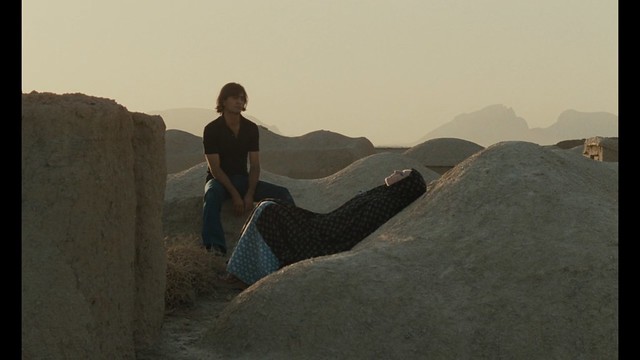
L'une chante l'autre pas (1977) - Varda screen shot 2023-03-14 at 9.36.17 am screen shot 2023-03-14 at 8.58.05 am screen shot 2023-03-14 at 2.29.37 pm screen shot 2023-03-14 at 2.12.45 pm screen shot 2023-03-14 at 2.54.49 pm screen shot 2023-03-14 at 2.47.34 pm screen shot 2023-03-14 at 2.47.58 pm One Sings, The Other Doesn't showcases a female friendship between Pomme (Valérie Mairesse) and Suzanne (Thérèse Liotard) for a decade and a half. With the women reproductive right's movement in the background, what's remarkable is Varda's penchant for natural, unhurried filmmaking that is neiter overly dramatic nor overtly political in its message.

Pomme, still in high school from a modest Parisian household, reconnects with Suzanne, an old neighborhood acquaintance whose sad portraits she sees in a photographer's studio. Suzanne happens to be a lover of the photographer and unwed mother of two and another one on the way. Struggling with poverty and living with a depressed man, she wants an abortion which was still illegal, the year is early 60s. Pomme lies to her parents about a school trip to give money to Susanne for an illigal abortion. After her parents find out about it, she quits school to pursue her singing career. Suzanne goes back to her provincial hometown after the photographer hangs himself in a suicide. They reconnect at the courtroom pro-abortion demonstration a decade later. Pomme belongs to a travelling female folk group, living with her Iranian boyfriend. Susanne has managed to leave her parents farm by becoming a typist, then opens a family planning facilities. Pomme Marries Darius in Iran and become pregnant but comes back to France after experiencing irresolvable cultural differences. And agreeing her child to be taken back to Iran with Darius, Pomme demands Darius to give her another child. Pomme and Susanne corresponds in letters.

Drawing these two very different women's life trajectories, Varda reflects the women and their sisterhood in the 70s France so beautifully. There is no pretention or acting in Mairesse and Liotard's performances. Drama comes in and out naturally as their characters lives flow forward. There are no morals to be learned. There's no judgment to be made with life's decisions that these women make. It is their decisions for them to make and live however they live. We are just glad to see these women exist in front of you and glad to see their life long friendship. In the epilogue, we see their friends and family in a picnic and it's as life should be - full of warmth and love and ever lasting friendship.

Wednesday, March 22, 2023

Emotional Necessity

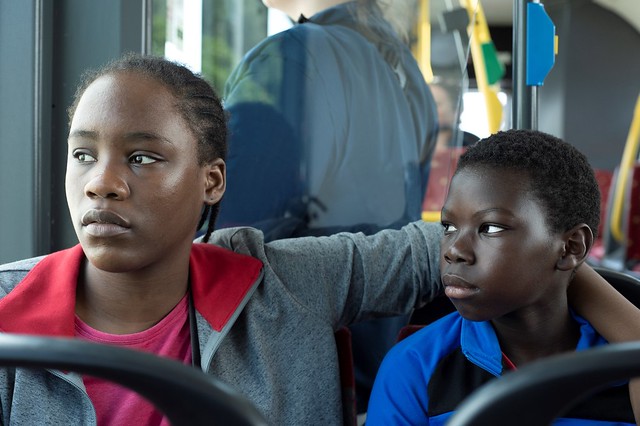
Tori and Lokita (2022) - Dardenne Tori and Lokita The Dardenne Brothers, Jean-Pierre and Luc have been making social realist dramas since the 90s. With Tori and Lokita, they tell a heartbreaking tale of two immigrant children bonding over their traumatic experience and trying to survive in a foreign country. Their makeshift family is quite different from that of Kore-eda's films: if Kore-eda's characters bonded together because of economic necessities, Tori and Lokita's bonding is simpler and based on innate emotions first and foremost: the everyday violence and fear the immigrants face on all sides are quite real and immediate and their need for each other's presence in absence of adults is even greater.

It starts with a teenage girl Lokita (Joely Mbundu) being questioned at a panel hearing which will determine whether they will grant her the necessary papers to stay in Belgium. But her story doesn't quite add up to prove that she is indeed Tori (Pablo Schils)'s older sister. She is prone to panic attacks, and they have to stop the interview. Later we see that they are rehearsing their questions and answers together (Tori already has papers). While staying at a communal housing provided by authorities, the two are inseparable, sharing a bed together where Tori only falls asleep to Lokita's lullaby. They sing together at a restaurant for money and Lokita delivers weed to client. It's Betim, the restaurant's chef, who runs the drug business out of his kitchen in the basement, that she works for. With the African smugglers, who brought them first to Europe from Benin, constantly demanding money with threats of violence, and Betim asking sexual favors all the time, it's quite difficult for Lokita to send money home where mom and five siblings are dependent on her, and also subsist a living in an unforgiving foreign country as a child. But Lokita is insistent on Tori continuing his education and not get involved with Betim's business.

The point the Dardennes are driving home with the film is pretty clear. It's the shared trauma that bonds Tori and Lokita together as they met on the boat that took them to Europe. Their bond is quite simple to understand – going through horrendous hardships together thousands of miles from home. Their need for emotional support for each other is tremendous. Lokita's panic attacks and their need for seeing and talking to each other every day is well illustrated throughout the film.

Things get darker when Lokita agrees to work at a weed farm in a faraway undisclosed location, tending weed while locked in the facility for days at the promise of fake documents that will let her stay in the country. It’s a modern slavery at work. Tori's desire to be reunited with Lokita and his resourcefulness locates her. He sneaks in through the ventilation system of the compound, and they plan to rip the chef off of his game. But they get caught.

Tori and Lokita hits you hard. It's one of the most brutal and emotionally bare films the Dardennes ever directed. Mbundu and Schils are terrific as two young leads. The film addresses some uncomfortable truths about horrible immigration system and lack of support for refugees, especially the children, to survive and deal with the trauma.

Tuesday, March 21, 2023

Hong's Multiverse

Walk Up (2022) - Hong Screen Shot 2023-03-17 at 10.51.20 AM A little three-story white building in Seoul is the setting for Hong Sang-soo's new film, Walk-up (Tab in Korean which means tower or monument). Kwon Haehyo plays Byeungsu, a film director of some repute. Always playing supporting role in Hong films, this is the first time I remember Kwon playing the main character. Like many of his previous films, Hong plays with multiple scenarios and possibilities involving same set of characters in the same place, all the while contemplating about steady companionship vs being alone, being productive, retirement, health and mortality.

Byeungsu is seen arriving in a European made small car with his daughter, Jeongsu (Park Miso, Introduction). He is trying to get his shy, estranged daughter a job through an acquaintance who is an interior designer Ms. Kim (Lee Hye-young, In Front of Your Face) who is the owner of the said building. She has a cafe on the first floor and rents out the second and third floor. The top floor has access to the roof. After introducing his daughter, Byeungsu leaves for an important meeting nearby, promising to come back soon. Jeongsu and the cafe owner converse awkwardly over some wine while waiting for Byeungsu to return. A couple of wine bottles later, Jeongsu drunkenly puts herself forward, aggressively asking for a job. Then she goes out to get more drinks.

When Byeungsu comes back on foot, he, Ms. Kim and Sunhee (Song Seon-mi), one of Ms. Kim's tenants, a cook and a big fan of Byeungsu, start drinking. Byeungsu tells them that his new project that he was working on for the last two years just got rejected by the investors. They also talk about how Jeoungsu working for Ms. Kim didn't work out. And there is palpable attraction between Byeungsu and Sunhee as they keep drinking and exchange their mutual admirations.

When we come back to the scene again, it's them as a couple living in the tiny place and Ms. Kim as their landlord. The ceiling is leaking, and the toilet doesn't work well. And Byeungsu is having health problems. Even though they seem happy together and Sunhee cares for him, feeding him some fresh salad concoction. But something is still off. And it bothers him that she is going to go see her old frenemy he doesn't approve. The place, once a charming space becomes unbearable tiny trap. Byeungsu wonders to himself that if being alone is better.

Next time we see him, he is living with yet another woman (Cho Yun-hee), a very supportive, affectionate woman who brings meat to grill and soju, while also getting Korean medicinal roots preserved in honey. This is an ideal scenario for an aging man. Is this his imagination, daydream or real?

With its elliptical ending, Walk-Up concocts different alternatives for our director protagonist. There is a natural flow to Walk Up that is harmonious and playful, yet never disruptive. It's as if Hong was daydreaming about the possibilities of his future, dreaming about retiring in Jeju Island, possibly with someone who will support him and spoil him. It's funny that this simple small white concrete building in the middle of glass urban jungle serves as an oasis that inspired Hong to dream up Walk Up. It's a good addition to Hong's expanding multiverse.

Tuesday, March 14, 2023

Preview: First Look Film Festival at MoMI

Once again, First Look Festival at the Museum of Moving Image in Queens, New York, is upon us, showcasing new, adventurous films from around the world. Encompassing features, shorts, narratives and non narratives, this year's wide ranging selections feature Tori and Lokita, a new film from the Dardennes, this year's Sundance favorite, Fremont and Mami Wata (Opening Night and Closing Night film respectively), a new Koji Fukada (Love Life), plus films from Argentina, China, Czech Republic, Ukraine, Senegal and whole lot more.

First Look has been and remains to be the unmissable go-to New York film event for surveying the exciting current filmmaking from around the world and discover new talents. I am very privileged to sample the following:

First Look runs 3/15 - 3/19 at Museum of Moving Image. Please visit their website for tickets and more info.

A Little Love Package - Gaston Solnicki A Little Love Package It's 2019. Vienna, the last bastion among the European cities where smoking in cafe has been allowed, bans smoking indoors. It's the end of an era. Two women, played by Angeliki Papoulia (Dogtooth) and Carmen Chaplin are looking for a house to buy. One is rich and very picky about her choices and the other, her interior designer is getting frustrated as her suggestions get rejected one after another. The rich woman's child wants private music lessons from a Korean pianist in Vienna, because she doesn't like the strictness of the music conservatory. After the rich woman finds an apartment, Carmen, the interior designer, travels back to her home in Malaga to visit her aging parents and argue with her sisters about the future of their home and parents.

Shot beautifully by Rui Poças (Tabu, Zama, The Ornithologist), A Little Love Package is loosely associated ideas and images with free-flowing narrative. Argentine Gastón Solnicki's experiments with improvisation using, for the first time, professional actors and also their real family, bear interesting results that are oddly engaging and liberating.

Rodeo - Lola Quivoron Rodeo Street smart misfit Julia (Julie Ledru) is passionate about the underground dirt bike culture. She wants to ride like those boys doing dangerous bike tricks on social media. Her specialty is seeing bikes for sale online, meeting the owner and asking for a test ride and just taking off. She falls in with the B-More, one of the bike gangs on the street at night showing off their skills. The gang is headed by Domino who runs the group from a prison cell with a mobile phone. Because Julia has skills for hustling off the bikes from the rich, Julia gets recruited to work for him. But because she is a girl and rising the ranks in the gang, there are some jealous members trying to shake her down.

Lola Quivoron's verité style energetic direction takes us to the dirt bike subculture with some stunning riding scenes. Ledru is a revelation as a tough as a nail Julia, who hails from Guadeloupe, the tiny French colonial island in the Caribbean, rides bikes and does her tricks, not for money but for the adrenaline rush. The film climaxes to her big idea of doing a heist of a truck full of high-end dirt bikes while on the road. Rodeo plays out if Cassavetes’s directed Fast & Furious.

Huahua's Dazzling World and Its Myriad Temptations - Daphne Xu Huahua Huahua lives in Xiongan, one of the designated 'new areas' in rapidly developing rural China, south of Beijing. She makes a living livestreaming her life, putting on colorful costumes and beautifying filters. She dances and sings, and chats online with her fans. Director Daphne Xu follows Huahua from her most mundane life: cooking, doing household chores, chiding her grandkids in her squalid home, to her internet persona. With her gambling, physically abusive husband, she goes through life's hardships, just like many of the illiterate, working class women. She faces censorship; there are certain words she can't use, and frequently has her channel taken down for a week or two as punishment. She is constantly angry at the realities of life, but she puts on a happy face and an upbeat attitude on the internet for her viewers. She understands that she gets laughed at for her videos, but she takes the live streaming as a means of making a living for her children. She also gets a new husband doing it.

Huahua's Dazzling World reflects the digitally infused world, where there's little distinction between reality and fantasy, commerce and art, exploitation and self-promotion all melding together into one. It's frightening and beautiful at the same time.

Herbaria - Leandro Listorti HERBARIA_15 Leandro Listorti, an Argentine filmmaker with background as a film archivist, investigates the sinewy connections between disappearing plant life and disintegrating old films. And he has a wealth of archival footage to draw from. And it is a beauty: early, discarded films with decaying marks from fungus and other elements, plants filmed in 1912, as well as 16mm and 8mm shot footage of painstaking fieldwork of plants being collected, dried and pressed, then archived. Narration from botanists, scientists, archivists and film projectionists are woven together to create fascinating layers of ephemera that are disappearing.

Herbaria recalls part Bill Morrison, part scientific documentary and part tone poem for everything physical and its eventual disintegration.

The Taste of Mango - Chloe Abrahams TheTasteOfMango How do you reconcile generational trauma that puts cracks in a mother/daughter relationship? Chloe Abrahams' documentary about her mother Rozana and grandmother Jean is a delicate family portrait about unconditional love, resolve and hope. Capturing candid moments with prodding questions, Abrahams tries to understand her mom's traumas stemming from sexual assaults she endured in the hands of her male relatives while Jean remained silent back home in Sri Lanka 40 years ago. It all makes sense to the 27-year-old filmmaker now why her mom never allowed sleepovers when she was a child. All her decisions throughout her life in England, was to protect her daughter from harm with her trauma playing out in her mind. Rozana is a radiant, intelligent woman who constantly sings American Country music songs all intimately captured in Abrahams' handicam. When Jean visits them in England, it's an uneasy stay. It's Abrahams being a mediator, loving two women unconditionally, being the bridge to the two women living in island nations.

Lyrical and heartbreaking, The Taste of Mango is a home movie about three generations of women and how they deal with sexual trauma.

Friday, March 3, 2023

Helping Hands in Godard's Films: Pierrot le Fou

screen shot 2023-02-17 at 10.45.28 am   One can argue that human hands represent progress, creativity, guidance, assistance, also destruction and violence. It is then no surprise that hands are a recurring motif in the works of Jean-Luc Godard, one of the key figures of French New Wave, championed the Auteur Theory and who, for the last six decades, labored over making connections between art and life. The connection between the act of creating and the presence of hands has always been present in Godard’s filmography. They represent both a sole authorial voice and steady companionship in many of his late period films. Alexandre Astruc’s article, The Birth of a New Avant-Garde: La Camera-Stylo, was a basis in defining French New Wave and The Auteur Theory a decade later. In it, Astruc advocates that film directors have the same authorial voice in much the same way that writers would write with a real pen; it was in other words, a call for a new kind of cinema, in which the vision of the ‘author’ – or auteur of the film was central. (Martin 2013). The recurring motif is in many of his 80s and 90s films and most prominently in his epic Histoire(s) du Cinema. What I am trying to suggest here with this article is that not only the act of writing, signifying the authorship is shown but helping hands and companionship, or lack thereof, through hands were presented as early as (if not earlier), in Pierrot le Fou.

  Pierrot le Fou was Godard’s tenth feature, shot in Techniscope for widescreen presentation, based on a crime novel Obsession by Lionel White. It is a road movie with a political intrigue, starring Anna Karina and Jean-Paul Belmondo. Godard had established himself as a formidable director by then, having a string of successes after Breathless; A Woman is a Woman, Vivre sa vie, Contempt, Band of Outsiders, etc. No doubt the success was due, in large part, to Karina’s on-screen presence. But their real-life relationship was tumultuous, and their marriage was dissolved after 5 years in 1965, with Pierrot being their first and last post-divorce era collaboration. Things were dicey in France during and after the Algerian War, 1954 - 1962. Even the north African country won its independence from France through armed struggle. Both in France and abroad, OAS, the extreme Right Wing militant group, carried out a series of violent attacks against those who advocated Algerian independence. The Vietnam War was still raging, and national protest was mounting, and all these sentiments would accumulate to May 68’ three years later. American culture and material goods were flooding in. So were sense disillusionment and escapism in rapidly changing society. This climate is all presented in Pierrot.
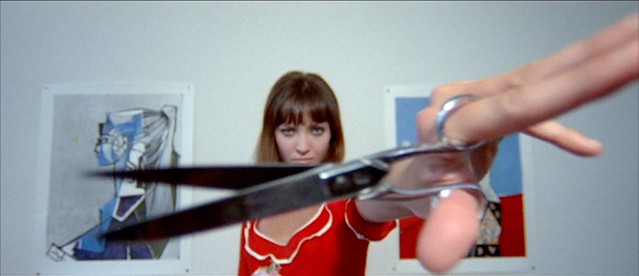
screen shot 2023-02-17 at 10.02.25 am   The story concerns Ferdinand (Belmondo) who flees his Parisian bourgeois family life with his former lover and family’s sometime babysitter Marianne (Karina), who has ties with dangerous illegal arms dealers. After finding a corpse with scissors stuck in his neck in Marianne’s apartment, the pair escape armed OAS goons and head for the south in the dead man’s car. After a crime spree and ditching two cars- one burned and the other willfully plunged into the water, they settle themselves on an island for simpler life. But the couple soon find out that they are very different from each other - while Ferdinand/Pierrot buries himself in books and writing, Marianne gets bored and longs for civilization and consumerist comforts. After getting caught by the criminals and tortured, they are separated. They find each other again at a marina in Toulon where Ferdinand works as a cabin boy for a woman who claims to be a Lebanese princess in exile. Marianne convinces him to swindle a briefcase full of cash and promises to run away with him afterwards. But she double crosses him with her real boyfriend gunrunner Fred and sails to an island where Fred has a mansion. Ferdinand/Pierrot pursues them and shoots them down. He then paints his face blue and wraps red and yellow dynamite around his head and blows himself up.

IMG_3618   I found a referential detour in Pierrot le Fou in two places. The film shows Ferdinand keeping a journal and constantly writing on graph paper. The act of writing is not new to Godard films; as early as Une Femme Coquette, his first fiction short from 1955 and Karina composing a letter in Vivre sa vie are examples. In Pierrot, it’s his own cursive being written in that journal. Godard’s monumental epic on history and story of cinema, Histoire(s) du Cinema is also ripe with visual motifs of hands. It starts with Godard furiously typing away on his electronic typewriter with that unmistakable screeching of an electronic machine from the 80s. Godard snarls in his throaty voice, “Man’s true condition: to think with hands,” borrowing from the Swiss writer Denis de Rougemont. (Vishnevetsky 2018) The presence of hands particularly stands out in those embodiments of his thoughts, because the essay film is practically a filmed writing process. (Kim 2018)
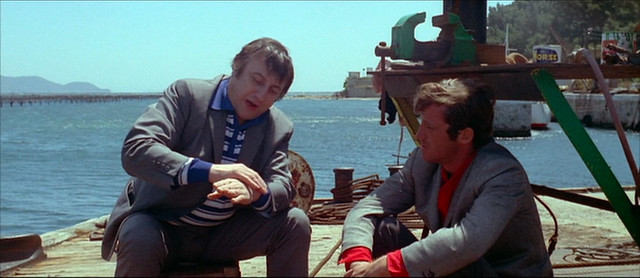
screen shot 2023-02-17 at 10.45.05 am   About two-third way into Pierrot, the second detour to hands appears with Raymond Devos, a well-known comedian of that time period, who plays a nostalgic man striking up a conversation with Ferdinand/Pierrot at the dock, a place where betrayed Ferdinand/Pierrot embarks for his revenge. The man proceeds to tell a long and convoluted story, with wild gesticulations, about his lost loves. He says he hears music in his head all the time and keeps asking Ferdinand if he hears it too. “Est-que vous m’aimez…?” He keeps singing the song and we hear the music that is in his head, identifying with the man. He says he was wooing a woman by holding and stroking her hand. The story goes that he asked if she loved him, and she said no. The second woman said yes but he didn’t. The third woman said yes, and he held on to her hand for ten years. “You don’t hear the music? You can come right out and tell me if you think I am crazy!” Ferdinand replies, “You are crazy” and hops on a boat to go to the island to kill the double-crossing Marianne and Fred. There are many comedic moments in Pierrot - at a gas station where the fugitive couple steal Ford Galaxie convertible (Godard’s own) off the pneumatic machine, the couple’s reenactment of Vietnam War at a pier for money where Ferdinand and Marianne play grotesque caricature of an American GI and a literal yellowface Vietcong are some of the prime examples. But five minutes of uncut reverie of Devos’s lovelorn loser routine is such an anomaly and comes out of left field at a pivotal, somber moment. Yet it comfortably fits into Godard’s antics- narrative dissonance that he cultivated both visually and aurally through the edits over the years.

  The Devos scene reveals a lot about the fraught relationship between Godard and Karina. “With the end of his marriage to Anna Karina came the end of his quest for a form in which to represent and reinforce it; his new formless way of filmmaking mirrored a frantic state of mind that left no illusion of balance, finish, or grace.” (Brody 2009, 237) When Godard was visiting Serge Rezvani, a musician who contributed two songs that Marianne sings in the film, he was apparently struck by the harmonious relationship Rezvani had with his wife Danielle. “Gazing at the Rezvanis, Godard beheld, to his amazement, an artistic couple that was thriving. Godard’s subsequent contact with the couple, Resvani noted, showed how consumed he was by the problem - by his failure and their success.” (Brody 2009, 242) It makes sense, given Godard's personal, reflexive filmmaking, that he saw himself as the sad philosophizing clown who was betrayed. And underneath Devos’s funny antics hid the longing for the lost love and fantasy of that perfect union of artistic minds and unwavering support that he did not find in Karina. Therefore, through a glass darkly, Pierrot can be seen as a self-damaging, violent, dark fantasy reflecting on his real-life relationship.
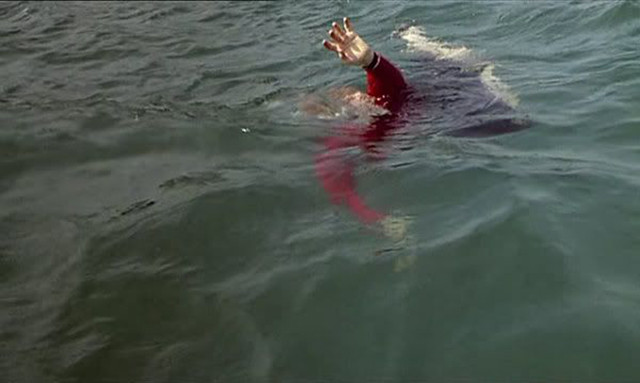
52723215446_7e4410fddb_o 66C647CF-820C-4330-B876-F75A61886A6E 52723618855_64fe3b209f_o 52723618840_838dfbafed_o   The visual and thematic motif of helping hand dominates Nouvelle Vague, Godard’s renewal of the new wave spirit in 1990. Not only the repeated close-up of hands that are shown in the film but thematically, from helping hands to a bum on the side of the road, pulling a drowning woman out of water, to lending a hand to the world in turmoil, the film is riddled with the metaphor of helping hands. Then there’s the pointing hand of Leonardo da Vinci’s St. John The Baptist in The Image Book, a hand over a naked young woman’s abdomen in Hail Mary, connecting the motifs with creation and divinity. In First Name: Carmen, an open hand covers the TV snow as if embracing the technology. In Film Socialisme, Patti Smith’s outstretched hands, trying to reach or caress the other side of the port, as the European Union tries to reconcile its colonial past. Thinking about all the visual motifs of hands in Godard’s filmography, I would say that this scene in Pierrot is perhaps the beginning where he incorporates the idea of helping hands.

anna-karina-jean-luc-godard   Pierrot le Fou reflects on a lot of social and political upheavals, as well as cultural trends of its time: The extreme right-wing violence, The Vietnam War, widely popular crime novels, rampant consumerism, yearning for simpler life and disillusionment of love. Every film needs to be seen and examined with a proper context. As reference heavy as Godard's films usually are, the visual motif of hands in Pierrot gives a great deal of insights to not only the filmmaker’s creativity and control over his craft, but outside the frame and his life in general. It all makes sense with Ferdinand constantly writing, in Godard’s own cursive and own words. Marianne, whom he thought he was in love with, turns out to be a double-crossing, morally lacking, consumerist manipulator. She’s not the like-minded sister-in-arms toward the artistic struggle. He tells her to “Shut up, I’m writing!” Twenty-five years old when they were filming Pierrot, Karina wanted to be free. Pierrot was the last collaboration between them and in his depressive state, he was able to exercise his dark fantasies one last time.

BIBLIOGRAPHY

Brody, Richard. “Everything is Cinema: The Working Life of Jean-Luc Godard.” Metropolitan Books/Henry Holt & Co., New York, 2009

Kim, Jihoon. “Video, the Cinematic, and the Post-Cinematic: On Jean-Luc Godard’s Histoire(s) du Cinema.” Journal of Film and Video 70.2, Summer 2018

Martin, Sean. “New Waves in Cinema.” Oldcastle Books, 2013

Vishnevetsky, Ignatiy. “The Hand of Jean-Luc Godard.” Mubi Notebook Feature, December 25, 2018 https://mubi.com/notebook/posts/the-hands-of-jean-luc-godard

Wednesday, March 1, 2023

Preview: Rendez-Vous with French Cinema 2023

Showcasing the best of contemporary French films, this year's Rendez-Vous with French cinema features 21 features from old masters to newcomers, including new films by Philippe and Louis Garrel, Arnaud Desplechin, Dominik Moll, Patricia Mazuy and Léa Mysius. Though I feel like I say this every year, about this ultimate festival for Francophiles, but this year's offerings are possibly the strongest in terms of quality and cinematic audacity, in years. Guest attendees include Virginie Efira, Louis Garrel, Christophe Honoré, Alice Winocour, Patricia Mazuy, Melvil Paupoud and more.

Rendez-Vous with French Cinema is presented by Unifrance and Film at Lincoln Center and runs 3/2-3/12 @filmlinc

Here are 5 films I was privileged to sample for the festival:

Brother and Sister - Desplechin Sister and Brother Arnaud Desplechin, one of the most literary minded film directors of our time, comes with Brother and Sister, a family drama rich with beautifully written characters. It stars Marion Cortillard and Melvin Poupaud as Alice and Louis, as estranged siblings coming to terms with their differences after fatal car accident involving their elderly parents. It starts out with a flashback at the wake of Louis and Faunia (Golshifteh Faranahi)'s young son where Alice and her husband are turned away at the doorstep by angry Louis. The film goes back and forth, peppered with flashbacks, giving the fraught sibling relationship its necessary contexts. It turns out that Alice, now a famous stage actress resented her younger brother's success as a writer. After many years of books by Louis writing about their thinly veiled relationship, they are not in speaking terms.

Things get very awkward while both parents are hospitalized because the siblings tiptoe around their visits, trying not to cross paths, while their partners, other siblings and friends encourage and discourage their possible encounters. Both Cortillard and Poupaud are marvelous as they act out the beautifully written script by Desplechin. It's the most emotionally resonant Desplechin film in years.

The Night of the 12th - Moll Screen Shot 2023-02-24 at 8.56.05 AM Gilles Marchant and Dominik Moll, the writer-director team known for tight Hichcockian psychological thrillers over the years, come with The Night of the 12th. It's a policier in the same vein as Memories of Murder and Zodiac. In a picturesque small alpine village near Grenoble on the night of October 12, a young woman is torched to death with a gasoline fluid and a lighter. It devastates the whole town and stumps its police department, headed by young captain Vivés (Bastien Bouillon) with lack of concrete leads. Moll deftly examines inherent sexism rampant in French society and generational differences in approaching romance and relationship. With its economical storytelling and sharply drawn characters, The Night of the 12th is an immensely watchable crime film.

The Five Devils - Mysius Five Devils - Still 2 Léa Mysius's follow up of her stunning debut Ava, is a time traveling queer love story starring Adèle Exachopoulos. The title refers to a small town overlooking the rugged mountain peaks in the southeast region of France. Exachopoulos plays Joanne, a swim teacher at a local pool living a mundane life with Jimmy, her firefighter husband and their adorable daughter Vicky.

Vicky, bullied constantly for her big afro, lives in her own world mostly and has a keen sense of smell of all things. She collects objects in jars to preserve their smells and has visions of the past. Things get shaken up when Julia, Jimmy's sister and Joanne's former flame returns to town. The Five Devils turns into a poignant story about prejudices and acceptance with black girl magic elements.

Winter Boy - Honoré Winter Boy Winter Boy tells a story of Lucas, a 17 year old gay high school student trying to come to terms with the sudden death of his father (played briefly by director Christophe Honoré) which might have been suicide. After the funeral, he tags along with his older brother Quentin (Vincent Lacoste) who is a burgeoning artist in Paris for a week. There, Lucas experiments with anonymous sexual encounters. He also falls for Lilo (Erwan Kepoa Falé), Quentin's roommate. Quentin gets furious when he finds out his sexual shenanigans and sends him home. Lucas then cuts his wrists while with his concerned mother, played by Juliette Binoche, and ends up in a rehab.

The film is set up like a confessional, with both Lucas and later mom talking to a dead father, as they try to deal with grief and absence of a loved one. Like many Honoré films, Winter Boy is a beautifully drawn, melancholic film dealing with truthful emotions when life hits you like waves. The living can't stay mad at the dead. We have a living to do, even with a hole in our heart.

Saturn Bowling - Mazuy Screen Shot 2023-02-26 at 7.09.11 PM Shocking in its depiction of violence against women, Patricia Mazuy's serial killer noir is extremely disturbing and uncompromising as it examines the origin of violence in our patriarchal society. Half-brothers Guilaume and Armand reunites after their father dies. Guillaume is a cop and just inherited a bowling alley from his dad. The bowling alley is a hub of his dad's big game hunter friends who want to keep things as it is. Guillaume doesn't want to deal with the business, so he offers Armand to run the place. Armand reluctantly accepts.

But it turns out Armand is a violent serial killer who preys on young women who frequents the bowling alley. He uses his dad's pad to have sex and kill them there. Bodies mount and unsuspecting Guillaume gets frustrated with the investigation. To complicate things, his love interest is an animal rights activist who doesn't see things eye-to-eye with the big game hunting crowds. With its deliberate pacing, simmering nighttime photography and daring perspective shifts, the film has a peculiar way to get under your skin while condemning male tendency or desire to kill. Making a point in a most brutal and succinct manner, Saturn Bowling is one of the most daring and unflinching film I've seen in a long while.

Sunday, February 19, 2023

Burnt Offering

Silver Haze (2023) - Polak Silver Haze Dutch director Sacha Polak teams up again with Vicky Knight, a British actress and a star of her previous film Dirty God, in her new film Silver Haze, which premieres at this year's Berlinale's Panorama section. Knight, who sustained serious burn on one third of her body as a child, plays Franky, a young woman who is a victim of a fire and carries the stigma both flesh and mind. Her East End family home is a mess - mom, an alcoholic who never recovered from her husband leaving for another woman, a younger sister who has yet to find her identity and an older male relative who is not quite the role model. Even though Franky is sleeping with a local boy, everyone close to her knows that she has lesbian tendencies. While working as a nurse at a hospital, she befriends a suicidal patient Florence (Esme Creed-Miles) and starts seeing her after being discharged. Florence, a young woman from a wealthy family, has been staying with Jack, her autistic brother, in the home of family friend Alice (Angela Bruce), an old black woman dying of cancer, near the beach in the south of London. Forever moody and unpredictable, Florence warns Franky that she is a bad person. Yet, Flo is the first person who makes Franky smile in a long time. She is the person who encourages her to come out of a shell. For the first time since she got burned, Franky can go out to swim, exposing her scarred body to the world.

But Flo is also a bad influence on Franky. She's Franky's id personified. After arguing and breaking up and disappearing for days on end many times, Flo encourages Franky to firebomb her dad's new house where he lives with his new family. It is dad's new wife whom she believes is not only responsible for the breakup of her family but also for setting a fire in the pub where she got burned.

Franky finds a makeshift family in Alice's home, away from daily bullying, physical, verbal abuses, and self-doubt. It is Jack, who has no filters, tells like it is - that the fire where Franky got burned might not have been an arson, that it could have been caused by a lot of different things, exposing Franky's hate and anger, and her desire to put a blame on one person all her life might have been willfully misdirected and a self-denial. Like the cannabis strain that Franky grows with care, where the title comes from, the film is about the smoke screens as a defensive mechanism to cope with life's traumatic events. But somehow you will need to face the reality to move on.

In the tradition of British kitchen-sink realism of Lynne Ramsay and Andrea Arnold and humanist makeshift family dramas of Kore-eda, Polak and Knight create an emotionally resonant film about forgiveness and finding peace via self-reflexive storytelling. Knight is a natural born actress and camera (captured by DP Tibor Dingelstad) adores her. Her brevity in using her life story and stigma she carries on screen is quite remarkable. Sensitively written and directed with clear eyes, Silver Haze is a great little gem and first great discovery of the 2023.