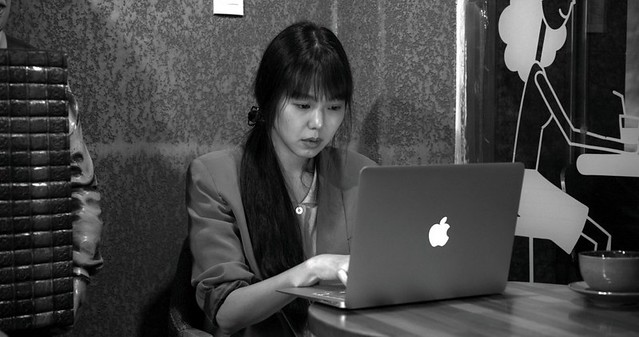
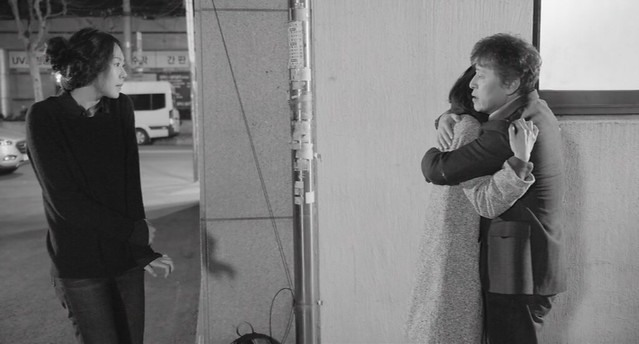
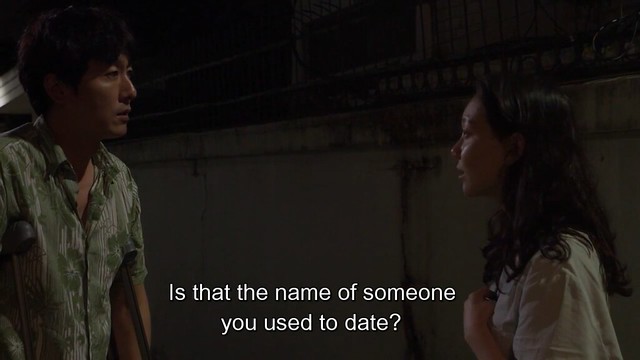
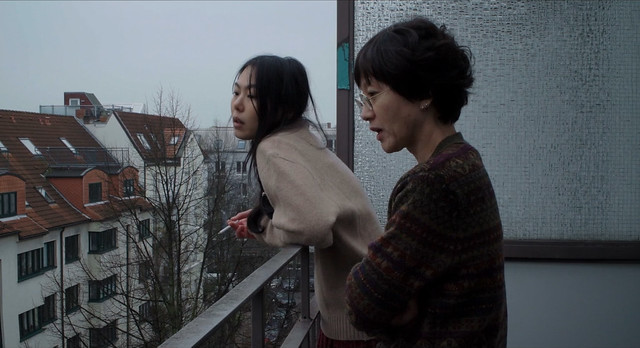
Showing posts with label Hong Sang-soo. Show all posts

Sunday, July 6, 2025

Drinking Test

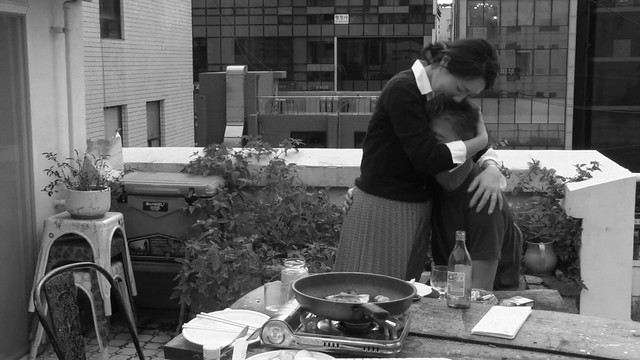
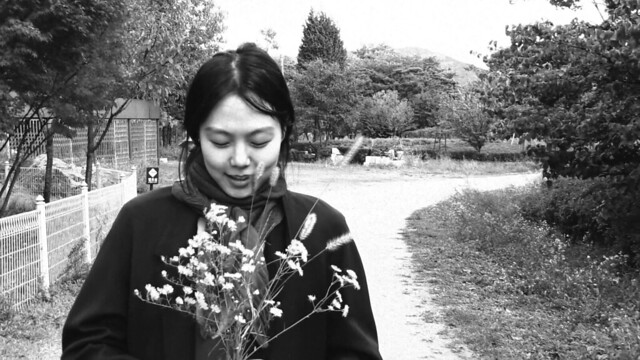
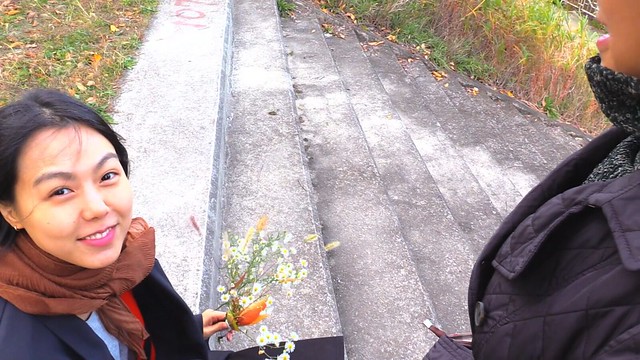
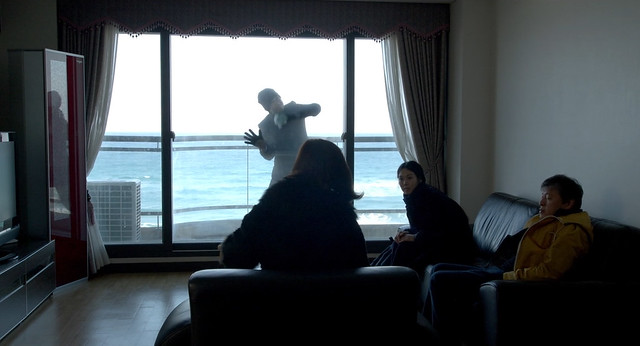
What Does That Nature Say to You (2025) - Hong Screen Shot 2025-07-06 at 7.01.42 AM Screen Shot 2025-07-06 at 7.33.16 AM Screen Shot 2025-07-06 at 7.53.40 AM Screen Shot 2025-07-06 at 8.32.51 AM Donghwa (Ha Seongguk), a thirty-something poet drops off his girlfriend Junhee (Kang Soyi) to her parents' house outside Seoul in his used old car that he loves. And the clunky blue car is the one that her father (Kwon Haehyo) notices, along with his facial hair. Maybe out of politeness, Dongwha and the father carries on an awkward conversation about the rural house that the father built for his now deceased mother, which is equipped with a chicken coop, a cozy private shack, and the impressive landscaping behind the house all the way up to the top of the hill with a majestic view. All is well and the father invites him to stay for dinner. Donghwa seems to be enamoured with the beautiful surroundings and Junhee's parents' DIY house. Whenever he finds an inspiration for his poetry, he jots it down in his little notebook that he carries everywhere.

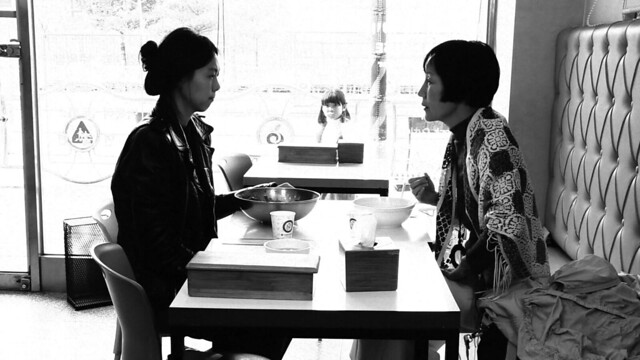
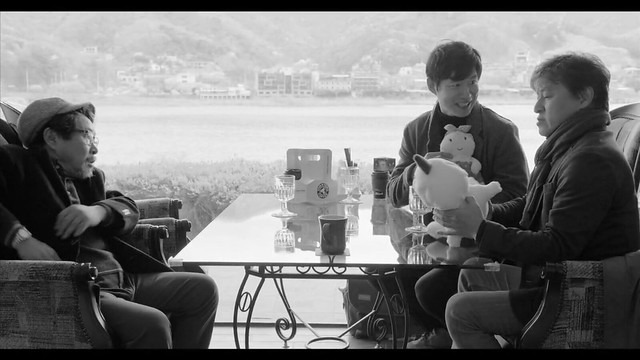
Dongwha, Junhee and her reclusive older sister (Park Miso) who might be suffering from depression, have lunch at a local restaurant by the river. Junhee's sister is not sure if Dongwha, a son of a famous TV defense attorney, working as a photographer at weddings, is as self-reliant and immaterialistic as he professes to be.

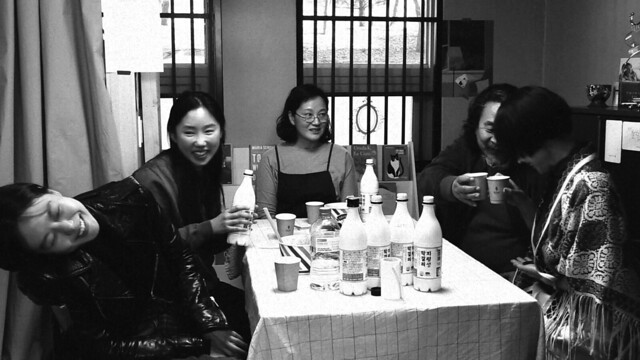
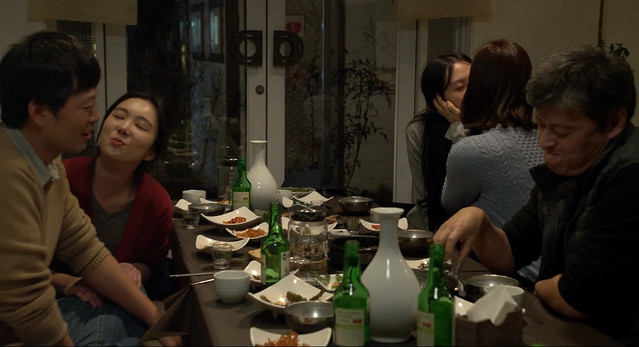
Junhee's mom (Cho Yunhee), who is also a published poet, lays out a chicken feast for the possible future son-in-law for dinner. And the conversation naturally turns interrogative. After a bit of Korean rice wine is consumed, by the encouragement of mom, Dongwha recites his terrible and naive poetry about night blooming flowers, eliciting polite responses. But it's the sister's niggling questions about his rich and famous father and whether he is truly self-reliant that sets Donghwa off. And the dinner ends in drunken outbursts and Dongwha passing out on the dinner table.

At night at his shack, the dad and mom assess Dongwha, just as any prospective in-law would - but not in definitive terms: He obviously has some deep seeded issues with his father. Junhee loves him now, but with life experience she will figure it out if they are gonna be good together. They laugh about him bombing the 'liquor test'- and if that was the dad's real intention, which he denies vehemently.

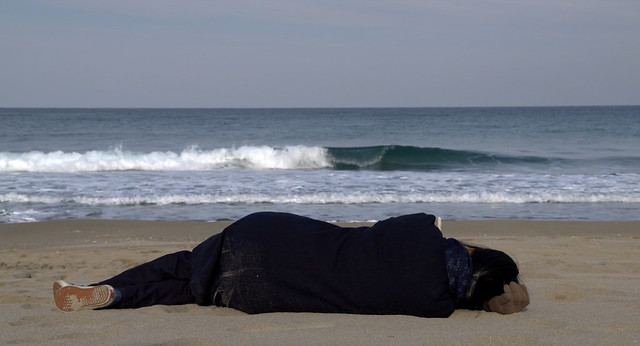
Dongwha is seen walking around at night on the hills, looking at flowers lit up by his cell phone, then tripping and falling, hurting himself.

With What Does That Nature Say to You, Hong Sangsoo sketches out another slice of life effortlessly: The awkward, funny interactions among the characters ring true as usual. The youthful idealism fades when we face the real world and responsibilities. The pursuit of truth and beauty is admirable, but it's not cute anymore when you are 35 and without a steady job. You can't guise it with junk cars, facial hair and actively not wearing glasses because you want to see the world a little bit fuzzy (a dig on Hong's own late style where things are intentionally out of focus) as your aesthetic.

Hong, as usual, is showing his cynicism toward young artistic types. It's probably because he went through that phase himself and now can look back and have a laugh.

Wednesday, October 9, 2024

If I Fall from Grace

By the Stream (2024) - Hong By the Stream Clocking at 111 minutes, Hong Sangsoo's new film, By the Stream, is perhaps the most busily plotted and the most sinewy among his recent output. It touches on many of Hong's preoccupations and reflexive filmmaking, along with the recent surge of the Korean feminist movement.

It concerns a disgraced actor, now a small bookstore owner Siyeon (Kwon Hyeho) in Kangwon province, being invited to stage a play in the year end festival in a women's university in Seoul, by his niece Jeonim (Kim Minhee) that he hadn't seen for years. It turns out that he is a last minute replacement, because the young director who was in charge of the production was dismissed because he slept with 3 of the cast members. The actor sees this opportunity as a kind of redeemable occasion which would rekindle his passion for art as he felt when he first started his career, which happens to be at the same university long ago.

Jeonim, in her early 40s, is living a quiet, uneventful life as a textile artist and working at the university. She is first seen sketching in her notebook by the steam in earth colored Fall attire. It was the university's department chair Jeong (Cho Yunhee) who gave her the job and trusted her and became a big sister figure in her life. It turns out Jeong is a big fan of Siyeon as an actor and really wanted to meet him. After a couple of drinking occasions and some grilled eels, the actor and Jeong get along swimmingly and that makes Jeonim a little uneasy and jealous. In the meantime, with new materials that Siyeon wrote, the 4-female play team rehearses their play under his guidance. The young women are eager and full of optimism in their expression of joy and outlook- the way only not-yet-jaded-by-life young people say and behave.

Jeonim confronts the young director (Ha Seongguk) who was let go, when he comes back into the university campus to talk to one of the girls he professed his love for. His remorseless behavior and demands to get his job back and his material being staged receives Jeonim's contempt and anger. Her reaction is almost feral.

When the young man makes a second appearance to propose to one of the girls, Siyeon steps in and has a talk with the young man. We don't get to see what's being said.

Hong leaves a lot of threads messy and untidy, unlike Jeonim's textile patterns with intricate designs. What really happened to Siyeon the actor? What made Jeonim content with her life? Why did their play receive poorly and why did the dean of the school want to talk to Siyeon? It Doesn't matter. Hong's characters interactions are delicious as always. It's a change of pace from his minimalist work with his last couple of outings, even the Isabelle Huppert starring A Traveler's Needs that came out this year as well.

Tuesday, July 30, 2024

Live Life Truthfully

A Traveler's Needs (2024) - Hong Screen Shot 2024-07-29 at 9.21.02 AM Screen Shot 2024-07-29 at 9.31.03 AM Screen Shot 2024-07-29 at 9.53.17 AM Screen Shot 2024-07-29 at 10.11.44 AM Screen Shot 2024-07-29 at 10.17.15 AM It is hard to quantify Hong's films, and I am not talking about him making two or three films of the year as he has been for the last decade or so. It's not that what Hong does need to be measured by the likes of me, but as someone who watched vast swaths of his films, with my ADHD triggered rating system toward a director's filmography going, I can't help myself ranking which of his films are better, more impactful than others in my head. and I am happy to say that A Traveler's Needs, his new film starring indomitable Isabelle Huppert, is one of his best films.

A Traveler's Needs concerns Iris (Huppert), a French woman living in Korea. She started giving French lessons to two Korean women recently. Her method seems interesting: she writes down a custom-made phrase on wads of index cards she carries in her bag for each person she is tutoring. Eager to please the foreign woman, Korean women play musical instruments in front of her. She asks each of them how they feel when they play. And they both in turn give generic answers which turn out to be identical. Iris pushes harder - but how do you really feel? Then she writes down her French phrases for them.

All the Hong signatures are present - a subtle comedy based on repetition, copious amounts of alcohol consumption - in this film, the choice is Makguli, a milky Korean rice wine.

The third act concerns a young man, Seong-guk who shares his flat with Iris. It turns out that he met her in a park, sitting there alone, playing a flute badly without a care in the world. It is revealed that she didn't have any means for living, so he suggested tutoring French which she has no prior experience in. Seong-guk's estranged mom stops by unexpectedly and chastises her son for living with some foreign woman. He explains that Iris lives her life truthfully. Mom wants him to ask her about her background. She doesn't want this mysterious foreign woman taking her naive son for a ride.

A Traveler's Needs have much in common with Wim Wenders's Perfect Days. These protagonists are people of very limited means and ambitions. They just float around living life as truthfully as they can. Never looking backwards but always forward. There's some sort of universality here - Wenders directing in Japan seeing the world through the eyes of Koji Yakusho and Hong directing and seeing the world through Huppert's eyes. Gentle, living by the moment, enjoying the surroundings - nature, sleeping, drinking, small human interactions.

I see that Iris can be the continuation of a character Huppert played in Mia Hansen-Løve's L'avenir/Things to Come (2016), a professor losing her job and marriage, trying to find the footing in the world for the first time in a long time as an aging woman. It is not difficult to imagine her character taking off to some foreign land and keep on living like that.

Huppert is marvelous as Iris. The best scene is perhaps her flirting with Kwon Hye-ho's character: obviously there's an attraction between them. She touches him on the shoulder and winks at him, then giggles like a schoolgirl. He is spellbound obviously.

A Traveler's Needs is up there in Hong canon and one of my favorite films of the year for sure. Here is my review for Things to Come

Tuesday, May 21, 2024

The 4 most important things in life

In Our Day (2023) - Hong Screen Shot 2024-05-21 at 4.23.49 PM Screen Shot 2024-05-21 at 4.24.19 PM Screen Shot 2024-05-21 at 4.25.14 PM Screen Shot 2024-05-21 at 4.23.03 PM Sleeping
Cats
Alcohol
Cigarettes
+ Ramyun with chili paste

Saturday, September 30, 2023

Out of Focus

In Water (2023) - Hong Screen Shot 2023-09-20 at 4.12.00 AM Hong Sang-soo, a Korean auteur who's singular minimalist filmmaking has comfortably found home in film festivals everywhere, again, presents two films at the NYFF this year unsurprisingly. In Our Day (had its premiere at Cannes) and In Water. Even clocking just over an hour, In Water will test audience's patience, and I expect there will be many walkouts. It's not because the film is inherently bad (I guess it depends on where you stand on Hong's often idiosyncratic films about not very much, but I digress), but because film is out of focus most of its running time. Expect frustrated audiences getting up and complaining to the ushers that there's something wrong with its projection throughout. But as the film plays out, there are spurts of scenes that are in focus, telling the audience that the rest of the film is intended to be out of focus. Now having made over thirty features, and no problem financing his microbudget films, Hong makes whatever he wants and however he wants. In Water, just like last year's The Novelist's Film, concerns artist's struggle to create and finding inspirations. It just happens to be all out of focus!

So, what does he try to convey in these fuzzy mostly static long shots? Does it reflect the young protagonist's creative block? Does it represent Hong's failing eyesight? We don't get to see three actors' faces most of the time. Does it symbolize the struggle to create is universal by making them sort of anonymous? It is a bold statement for sure.

Sung-mo (Shin Seok-ho, Introduction, Walk-up) is location scouting for his short film in an off-season southern seaside town with two friends, Sang-guk (Ha Seong-guk) and Namhee (Kim Seung-yun). It is revealed in their conversation that the former actor is trying out his directing and the two friends from college days are there to help out. The young filmmaker is putting his own money into this week-long excursion without a script. He is trying to find inspirations in the surroundings.

There had been some ideas that Sung-mo had for a project but he is less certain now if they will work. Sang-guk and Namhee are cordial enough to follow his leads, braving the cold, windy weather by the sea. While looking out over the cliff, while Namhee shows off her Taekwondo kicks to Sang-guk, Sung-mo notices a woman collecting trash on the rocky beach below. He goes down there to talk to her. She is volunteering to clean the beaches because she lives in the neighborhood.

Then there is a phone call Sung-mo makes to a friend (ex-girlfriend?) who is in Malaysia, voiced by Hong's partner/muse, Kim Min-hee. He asks her if he can use the song he composed for her birthday in the past to be featured in the film. He is trying to gather inspirations from everywhere.

Just like reflecting his own creative process, with In Water, Hong shows where he draws his inspirations from - the surroundings, past relationships, supportive friends, etc. But obviously, Sung-mo, a young man who is dabbling in directing for the first time, is not Hong, a seasoned filmmaker in his 60s. It ends with Sang-guk filming him walking into the sea and I burst out laughing, because that was how I ended my extremely pretentious student film that I made long ago. But at least mine was in focus!

Hong is being playful here within the margins of his minimalist aesthetics that he cultivated over the years. The film being out of focus might mean a lot of different things as I mentioned above, but knowing Hong through his films over the years, I don't think there's greater mystery, deep philosophical subtext, or puzzle box to solve in In Water. He is at a career stage where he can comfortably experiment with form, within the minimalistic confines of his filmic world. And I am loving it.

Tuesday, March 21, 2023

Hong's Multiverse

Walk Up (2022) - Hong Screen Shot 2023-03-17 at 10.51.20 AM A little three-story white building in Seoul is the setting for Hong Sang-soo's new film, Walk-up (Tab in Korean which means tower or monument). Kwon Haehyo plays Byeungsu, a film director of some repute. Always playing supporting role in Hong films, this is the first time I remember Kwon playing the main character. Like many of his previous films, Hong plays with multiple scenarios and possibilities involving same set of characters in the same place, all the while contemplating about steady companionship vs being alone, being productive, retirement, health and mortality.

Byeungsu is seen arriving in a European made small car with his daughter, Jeongsu (Park Miso, Introduction). He is trying to get his shy, estranged daughter a job through an acquaintance who is an interior designer Ms. Kim (Lee Hye-young, In Front of Your Face) who is the owner of the said building. She has a cafe on the first floor and rents out the second and third floor. The top floor has access to the roof. After introducing his daughter, Byeungsu leaves for an important meeting nearby, promising to come back soon. Jeongsu and the cafe owner converse awkwardly over some wine while waiting for Byeungsu to return. A couple of wine bottles later, Jeongsu drunkenly puts herself forward, aggressively asking for a job. Then she goes out to get more drinks.

When Byeungsu comes back on foot, he, Ms. Kim and Sunhee (Song Seon-mi), one of Ms. Kim's tenants, a cook and a big fan of Byeungsu, start drinking. Byeungsu tells them that his new project that he was working on for the last two years just got rejected by the investors. They also talk about how Jeoungsu working for Ms. Kim didn't work out. And there is palpable attraction between Byeungsu and Sunhee as they keep drinking and exchange their mutual admirations.

When we come back to the scene again, it's them as a couple living in the tiny place and Ms. Kim as their landlord. The ceiling is leaking, and the toilet doesn't work well. And Byeungsu is having health problems. Even though they seem happy together and Sunhee cares for him, feeding him some fresh salad concoction. But something is still off. And it bothers him that she is going to go see her old frenemy he doesn't approve. The place, once a charming space becomes unbearable tiny trap. Byeungsu wonders to himself that if being alone is better.

Next time we see him, he is living with yet another woman (Cho Yun-hee), a very supportive, affectionate woman who brings meat to grill and soju, while also getting Korean medicinal roots preserved in honey. This is an ideal scenario for an aging man. Is this his imagination, daydream or real?

With its elliptical ending, Walk-Up concocts different alternatives for our director protagonist. There is a natural flow to Walk Up that is harmonious and playful, yet never disruptive. It's as if Hong was daydreaming about the possibilities of his future, dreaming about retiring in Jeju Island, possibly with someone who will support him and spoil him. It's funny that this simple small white concrete building in the middle of glass urban jungle serves as an oasis that inspired Hong to dream up Walk Up. It's a good addition to Hong's expanding multiverse.

Sunday, June 12, 2022

Compulsion/Stagnation

The Novelist's Film (2022) - Hong Screen Shot 2022-06-12 at 6.16.28 AM Screen Shot 2022-06-12 at 6.27.12 AM Screen Shot 2022-06-12 at 6.43.19 AM Screen Shot 2022-06-12 at 6.50.26 AM Screen Shot 2022-06-12 at 6.54.47 AM In Hong's latest, The Novelist's Film, the conversations revolve around a period of creative stagnation among artists. And it unfolds how chance meetings could break such a dry spell and give everyone involved a new direction. Junhee (Lee Hae-young of In Front of Your Face), a novelist in her slump, visits her old writer friend who fled Seoul and set up a bookshop in the suburb. She is salty about her friend's sudden disappearance and not contacting her. But they make up and Junhee is dropped off to a tall building nearby, which seems to be a local attraction, equipped with an observation deck where one can see the stretches of the Han River and nearby park. There she meets a film director Park (Kwon Hae-hyo) and his wife. Awkward pleasantries suggest that they have some histories together. Looking down at the river park, they decide to drive down to the park to have a walk. In the park, it is revealed that their project, an adaptation of Junhee's book, fell apart. Then they run into an actress Gilsoo (Kim Min-hee) who is contemplating quitting her profession. Park laments about the loss of a talent and wasted potential and Junhee vehemently defends Gilsoo's decision about her career. After the director and his wife leave embarrassed, the novelist and the actress hit it off. With Gilsoo's film school student nephew joining in, they concoct a short film project that Junhee wants to make, if Gilsoo and her artist husband agree to be in it.

By another chance, Gilsoo takes Junhee to her friend who is in need of help. Her friend turns out to be the bookshop owner. There, in the small corner of the bookshop, 5 people are crammed in to talk and drink copious amount of makgeoli (Korean rice wine). Junhee stopped writing because she found her words felt like exaggerating, as if she had to find meaning in each word she writes.

So goes another meta auto fiction of Hong as he reveals sliver of his filmmaking process - 'compulsion' to make films in the director's earlier days are gone, giving way to stagnation, brought on by success, relative comfort and getting old. Story isn't as important. It can be as simple as something from the real life. Inspirations and directions can't be forced and life provides them in unexpected ways. But as the director has always done by reflecting life with actors and script, he gives it a distance from himself, and by not putting any extra weight of what it all means. It doesn't have to be a documentary to be 'truthful', nor needs to be metaphoric and imbued with 'meaning'.

With his consistent output, Hong's metaverse has become as comfortable as home for his fans. Watching his films is like meeting and conversing with an old friend now - they know you, you know them. But also, you start noticing small things, a delicate story within a story and small nuances in characters that you find pleasurable. I find the bookshop owner's cutting all her ties in Seoul and 'start over' in anonymity in some other town story an added bonus. The beginning of the film where we hear off screen her berating her younger employee contrasts with Gilsoo's description of her as a good natured woman, gives more complex pictures of the character. The younger employee, played by Introduction's Park Mi-so, who played a young student lover, reveals that she is (despite her looks) 33, indicating that all these characters are grownups and no one can be told about what they need to be doing with their lives (and by extension Hong's both artistic and private life). There is a little girl staring through the restaurant's window while Gilsoo and Junhee eat lunch. Maybe she is staring at Gilsoo because she is a famous actress. Gilsoo excuses herself and goes out to talk to the little girl. We don't hear it, but she talks to the girl a long while, all captured in one take. Loved the poet (Ki Joo-bong) not remembering an unwelcomed story he wanted to tell while drunk. These are all delicious.

The Novelist's Film ends with Gilsoo watching the novelist's film. The film within a film, just like the rest of the film shot in high contrast black and white, most of the time Gilsoo looking directly at the camera, thus breaking the forth wall. The last spurts of color at the end gives a jolt, as if it is revealed that we are watching something real, private, truth.

Prolific as ever, Hong is not stagnating for sure. But I guess with the pandemic it crossed his mind. I hope his compulsion never stops.

Saturday, October 2, 2021

Lamentation on Young Love

Introduction (2021) - Hong Screen Shot 2021-10-02 at 9.20.25 AM Introduction, Hong Sang-soo's second film at the festival, is a timeline jumbled, melancholic piece about young love in the eyes of adults. Shot just before Covid pandemic and the ensuing lockdown in February-March of 2020, this slight film, clocking at mere 65 minutes, is an unusually serene drama for the director. Perhaps it was the result of our collective helplessness and fear for the future that Hong felt when he conceived the project, in regards to the younger generation.

It starts with a doctor practicing Chinese medicine at his office, praying to god that he would devote himself if god gives him a second chance. To do what? We never find out. Distraught, he forgets that he left patients with acupuncture needles still on them in the examining tables and even his son, Young-ho (Shin Seok-ho) who's been waiting to see him in the waiting room, and falls asleep at his desk.

We move to Berlin, where mom (Seo Young-hwa) is dropping off her daughter Ju-won (Park Mi-so) in the care of a painter friend (Kim Min-hee). Ju-won is there to study fashion design. She sneaks off to see Young-ho, who surprised her by flying over to see her. They talk about Young-ho coming to study in Germany too, that they want very much to be together. HIs parents should help him financially to study abroad, he wishes.

Next we see Young-ho summoned by his mom (Cho Yun-hee, also in In Front of Your Face), to consult his career with a famous stage actor (Ki Joo-bong) in Kangwon province. (Hong's favorite destination for his characters to 'run away'to) Young-ho brings his buddy with him to the meeting, just to be his buffer. The meeting gets heated after a copious amount of soju is consumed: the reason Young-ho gave up acting was he felt guilty kissing other women in student films because of his girlfriend. The old actor blows up on him. How naive. 'Hugging' a woman, in Korean alludes to 'making love'. He shouts to the young men in his drunken stupor. "So hugging in acting is also an act of love. Everything an actor does is an act of love! How can your girlfriend not understand that?!"

Young-ho excuses himself and runs out to the winter beach and finds Ju-won playing in the sand. She tells him that she left her German husband and came back to Korea. She is also going blind. He comforts her, saying everything will work out.

Then we do a double take on the beach, Young-ho is braving the water in his underwear, and his buddy warns him of catching a cold. In the distance, his mom is watching him from her hotel balcony.

Characters overlap in three chapters. Hong's cinematic playfulness is there. Loose structure and double takes are there too. But with black and white cinematography and blustery and cold winter landscape give way to the film's overall melancholic mood.

Introduction is a bittersweet love story of a young couple deeply lost, as they are swayed back and forth by the older generation. Even though they went through the same thing in their youth, the elders don't spare the youth in their criticism: they are too weak, too naive, and too idealistic. Kim Min-hee's painter, who is pragmatic and understanding, plays a bridge between two generations here.

The worldwide pandemic exposed many unnerving truth about our society, but how it affects the younger generation is seldom discussed and the future effect of this period remains to be seen. Perhaps Hong is asking us to be more introspective in the time of crisis and cut our young ones some slack.

Drunken Promises

In Front of Your Face (2021) - Hong In Front of Your Face The voice-over that starts Hong Sang-soo's In Front of Your Face is more like a prayer. It belongs to Sang-ok (Lee Hye-young), a serene faced, aging beauty crashing on the couch in her younger sister Jeong-ok (Cho Yun-hee)'s high-rise apartment in the sprawling suburb of Seoul. Living abroad, she is visiting her sister for the first time since their mom's funeral long ago. Again, her narration has a feel of detachment and a confessional. Something is up. So starts yet another wry snapshot of life by Hong, who remains prolific as ever, with presenting two films in this year's NYFF. But In Front of Your Face turns out to be much more emotionally invested affair, if less inventive structurally and narratively from a formalist standpoint.


Over the morning coffee, the sisters commiserate about their lives. Jeong-ok is rightfully miffed that Sang-ok never contacted her for all these years and never visited. The older sister is quite cagey about her life story, but the her narrative is pretty typical immigrant story - financial hardships, peripheral jobs, no savings unlike native Koreans who seem to have a lot of money to buy real estates in a housing boom, Sang-ok observes.

It is springtime and everything is in bloom. The greenery surrounding mega vertical structures, in Hong's minimalist aesthetics, complete with auto zooms, looks oppressively sweltering, rather than calm and refreshing. It turns out Sang-ok was a famous actress as some fans recognizes her in the street, on the way to a meeting. It is revealed that she is in Korea partly to have a meeting with a film director later that afternoon. But again, she is tightlipped about it. Jeong-ok drags her around to show new real estate developments, in the hopes of having her estranged older sister coming back to Korea permanently and settle down near her.

After splashing some ddukbokki (spicy rice cake) juice on her blouse at her nephew's small snack shop, Sang-ok is off to see the film director. But on the way there, she stops by at an old house where she grew up, which now is a fancy gift shop. She immediately regrets her visit, beating herself up for being nostalgic and sentimental. Because her zen-like voiceover has been suggesting to live only in the present - to 'seize the day'.

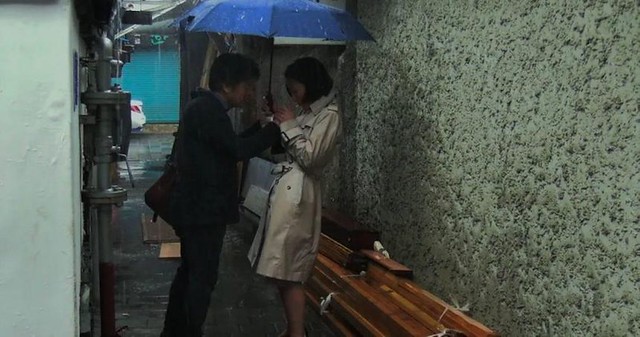
The meeting with a film director (played by Hong regular Kwon Hae-Hyo) takes place in a bar in a trendy part of Seoul. He arranged a meeting so they can be alone together. He is a big fan ever since he saw her films in his youth in the 90s and wants to do a film with her. After Chinese food delivery with copious amount of liquor, the truth comes out. She only has 5-6 months to live. Heartbroken, they cry and laugh together. The director then suggests they take a trip together the next day to Kangwon province, he would like to make something very quick and capture her on film as much as he can. She asks him if he wants to sleep with her. They have a moment. It's raining outside and all so romantic. It's a scene right out of some fatalistic French romance movie. Would Hong really end a movie like this?

In Front of Your Face may lack Hong's narrative and structural inventiveness but it has a nasty hook that gets you at the end, defying the conventional romance narrative. It's wickedly funny too. Lee Hye-young, who started her career in Lee Jang-ho's salacious Korean classic Between the Knees (1984) and starred in countless TV dramas, is a revelation here. Her graceful features and beauty dominate the screen in a bittersweet performance. Her hysterical laugh at the end listening to a voicemail over and over, is the funniest/saddest film moment of the year. I really adored this film.

Wednesday, October 7, 2020

Monotony vs. Chaos

The Woman Who Ran (2020) - Hong The Woman Who Ran Gamhee (Kim Minhee) is visiting Youngsoon (Seo Younghwa)'s house in the outskirts of Seoul. It's an almost pastoral setting. Youngsoon has a back yard and her neighbor has a chicken coop. Gamhee, married for five years, tells her long time friend that her trip to the house is the first time she is not accompanied by her husband. They never have been not together for even a day. How is that possible, Youngsoon and her roommate wonder over the grilled meat that Gamhee brought along with liquor. Gamhee says her husband believes that if they love each other, then they should be together all the time. And she doesn't seem to mind.

Again, Hong's new film is built around his muse Kim Minhee's character as she observes her surroundings. And of course the conversation naturally leads to reveal her relationships with men. Although Kim played many roles in slightly varying degrees in previous Hong's films, her characters were, however beguiling, more often than not, confrontational toward her male counterparts. In The Woman Who Ran, Gamhee seems to be more subdued and more comfortable with her situations and herself. Being a little bit older, it's as if she is tired of human entanglements and unnecessary interactions. But as the title suggests, Hong might be playing with something here. And everything is not what it seems. Who is the woman who ran if not Gamhee?

While they are having pleasant BBQ dinner, a new neighbor visits them. It's a young man and he passive aggressively complains about Youngsoon and her roommate feeding stray cats. His wife is afraid of seeing cats in their backyards and he wants to discourage them to feed the cats. They decline to do so, arguing the cats needs are just as important as humans. There are many references to animals in the film, including chickens, cows and cats, as women make case that humans are not the only animal with a conscience. With that, Hong seems to suggest that these relationships and entanglements are silly, in a larger scheme of things.

The next house Gamhee visits is Suyoung (Song Seonmi), a pilate instructor and a dancer friend. She lives alone in a modern apartment with a great view of a mountain. She recently bought the place with divorce settlement and some bank loan. She even scored a major discount because the building owner favors artistic types to live there. Gamhee again, tells the story about how she and her husband being inseparable. She could be so lucky. Their peace is interrupted by a 26 year old lovelorn poet at the door. He is in love with Suyoung. She shoos him off. The young man makes matters more complicated since she likes the neighbor who frequents the bar also frequented by the young man, she tells Gamhee. Gamhee makes an observation, "You live an interesting life!"

Considering Hong's penchant for a double take, these two encounters with older female friends might be a variation of the same encounter, suggesting infinite possibilities. And both of these encounters are interrupted by irate males.

Now Gamhee is in a cafe of a cultural center, coincidentally run by her frenemy Woojin (Kim Saebyuk). Gamhee used to date Woojin's now husband Jung (Kwon Haehyo), who is doing a book tour in the same building downstairs. Gamhee says she is there to watch a movie. Woojin, feeling guilty about stealing a man from her, apologizes to Gamhee who says it's all in the past and insists that she is not there to see him. Gamhee asks if he changed in any way since his career took off. Woojin says he is a chatterbox now and he comes across as insincere as he repeats his stories a lot in front of other people. It's becoming annoying.

She runs into Jung who was taking a cigarette break outside the building. Did she really come to see a movie or did she come to tell him off?

Deceptively simple yet deliciously playful, The Woman Who Ran again shows that Hong, a truly unique voice in cinema at his best, honing his skills as a storyteller by constantly experimenting with his usual theme.   

She goes back to watch the movie that she just came out of. It's the same scene of a beach with a jangling guitar soundtrack seen previously. Is Hong suggesting watching the film again to give it a second take? Or does the movie theater work as a sanctuary, a comfortable place for our heroine? In these Covid times, whether Hong intended or not, I'd like to think the latter is the case. As Gamhee sits alone in a cushy movie theater seats alone, eating a piece of bread, I want nothing more than being in the comfort of a movie theater, preferably alone.

Friday, July 5, 2019

Ambivalent but Diligent

Hotel by the River (2018) - Hong
Screen Shot 2019-07-04 at 11.16.08 AM
Didn't like it at all. Unusually sentimental for Hong standard, Hotel by the River is overlong and middling affair. It concerns an aging poet (Ki Joo-bong), recognizing his own mortality, summons his estranged two grown up sons to make amends. It's winter. He is staying at a hotel by Han River for free indefinitely, by the grace of its owner/admirer, whom he met at a bar by chance.

There is a side story about a woman (Kim Min-hee) recovering from a bad breakup with a married man, staying in the same hotel, visited by her older, kind friend (Song Seon-mi). They have run-ins with the poet and his sons.

As usual in Hong's movies, resentment and regret come to light when drinking- daddy abandonment issues, sibling rivalry, painful words are uttered, feelings are hurt and so on and so forth. On women's side, it's all "good men are hard to find."

There are a lot of nodding off in Hotel by the River: on the couches in the hotel coffee shop and hotel rooms. It's nice to see Kim and Song lying down in the same bed, face to face, sleeping in their cozy sweaters. The poet disappears for a length of time and reappears as if he is there but not there. Compare to Hong's other films, Hotel's volume is cranked down significantly. Wintry landscape helps with that too. It's pleasant.

The poet's younger son is a film director with a little bit of repute. Song's character explains his films to Kim, "a little bit ambivalent, but he is diligent." "Sounds boring", she replies. I can say the same thing about this film.

Saturday, October 6, 2018

Emotions Run High in Hong Sangsoo's Grass

Grass (2018) - Hong
grass-2018-001-kim-minhee-at-computer
Yet another slight bunch of vignettes taking place in and around a coffee shop in Seoul, Grass is ever prolific Korean auteur Hong Sangsoo's first release of the two this year (the second one being Hotel by the River, read Pierce's review here). It sketches out 4 different 'conversations'. Clocking in brisk 66 minutes, the film sees director's ever present muse, Kim Minhee passively observing then participating in those conversations. Being in 5 of the last 6 Hong films, one can assume that Kim's contribution to his artistry is only growing. Here, she is still a beguiling beauty, but shows that she can be merciless and downright nasty when she wants to be even without the help of usual heavy consumption of soju. Grass is not groundbreaking or anything, but it's perhaps more cynical and darker than his other films. Still, Hong's human comedy continues with slight variations each time with delicious results.

Areum (Kim) is seen typing away her thoughts in her macbook in the near-window corner of an unassuming coffee shop. She eavesdrops conversations of customers and gives her thoughts in a constant voice-over. One can wonder if these conversations and arguments were her creations.

There are much discussions about death: the first conversation she eavesdrops is from the young couple. Their chat starts harmless then descends into emotional outbursts- the girl accusing the boy of their friend's death. Then there is an old stage actor whose attempted suicide over a woman left him jobless and homeless. But his pupil can't bring herself up to invite him to stay with her family. Areum makes assumptions and judges these people harshly in her thoughts.

What brings Areum's disdain out in the open is the presence of an actor/writer (played by Jung Jinyoung, pretty much Hong stand-in), who is looking for a writing partner for his new script. After his request gets rejected by his writer friend (Kim Saebyuk) who chastises him by saying, "writers write alone," he tries his luck on the beautiful stranger. Areum outright says that she is not a writer. She just writes for herself. He insists that they collaborate. And in order to do that, he needs to move in with her and spend 10 days observing her. Saved by her younger brother's arrival, she excuses herself out of the conversation. On the street, she tells her brother with the tone of disgust how the actor came on to her.

Her nasty streak continues when she meets her brother's new girlfriend. She skewers the young couple for thinking about marriage without knowing each other too well. "You are already set up for a failure!" She then blows up on her brother for not picking up the check for their lunch and scowls him for being pussy-whipped.

It's no use to describe Hong's style here anymore - minimal long take, goofy auto zoom and pan, two shot long takes. He's obviously not interested in 'making a mark' with his 'style'. But with just one look at his films, everyone can recognize that they are his. No style has become his style. I heard him saying "because I ran out of things to name," when asked why the film is called Grass at Berlinale. He tries different things here and there - notably in Grass, there is an extended over the shoulder shot where we don't see a man's face then camera pans to see his shadow on the wall gesticulating as the conversation heats up. The usual chicken scratch titles are gone and replaced by what looks like xeroxed title cards. Yet these (no) stylings don't add up to much, nor does dissonant classical music, that blares all over dialog, which only serves more as an absurd comedic effect.

The later part of the film brings them all together back in the coffee shop, drinking off of couple of soju bottles they sneaked in in the grace of unseen, good-hearted shop owner. There you see Areum accepting an invitation to join the conversation. She's shown that she can take care of herself from unwanted and frequent men's advances, and when necessary, doesn't take shit from anybody. “Emotions are gullible and forceful, precious, cheap and alluring.” her voice over says. Even if Areum looks down on everyone from her pedestal, at the end, emotions are what makes us human, Hong seems to say.

Saturday, November 18, 2017

Selfish Love

The Day After (2017) - Hong
Screen Shot 2017-11-18 at 12.26.43 AM
The Day After is just as delicious as Alone on the Beach at Night. Clocking just over an hour, it tells an illicit love affair of a small time book publisher (Kwon Haehyo) and his mousy employee (Kim Saebyeok) from the point of view of a new employee named Arum (beauty in Korean, played by Hong's muse Kim Minhee). Arum gets tangled up in the publisher's messy life on her first day on the job, when she gets assaulted by his suspecting wife. After half-convincing the wife that Arum is not the one, and telling her that the girl he was seeing went away, and asking Arum not to quit after one day at the job, to complicate the matter, the mousy lover comes back the same night. So he has to let Arum go (he can only afford one employee) after all. Arum is dejected and disgusted by this love affair she was involuntarily ensnared into, but ultimately could care much since it's not her problem.

As always in Hong fashion, The Day After is shot unremarkable and is in ugly black and white. Don't matter, it's still great human comedy about fickle relationships. Not as angry as Alone on the Beach, but just as confessional, Hong makes a case for how hurtful affairs can be. He and the publisher know too well that the affair is not going to end well. But when you are in love nothing really matters- you will sacrifice everything including a stranger who just happens to be there. Love can be a very selfish and ugly thing.

It's sad, funny and poignant all the same. Grown to love Hong's naturalism. There is no movie phoniness or over the top self-reflexiveness in his work. Kim's natural performance, as a kind of shy, yet frank beauty is a great fit in his films.

Sunday, October 15, 2017

Clean Slate

Yourself and Yours (2016) - Hong
Screen Shot 2017-10-15 at 9.57.57 AM
Starting over afresh - I'm pretty sure all of us wished that one time or another. With Yourself and Yours, Hong exercises that fantasy in the form of Minjung (Lee Youyoung). She apparently has a drinking problem. Everybody in town knows about it. Couple of days ago, she was seen getting into a drunken fight with a stranger at the bar. And this distresses her possessive boyfriend Yongsoo (Kim Ju-hyuk) because she promised him to limit her drinking by 5 soju shots and 3 beers. Enraged, Yongsoo confronts her one night about it but she'd rather leave him if he doesn't trust her word over everyone else's.

Yourself and Yours turns out to be perhaps the most poignant and romantic film of all the Hong's I've seen so far. Inebriated Minjung flirts with a film director she just met, over beer. When they meet, the director is convinced that he knows her from somewhere but she vehemently denies it. Over a short period of time before the encounter, she leaves Yongsoo and breaks up with an older man who also first thought she was Minjung but she tells him that she is her twin sister.

Just to be in the clear, Yourself and Yours is nothing like Buñuel's or Kieslowski's. Hong's interest is not in identity crisis or duality of men. His double takes and alternate scenarios may seem manipulative (also delicious) but the movie is more to do with accepting a person for who that person is, with blemishes and all that. It's also got to do with men's folly. "Men are either wolves or babies," Minjung tells the director, "they either pounce or cry." Hong's message to all the fellow Korean men is clear: No one can possess another. You have to let go the notion that all women are some ideal naive angels.

Friday, October 6, 2017

Don't Deserve Love

On the Beach at Night Alone (2017) - Hong
on the beach1
on the beach2
on the beach3
on the beach
The first part of the film, simply titled 1, starts with Young hee (Kim Min hee), a pretty Korean actress, in care of an older female friend in Hamburg in winter, pining for a married director she's been having an affair with. She keeps saying he might or might not come for her but she won't wait for him forever because being in love with him hurts so much. It seems she tried to get away from the publicized affair and is very much enjoying her anonymity and tranquil surroundings in another country.

In part 2, Young hee is back in Korea, in the coastal town of Kangrung, the same one seen in Hong's Power of Kangwon Province, in winter. It's a favorite spot a Seoulite can think of when they run away- the farthest, the most distant, remote place one can think of, near the sea. She is seeing some friends. The affair is over and the true colors come out over couple of drinks at the restaurant.

On the Beach reflects Hong's own much publicized affair with Kim in real life. We get to see from Kim Min hee's side mostly through Young hee- after couple of drinks, as she lashes out to others at the table how undeserving everybody is of love, that how her affair is anybody's business. A moments later she declares she'd rather do without men and go lesbo, starts kissing her kind, older confidant. Her heart's not in it, because she still misses him terribly.

In a later part of the film, the director in question, played by Hong regular Mun Seung gun, recite the passage from a book he tries to give her that describes the agony and ecstasy of their final embrace. He breaks down and cries, as she steely stares at him.

I was looking at Hong's films all wrong. As I see more of his, I realize that I don't need to compare him to anyone who might or might not have influenced him. His is very much his own and original. He has a sense of humor about portraying human vagaries. He's playful in his own small way and puts much trusts in his actors. He might be lazy about 'presentation' - unlike the title, Young hee doesn't end up on the beach at night. It's daytime, dusk at best. For a night time shoot, it would cost too much and too much of a hassle to arrange. But it doesn't matter to tell his story which is still simple and direct and real.

Love and break up is a painful business. Hong shows how it is under the scrutinizing eyes of the public, physically manifested here as a stranger in jarring surrealist moments - first in Hamburg, asking Young hee what time it is, then as a window washer in the second one. They are minor characters, but they are widely visible, but soundly being avoided and ignored yet their presence felt. For a Hong film, even though it has many funny moments, the over all mood of On the Beach is bitter and sad.

Monday, June 20, 2016

Lighthearted Romantic Entanglement

Princess of France (2014) - Piñeiro

Another slice of Shakespearean comedy by Matia Piñeiro. All his regular actors are back to play assortment of characters, romantically entangled among themselves. This time, everything revolves Victor (Julián Larquier Tellarini), who came back to Buenos Aires after spending a year in Mexico. He wants to do a radio project, doing the bard's Love's Labour's Lost with the group of his friends. In the absence of his girlfriend Paula (Agustina Muñoz), Victor flirts with every girl who is going to take part in the project.

Using mutiple takes on same scenes and settings with slightly different outcomes and a copy of Love's Labour's Lost working as a clever communication device, Princess is all about little details. After watching a couple of Hong Sang-soo films last couple of months, I was thinking about his equivalent in the world cinema. And I think I finally found Hong's match in Piñeiros. They are equally distinctive and very regional in their own way, but have a lot in common presenting lighthearted romantic entanglement and its infinite number of possible outcomes.

Thursday, June 9, 2016

Dissonance

Hill of Freedom (2014) - Hong
 photo 1585943e-7dba-43d0-97d8-668fe294ad83_zpskganszur.jpg
The film starts with Kwon (Seo Young-hwa), a suit case in her hand, picking up a thick letter then dropping it on the floor. The multi-page letter was written by Mori (Ryo Kase), a Japanese man who came to Korea to look for her with the intention of confessing his love for her, without knowing she is away. As she picks up the letter all jumbled now and starts reading it, consequently the film too, is jumbled, timeline completely out of wack. With Hong's typical zoom in, we know that there will be some gaps in the storyline too, since she missed picking up some of the pages on the floor. Hill of Freedom is a gentle misadventure of Mori: as he waits for Kwon to appear, he meets people, talks and even have an affair with the cute cafe owner with a dog. It's perhaps the gentlest of all Hong films I've seen that it barely registers. Mori is a sweet, direct man who doesn't suffer from any of Hongian neurosis and selfishness of his usual boorish drunken characters. Dialog is mostly in heavily affected English- since Mori doesn't speak any Korean, and it adds to the overall disarray. I know what Hong is going for- a kind of dissonance and playfulness in structure, but some of the segments doesn't really go with the over all mood of the film, especially the scene with Jeong Eun-chae (of Our Sunhi), as she throws a loud fit for no apparent reason. It is a lesser Hong for me.

Tuesday, May 31, 2016

Delightful Double Take

Right Now, Wrong Then (2015) - Hong
 photo 13b86af9-e0f5-47ff-9bdc-880c463683e8_zpsdxsnjjxx.jpg
Right Now, Wrong Then, a double take on a chance encounter is another delightful comedy of errors from Hong Sang-soo. Jeong Jae-yeong plays an arthouse movie director named Ham Chun-soo who finds himself in Suwon, a suburb of Seoul in winter, a day prior to his film screening and following discussions at the city's cultural center. The early voiceover suggests that he is contemplating banging his enthusiastic young guide from the center. Killing time at the near deserted ancient palace/tourist trap, he meets beautiful Hee-jeong (Kim Min-hee) and strikes up a conversation. Defensive at first, Hee-jeong soon finds Chun-soo more interesting once learning that he is a movie director she's heard of, even though she doesn't like watching movies or seen any of his films. He asks her to go out for coffee, even though she doesn't drink coffee or smoke (she is a sensitive type). They awkwardly flirt. It's all pleasantries and flattery. She used to be a model but now she is a painter. He wants to see her paintings, so they move to her atelier. Obviously he wants to bang her so everything that comes out of his mouth is some form of flattery. She goes along with it. Then they go to sushi for dinner and soju. They get shitfaced, still flattering each other but neither making the ultimate move. Hee-jeong suggests they go together to a party of her friends that she can't excuse herself out of. He obliges. Things get uncomfortable as Hee-jeong's friends who are fans of his and start mentioning the rumors of his womanizing ways and his marriage. A disaster!

We try again. Chun-soo this time, is more forward and honest, even though what comes out of his mouth hurts Hee-jeong. As they go through the same routine as the first, this honesty gets them closer, but also it means Chun-soo get more wasted on soju and make bigger ass out of himself in front of Hee-jeong and her unsuspecting friends.

What I appreciate about Hong is not only his steadfast consistency in traipsing the stickiness of the human relationship but also his complete disregard for what he deemed unnecessary bullshit - namely excessive title sequence, dramatic music or coverage (hence the excessive used of funny, automated zooms). Coquettish Kim Min-hee is amazingly cute in this. Right Now, Wrong Then also doesn't really care much about the conventions of a do over/what if romantic comedy. The first take isn't an earth shattering catastrophe or anything and completely plausible as much as second scenario which is obviously more desirable. He plays with the notion of the games we play and certain inhibitions in our society on different occasions. It's also a delight to see reversing those roles fueled by alcohol. His jab at film critics and how to behave in front of them were also telling. All in all, the film is yet another great comedy from prolific Hong who continues building a great, unique body of work.

Monday, December 30, 2013

Top 20 Discoveries 2013

Looking through the list, I admit my film viewing wasn't as adventurous as the last year's. I don't even have anything before 1969 on the list. Shame on me. I did exercise some concerted effort to explore certain filmmakers which I never consciously have in my film viewing previously, ever. Still there are so many filmmakers to explore...

Top 20 in order watched:
*Click on the titles for full reviews

Life and Nothing More... (1992) - kiarostami
Image
Kiarostami's moving picture continues. A middle aged man and his young son are on the road to Koker, a northern rural town leveled by the devastating earthquake in 1990. It is only revealed later on that the man is a film director (a Kiarostami stand-in) who is looking for a child actor who starred in his previous film, Where is Your Friend's Home? (AK's 1987 film also taking place in that region). As they encounter monstrous traffic jam and many victims of the 'god's will', the line between reality and fiction evaporates: the traveling pair encounters an old man who was also in the said film, carrying a porcelain sink to his house amid devastation around him. He explains, "You never know when you need it." When asked if the big house he is entering (but doesn't have a key to) is his, he replies, "This is not my house. It's only my house in this film. My real house collapsed in the earthquake."

Shot shortly after the real earthquake that took the lives of 50,000, and based on his own experience driving around (with his real son), Life and Nothing More... shows resilience of the people amid a horrible disaster. As they make ends meet, digging out their household items from debris, they still look forward the better future. They fidget a TV antennae to watch a World Cup match in ruins. With Through the Olive Tree (a fictional 'making-of' Life and Nothing More...) as the third film taking place in Koker, these films are seen as the Koker Trilogy. There are many elements here that are present in his later films: interior driving shots, wide scenery long takes, no close-ups. Elegantly simple and captivating throughout with an open ending, Life and Nothing More... is a beautiful film.

Taste of Cherry (1997) - Kiarostami
Image
Inquisitive dialog, just like intimate questionnaires in documentaries is where it's at with all Kiarostami's films, staged usually in moving cars. The beauty of Taste of Cherry lies in its simplicity- a man drives around looking for someone to assist him in his suicide. They don't have to do the deed. He will take sleeping pills and lie down in an already dug up grave. In the morning, they can put some earth on him if he's dead. They will be rewarded handsomely. First, a young soldier runs away after finding out what the man is up to. Second, a seminary student from Afghanistan objects because of his religious beliefs and tries to dissuade him. Finally, an old taxidermist agrees to it, because he has a sick child.

Kiarostami lets us know that we are watching a film. With Louis Armstrong's St. Jame's Infirmary playing at the end over the image, he tells us that death is inevitable for all of us and makes us think. His cinema is precious because it doesn't resemble any other. If Tarkovsky tried to make us feel the 'passage of time' with his virtuosic camera movements, framing and lighting, Kiarostami succeeds in astounding simplicity, in one hour and forty minutes. Life is a moving car. Done. The impact is still immense. The abrupt intrusions of continuity in the middle and at the end are quite delicious in cinematic terms. It all fits nicely with his theme of life, death, cinema, reality... just amazing!

Hadewijch (2009) - Dumont
Image
Austere and sincere. Another masterpiece from Dumont.

The White Ribbon (2009) - Haneke
Image
Masterful examination on the existence of 'innocence'.

It's the Earth Not the Moon (2011) - Tocha
Image
Loved every single moment of this 3 hour Portuguese documentary.

Le pont du nord (1981) - Rivette
Image
Loveliness of Pascal Ogier is just an icing on the cake in this playful comedy by one of the unsung heroes of French New Wave.

La captive du desert (1990) - Depardon
Image
Desert + Sandrine Bonnaire = cinematic heaven

Céline et Julie vont en bateau (1974) - Rivette
Image
One of the classics I hadn't seen that I was able to get to this year. It lives up to all the praises.

A Nous Amours (1983) - Pialat
Image
One of the best cinema debuts ever- 16 year old Sandrine Bonnaire ignites the screen. Pialat's uncompromising direction goes down in my book as one of the best coming of age movies of all time.

Coup de Torchon (1981) - Tavernier
ImageThe most hilarious Jim Thompson adaptation ever!

Emperor's Naked Army Marches On (1987) - Hara
Image
Crazy documentary. You can totally see the continuation of Japanese New Wave in this anti-gov/anti-war film.

Peppermint Candy (1999) - Lee
Image
Dehumanization of a man who experienced the Gwangju Massacre in Korea, 1980, told in reverse timeline. It's definitely the best Korean film I've ever seen.

City of Sadness (1989) - Hou
Image
Hou's history lesson of Taiwan is masterful and affecting.

Mon Oncle Amerique (1980) - Resnais
Image
Slowly getting into master filmmaker Resnais's artistry. There are still so much to explore in his filmography!

Mandala (1981) - Im
Image
I grew up watching Im Kwontaek's films. I was too young to appreciate them back then. Beautiful, if not a little conventional storytelling. If you want good films about Buddhism, look no further than Im's films.

Heart of Glass (1976) - Herzog
Image
This was One of my blind spots in Herzog's filmography. As expected, a grand experience at the cinema.

35 Rhums (2008) - Denis
Image
So simple yet so perfect. This quiet family drama reaffirms why Claire Denis is one of my favorite director of all time.

Caravaggio (1986) - Jarman
Image
I was planning on taking large volumes of screenshots from this visually stunning film. But it turns out the dvd I got from netflix is too scratched to play on my computer. I'm seriously thinking about buying this. Jarman was a true visionary. Taking on the well known cocky post-Renaissance painter Amerighi Caravaggio's life with his painterly, dramatic style that surpasses even the best of Greenaway's bombastic visuals, he shows the painter's lust for life and disdain for what was socially acceptable in a very Catholic era. Young Tilda Swinton and Sean Bean are sculpted with theatrical light skillfully thus their youthful beauty immortalized on the celluloid forever. Nigel Terry (King Arthur in Excalibur) plays famed painter with messy private life who was attracted to many of his subjects, including young Tilda and Sean. It wouldn't have worked if it was done by any other, but when Jarman mixes old and new (modern costumes, typewriter etc), transcending time and space, it works wonders. Amazingly beautiful and playful, I am totally blown away by this.

Days of Eclipse (1988) - Sokurov
Image
Yes, Sokurov is quite different from Tarkovsky as a director and visual storyteller. I realize that after seeing this film. It's quite hard to describe this 'Sokurovian cinema'. But this film was an eye opener.

Shame (1969) - Bergman
Image
What more can I say about this? Bergman is a true master of cinema.

Directors explored:

Jacques Rivette:
Le pont du nord
Celine et Julie vont en bateau

Maurice Pialat:
A nous amours
Loulou
Police

Abbas Kirarostami:
Life and Nothing More
Taste of Cherry
Homework
The Reoprt

Hou Hsiao Hsien:
City of Sadness
Millennium Mambo

Bruno Dumont:
Flandres
Hadewijch
Hors Satan
Camille Claudel 1915

Alain Resnais:
Mon oncle Amerique
Muriel
Vous n'avez encore vu

Raymond Depardon:
Une femme en Afrique
La captive du desert
L'homme sans O'ccidental

Alexandr Sokurov:
Days of Eclipse
Mother and Son
Moloch

Hong Sangsoo:
In Another Country
Nobody's Daughter Haewon

Top 20 Discoveries 2012